
A qualified lead is a prospect whose fit, intent, and accessibility make them ready for a real sales conversation, not just a form submission. Responding to high-intent inquiries within five minutes has been associated with a 21-times improvement in the likelihood of qualification compared with waiting 30 minutes (MIT lead response research summary).
That distinction matters when your inbox is full but your calendar isn't. A roofer may receive requests from outside the service area, homeowners seeking free advice, tenants who can't authorize work, and people who need a repair the company doesn't offer. A law firm may collect forms from people with the wrong case type or no viable consultation path. An HVAC company may get inquiries that never receive a reply because they arrive after hours.
The practical qualified lead definition is therefore operational: the prospect fits the business, has a problem the business can solve, shows meaningful intent, and can be reached through a workable intake process. The final element is where many otherwise sound definitions fall short.
Table of Contents
- What a Qualified Lead Actually Looks Like
- Qualified vs Unqualified Leads and Where MQLs and SQLs Fit
- The BANT Framework Translated for Service Businesses
- A Practical Lead Scoring Model You Can Copy
- Form Fields and Intake Questions That Filter for Fit
- Why Speed to Lead Decides Whether a Qualified Lead Stays Qualified
- How Website, SEO, and CRO Attract and Validate Qualified Leads
What a Qualified Lead Actually Looks Like
A roofer checks the inbox after lunch and sees twelve new inquiries. Three include only a name and phone number. Two ask whether the company is hiring. One comes from outside the service area. Another wants a small repair the business doesn't perform. The remaining messages look promising, but only one describes storm damage, gives a service address, and asks for an inspection this week.
All twelve are contacts. They aren't all qualified leads.
The MIT Lead Response Management Study analyzed more than 15,000 web leads and 100,000 call attempts. Its definition of qualification centers on a lead being willing to enter the sales process, which may include setting an appointment with a sales representative. For a service business, that means a form submission becomes meaningful when it can plausibly progress to a consultation, intake, site visit, or accepted estimate.
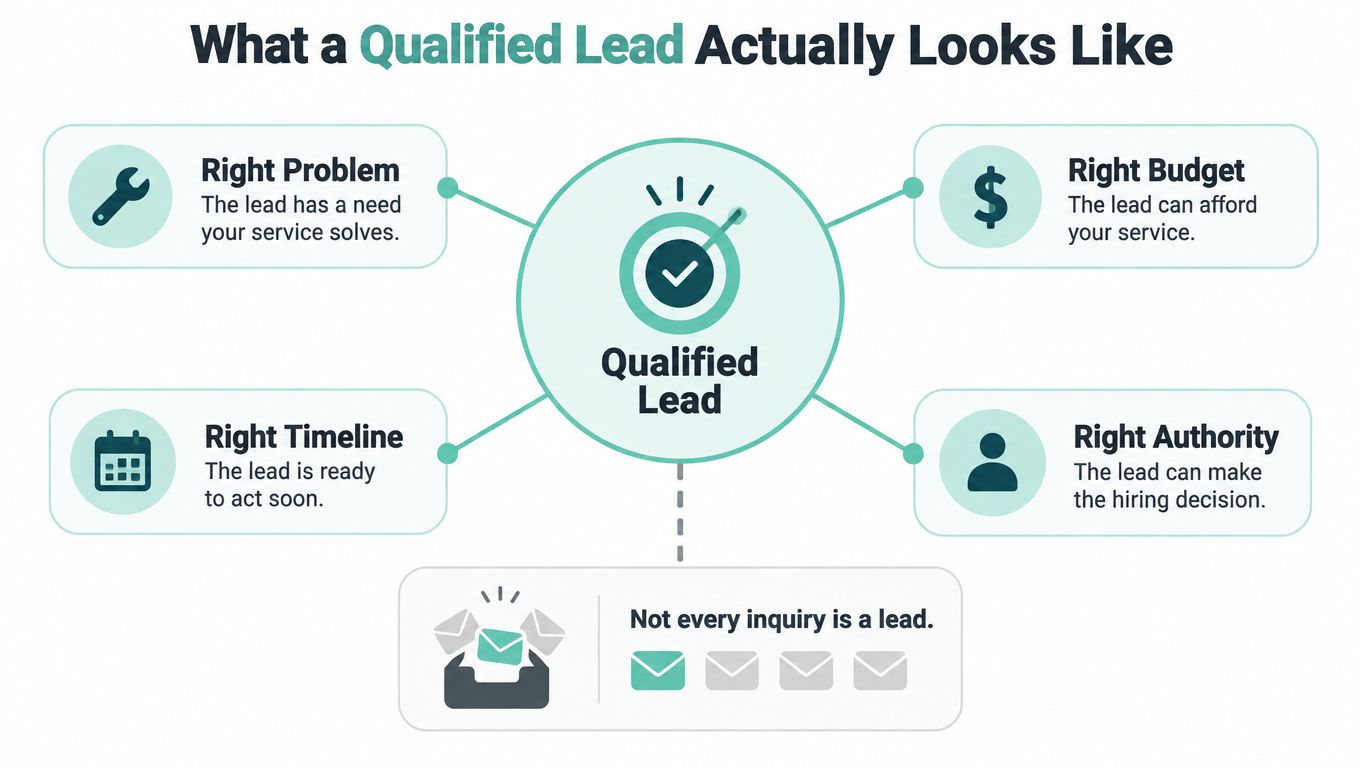
Fit and intent must appear together
Fit answers, “Is this the kind of customer we can serve?” Intent answers, “Is this person behaving like someone who may hire us?” A prospect can fit the ideal customer profile and still be casually researching. Another person can urgently need help but live outside the company's territory or request an unavailable service.
A useful review looks for:
- A real service need: The problem falls within the company's actual offering.
- A workable location: The property, incident, or matter is inside the service area.
- A credible buying signal: The prospect asks for an appointment, estimate, consultation, pricing guidance, or a next step.
- A route to engagement: Someone can reach the prospect, and the prospect is willing to continue the conversation.
Raw traffic, impressions, page views, downloads, and generic form fills can help diagnose marketing activity. They don't prove qualification. A credible website can improve trust and reduce hesitation, but credibility alone doesn't turn every visitor into a sales opportunity. A practical explanation of that relationship appears in this guide to what makes a site credible.
Practical rule: Count the lead when the prospect can move into a defined sales or intake step, not when the analytics platform records an interaction.
Label the inquiries in your CRM this week. Separate contacts that merely supplied information from prospects who match your service, location, problem, and next-step criteria. That exercise usually exposes why a business believes it has a lead-volume problem when it has a definition problem.
Qualified vs Unqualified Leads and Where MQLs and SQLs Fit
A personal injury firm may receive a form from someone who clicked a search result, entered a phone number, and wrote, “Need help.” That submission is an inquiry, not automatically an MQL or SQL. The intake team still needs to establish whether the matter fits the firm, whether the person is in the relevant jurisdiction, whether there is a real legal issue, and whether the person is willing to schedule a consultation.
The labels describe different levels of evidence:
- Raw inquiry: Contact information and an expression of interest have been captured.
- Marketing-qualified lead, or MQL: Marketing has evidence of fit and meaningful engagement and considers the contact appropriate for sales or intake review.
- Sales-qualified lead, or SQL: Sales or intake has spoken with the prospect, confirmed a legitimate opportunity, and determined that continued follow-up is justified.
An out-of-state visitor asking a general legal question may be an inquiry but not an MQL. A local person who submits a case-specific intake request may qualify for sales review. Once the firm confirms the matter, geography, timing, and consultation path, the contact may become an SQL.
| Criterion | MQL | SQL |
|---|---|---|
| Fit | Appears to match the target customer and service area | Confirmed through sales or intake |
| Intent | Shows meaningful behavior, such as requesting contact or asking about fit | Expresses willingness to discuss the matter and take a next step |
| Validation | Usually based on form data and marketing signals | Based on direct conversation or verified intake |
| Action | Route for prompt human review | Advance into consultation, proposal, estimate, or case evaluation |
The distinction prevents marketing from inflating performance with every download or incomplete form. Educational engagement can indicate interest without proving purchase readiness. A useful industry comparison is this guide for manufacturers seeking B2B leads, which also separates marketing activity from sales-confirmed opportunity.
Apply the labels to the handoff
For a law firm, the handoff should include the case type, location, incident timing, contact details, and requested next step. “Received form” isn't enough context for an intake coordinator. The person handling the lead needs to know why the contact belongs in the queue and what remains unverified.
An unqualified lead should not disappear into the same pipeline as a consultation-ready prospect. Mark spam, job inquiries, out-of-area matters, and unsupported case types clearly. Route uncertain contacts to review or nurture rather than letting them distort the firm's SQL count.
The BANT Framework Translated for Service Businesses
BANT remains useful because it replaces vague judgments about “interest” with four questions: Budget, Authority, Need, and Timeline. The framework is widely attributed to IBM's mid-20th-century enterprise sales organization, although accounts disagree about whether it began in the 1950s or 1960s. The logic matters more than the disputed date, especially when a service company adapts it rather than treating it as a rigid gate.
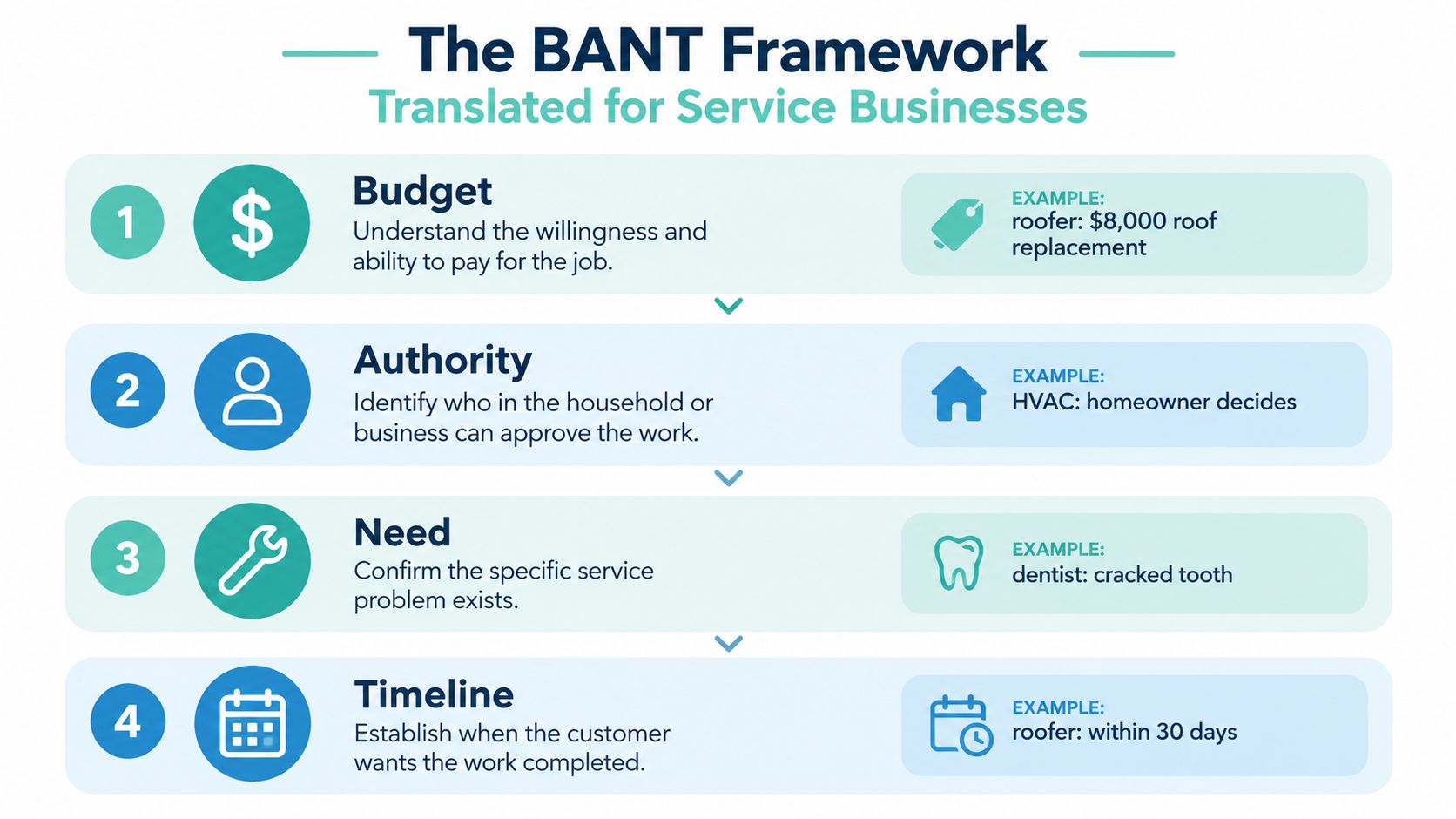
Translate each criterion into an intake question
Budget doesn't require a finalized quote. It means the prospect has the willingness and realistic ability to fund the work. A roofer can ask whether the owner is considering repair, replacement, or an insurance-supported project. An HVAC company can clarify whether the caller is seeking an emergency repair or planning a larger replacement.
Authority identifies who can approve the work. For a residential HVAC call, that may be the homeowner. For commercial roofing, a facilities manager may recommend the contractor while an owner or property manager approves the project. If the person calling can't authorize anything, the intake team should identify who must join the next conversation.
Need means a specific problem exists. “I want to learn about your services” is weak evidence. “The unit is blowing warm air,” “the roof is leaking near the skylight,” or “I was injured in a collision” gives the business a service problem to evaluate.
Timeline establishes when action matters. A storm event, planned remodel, failed furnace, or approaching legal deadline carries more weight than general research. The team should ask what triggered the inquiry and what happens if the work waits.
Use a simple qualification record
Score each category as yes, partial, or unknown rather than forcing false precision. A service business can use a first-call script such as:
- What service do you need, and what happened?
- Where is the property or matter located?
- Who will approve the work or engagement?
- When do you need a decision or appointment?
- Is there a budget range or funding path we should understand?
A Texas small business can adapt the wording to its trade, but the discipline stays the same. Record the answer in the CRM, mark the missing evidence, and assign the next action. BANT works when it improves a conversation. It fails when staff read it as an interrogation or reject a good opportunity because the prospect hasn't prepared a formal budget.
A Practical Lead Scoring Model You Can Copy
Lead scoring is useful only when it mirrors the way your team accepts work. Start with fit, add intent, and reserve the highest priority for signals that suggest a real next step. Do not score page views as if they were appointment requests.
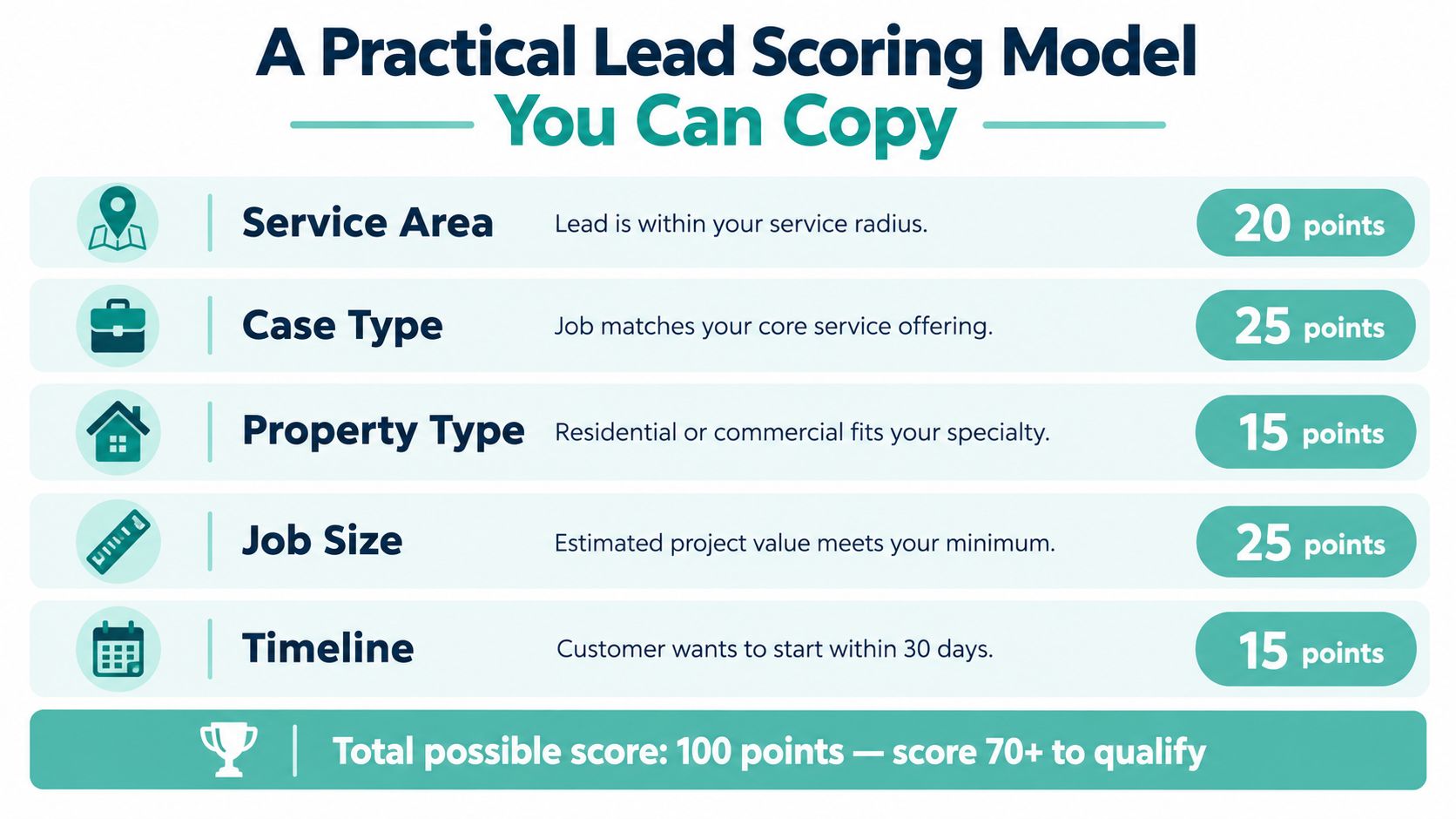
The infographic below provides a simple fit model with a 100-point total and a 70-point qualification threshold. Those values are a working example for the worksheet, not a universal benchmark.
Build the worksheet around fit
Use the following categories as a starting structure:
- Service area, 20 points: The lead is inside the radius or jurisdiction.
- Case type, 25 points: The request matches a core offering.
- Property type, 15 points: The residential or commercial setting fits the specialty.
- Job size, 25 points: The likely project meets the company's minimum.
- Timeline, 15 points: The customer wants to begin within 30 days.
A roofer inquiry from the service area, involving a full replacement on a property type the company serves, can pass the fit screen before anyone discusses a final price. An HVAC company may substitute system type or emergency status for property type. A law firm may replace job size with case viability and jurisdiction.
Add intent without double-counting
Create a second layer for actions that deserve faster handling. Requesting an estimate, booking a consultation, calling after hours, describing a specific problem, or naming a deadline can raise priority. A content download by itself should not carry the same weight as a request to speak with someone.
Consider three sample records:
- Personal injury firm: A local visitor submits a case-specific form, gives an incident date, and asks for a consultation. Strong fit and strong intent, with intake still responsible for confirming the matter.
- Roofer: A homeowner provides the service address, selects storm damage, uploads details, and requests an inspection. This is a high-priority inquiry because the request contains both job fit and a clear next step.
- HVAC company: A nearby caller reports a failed system but won't identify the property type or decision-maker. The need is urgent, but the record remains incomplete until the coordinator confirms access and authority.
Set one threshold for immediate human follow-up and another route for nurture or manual review. Revisit the rules when staff repeatedly reject high-scoring leads or spend time on contacts that never progress. The score should organize attention, not replace judgment.
Form Fields and Intake Questions That Filter for Fit
Most service websites ask for a name, email, phone number, and a large box labeled “How can we help?” That form is easy to build and difficult to qualify. It forces the prospect to guess what information matters, while giving the team too little context to route the inquiry.
A better form asks only for information that changes the next action. The fields should feel relevant to the customer, not like a qualification test.
Use service-specific fields
For a law firm, request:
- Case type: Present clear options instead of an empty text field.
- Location: Ask where the incident occurred or where the prospect lives.
- Timing: Ask when the incident happened or when help is needed.
- Brief description: Invite the facts needed for an initial routing decision.
- Preferred contact method: Let the person choose phone, email, or text if available.
For a roofer, ask for the property address or ZIP code, property type, service needed, visible damage, and desired timing. For HVAC, request the service address, system issue, property type, and whether the problem is an emergency.
A budget question can work when phrased as a range or project context. “Which best describes your project?” is less hostile than a mandatory free-text demand for an exact amount. Options might distinguish repair, replacement, inspection, or planning, depending on the trade.
Keep the form from becoming a wall
Every field creates friction, so don't collect information the team won't use. A conditional form can show different questions for a roof replacement, leak repair, or inspection. A service-area gate can stop an out-of-area submission before it reaches the sales queue.
The form should also promise a concrete next step:
Recommended confirmation: “Thanks. We received your request and will review the details before contacting you about the next available appointment.”
That message sets an expectation without promising a response the business can't deliver. The form, confirmation email, call routing, and CRM record should carry the same service categories and location fields. A conversion-focused web design approach helps connect those elements instead of treating the form as an isolated component.
The person answering the phone needs a matching script: “What service do you need, where is the property or matter located, and when would you like us to help?” The script should sound conversational, then capture the answers in structured fields.
Why Speed to Lead Decides Whether a Qualified Lead Stays Qualified
Qualification doesn't end when someone submits a strong inquiry. A prospect with a real need can contact another provider while waiting, lose confidence after an unanswered call, or decide that the business isn't organized enough to hire.
Research summarized by The Digital Bloom reports that responding to high-intent inquiries within five minutes can produce a 21-times improvement in the likelihood of qualification compared with waiting 30 minutes (response-time research summary). The number shouldn't be treated as a promise for every trade or market. It does show why response time belongs inside the qualified lead definition rather than in a separate customer-service discussion.
Local businesses also need an after-hours plan. Research based on more than 3,000 businesses found that approximately 23% of local leads arrive after normal business hours (local lead response research summary). A roofing company that ignores evening storm inquiries may lose the most urgent prospects before the morning shift begins.
Assign ownership before the inquiry arrives
A small team doesn't necessarily need more staff. It needs a clear routing decision:
- Forms: Send the notification to a monitored inbox and assign one person to review it.
- Phone calls: Route urgent service types to the person who can answer or return the call.
- Chat: Use a defined handoff instead of letting conversations sit in a dashboard.
- After hours: Confirm receipt, state when a callback will occur, and identify the emergency route when one exists.
- CRM records: Store the source, service type, location, and owner so nobody assumes someone else is handling it.
A confirmation email isn't a substitute for human contact. It buys clarity while the responsible person reviews the inquiry. If the business can't promise an immediate answer, it should provide an honest expectation and follow it consistently.
Teams should track response time alongside booked consultations, completed intakes, and accepted estimates. A site can generate excellent-fit inquiries while the intake process turns them into lost opportunities. Basic Google Analytics reporting for website visitors can show where people arrive and convert, but the CRM and phone process must show what happens after the conversion.
How Website, SEO, and CRO Attract and Validate Qualified Leads
SEO should not be judged by traffic alone. A page that attracts people outside the service area, unrelated case types, or low-value work can make reporting look healthy while creating more cleanup for the intake team. The better question is whether search visibility produces inquiries that fit, progress, and become booked consultations, completed intakes, or accepted estimates.
That requires alignment before publication. Service pages should name the exact problem, customer type, location, and next step. A roofer needs separate paths for replacement, storm damage, inspection, and repair when those services have different search intent. A law firm needs clear case-type and jurisdiction language. An HVAC company should distinguish repair, maintenance, replacement, and emergency service if the intake process handles them differently.
Connect search intent to form logic
Use the page to pre-qualify without sounding exclusionary:
- Service pages: State what the company does and doesn't do.
- Location content: Identify the service area and nearby communities the business serves.
- Proof and trust signals: Explain credentials, process, experience, and what happens after contact.
- Structured data: Support clear business and service information for search systems.
- Calls to action: Offer the next step that matches intent, such as booking an evaluation or requesting an estimate.
- Contextual forms: Ask for service type, location, urgency, property type, or case details when those answers affect routing.
Conversion rate optimization then improves the path from qualified click to usable inquiry. Test the headline, call-to-action wording, phone placement, form length, confirmation message, and appointment options. Don't celebrate a higher submission rate if the sales team receives more spam or out-of-area requests. A shorter form may increase volume while reducing the information needed to qualify the contact.
Report revenue movement, not vanity volume
A practical dashboard separates:
- Organic visits by service and location.
- Form submissions and calls.
- Inquiries that pass fit criteria.
- Leads reached by the team.
- Consultations, estimates, or appointments booked.
- Matters or jobs accepted.
Digital Skyrocket offers lead-generating website design, local SEO, answer engine optimization, contextual forms, analytics instrumentation, and conversion optimization for service companies such as law firms, roofers, and HVAC businesses. Its approach connects website structure and search work to qualified inquiry tracking rather than treating rankings and raw submissions as the final outcome.
Use the qualified lead definition as a shared operating rule. Review it with the person who answers calls, the person who manages the CRM, and the person responsible for SEO. When those people agree on fit, intent, ownership, and follow-up, marketing reports become more useful and the pipeline becomes easier to trust.
If your website generates inquiries but your team can't tell which ones deserve immediate follow-up, Digital Skyrocket can assess the site, intake flow, local SEO, and conversion paths that shape lead quality. Visit Digital Skyrocket to explore its lead-generating website and ongoing SEO services for service businesses.