
Reputation management is the structured process of monitoring, evaluating, and influencing how people perceive a business across public information channels, with online reviews as its modern foundation. In 2004, 26% of U.S. adult internet users, more than 33 million people at the time, had rated a product, service, or person online.
A homeowner with a leaking pipe searches for a local plumber, scans the map results, opens a business profile, reads the latest reviews, and checks whether the owner responds to complaints. The plumber may never know that evaluation happened, yet the decision to call or keep searching is already taking shape.
That pattern applies to a law firm, dentist, roofer, HVAC company, and nearly every other local service provider. Reputation isn't limited to what customers say at the kitchen table anymore. It appears in search results, business listings, review platforms, testimonials, website pages, and increasingly in the answers people receive from search and answer engines.
Table of Contents
- Why Online Perception Matters Before Anyone Picks Up the Phone
- What Reputation Management Actually Includes
- How Service Businesses Should Monitor and Respond to Reviews
- Why Five-Star Targets Can Mislead Service Businesses
- Legal and Platform Rules That Shape Ethical Reputation Practices
- How Reputation Management Connects to Local SEO and Conversions
Why Online Perception Matters Before Anyone Picks Up the Phone
A prospective client rarely begins with a sales conversation. They begin with uncertainty. Can this firm handle my case? Will this contractor arrive when promised? Does this dentist explain treatment clearly? Public information helps them answer those questions before they submit a form or make a call.
The prospect may compare several providers in a single search session. They notice whether the phone number, hours, service area, and address are consistent. They read recent reviews, then look closely at the most critical feedback. They may also check whether the business responds with useful context or ignores complaints entirely.
Practical rule: Treat every public profile as part of the first sales conversation, even when nobody from your team is present.
Pew Research Center reported that 82% of U.S. adults at least sometimes read online reviews or ratings before purchasing a product or trying a service, while 40% said they nearly always rely on reviews for purchasing decisions. Among review readers, 51% said reviews generally provide an accurate picture of quality, but 48% said it can be difficult to determine whether reviews are truthful and unbiased. Pew's research on trust in online reviews shows why businesses must manage both visibility and credibility.
The modern foundation of reputation management emerged as online reputation systems made personal opinions searchable and scalable. In Pew's 2004 study, users could express opinions and read opinions from others, shifting reputation away from private networks and traditional media toward persistent public records. Pew Research Center's history of online reviews documents that transition.
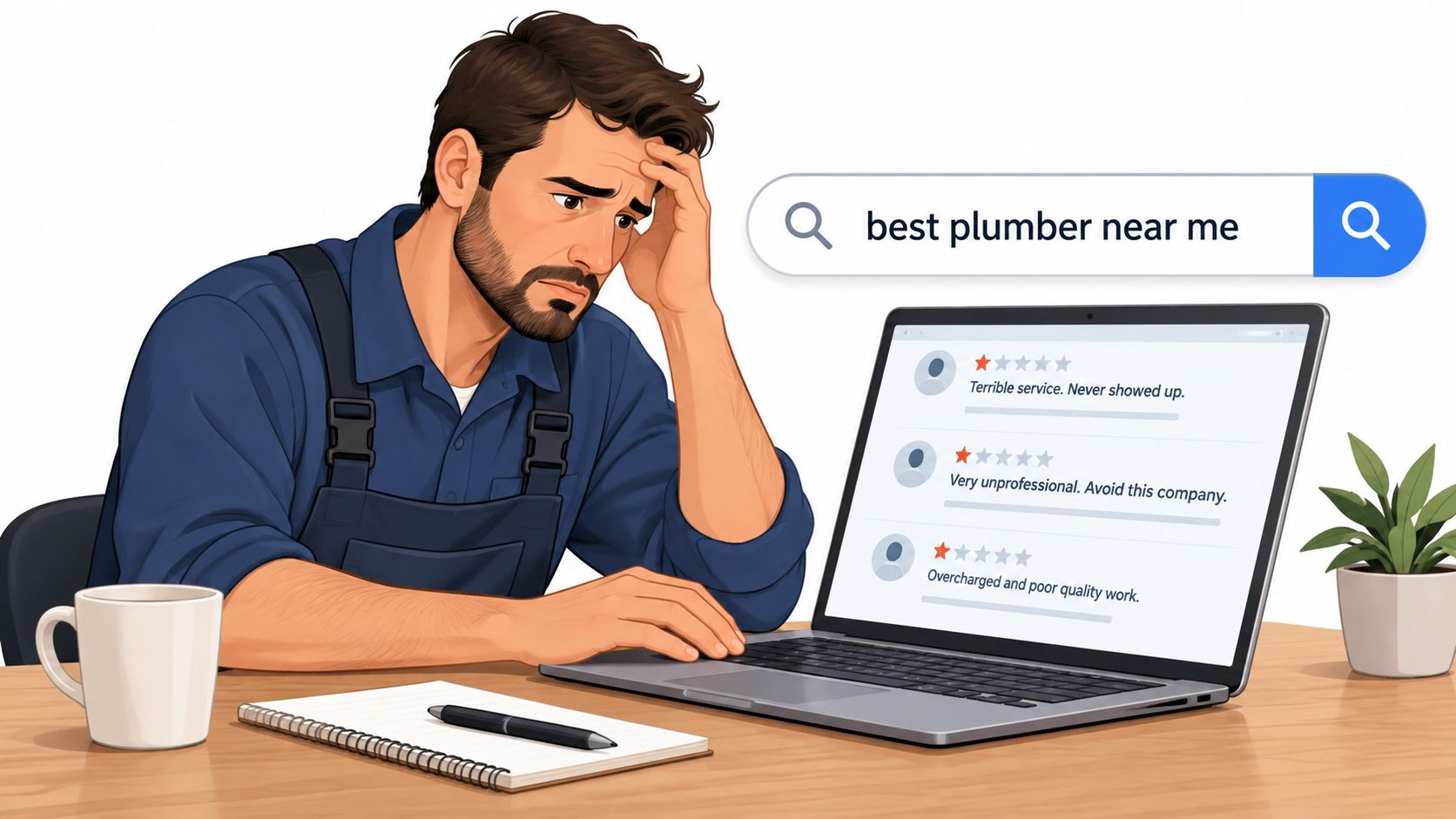
Reputation starts with what customers can verify
For a service business, the public impression usually comes from several sources working together:
- Search results: Branded pages, local listings, news, directories, and reviews.
- Business profiles: Categories, services, photos, hours, contact information, and owner updates.
- Customer feedback: Praise, criticism, recurring complaints, and responses.
- The website: Service explanations, credentials, locations, process details, and clear next steps.
A credible website can't compensate for an unanswered pattern of complaints, just as a strong rating can't correct an incorrect phone number. Owners should evaluate the full experience, including what makes a site credible and whether the information surrounding it supports a confident decision.
When a serious allegation or potentially defamatory statement appears, the response may require more than a routine review reply. A resource such as RNC Group crisis management insights can help business owners understand why factual documentation, careful communication, and appropriate escalation matter.
Reputation management therefore begins before a complaint arrives. It means making accurate information easy to find, observing how people describe the business, and improving the customer experience that produces those public signals.
What Reputation Management Actually Includes
Reputation management is an operating discipline, not a collection of occasional public-relations gestures. It monitors, evaluates, and improves publicly available signals about a business, especially reviews, owner responses, complaints, testimonials, and review-platform profiles.
A useful system answers practical questions. Where are customers talking? Which complaints indicate a serious service failure? Who owns the response? Did the customer receive a resolution? Has the same problem appeared across several locations or platforms?
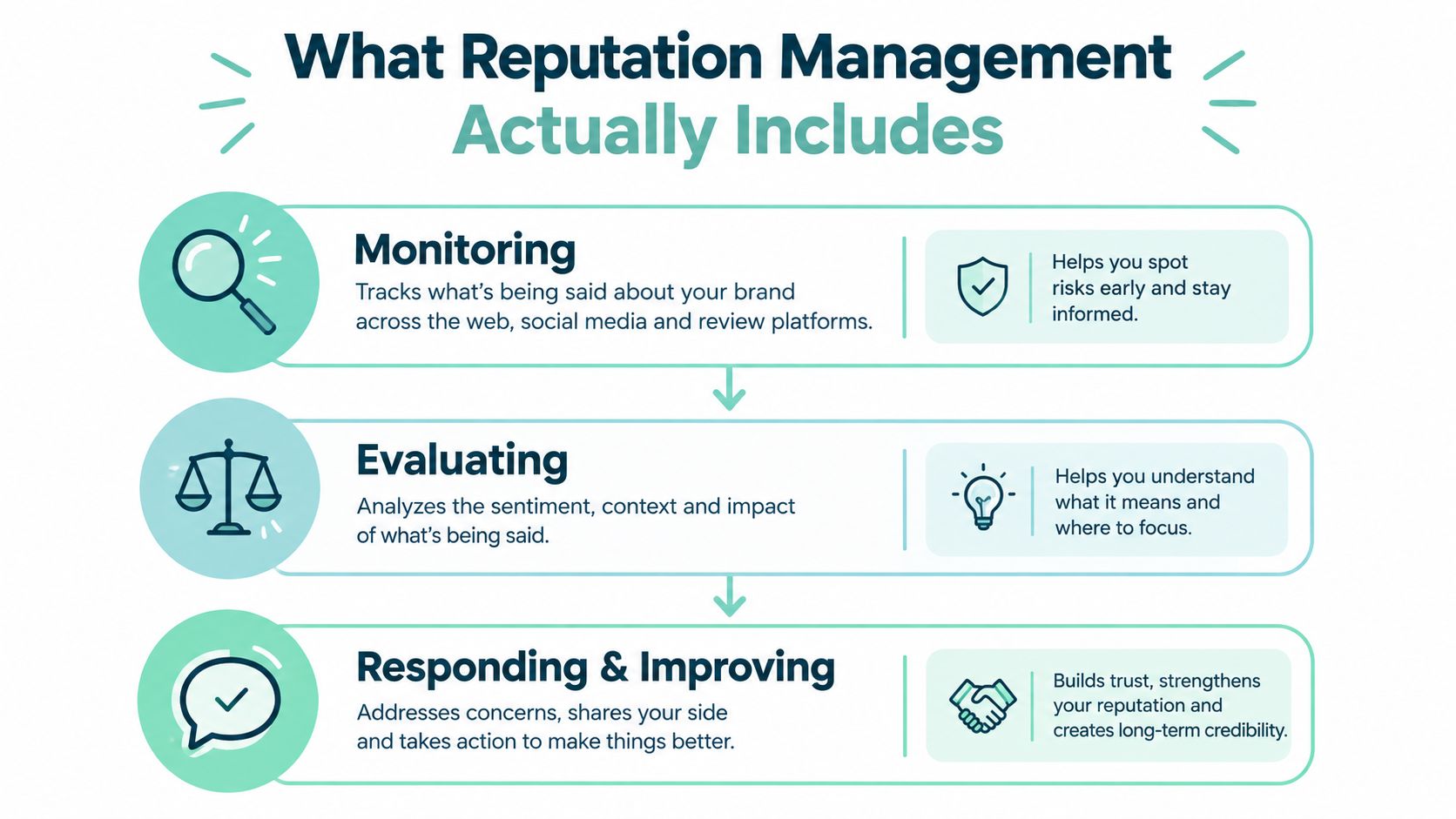
Monitoring reveals the public version of the business
Monitoring means consolidating feedback from the places customers use. For a local provider, that can include Google Business Profile, Yelp, BBB, Nextdoor, industry directories, community forums, and the company website.
A review dashboard is useful, but its value comes from classification. Label feedback by location, service type, severity, and theme. “The technician was late” points to scheduling. “The estimate changed without explanation” points to sales communication. “The office never returned my call” points to intake.
Evaluation separates noise from a service problem
Not every harsh statement requires the same response. A single vague complaint may need a courteous reply and internal review. A repeated billing complaint deserves a process owner and a defined corrective action. A review containing private information, spam, or content that violates platform policy should be escalated for appropriate reporting.
The operating metrics should reflect performance, not vanity:
- Response time: How quickly does the business acknowledge public feedback?
- Response coverage: How consistently does it respond across platforms and locations?
- Resolution rate: How often does a complaint reach a documented outcome?
- Rating distribution: Are reviews concentrated at one extreme, or do they reveal a more complex experience?
- Recurring themes: Which service failures appear repeatedly?
- Conversion impact: Do changes correlate with calls, forms, booked consultations, or qualified inquiries?
Businesses sometimes need to investigate whether an identity, transaction, or public statement is authentic before deciding how to escalate. A private detective may be relevant in unusual cases involving suspected fraud or disputed facts, but ordinary criticism should still be handled through customer service and platform procedures.
Response creates a visible record of accountability
A response isn't only for the reviewer. Future customers read it as evidence of how the business behaves under pressure. A useful reply acknowledges the concern, avoids revealing private details, explains the next step, and gives the customer a direct path to resolution.
That approach is different from trying to make every public signal look positive. Reputation management doesn't erase reality. It makes the business more accurate, responsive, and easier to evaluate.
How Service Businesses Should Monitor and Respond to Reviews
Start with coverage. A business that checks only Google may miss important feedback on another platform, a directory, or a location-specific profile. BrightLocal's 2025 U.S. consumer research found that 74% of consumers check reviews on at least two platforms when researching local businesses. BrightLocal's local consumer review survey supports a simple operational conclusion: monitoring must extend beyond one profile.
Build a repeatable review workflow
Assign an owner for monitoring and a backup for absences. Gather new reviews into a shared view, then classify each item before responding.
- Check every relevant platform. Include Google Business Profile, major industry sites, and location-specific listings.
- Classify the feedback. Separate praise, routine criticism, urgent complaints, suspected policy violations, and privacy-sensitive content.
- Route the issue. Send billing problems to billing, scheduling failures to operations, and serious allegations to the appropriate manager.
- Respond publicly with restraint. Thank the customer where appropriate, acknowledge the concern, and avoid arguing over details that belong in private.
- Close the loop internally. Record the resolution and look for similar complaints elsewhere.
BrightLocal also found that 89% of consumers said they would use a business that responds to all reviews, compared with 44% for a business that doesn't respond at all. The same source should be read as a behavior signal, not a promise of rankings or sales. A response demonstrates attention, which can reduce uncertainty for someone comparing local providers.
The strongest review response solves two problems at once. It helps the customer and shows the next customer how the business handles accountability.
Turn review language into website improvements
Reviews often contain the exact objections that service pages fail to answer. If customers repeatedly mention unclear estimates, explain the estimate process on the relevant page. If they praise emergency availability, make that capability clear in the service content and business profile. If they ask about financing, response times, or preparation requirements, create an FAQ that answers those questions directly.
Connect those changes to conversion data. Track calls, forms, booked consultations, and qualified inquiries by service page or location. The point isn't to claim that a review reply caused every lead. The point is to identify whether clearer information and better service recovery coincide with stronger lead quality.
For businesses with many locations, the workflow must preserve local detail rather than forcing every branch into an identical script. Guidance on managing reviews across every location can help multi-location operators think through ownership, consistency, and escalation.
Owners should also develop a calm, specific process for responding to Google reviews. A template can speed up routine replies, but automated language shouldn't replace judgment when a complaint involves safety, privacy, billing, or a serious service failure.
Why Five-Star Targets Can Mislead Service Businesses
A higher rating can be useful, but it doesn't automatically prove that customers are receiving better service. Reviews represent the people who chose to speak publicly, on a particular platform, under particular conditions. That selection can differ from the broader customer base.
A 2025 peer-reviewed study found that review behavior and ratings differed by platform. On Google Travel, people with negative experiences were less likely to post reviews, yet those who did post tended to rate their experience more negatively than they had in surveys. TripAdvisor showed a different pattern, with posted ratings sometimes more positive than survey responses after negative experiences. The study on platform-specific review behavior makes the measurement problem clear.
The visible rating is only one signal
Consider a dental practice with a polished rating but a growing number of appointment cancellations. The public score may look healthy while the cancellations reveal dissatisfaction that never becomes a review. A roofing company might receive glowing feedback from homeowners who finish projects smoothly, while prospects who abandon estimates leave no public record at all.
A practical reputation dashboard should compare reviews with first-party evidence:
- Customer surveys: What did customers say privately?
- Cancellations: Where do prospects or booked customers drop out?
- Repeat business: Do customers return or refer others?
- Complaints: Which issues recur across channels?
- Lead conversion: Do visitors who read reviews become qualified inquiries?
- Service data: Are certain teams, locations, or services associated with recurring problems?
This approach doesn't dismiss five-star feedback. It places that feedback in context.
Avoid turning solicitation into distortion
Aggressive review requests can make the public record less representative, especially when a business asks only its happiest customers to speak. A neutral request to genuine customers creates more useful evidence than a campaign designed to produce a particular sentiment.
The right question isn't, “How do we get more five-star reviews?” It is, “What do public reviews reveal about customer experience, and where does that picture differ from our private data?”
That change in framing improves both service operations and marketing decisions. Website content can address real concerns, managers can fix recurring failures, and marketers can judge reputation against inquiries rather than treating a star average as the final objective.

Legal and Platform Rules That Shape Ethical Reputation Practices
Reputation work has a clear boundary. A business can invite genuine feedback, correct inaccurate information, respond to criticism, and improve service. It can't manufacture customer sentiment or conceal legitimate criticism through intimidation.
The FTC's Consumer Reviews and Testimonials Rule took effect on October 21, 2024. It prohibits buying or selling fake reviews, purchasing positive or negative reviews, using undisclosed insider testimonials, operating company-controlled review websites that falsely appear independent, and engaging in certain review-suppression practices. The FTC's final rule announcement also explains that knowing violations can expose businesses to civil penalties.
Compare defensible and risky practices
| Defensible practice | Risky shortcut |
|---|---|
| Request feedback from genuine customers through a neutral workflow | Pay for reviews or ask for a specific positive rating |
| Preserve evidence of the customer relationship | Use testimonials from insiders without clear disclosure |
| Separate private service recovery from public review requests | Offer an incentive only for favorable sentiment |
| Report content that violates platform policy | Threaten customers to suppress criticism |
| Approve automated replies before publication | Publish identical responses without checking the facts |
Google's Business Profile rules require reviews to reflect genuine experiences. They prohibit paid reviews, reviews posted from multiple accounts at one person's request, and incentivized or otherwise biased ratings. Google may remove violating content, temporarily prevent a profile from receiving new reviews, unpublish existing reviews, or display a warning that fake reviews were removed. Google's policy on prohibited and restricted content outlines those consequences.
Know what reporting can and cannot do
A negative review isn't automatically removable. Google allows businesses to report reviews that violate its policies, such as spam or prohibited content, but reporting alone doesn't guarantee deletion. If Google confirms a violation, the review may be removed from Maps and Search. Google's review-removal process distinguishes policy violations from criticism based on a genuine customer experience.
For the latter, the appropriate response is usually public acknowledgment, private resolution where needed, and operational improvement. A compliant review program should document eligibility rules, use platform-compliant request templates, preserve customer-relationship evidence, and escalate defamatory or privacy-sensitive material without turning every complaint into a legal threat.
How Reputation Management Connects to Local SEO and Conversions
Reputation management supports local SEO because search visibility is only useful when people trust what they find. Accurate business information helps prospects identify the right provider. Relevant reviews give them context. Thoughtful responses show how the company handles problems. Website pages then answer the questions that reviews reveal.
The same system supports answer engine optimization. Search and answer engines need consistent, well-organized information about services, locations, expertise, and customer experience. Conflicting addresses, incomplete profiles, and unresolved public complaints make that information harder for people and machines to interpret confidently.
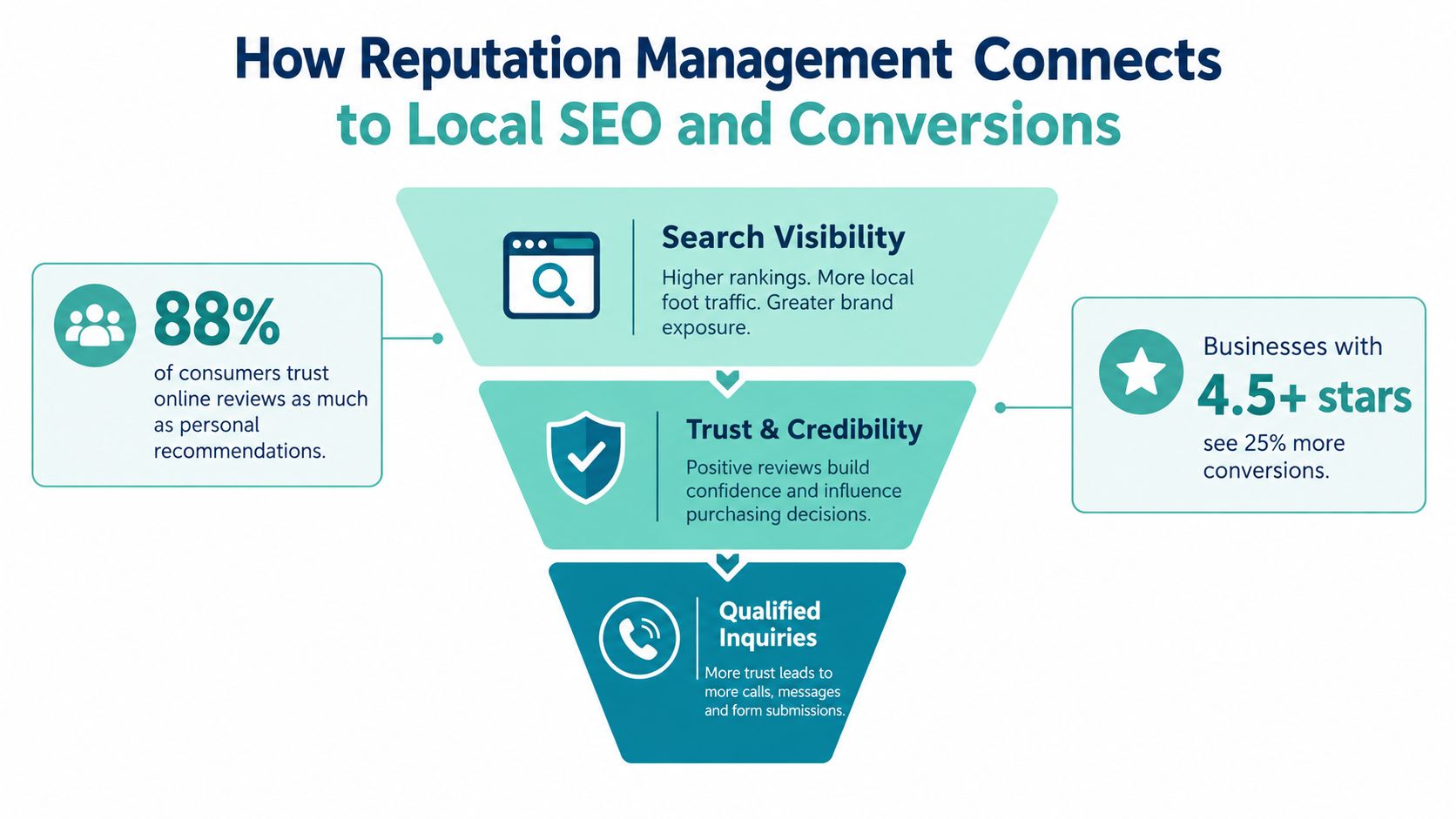
Connect public signals to business outcomes
A local reputation system should connect three layers:
- Visibility: Track branded search results, local profiles, service pages, and answer-engine references.
- Trust: Review response coverage, recurring themes, information accuracy, and the clarity of service explanations.
- Action: Measure calls, forms, consultation requests, booked jobs, and qualified leads.
This prevents a common reporting mistake. A business may celebrate more reviews while qualified inquiries remain weak because the website doesn't explain pricing, service areas, qualifications, or next steps. Conversely, a modest review profile may perform better after the business corrects its information and answers the objections prospects actually have.
The relationship between reviews and SEO is therefore broader than a star rating. Reviews provide language for content development, responses provide evidence of accountability, and service improvements create stronger material for future customer feedback.
Digital Skyrocket is one option for businesses that need this work connected to a new website and ongoing SEO. Its services include web design, local SEO, answer engine optimization, reputation-management workflows, analytics, and conversion-rate optimization for service companies such as law firms, dentists, roofers, and HVAC providers.
A practical next step is to audit your business name, profiles, latest reviews, recurring complaints, and lead data together. Then fix the information customers see, assign review ownership, and turn repeated objections into clearer website content.
Digital Skyrocket helps service businesses connect reputation management with web design, local SEO, answer engine optimization, and conversion tracking. Visit Digital Skyrocket to discuss a website and ongoing SEO plan built around qualified inquiries.