
Replying to every Google review sounds like the safest advice. It isn't.
A generic “Thanks for your feedback” posted days late can make an active business look automated, while an overly detailed response can expose private information or create a promise the owner can't keep. The right question isn't whether a business replied to every review. It's which response belongs in public, what the reply needs to accomplish, and how much risk the wording creates.
That distinction matters because 93% of consumers expect businesses to respond to reviews, and 34% expect a response within two to three days, according to BrightLocal's 2024 Local Consumer Review Survey. Google reviews are often the first customer-service interaction a prospect sees, especially when someone is comparing law firms, roofers, dentists, or other local providers. A response can reduce hesitation, but only when it sounds specific, timely, and appropriate to the situation.
This guide uses three filters for responding to Google reviews: review type, response goal, and risk level. That approach produces better decisions than a blanket rule, particularly for regulated businesses where a public reply can create privacy, legal, or professional-responsibility problems.
Table of Contents
- Why Most Google Review Reply Advice Is Already Outdated
- Response Timing and the Workflow Behind It
- Writing Positive Review Replies That Build Trust
- Negative Review Templates for Service Businesses
- When to Go Private, Escalate, or Report the Review
- Turning Review Replies Into Leads and Clients
- A Repeatable Review Response System You Can Start This Week
Why Most Google Review Reply Advice Is Already Outdated
The old playbook says to thank every five-star reviewer and apologize to every one-star reviewer. Follow that formula long enough and the profile starts reading like it was written by one exhausted template.
The problem isn't consistency. It's unthinking consistency. A family law firm, a roofing contractor, and a healthcare-adjacent practice shouldn't use the same tone, escalation process, or level of detail. Even within one profile, a thoughtful response to a detailed review deserves different treatment from a one-line rating with no written feedback.
Consumers pay attention to the response itself. BrightLocal's 2024 survey found that 88% of consumers would use a business that replies to all reviews, compared with 47% who would use a business that doesn't respond at all. The same research found consumers were 41% more likely to choose a business that responds to every review, while 93% expect businesses to respond. Those figures support active review management, but they don't support low-quality automation.
Selective replies protect the brand voice
Research on hotel review systems found that a defined response strategy performed better than having no strategy, and that response quantity could support competitive performance. It also found that selective responding was more effective than replying indiscriminately. The practical lesson is straightforward: reply broadly, but don't treat every review as an invitation to publish the same sentence.
Practical rule: A response should add information, reassurance, or a clear next step. If it adds none of those, rewrite it or leave it unpublished.
A useful positive reply might reference the service experience without repeating the reviewer word for word. A negative reply might acknowledge frustration and move resolution offline. A potentially fake review might need documentation and reporting rather than a defensive public argument.
Regulated businesses need stricter guardrails
Law firms must avoid confirming an attorney-client relationship or discussing active matters. Healthcare-adjacent businesses need to avoid personal health information. Contractors must be careful with disputed work, warranties, prices, and promises about remediation.
The objective is not more replies. It's a profile that shows attentive service without making the business sound scripted, defensive, or careless.
Response Timing and the Workflow Behind It
A strong response strategy starts before the first review arrives. Someone needs to monitor the profile, classify the review, decide who can answer, and record what happens next.
For a personal injury law firm, I'd route any review mentioning a legal outcome, medical outcome, settlement, diagnosis, or active case to the intake lead and an attorney before publication. For a residential roofing contractor, a field manager can often handle a straightforward service complaint, while safety allegations, property damage, or disputed warranties should reach the owner.
Use internal service windows that match the risk:
- Negative reviews: Route them immediately and aim for a response within four hours.
- Neutral and positive reviews: Aim to publish within 24 hours.
- Sensitive keywords: Send any mention of legal results, medical outcomes, or safety for same-day review.
These are operational standards, not claims about Google's ranking system. Their value is that they prevent a review from sitting unnoticed while the potential customer is still comparing providers.
Assign one owner to every stage
A simple queue works better than a vague group responsibility.
- Intake staff monitor alerts and tag each review as positive, service complaint, outcome complaint, factual dispute, or high risk.
- The marketing lead drafts or edits the response, checking tone, specificity, and the intended next step.
- The attorney, owner, or designated manager approves sensitive replies before anything goes live.
- One person records the outcome, including whether the reviewer moved to phone, email, or another private channel.
Google Business Profile alerts may work for a small profile. Once the queue becomes difficult to track, a shared inbox or platform such as Birdeye or Podium can centralize assignments. Businesses that need a more deliberate operational view can also use a response time monitoring setup to identify delays and assign responsibility.
Use a short triage flow
Ask three questions in order:
- Does the review require a public acknowledgment?
- Does the subject require private handling?
- Does the content appear to violate Google's policies?
The answer determines the owner, the wording, and the deadline. That routing prevents a slow reply from becoming a lost lead or a risky statement.
Writing Positive Review Replies That Build Trust
A five-star review from a family law client might say that the attorney explained each step clearly, answered questions promptly, and helped the client feel less overwhelmed. A weak response would be: “Thank you for your five-star review. We provide the best family law services in the area. Contact us today for all your family law needs.”
That reply sounds like an advertisement. It repeats the rating, inserts a keyword, and ignores the actual experience.
A stronger version would be: “Thank you, Maria. We're glad the step-by-step explanations helped you feel more prepared during a difficult process. If a friend or family member needs guidance with a family law matter, we'd be grateful if you shared our information.”
The stronger response makes three moves:
- It acknowledges the person by name, when appropriate and permitted.
- It references one specific detail, proving someone read the review.
- It offers a soft forward signal, such as a referral invitation or a relevant service path.
The reply stays short because sincerity doesn't require a paragraph. Two or three sentences can feel more human than a long block of polished marketing copy.
What positive replies shouldn't do
Don't repeat the reviewer's entire wording. Don't add several service keywords. Don't claim to be the “best” provider. Don't turn gratitude into a sales pitch.
A useful reply pattern for a contractor is: “Thanks, Jordan. We appreciate you mentioning how clearly the crew explained the repair options before starting. If you need help with another roofing concern, our team is happy to talk through it.”
For a professional practice, try: “Thank you, [Name]. We're pleased that [specific detail] made the process easier. If someone you know needs help with [relevant service], we're happy to be a resource.”
Teams handling a steady flow of praise can use a build pipeline with 120 replies resource for drafting support, but every published reply still needs human editing. Broader reputation management best practices should reinforce the same standard: personalization before publication, not automation without review.
Negative Review Templates for Service Businesses
Negative reviews become easier to handle after you identify the operational problem underneath them. Most fall into one of three categories: a service failure, an unsatisfactory outcome, or a factual or identity dispute.
A service complaint might involve a late arrival, missed appointment, poor communication, or unfinished work. The response needs ownership, a limited acknowledgment of what can be confirmed, and a private handoff.
An outcome complaint is different. The customer may believe the service failed to produce the expected result, but the public reply shouldn't debate technical facts or disclose a case file. Lead with empathy and direct the person to a private conversation.
An identity dispute needs verification language. Don't confirm that the reviewer was a customer, and don't accuse the person of lying. Ask them to contact a named person through a controlled channel so the business can investigate.
Practical reply patterns
| Complaint Type | Opening Sentence | Key Acknowledgment | Closing Next Step | What to Leave Out |
|---|---|---|---|---|
| Service complaint | “We're sorry the appointment experience fell short.” | “We're reviewing the scheduling and arrival details with our team.” | “Please contact [Name] at [private channel] so we can look into this directly.” | Staff blame, pricing arguments, promises of compensation |
| Outcome complaint | “We're sorry to hear that the result didn't match your expectations.” | “We'd like to review the details privately and understand what happened.” | “Please reach [Name] with your case or service reference, if you have one.” | Diagnosis specifics, settlement language, technical conclusions |
| Identity or factual dispute | “We take this concern seriously, but we can't identify the situation from the information shown here.” | “We'd like to verify the customer and service details before commenting further.” | “Please contact [Name] through [private channel] so we can investigate.” | Accusations, personal data, claims that the review is fake |
Keep the public record narrow
A public response shouldn't contain pricing, settlement language, diagnosis details, account numbers, or any acknowledgment that could be quoted back in litigation. Google's guidance also warns businesses not to share personal data or attack reviewers personally, and recommends investigating the reason for a negative impression and reporting inappropriate content when necessary. See Google's guidance for managing reviews before publishing a sensitive reply.
Avoid binding-feeling promises. A roofer who writes, “We'll redo the entire job,” may be trying to calm the situation, but the statement can create an expectation before the company reviews the contract and work record. A dentist saying, “We'll redo the crown,” creates the same problem. Use a review-and-contact commitment instead, then let the responsible manager determine the remedy privately.
When to Go Private, Escalate, or Report the Review
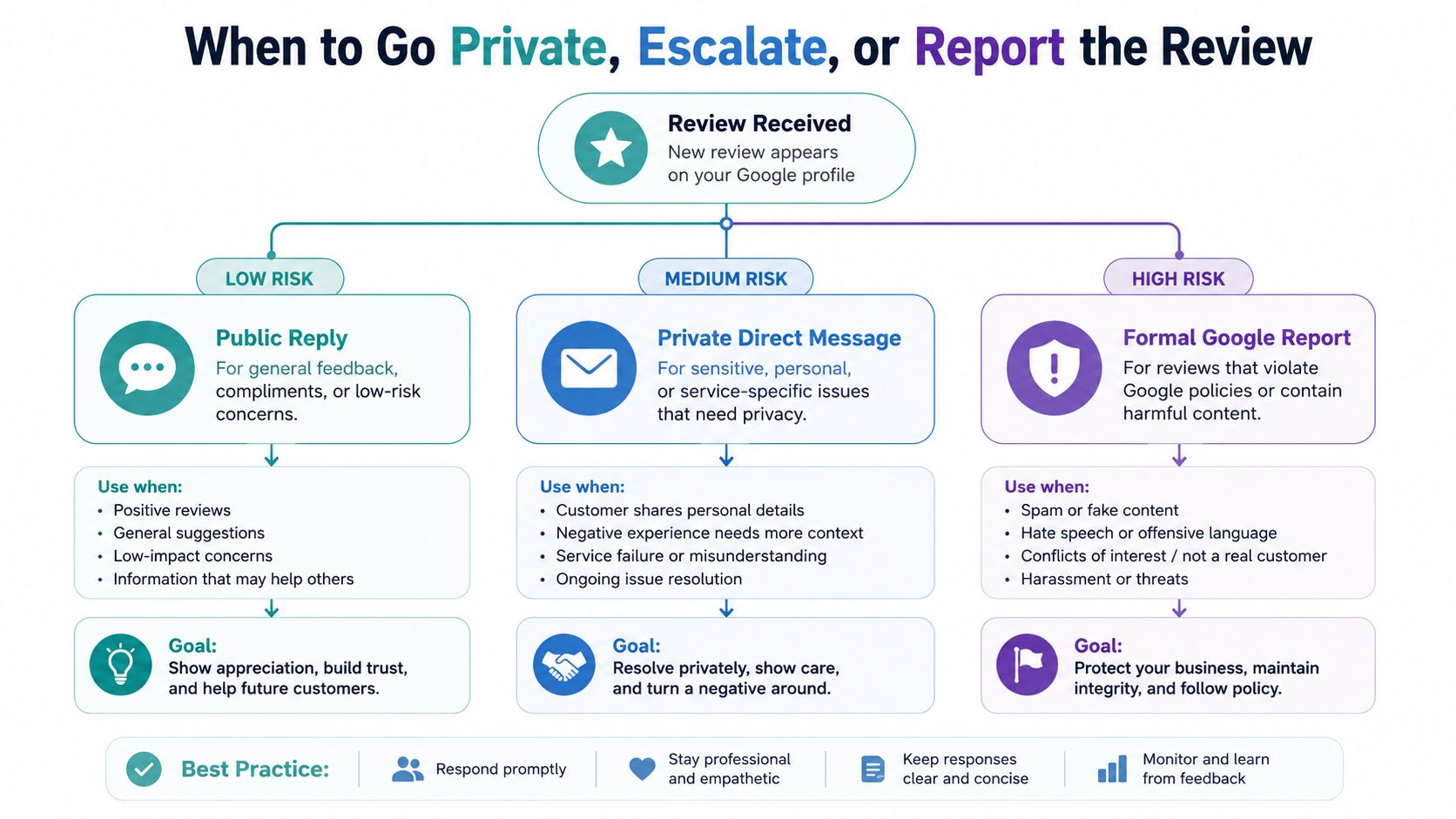
Every review offers three possible actions: respond publicly, move the matter into a private channel, or report the content to Google. The right choice depends on risk, verifiability, and the audience likely to read the reply.
A public response fits a low-risk complaint about communication, scheduling, cleanliness, or general service. It shows future readers that the business noticed the concern and has a process for handling it. Keep the wording factual and avoid debating the reviewer.
Private escalation fits sensitive content. That includes protected health information, attorney-client details, active litigation, disputed customer identity, and service records that can't be discussed publicly. A short public acknowledgment can say the business wants to connect directly, then point the reviewer to a private phone or email channel with an internal record of the contact.
Reporting fits content that appears to violate Google's prohibited-content rules, such as spam, hate speech, or a review from someone who wasn't a customer. Reporting isn't a substitute for a response strategy. An analysis of 335,520 deleted Google reviews found that 60.1% of reviews removed in the updated dataset had received a business response, which shows that replying doesn't shield non-compliant content from moderation. The response and the report serve different purposes.
Use evidence, not outrage
For a report, preserve screenshots, the reviewer's account history where visible, transaction or appointment records, and notes showing why the content appears inaccurate or prohibited. Don't threaten the reviewer with legal action in the public thread. Don't call a competitor a fraud without evidence.
A law firm might follow this path:
- Review mentions an active case or confidential facts.
- Attorney reviews the draft.
- Business posts a brief acknowledgment without confirming representation.
- Intake staff moves the matter to a private channel.
- The firm preserves records and reports only if the content violates policy.
A roofer might follow a different path:
- Review alleges work at an address the company can't match.
- Owner checks job records and account history.
- Business avoids confirming or denying customer identity publicly.
- Owner requests private verification.
- If evidence points to spam or prohibited content, the owner files a report with supporting documentation.
A practical online reputation management approach for small businesses should treat the public reply as one part of the process, not the entire resolution.
Turning Review Replies Into Leads and Clients
A review reply is a small conversion opportunity. The reader may be a past customer, a referral source, or someone comparing local businesses after reading the original review. A reply that ends with “Thanks for your feedback” closes the door. A reply with one appropriate next step keeps the conversation measurable.
For a roofer, that next step might be a booking link for an inspection. For a law firm, it might be a consultation form. For a dental practice, it could be a direct line to the front desk. The link or invitation should move the person to a private channel, never ask for case details, medical history, or account numbers in public.
Build the reply around one action
Use this sequence:
- Acknowledge and thank: Recognize the reviewer and the specific experience they mentioned.
- Add one relevant call to action: Invite a booking, consultation, phone call, or private follow-up.
- Track and follow up: Tag the contact in the CRM and record whether the interaction became an inquiry or service opportunity.
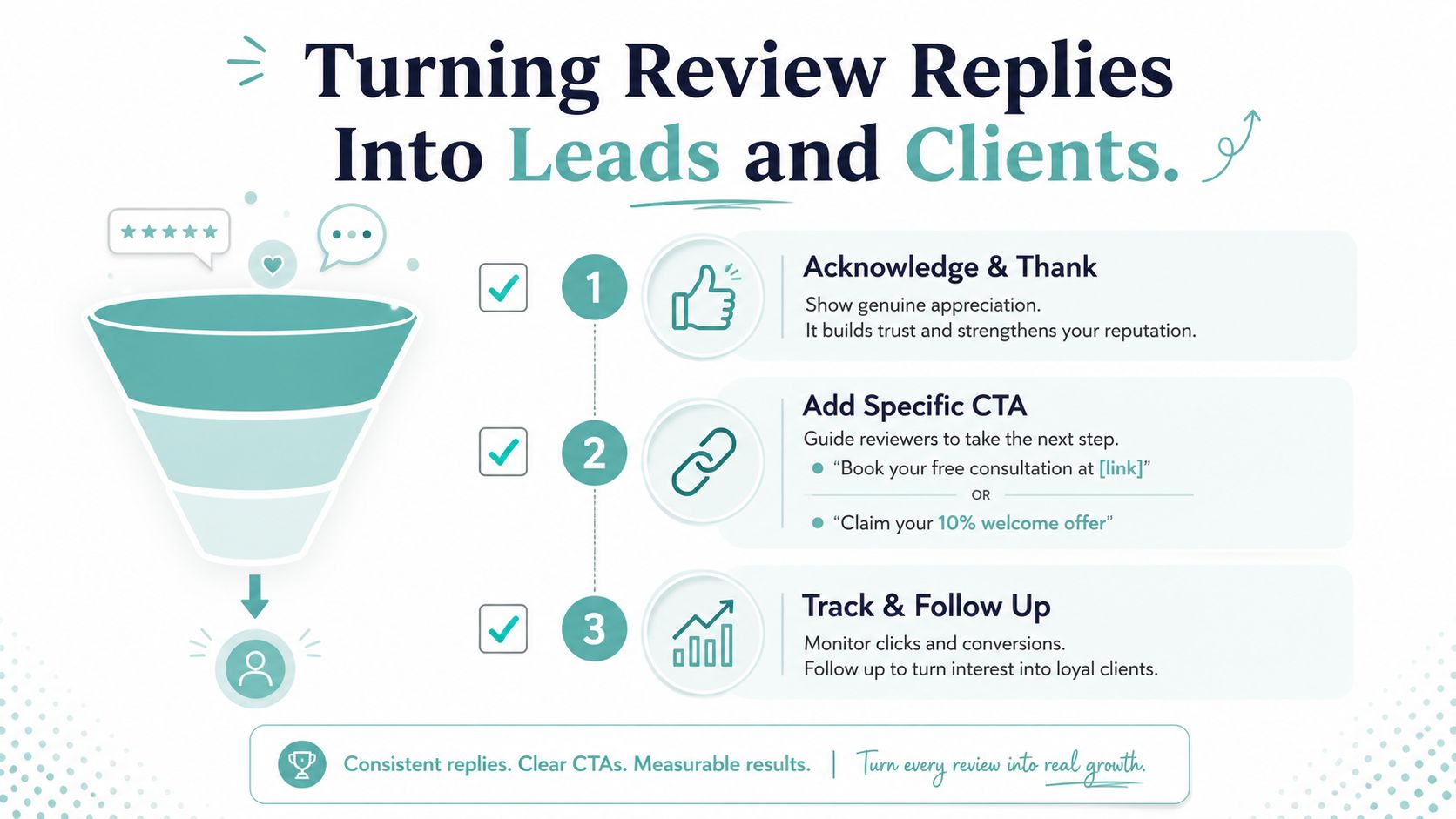
The CTA should match the review. A positive roofing review might end with, “If you need help with another roof concern, you can request an inspection through our website.” A law firm could say, “If someone you know needs help with a similar legal issue, our intake team can explain the next step privately.” A negative review may need no promotional CTA at all. The conversion goal there is resolution and trust repair.
Measure the handoff, not vanity activity
After publishing, tag the reviewer in the CRM, trigger a courteous follow-up email when appropriate, and flag the thread for a later check-in. Don't offer an incentive in a way that pressures a customer to change a review. Keep the record focused on the private conversation and the service outcome.
The point isn't to force a sale from every reply. It's to connect reputation work with booked consultations, repeat service calls, or referrals from nearby customers. Guidance on how to ask for reviews can support the broader feedback cycle, but the public response still needs to stand on its own.
A Repeatable Review Response System You Can Start This Week
A solo owner or office manager can build a workable system without turning review management into a full-time project. Start with four inputs: a review alert tool, one responsible responder, a list of escalation contacts, and a shared dashboard or sheet.
Set the system around triggers
Create a row for every new review with the date, star rating, category, assigned owner, risk tag, response status, and private follow-up status. Set triggers for a new review, a low-star rating, and keywords tied to legal outcomes, medical matters, safety, refunds, property damage, or active disputes.
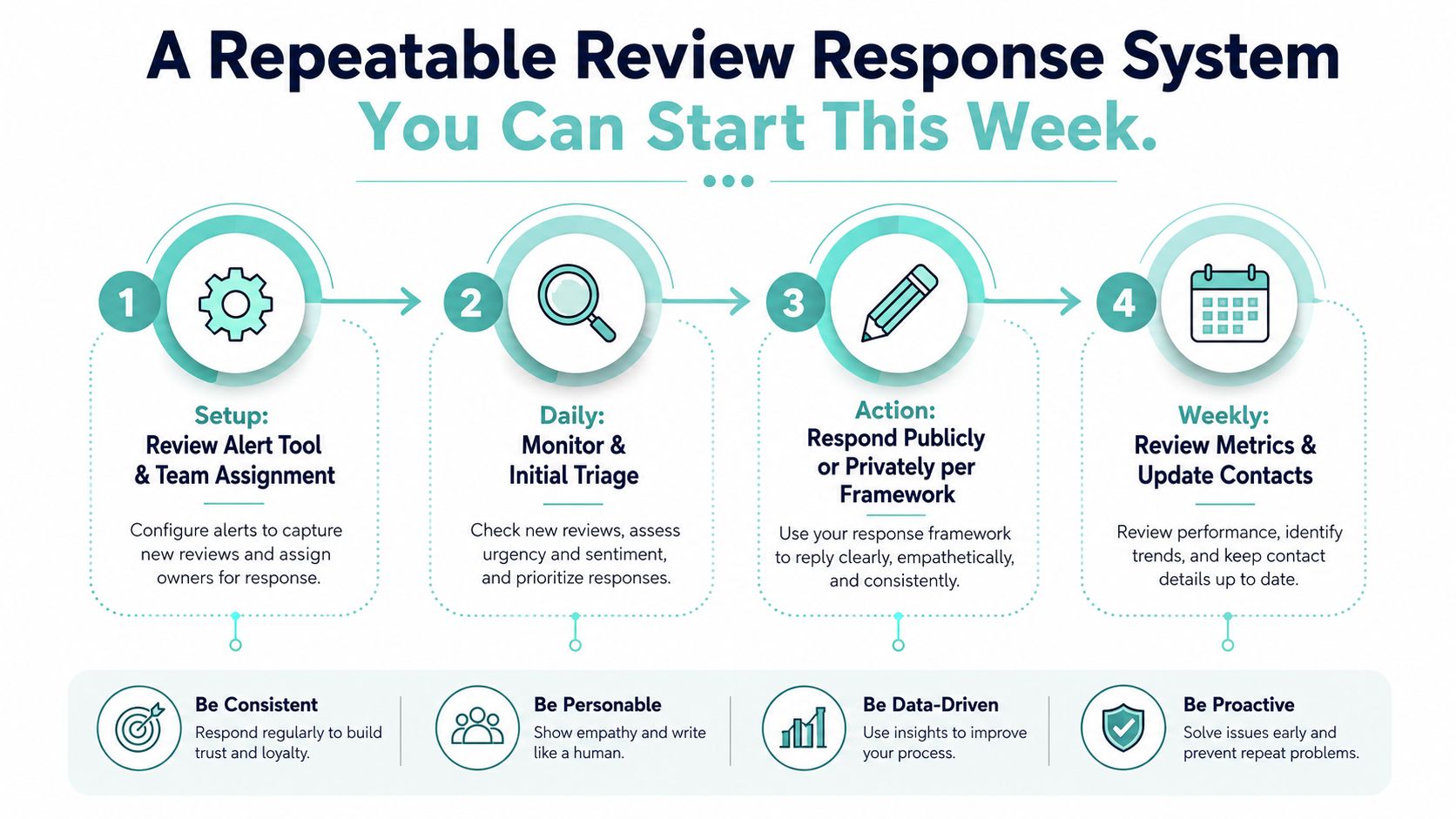
Then assign actions:
- Setup: The office manager confirms alerts and names the responder.
- Daily monitoring: Intake or customer service staff classify new reviews.
- Public or private action: The authorized person drafts, approves, and publishes the response.
- Weekly review: The owner studies recurring complaints and updates staff, contacts, and templates.
Use internal deadlines that create accountability. Acknowledge ordinary reviews within 24 hours when possible, pursue a resolution within 72 hours, and document the final status within seven days. High-risk reviews should move through the designated attorney, owner, or compliance contact rather than waiting in the ordinary queue.
Review the pattern every week
One isolated complaint may need a courteous response. Several complaints about missed calls, unclear estimates, or appointment delays point to an operational problem. The owner should compare review themes with lead records, call notes, and staff feedback, then assign a specific corrective action.
A broader reputation management PR playbook can help businesses prepare for issues that extend beyond a single review. For day-to-day operations, keep the rule simpler: a reply should move a public reader toward trust and, when appropriate, a private conversation. Measure response time, escalation completion, private contacts, and resulting inquiries rather than counting replies alone.
Digital Skyrocket helps service businesses connect reputation management with local SEO, conversion-focused website design, and lead tracking, including for law firms, roofers, dentists, and other providers. If your Google reviews are generating attention but not enough qualified inquiries, visit Digital Skyrocket to discuss a website and ongoing SEO system built around better visibility and clearer conversion paths.