
93% of consumers say online reviews influence their purchasing decisions, and 81% research a business online before buying, according to reputation management research from Newmedia. For a Texas roofer, HVAC contractor, dentist, or law firm, that means a prospect often forms an opinion before calling, submitting a form, or visiting an office.
Online reputation monitoring turns that first impression into an operating system. It connects reviews, local search visibility, brand mentions, customer experience, and qualified-lead volume, so your team can spot problems while they're still fixable instead of discovering them after the phone stops ringing.
Table of Contents
- Why Online Reputation Monitoring Matters Now
- What Online Reputation Monitoring Actually Is
- The Five Signal Categories Every Service Business Watches
- Building a Tiered Alert System That Reduces Noise
- Metrics and Response Timing That Move Rankings
- A Real-World Response Playbook for Negative Events
- Connecting Monitoring to Local SEO, CRO, and AI Answer Engines
- Your 30-Day Online Reputation Monitoring Starter Plan
Why Online Reputation Monitoring Matters Now
Reviews aren't a vanity metric. They're part of the buyer's search process, especially for local service businesses where a customer may compare several providers before making contact. The same research reports that 41% of companies experiencing a reputation crisis lose brand value and revenue within the first year (Newmedia).
That creates three practical consequences for a service business:
- Reputation and local SEO are connected. Review quality, volume, freshness, and responses shape how a Google Business Profile looks beside competing listings. A business can have strong technical SEO and still lose local clicks if its profile presents a weaker trust signal.
- Searchers filter before they convert. A prospect can reject your listing from the search results page without ever reaching your website. If the profile looks neglected, the lost opportunity won't appear in your analytics as a failed form submission. It never becomes a visit.
- Unanswered criticism creates a one-sided record. A negative review remains visible while your business offers no evidence of accountability. Silent readers may not comment, but they still use what they see to decide whether your company feels safe to hire.
Practical rule: Treat every review and prominent mention as part of the path to a call, not as a separate public-relations task.
Monitoring catches those leaks early. It can flag a sudden rating change, a recurring complaint about missed appointments, a negative page entering branded search results, or a service-area error in a public profile. The owner or office manager can then investigate the operational cause before the issue spreads across more locations or service lines.
Texas businesses also need to account for market complexity. A Dallas HVAC company, a Houston dentist, and an East Texas roofing contractor may use different platforms, neighborhoods, and service queries. A useful starting point is the Expressify AI service business playbook, which can help teams think through reputation and demand-generation workflows in the context of service businesses.
The central idea is simple: online reputation monitoring is connective tissue. It links what customers say to where you appear, what prospects believe, and whether qualified inquiries reach your team.
What Online Reputation Monitoring Actually Is
Online reputation monitoring isn't review generation. It isn't a public-relations statement after a crisis, and it isn't a quick daily glance at a Google Business Profile. Those activities may support reputation management, but monitoring is the measurement layer that tells you what changed and what deserves attention.
A doctor doesn't wait for a patient to describe every symptom before checking vital signs. The doctor measures blood pressure, heart rate, and temperature on a schedule, then responds when a reading crosses a threshold. Service businesses need the same discipline online.
Online reputation monitoring is the continuous, systematic collection of review, mention, sentiment, search, and answer-engine signals, paired with a response rule for each meaningful event.
Four components make the system useful
- Channels: Google Business Profile, Yelp, BBB, Nextdoor, industry directories, social platforms, forums, search results, and AI answer engines.
- Signals: Star rating, review volume, response status, sentiment, recurring language, ranking position, citations, and factual accuracy.
- Cadence: Real-time alerts for urgent events, same-day review for actionable issues, and weekly analysis for patterns.
- Response rules: A named person, a severity level, a deadline, and an escalation path.
A reactive process asks, “Did anything bad happen?” after someone notices a problem. A proactive process asks, “Which signals changed, how serious are they, and who owns the next action?” That distinction matters because a monitoring system should produce decisions, not just notifications.
Small businesses evaluating software can use this guide to find reputation monitoring tools for small business, then compare each option against actual workflows. The right tool is the one your team will configure, check, and act on consistently.
The Five Signal Categories Every Service Business Watches
A reputation dashboard should measure more than the average star rating. For service companies, the important signals fall into five connected categories.
1. Review velocity and star rating
Watch Google Business Profile, Yelp, BBB, Nextdoor, and industry platforms such as Avvo or Healthgrades. Useful triggers include a rating falling below 4.3 stars, more than two negative reviews in seven days, or no new review activity for 30 days. These thresholds are operating choices for prioritization, not universal ranking rules.
2. Recency and response rate
A review from yesterday carries a different decision context than one from months ago. Track unanswered reviews, the age of each unanswered item, and the share of reviews receiving a response. A neglected response queue can make the profile look inactive even when the business is delivering good work today.
3. Brand and service-line mentions
Search for the company name, owner names, misspellings, branded services, and non-branded phrases. Monitor Reddit, city subreddits, Facebook groups, and industry forums where customers may discuss “roof leak repair,” “Dallas emergency HVAC,” or a local attorney without tagging the business.
4. Sentiment and language patterns
Sentiment becomes more useful when paired with recurring words. Terms such as “no-show,” “overcharge,” and “rude” can reveal a process problem before the rating trend becomes obvious. A single complaint may be isolated. Repeated language deserves an operational review.
5. Search and answer-engine visibility
Track local-pack positions for priority services, branded search results, SERP features such as “best plumber in Dallas,” and references in ChatGPT, Perplexity, Gemini, and Google AI Overviews. A missing or inaccurate service area can reduce qualified inquiries even when the business name still appears.
| Signal Category | Primary Platforms | Trigger Event |
|---|---|---|
| Review velocity and rating | Google Business Profile, Yelp, BBB, Nextdoor | Rating falls below 4.3, multiple negatives, or review silence |
| Recency and response rate | Review profiles and directories | Negative review remains unanswered |
| Brand and service mentions | Reddit, Facebook groups, forums | New complaint or unusual mention volume |
| Sentiment and language | Reviews, social posts, support records | Repeated “no-show,” “overcharge,” or “rude” language |
| Search and AI visibility | Google, ChatGPT, Perplexity, Gemini | Incorrect citation, lost local feature, or negative result |
A category missing from this list is usually a qualified-lead leak waiting to surface within a business planning cycle. Teams wanting a broader operational checklist can review these reputation management best practices and adapt them to their location and service mix.
Building a Tiered Alert System That Reduces Noise
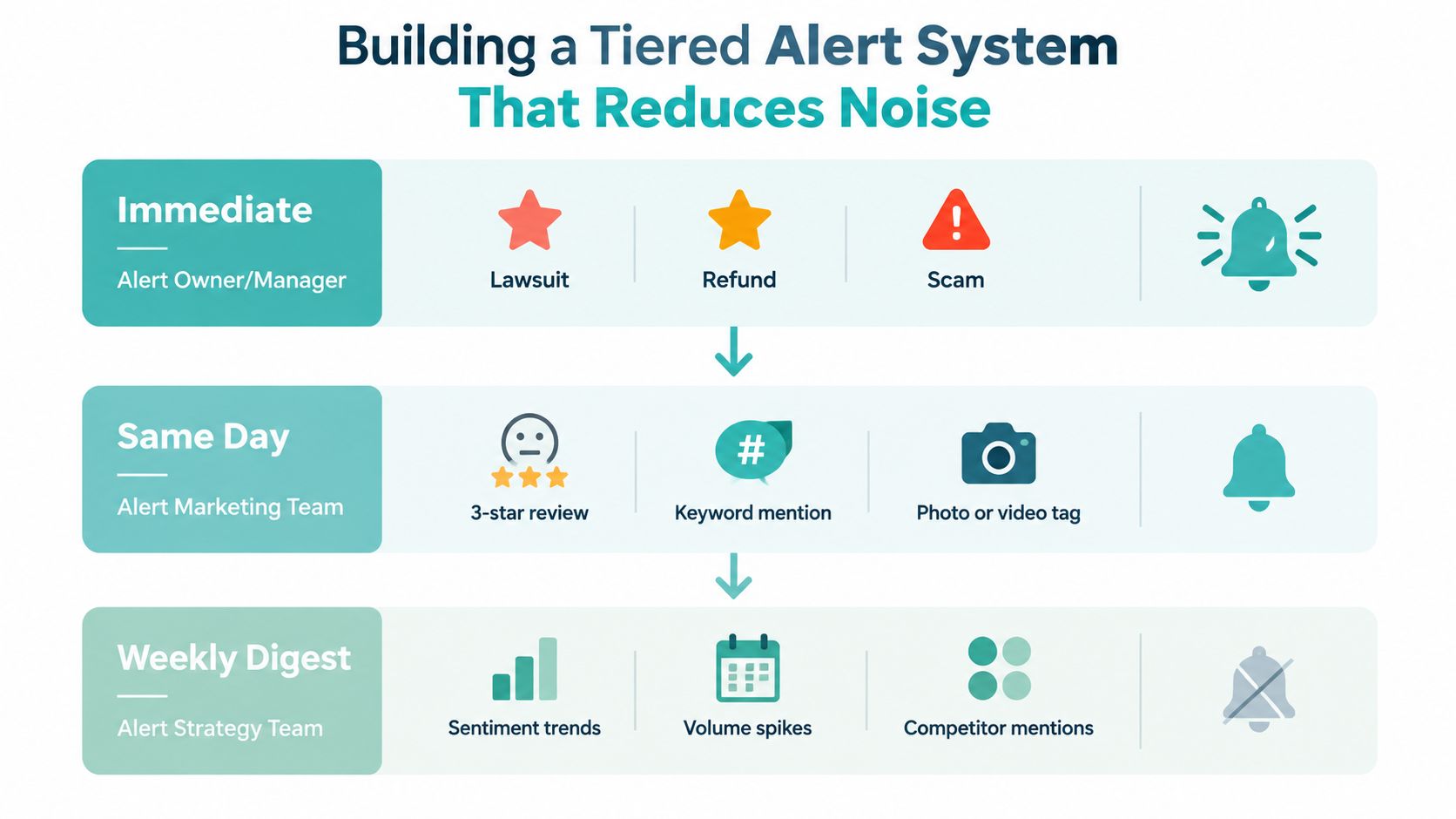
An alert system fails when every event arrives with the same urgency. Owners start ignoring notifications, office managers lose context, and marketing teams spend time sorting routine praise from genuine risk. Tiering solves that by matching the alert channel to the consequence.
Immediate events
Send a text message or push notification to the owner or office manager for:
- Severe reviews: New one-star or two-star reviews.
- Risk language: Mentions containing “lawsuit,” “refund,” “scam,” or similar escalation terms.
- Direct complaints: Public complaints on Google Business Profile, Facebook, or Nextdoor.
The response owner should acknowledge the event quickly, verify the customer record, and decide whether the issue requires an operational or legal escalation. A practical framework places crisis keywords, major media coverage, and executive reputation events in an immediate bucket, with action targeted within one hour (Gray Group International).
Same-day events
Route three-star reviews, tagged negative posts, unresolved support tickets older than 24 hours, and unlinked brand or service mentions to the marketing or customer-service team. Review them during a consistent afternoon meeting rather than interrupting the owner for every moderate signal.
Weekly events
Put review velocity, competitor review spikes, citation inconsistencies, sentiment movement, and AI answer-engine references into a weekly digest. A digest should identify trends and owners, not merely list URLs.
Thresholds keep the system usable. One guide recommends instant alerts for reviews of three stars or below, negative social posts reaching 50 or more engagements, and a negative URL entering the search top 10 (Suff Digital). Your thresholds can differ, but they should be explicit enough that two team members reach the same conclusion.
Metrics and Response Timing That Move Rankings
Academic work on review behavior separates reputation into review valence, volume, authenticity, and interactivity. That model is more useful than a star-rating-only dashboard because it recognizes that a business changes outcomes through its responses, not just through the reviews customers publish.
A peer-reviewed hotel study found that firms responding to reviews experienced a 0.12-star increase in ratings and a 12% increase in review volume, while responses also changed the composition of criticism by producing fewer but longer negative reviews (Marketing Science). Service businesses shouldn't copy those results as a forecast, but they should use the finding to measure response activity as an operational variable.
The weekly dashboard
| Metric | Why It Matters | Weekly Target |
|---|---|---|
| Average star rating | Shows the public trust signal on major profiles | Track direction and investigate abrupt movement |
| Review count | Indicates the depth of customer feedback | Compare with the business's normal pace |
| Review velocity | Reveals whether recent customer experiences are being recorded | Flag unusual increases or silence |
| Review recency | Helps prospects judge whether feedback reflects current service | Keep the queue current |
| Response rate | Shows whether the business acknowledges customers | No negative review left without an owner |
| Response latency | Measures how quickly the team engages | Route urgent items for same-day action |
| Language diversity | Reveals recurring service themes | Track complaint and service terms |
| Sentiment trend | Separates isolated criticism from a pattern | Review changes against prior periods |
Research summarized by the International Journal of Economics, Business and Management Studies associates responses within 24 hours with more positive sentiment and credibility. The same synthesis reports that solution-oriented replies generated 35% to 40% more positive brand perceptions than unanswered reviews, while replies within 24 hours outperformed replies delayed beyond 72 hours by about 70% in reputation outcomes.
The operational rule is straightforward. Assign a deadline to every alert tier, measure response latency in hours, and inspect the reason whenever a negative review stays unanswered. A fast, generic response isn't enough. The reply should acknowledge the specific issue, avoid exposing private information, and move resolution to a direct channel.
A Real-World Response Playbook for Negative Events
At 8 a.m., a Dallas HVAC company receives a one-star Google review about a missed appointment and a $200 diagnostic fee. The monitoring system sends an SMS to the office manager because the review meets the immediate-alert rule.
The office manager acknowledges the alert within 15 minutes, checks the job record, and confirms that the technician sent a 30-minute arrival estimate by text. The customer didn't respond, but the internal record doesn't erase the customer's experience. The business still needs to address the missed expectation and understand how the fee was communicated.
The public response
By 10 a.m., the owner posts a calm, specific reply. It acknowledges the frustrating experience, names the appointment communication problem, and offers a direct callback. It doesn't argue about the customer's interpretation, publish private details, or demand that the review be removed.
The owner then contacts the customer privately, refunds the fee, and offers to reschedule. The public reply remains factual because future readers need to see that the company took responsibility without turning the review into a private dispute.
Response standard: A public reply should show accountability. The private conversation should solve the customer's problem.
Teams can use this practical guide to responding to Google reviews to build response templates, but templates shouldn't replace investigation. The best reply reflects the actual record and offers a credible next step.
Fix the process, not just the review
That afternoon, the team logs the event and identifies two changes:
- Dispatch confirmation: Add clearer language explaining the arrival window and what happens if the customer can't confirm.
- After-call confirmation: Require a follow-up message after service so the customer understands the diagnostic fee and next step.
The incident is valuable because it links reputation monitoring to service delivery. A response can protect trust in the moment, but the process change reduces the chance that another customer reports the same failure.
Connecting Monitoring to Local SEO, CRO, and AI Answer Engines
Reputation monitoring now reaches beyond review sites and branded search. The 2026 monitoring surface includes AI answers from ChatGPT, Perplexity, Gemini, and Google AI Overviews, creating a new responsibility for local businesses: audit what answer engines say about the company, not just whether they mention it (Cloro).
For a Houston dentist, the audit might use fixed buyer-intent prompts such as “is [brand] legit?” or “[brand] vs [competitor].” The team logs the sentiment, factual claims, cited sources, service area, name-address-phone information, review count, and any outdated narrative. Running the same prompts repeatedly makes changes easier to detect.
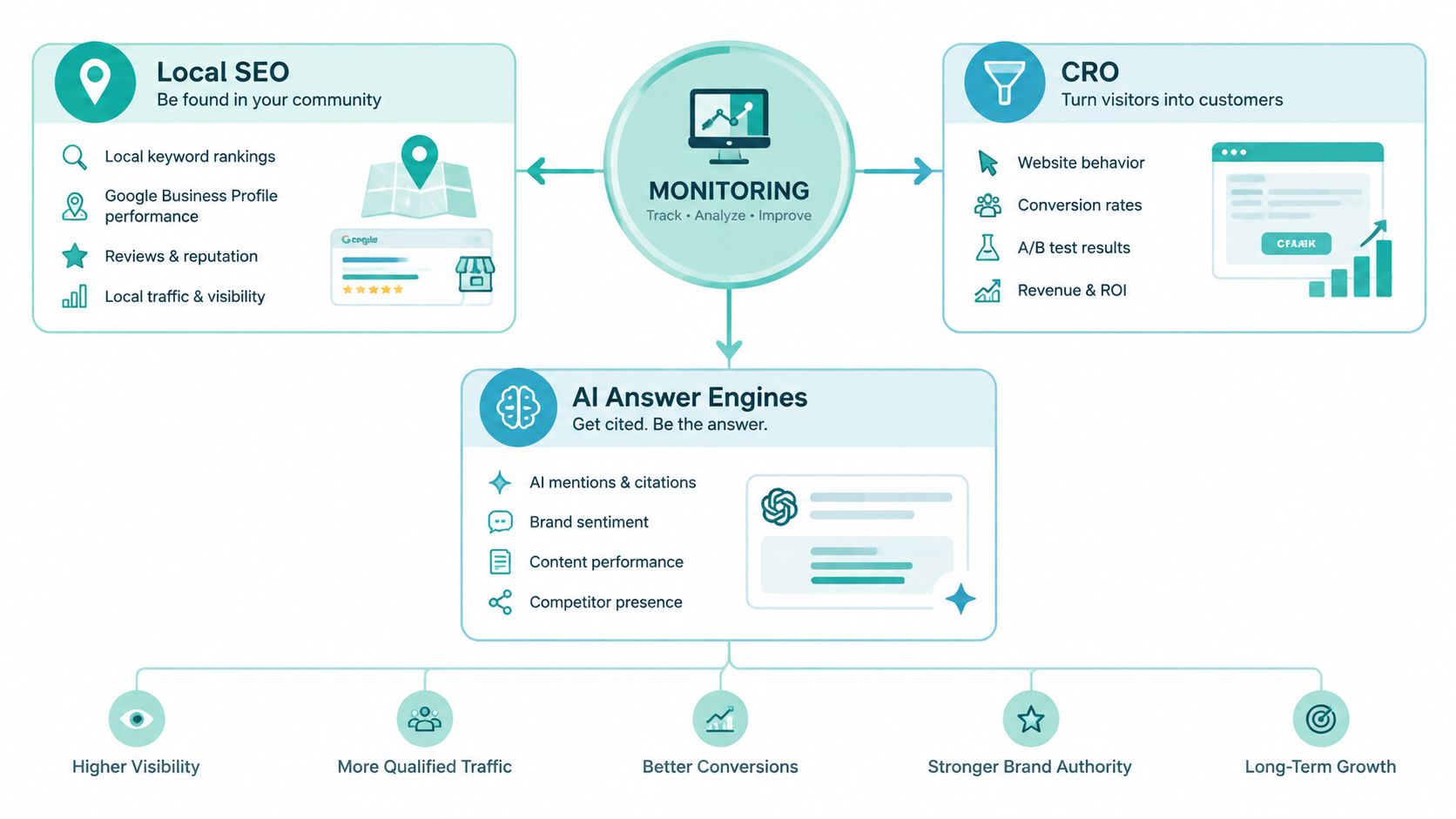
One monitoring loop, three outcomes
- Local SEO: Review velocity, sentiment, responses, and Google Business Profile Q&A provide context for local visibility and user trust.
- CRO: Call tracking and form analytics show whether a reputation change corresponds with stronger or weaker qualified inquiries.
- Answer-engine optimization: Citation audits reveal missing entities, stale facts, and incorrect service-area descriptions.
The connection to conversion rate optimization matters. A business shouldn't place a star rating, testimonial, response excerpt, or trust badge on a landing page merely because it looks persuasive. Monitoring should confirm that the claim is current, defensible, and consistent with the profile prospects see in search.
A practical introduction to this broader discipline is answer engine optimization. The important shift is operational: the team audits AI outputs as a buyer-facing channel, records errors, and improves the underlying business information rather than treating an answer-engine mention as a one-time curiosity.
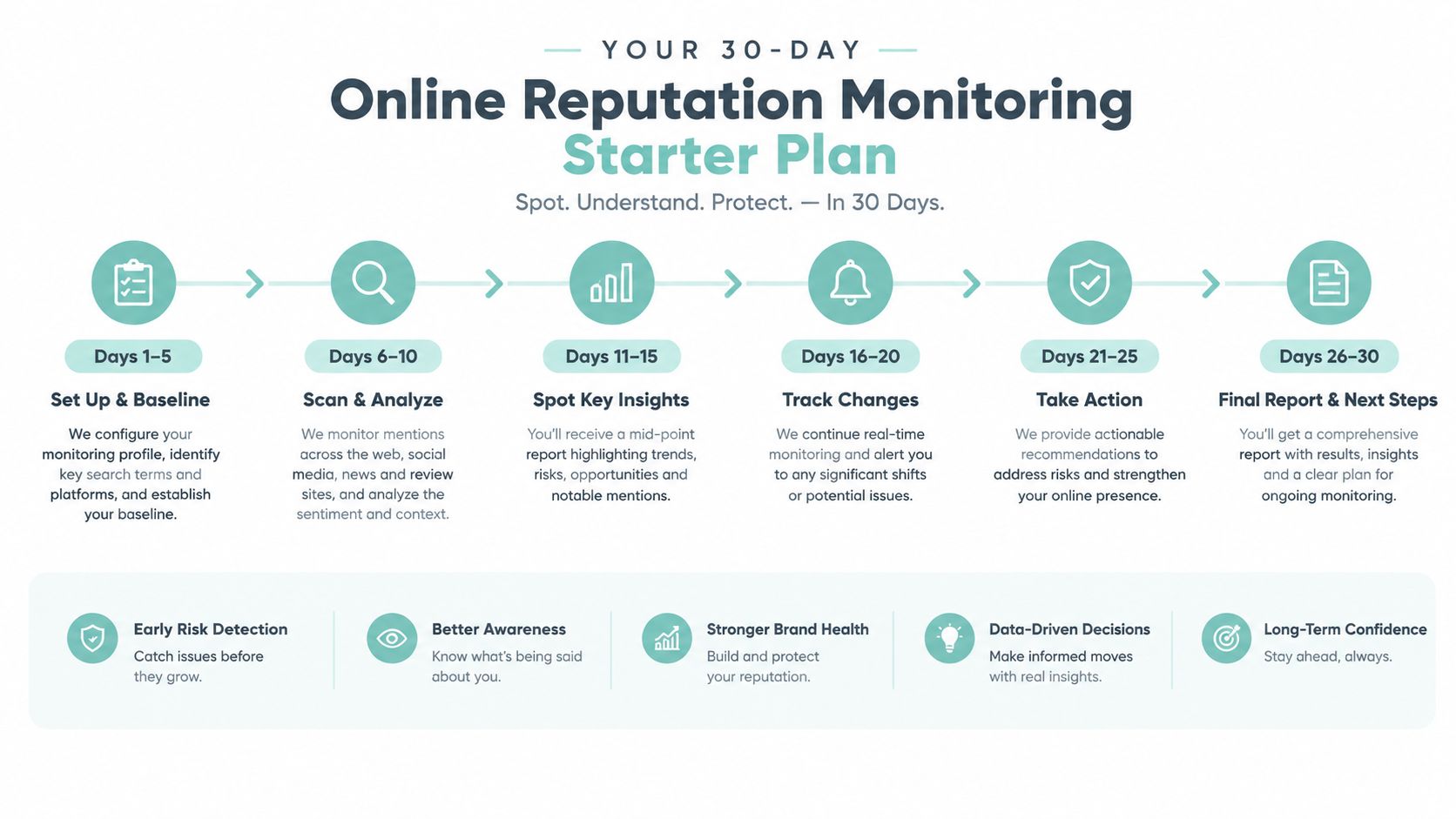
Your 30-Day Online Reputation Monitoring Starter Plan
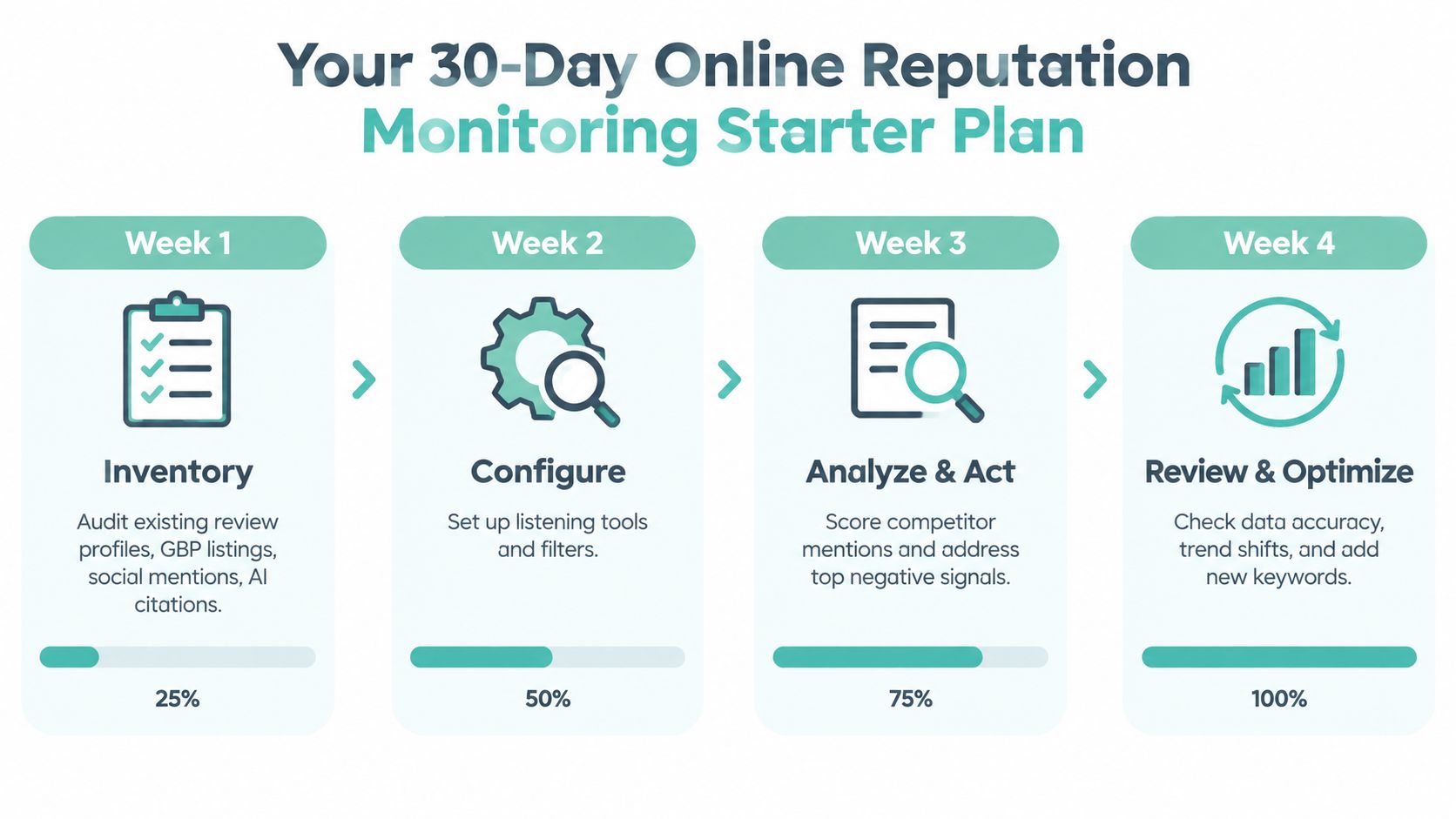
A small service business doesn't need a massive platform to begin. It needs a complete inventory, clear owners, sensible thresholds, and a dashboard that connects reputation movement with qualified leads.
Week one, inventory the public footprint
List every Google Business Profile, Yelp page, BBB profile, Nextdoor listing, industry directory, social account, and branded search result. Claim the profiles your team can control, record duplicate or inaccurate listings, and search the business name with common misspellings.
Run fixed service and buyer-intent prompts through ChatGPT, Perplexity, Gemini, and Google AI Overviews. Save the answers and note incorrect service areas, NAP details, review counts, citations, or outdated claims. Connect call tracking so the team can compare source quality with reputation changes.
Week two, configure ownership and alerts
Set immediate, same-day, and weekly rules. Assign the owner or office manager to severe events, marketing or customer service to moderate issues, and a strategy owner to weekly trends. Test each notification before relying on it.
A useful first-month target is zero unanswered negative reviews older than 24 hours. That target is operational, visible, and directly tied to the public customer experience.
Week three, rehearse the response process
Create response templates for praise, moderate dissatisfaction, severe complaints, suspected fraud, and privacy-sensitive cases. Define when staff should move a conversation offline, when an owner must approve the reply, and when legal counsel should review the situation.
Hold a short weekly meeting with the review queue, recurring complaint terms, unresolved cases, and process fixes. Don't judge the team only by response speed. Check whether the response led to a real resolution.
Week four, launch the dashboard
Track:
- Review velocity and average rating
- Response rate and response latency
- Negative-review age
- Sentiment and recurring complaint language
- Search visibility for priority services
- AI citation accuracy
- Qualified calls and forms by source
- Cost per lead by source
The dashboard should make ownership obvious. If a rating changes but nobody knows who investigates, you've built a report, not a monitoring system. If an AI answer repeats an incorrect service area, correct the business's source information and verify the output again.
Start with the profiles, queries, and alerts that influence your highest-value services in your most important Texas markets. Then review the data every week and let customer language guide the next website, local SEO, and service-process improvement.
Digital Skyrocket builds websites and ongoing SEO systems for service businesses, with reputation monitoring connected to local search, answer-engine visibility, and qualified inquiry tracking. If your Texas law firm, dental practice, roofing company, or HVAC business needs a website and search strategy that turns reputation signals into better lead paths, visit Digital Skyrocket to start a fit conversation.