Most advice on white hat vs black hat SEO still asks the wrong question. It treats SEO risk like an ethics quiz. In practice, Google doesn't rank your site by deciding whether you're a good person. It evaluates patterns, signals, and policy violations.
That's why two sites can both call themselves "white hat" and have very different risk profiles. One publishes solid service pages and earns links through outreach. Another publishes solid service pages but also buys guest posts with manipulative anchor text, leases pages on third-party domains, or spins out city pages that function like doorways. The second site may look respectable in a sales pitch and still be one policy review away from a serious problem.
I've found that the useful way to think about this in 2026 is simpler. Stop asking whether a tactic sounds white hat or black hat. Ask which specific Google spam policy it could trigger, what evidence it leaves behind, and whether you could defend it in Search Console, in a reconsideration request, or in front of a client who wants to know why leads disappeared.
Table of Contents
- Why the White Hat vs Black Hat SEO Question Deserves a 2026 Reset
- Defining White Hat SEO and Black Hat SEO in Practice
- Side-by-Side Comparison of Approaches and Trade-Offs
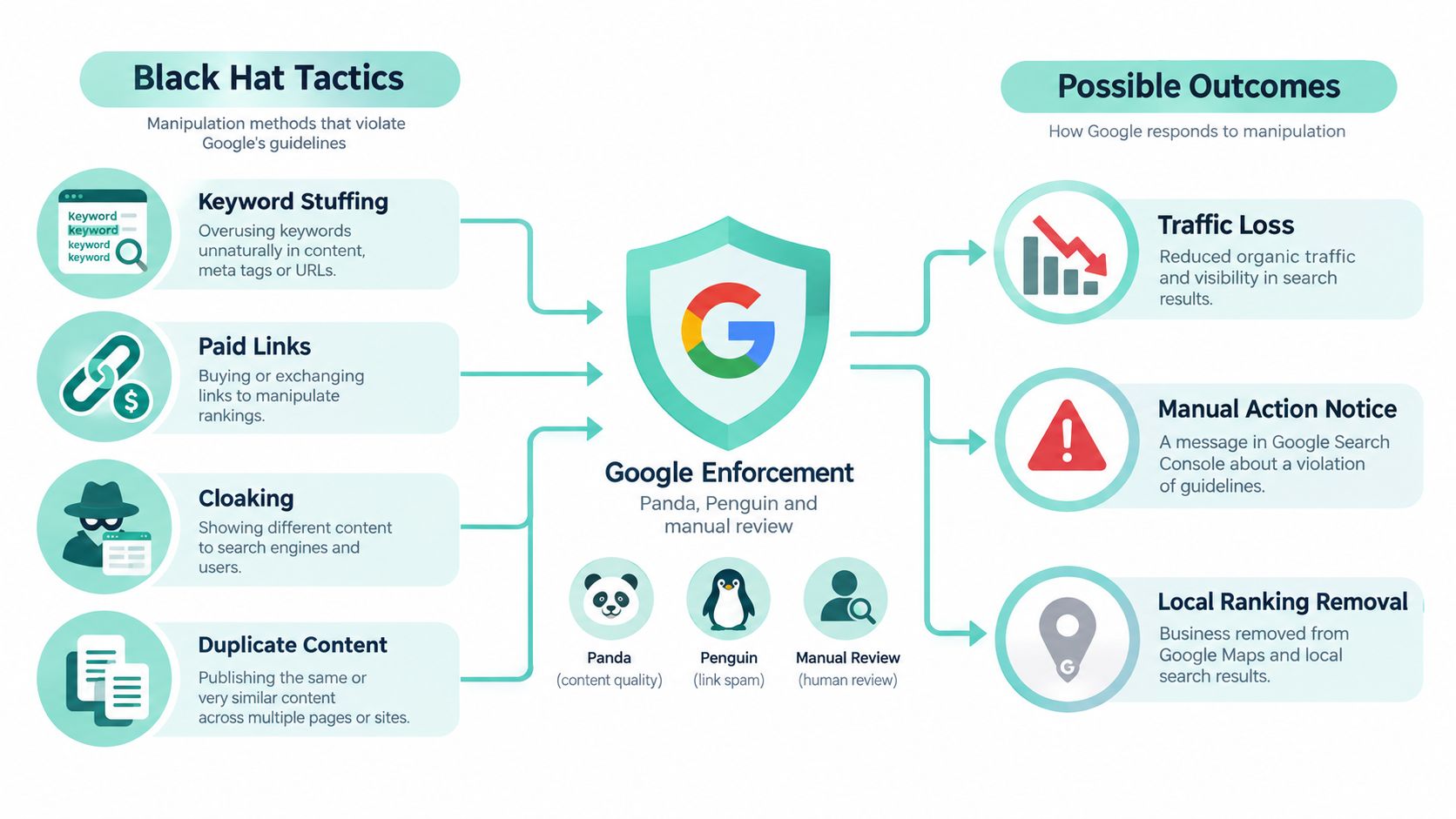
- How Google Penalizes Manipulation and What Triggers Action
- Auditing Your Site or Vendor for Risky Tactics
- Steps for Cleaning Up a Site That Crossed a Line
- White Hat Strategy for Local SEO and AEO Conversions
- Sustainable SEO for Service Businesses and What to Watch
Why the White Hat vs Black Hat SEO Question Deserves a 2026 Reset
The old framing still has some value. It helps beginners separate sustainable SEO from manipulative SEO. But it breaks down fast once you start auditing real sites.
Google's own documentation now names concrete abuse patterns such as hidden text, cloaking, doorway pages, scaled content abuse, and link schemes, rather than relying on a broad moral category of “black hat” SEO. Hidden text abuse includes tactics like white text on a white background, off-screen CSS positioning, opacity set to zero, or hiding a link inside a single character, according to Google's spam policies.
The real risk surface is policy-specific
If you're evaluating a vendor, the binary label isn't enough. A firm can talk about helpful content, technical SEO, and long-term growth while placing manipulative links. Another can avoid paid links but ship location pages that are basically doorway templates with city names swapped out.
Google's anti-spam enforcement also hasn't faded. A major milestone came with Penguin in 2012, which targeted manipulative link practices. More recently, Google reported that its March 2024 spam work would result in 45% less low-quality, unoriginal content in search results than before the update, as summarized at Keystar Agency's Google penalty statistics page.
Practical rule: If a tactic depends on hiding intent, faking editorial signals, or scaling pages primarily for ranking footprints, don't judge it by branding. Judge it by the exact policy language it resembles.
What matters more than the label
For service businesses, five patterns deserve immediate scrutiny:
- Doorway pages that exist mainly to capture geographic variations
- Cloaking that shows one thing to Google and another to users
- Hidden text or links inserted for ranking signals rather than visitors
- Scaled content abuse where pages are mass-produced with little original value
- Link manipulation through paid placements, PBNs, exchanges, or engineered anchors
That's the frame that holds up in audits, recoveries, and vendor reviews. It's also the frame that makes better decisions under pressure.
Defining White Hat SEO and Black Hat SEO in Practice
The cleanest definitions come from how a tactic behaves, not from how an agency markets it.
White hat SEO is work that improves search visibility by making the site more useful, more understandable, and more trustworthy for users and search engines. Black hat SEO uses deceptive or manipulative methods to create ranking signals Google hasn't editorially earned.
What white hat SEO looks like on a real site
White hat work usually includes a mix of editorial, technical, and local search tasks:
- Useful original content that answers a service question clearly, with real expertise
- Honest metadata where titles and descriptions match the page
- Structured data that helps search engines interpret entities, services, reviews, or FAQs
- Technical fixes that improve crawlability, indexing, rendering, and internal linking
- Legitimate promotion such as digital PR, citation cleanup, outreach for editorial mentions, and link reclamation
- Local SEO basics like consistent business information, complete profiles, and strong location pages
On a service-business site, that often means topical service clusters, clear author or business identity signals, review management, schema markup, and content that helps a prospect decide whether to call.
What black hat SEO looks like in plain language
Google explicitly prohibits a range of tactics, including doorway abuse, cloaking, expired-domain abuse, hacked or hidden content, keyword stuffing, machine-generated traffic, malware, misleading functionality, and scaled content abuse, as stated in Google's documentation on spam violations.
Here's how that usually appears in vendor language:
- “We built city pages at scale” often means doorway pages
- “We placed authority guest posts” can mean paid link placements
- “We use a private network we control” usually means a PBN
- “We created local relevance signals” can mean spun location content
- “We boosted CTR and authority signals” can hide bot traffic or fake engagement
- “We repurposed high-performing content fast” can drift into scraped or mass-generated pages
A lot of site owners don't spot the problem because the deliverable sounds normal.
If the tactic exists mainly to manipulate a ranking signal instead of helping a human visitor, it's already in dangerous territory.
The gray area that confuses buyers
The tricky part isn't obvious cloaking. It's the tactic that looks clean on the surface. Guest posting is a good example. Independent guidance summarizing Google's policies notes that Google doesn't attach a universal volume threshold to manipulative link tactics, which means even a small number of clearly manipulative links can violate policy if the intent is ranking manipulation rather than editorial citation, as explained in the SEO Handbook discussion of black hat SEO.
That's why definitions alone don't save you. You need to inspect intent, scale, and execution.
Side-by-Side Comparison of Approaches and Trade-Offs
Here's the comparison most business owners need. Not “good vs bad,” but what each approach does to your risk, time horizon, and cleanup burden.
| Criterion | White Hat SEO | Black Hat SEO |
|---|---|---|
| Risk surface | Lower direct policy risk, but still needs review as Google policies evolve | High exposure to manual actions, algorithmic demotion, or deindexation |
| Time horizon | Usually compounds over months as content, links, reviews, and technical quality mature | Often creates short bursts followed by volatility, reversals, or cleanup cycles |
| Cost | Invests in content, development, structured implementation, outreach, and review systems | Often spends on cheap links, content farms, PBNs, rented domains, or scaled page generation |
| Defensibility | Easier to explain to stakeholders and defend in a reconsideration request | Hard to defend because intent is usually manipulative and leaves artifacts |
| Scalability | Scales slower because editorial quality and implementation capacity limit speed | Scales fast, but spreads risk across links, templates, and networks |
White Hat vs Black Hat SEO Decision Criteria Compared
The core trade-off is that white hat SEO tends to build assets, while black hat SEO tends to build liabilities.
A strong service page, a well-optimized Google Business Profile, a review response workflow, or a clean internal linking system still helps next quarter. A paid link package, doorway template set, or rented parasite page may produce movement, but it also creates a future forensic problem. Someone eventually has to identify what was done, where it was deployed, and whether it can be removed.
What agencies often leave out
Agency pitches usually flatten this choice into values. They say one path is ethical and one isn't. That's incomplete. Buyers should evaluate these tactics by operational impact.
Consider the questions that matter:
- Can this survive a manual review
- Can your team explain it to legal or leadership
- Can you remove it if the vendor disappears
- Does it create dependencies on networks you don't control
- Will it still make sense if Google reclassifies a scaled tactic as abuse
A policy-aligned SEO program still has trade-offs. It takes patience, editorial control, and technical discipline. But the work is cumulative. You can improve it, document it, and hand it off.
Why link quality still separates the two camps
Independent crawl-and-rank experiments on web spam found that filtering manipulative links can improve ranking quality substantially, with precision improvements of more than 200% over the standard HITS link-based ranking algorithm when spam links were filtered, according to the Lehigh University paper on web spam and ranking quality.
That matters because the argument for black hat link building has always depended on one hope. That manipulative links will be counted as if they were genuine editorial votes. Search engines have spent years trying to remove exactly that advantage.
How Google Penalizes Manipulation and What Triggers Action
The failure pattern usually isn't dramatic at first. Rankings soften. Some pages stop climbing. A local pack listing slips. Then someone says, “Maybe this was just a core update.” Sometimes it was. Often it wasn't.
Three common trigger patterns
A plumber buys a citation and link bundle from a vendor that controls a network of thin local sites. The pages look like directories, but the outbound linking pattern is engineered. Search Console may not hand you a neat confession, but the backlink profile often shows clusters of low-trust referring domains, repeated anchor themes, and placements that no customer would ever visit.
A law firm hosts third-party articles on a partner domain because someone promised quick authority transfer. Those articles target legal queries the host site doesn't serve. That's the kind of arrangement that drifts toward site reputation abuse or parasite-style publishing, where the host domain's trust is used to rank content that isn't editorially integrated.
An agency rolls out dozens of city pages for a home-services client. Every page uses the same structure, same copy blocks, same service list, and a swapped city name. Those are often sold as local landing pages. In reality, many function like doorway pages.
What the enforcement looks like
Google enforces manipulation through both algorithmic systems and manual action workflows. A longitudinal 2024 study of SEO spam found that search engines measurably target spam and affiliate manipulation with ranking updates, and that spam-heavy pages face algorithmic suppression rather than stable indexation, according to the Webis study on SEO spam and ranking updates.
What you see depends on the trigger:
- Algorithmic demotion often appears as broad ranking decay, unstable query positions, or suppressed visibility after spam-focused refreshes
- Manual actions can appear directly in Search Console when a reviewer identifies a policy violation
- Partial impact can hit a page set, directory, or template class rather than the whole domain
- Sitewide trust damage often shows up when manipulative patterns are repeated across the site
Don't diagnose from traffic alone. Pull Search Console messages, inspect the affected page class, and trace the exact tactic before blaming “Google volatility.”
Why 2026 requires more precision
The old black-hat label is especially weak in a policy-heavy environment. A major open question for 2026 is whether the phrase itself still fits, because Google's enforcement appears focused less on a simple ethical binary and more on named abuse patterns such as cloaking, doorway pages, scaled content abuse, sneaky redirects, hidden text, and link schemes. During the August 2026 update, third-party performance data showed 16.71% of URLs that had ranked in Google's top 10 dropped beyond position 100 for the same keyword, versus 9.2% in a comparable non-update period, as referenced alongside Google's Search Status incident documentation.
That doesn't mean “everything is risky.” It means diagnosis has to be more specific than ever.
Auditing Your Site or Vendor for Risky Tactics
Most bad SEO doesn't announce itself. It hides in deliverables, anchor text, page templates, and reporting dashboards that summarize away the uncomfortable details.
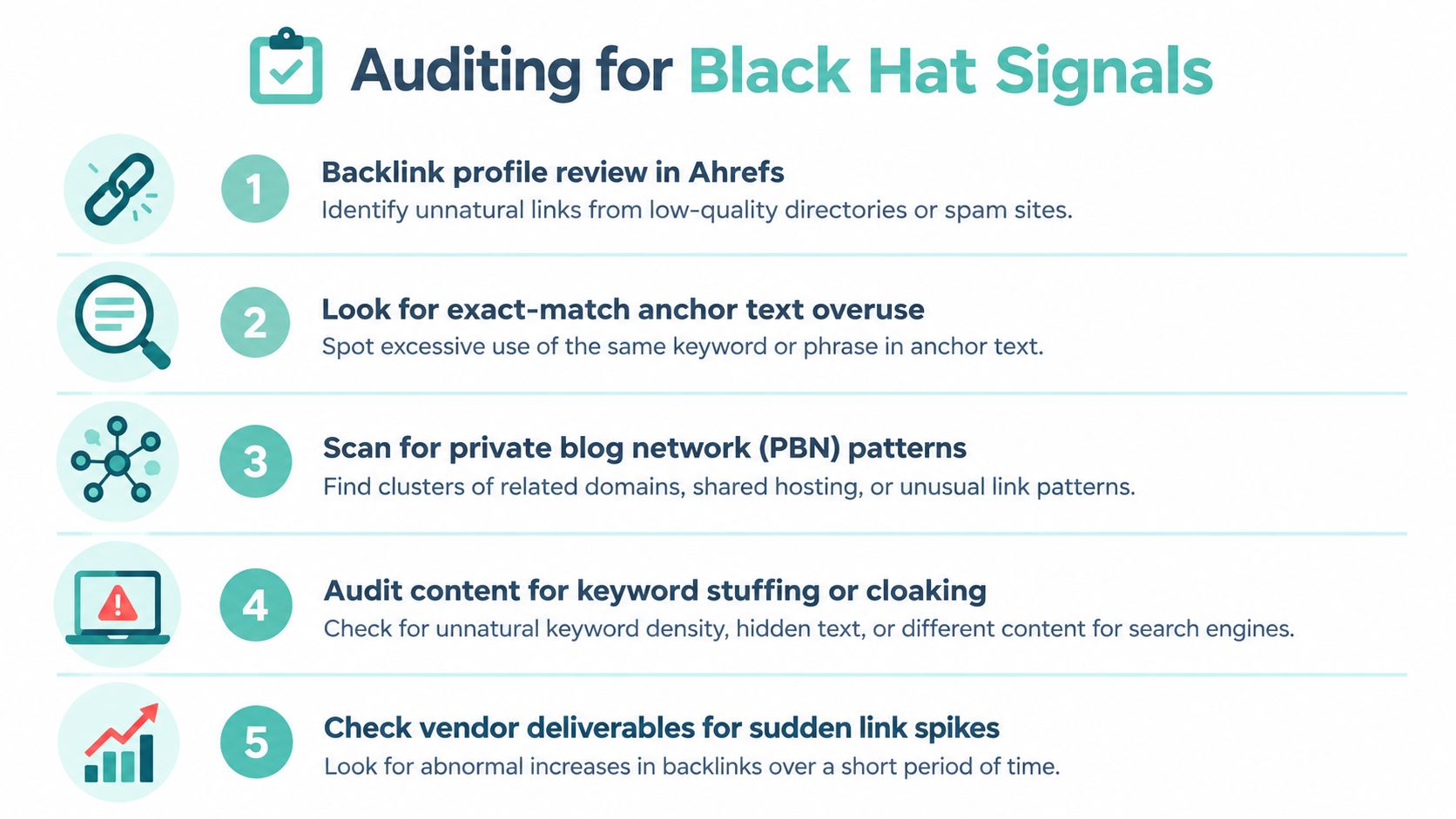
Start with what the vendor can't spin
Use tools like Ahrefs, Semrush, and Google Search Console, but don't rely on any one dashboard score. I care more about patterns than labels.
Look for these signals first:
- Referring domain spikes that don't match any PR campaign, launch, or content event
- Anchor text repetition where exact-match service terms dominate unnaturally
- PBN footprints such as same-theme templates, thin sites, weak branding, and repetitive outbound link behavior
- Location-page duplication where only city modifiers change
- Hidden or redirected elements that users don't experience the way crawlers do
If you need a broader process for technical review, a structured technical SEO audit checklist helps you map risk across crawlability, page templates, internal linking, and implementation gaps.
Questions that expose risky work
Ask the vendor for raw evidence, not summaries.
- Show the placement list for every acquired link
- Show implementation logs for on-page changes and redirects
- Explain anchor text strategy using examples, not theory
- Identify all pages built from templates and who approved them
- Disclose any private network, partner site, or syndication method
A clean vendor may still make mistakes, but they won't hide the work.
A guaranteed ranking pitch, especially when paired with secret methods or “proprietary publishing networks,” is usually a risk warning disguised as confidence.
How to document the audit trail
Create an audit sheet with columns for URL, issue type, suspected tactic, source, evidence, and action needed. That sounds basic, but it speeds up recovery when a site takes a hit months later.
Use practical review methods:
- Export backlinks by date and inspect abrupt acquisition windows manually.
- Run site queries and crawls to find near-duplicate local pages, orphan sets, and unexpected indexed content.
- Search rendered HTML and CSS for hidden blocks, odd styling rules, and injected links.
- Compare page intent to search intent. If a page exists only to capture a keyword variant, treat it as suspect.
- Save copies of vendor reports. If a future cleanup team needs to trace responsibility, those reports matter.
If you can't clearly explain why a link exists or why a page was published, keep digging.
Steps for Cleaning Up a Site That Crossed a Line
Cleanup goes badly when teams jump straight to the disavow file or the reconsideration request. Recovery starts with diagnosis, not paperwork.
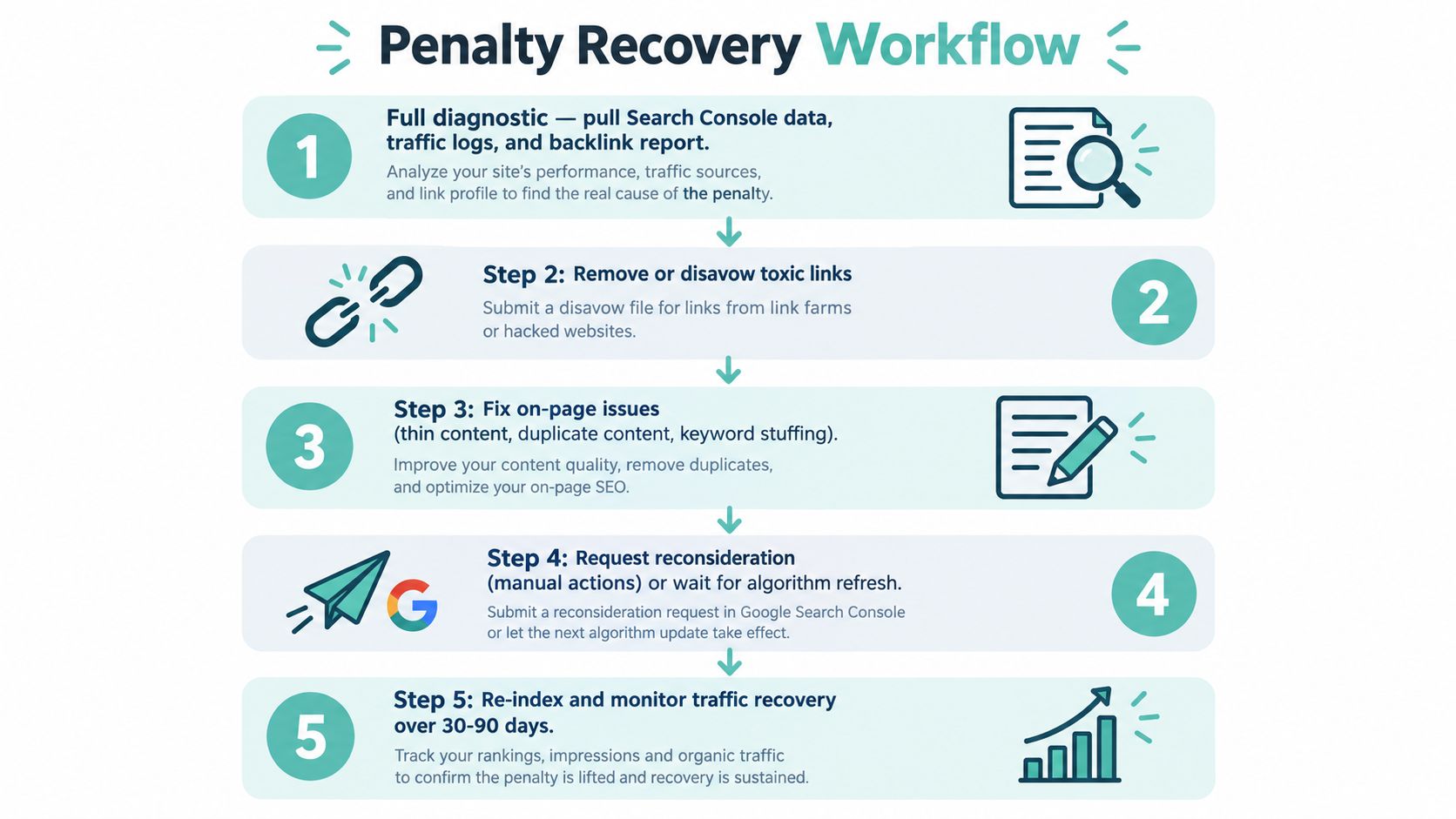
Sequence matters in recovery
Pull Search Console data first. Check for manual action notices, indexing anomalies, coverage changes, and the exact page groups that lost visibility. Then compare timing against known update windows and your own implementation history.
Next, inventory every tactic that could plausibly have triggered the loss:
- Doorway sets and doorway-adjacent city pages
- Manipulative link placements or unnatural anchors
- Thin affiliate or boilerplate pages
- Expired-domain or third-party publishing arrangements
- Hidden text, redirect tricks, or cloaked elements
If the issue spans multiple systems, rank fixes by policy severity and scale. Remove obvious violations before you fine-tune content.
What to fix first
The first wave of remediation should reduce direct policy exposure:
- Remove, merge, or noindex doorway-style pages
- Request link removals where possible, then prepare a disavow file for links you can't control
- Rewrite thin or duplicated pages so each one has a legitimate reason to exist
- Normalize internal anchors if they've been over-optimized across the site
- Shut off scaled content workflows until editorial review exists
For a broader remediation framework, a structured website audit checklist is useful for organizing technical, content, and off-page cleanup into a single working document.
Reconsideration requests and monitoring
Only file a reconsideration request after real fixes are complete and documented. Include what happened, what was removed, what was disavowed, and what process changed internally so the issue won't repeat. Vague apologies don't help. Evidence does.
After cleanup, install guardrails:
- Weekly backlink alerts in Ahrefs or Semrush
- Content QA sampling before new pages go live
- Template review for location or service expansions
- Quarterly third-party audits if multiple vendors touch the site
- Conversion tracking checks so recovery gets tied to calls, forms, and booked jobs rather than rank screenshots
Recovery takes discipline because you're not just restoring rankings. You're removing the conditions that caused the loss in the first place.
White Hat Strategy for Local SEO and AEO Conversions
For service businesses, the durable version of white hat SEO isn't abstract. It's local visibility that turns into calls, form fills, consultations, and booked work.
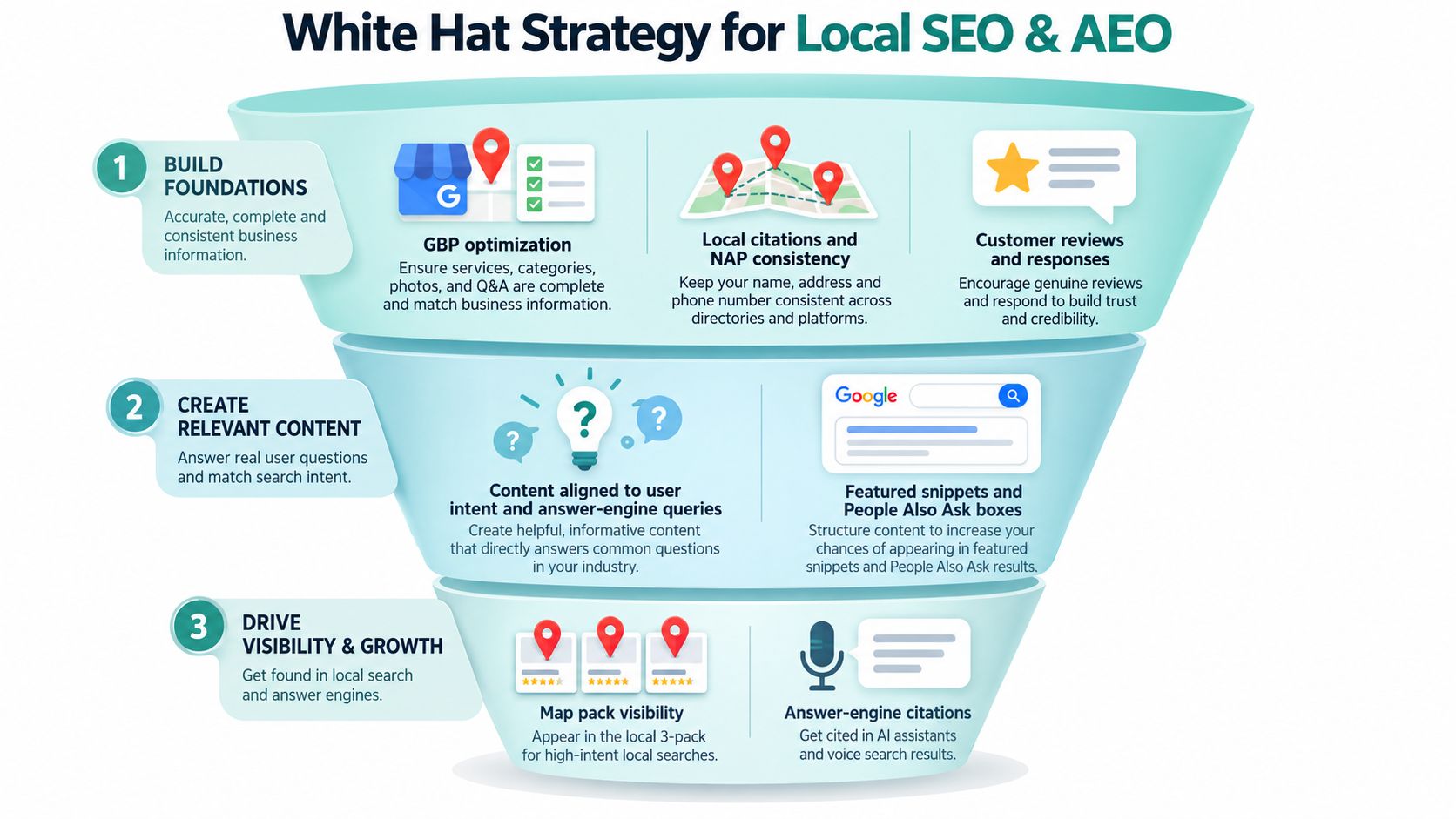
The same trust signals support local SEO and AEO
A solid Google Business Profile, consistent business information, credible reviews, and strong location pages help in local search because they reduce ambiguity about who you are, where you operate, and why customers trust you. Those same signals also help answer engines interpret your business as a reliable entity.
That's why local SEO and answer engine optimization should be built together. If you're refining that side of your strategy, this guide on answer engine optimization is a useful reference point.
What actually works for service businesses
The foundation is operational, not flashy:
- Google Business Profile completeness with accurate categories, service lists, photos, Q&A, and review management
- NAP consistency across major citations and industry references
- Location-page architecture that reflects real service areas without turning into doorway spam
- Structured data that clarifies organization, services, reviews, and local relevance
- Concise factual answers on pages that can be extracted into AI-driven search experiences
Clear author bylines, transparent business details, and pages written to answer real customer questions also improve your odds of being surfaced in AI-assisted answer formats. The content doesn't need to sound robotic. It needs to be precise.
Tie visibility to revenue, not vanity metrics
Track local and AEO work with an attribution stack that shows business impact:
| Focus area | What to implement | Why it matters |
|---|---|---|
| Calls | Call tracking tied to organic and GBP sources | Shows whether local visibility creates intake |
| Forms | Unique form IDs and thank-you event tracking | Separates lead sources by page and channel |
| Bookings | CRM or scheduler source capture | Connects rankings to closed opportunities |
| GBP actions | Calls, direction requests, website clicks | Helps interpret local pack performance |
| AEO mentions | Manual citation checks and prompt testing | Reveals whether your brand appears in answer surfaces |
One practical option for businesses that want this built into a website and ongoing SEO workflow is Digital Skyrocket, which focuses on web design, local SEO, technical SEO, AEO, and conversion tracking for service companies.
The local businesses that win consistently usually aren't gaming the algorithm. They're easier to verify, easier to trust, and easier to choose.
Sustainable SEO for Service Businesses and What to Watch
The sites that hold visibility over time usually treat SEO as an operating discipline. Not a launch checklist. Not a batch of blog posts. Not a one-time link campaign.
A monthly cadence that keeps risk low
A sustainable program needs recurring review across visibility, reputation, content quality, and conversion flow.
| Cadence Item | Metric Tracked | Primary Tool | Conversion Tie-In |
|---|---|---|---|
| Rank and visibility review | Core service keyword movement and landing page shifts | Google Search Console plus a rank tracker | Identifies pages that may affect lead volume |
| GBP review | Calls, website clicks, reviews, and listing completeness | Google Business Profile tools | Connects local visibility to inbound inquiries |
| Review acquisition and response | New review trends and response coverage | GBP plus reputation workflows | Supports trust and close rate |
| AEO citation monitoring | Brand and page presence in answer experiences | Manual prompt testing and SERP review | Indicates emerging non-click visibility |
| Content refresh | Changes on top-converting service and location pages | GA4, Search Console, CMS review | Protects pages that already generate leads |
| Competitor gap scan | New page types, local pack moves, and review velocity | Ahrefs, Semrush, Maps review | Helps defend market share |
What deserves extra scrutiny now
The watchlist is straightforward:
- Link spam patterns that look harmless in small doses but accumulate
- Site reputation abuse where third-party content rides on someone else's authority
- Scaled content abuse masked as efficiency
- AI-generated doorway pages built from service and city permutations
- Local pack volatility tied to entity consistency, proximity, and review trust
Many firms overcomplicate things. They chase hacks instead of maintaining controls. A smaller KPI dashboard works better if it includes organic conversions, cost per lead compared with paid channels, branded search growth, and lead quality from organic pages.
Why durable SEO wins in Texas-style service markets
In competitive metro areas, especially the kinds of markets service businesses face across Dallas, Fort Worth, Houston, Austin, and East Texas, shortcuts don't create much of a moat. Anyone can buy links. Anyone can clone location pages. Anyone can spin out AI-assisted service content.
What's harder to replicate is a well-built site, a verified business entity, strong reviews, clean page architecture, trustworthy local signals, and content that converts once the visitor arrives. That combination is slower to build, but competitors can't copy it quickly with a rented network or a package of placements.
If you keep asking “white hat or black hat,” you'll miss the more useful question. Which actions make the site more credible, more useful, and easier to defend when search systems tighten? That's the standard that holds up.
If your site has grown through mixed SEO tactics, or you're not sure whether an agency crossed a policy line, Digital Skyrocket can audit the work, identify the risky patterns, and map a cleanup and rebuild plan around technical SEO, local SEO, AEO, and conversion tracking. If you want a lead-focused website and ongoing SEO built to avoid the shortcuts discussed here, visit Digital Skyrocket.