
A local SEO checklist becomes useful when it helps you earn calls, form fills, and booked appointments, not when it stops at rankings. That matters because complete Google Business Profiles reportedly receive 7 times more clicks than incomplete ones, which is a sharp reminder that local visibility often rises or falls on basic execution before advanced SEO even starts.
For service businesses such as law firms, dentists, roofers, and HVAC companies, the sequence matters. First, establish the business entity Google can trust. Then match local intent with the right service and location pages. After that, strengthen reviews, links, and citations, remove technical friction, and track which pages and profile actions produce qualified inquiries. If you need outbound support after that inbound foundation is in place, some teams also pair local search with hire appointment setters to handle follow-up speed.
Relevant educational resources can help along the way. What you shouldn't do is send readers to conversion-focused competitor pages. Keep the attention on implementation, evidence, and what moves real leads through intake.
Table of Contents
- 1. Claim and Optimize Your Google Business Profile
- 2. Conduct Keyword Research Aligned with Local Search Intent
- 3. Optimize On-Page Content and AEO for Local Intent
- 4. Create Location-Specific Landing Pages for Multi-Area Service Coverage
- 5. Build Local Citations and Ensure Consistent NAP Across the Web
- 6. Collect, Manage, and Respond to Customer Reviews Strategically
- 7. Improve Website Technical SEO and Core Web Vitals for Local Search
- 8. Build High-Quality Backlinks from Relevant Local and Industry Sources
- 9. Set Up Conversion Tracking and Local Lead Attribution
- 10. Implement an Ongoing SEO Maintenance and Reporting System
- 10-Point Local SEO Checklist Comparison
- Make the Checklist a Working System
1. Claim and Optimize Your Google Business Profile
Your Google Business Profile is the first thing I'd fix for almost any local service business. Google's own local ranking documentation says local results are mainly based on relevance, distance, and prominence, so your profile has to communicate exactly what you do, where you do it, and why customers trust you.
A personal injury firm in Dallas, an HVAC contractor in Tyler, and a dental office in a busy suburb all face the same problem. If the profile is unverified, thin, or inaccurate, Google has less confidence in showing it and searchers have less confidence in calling it.
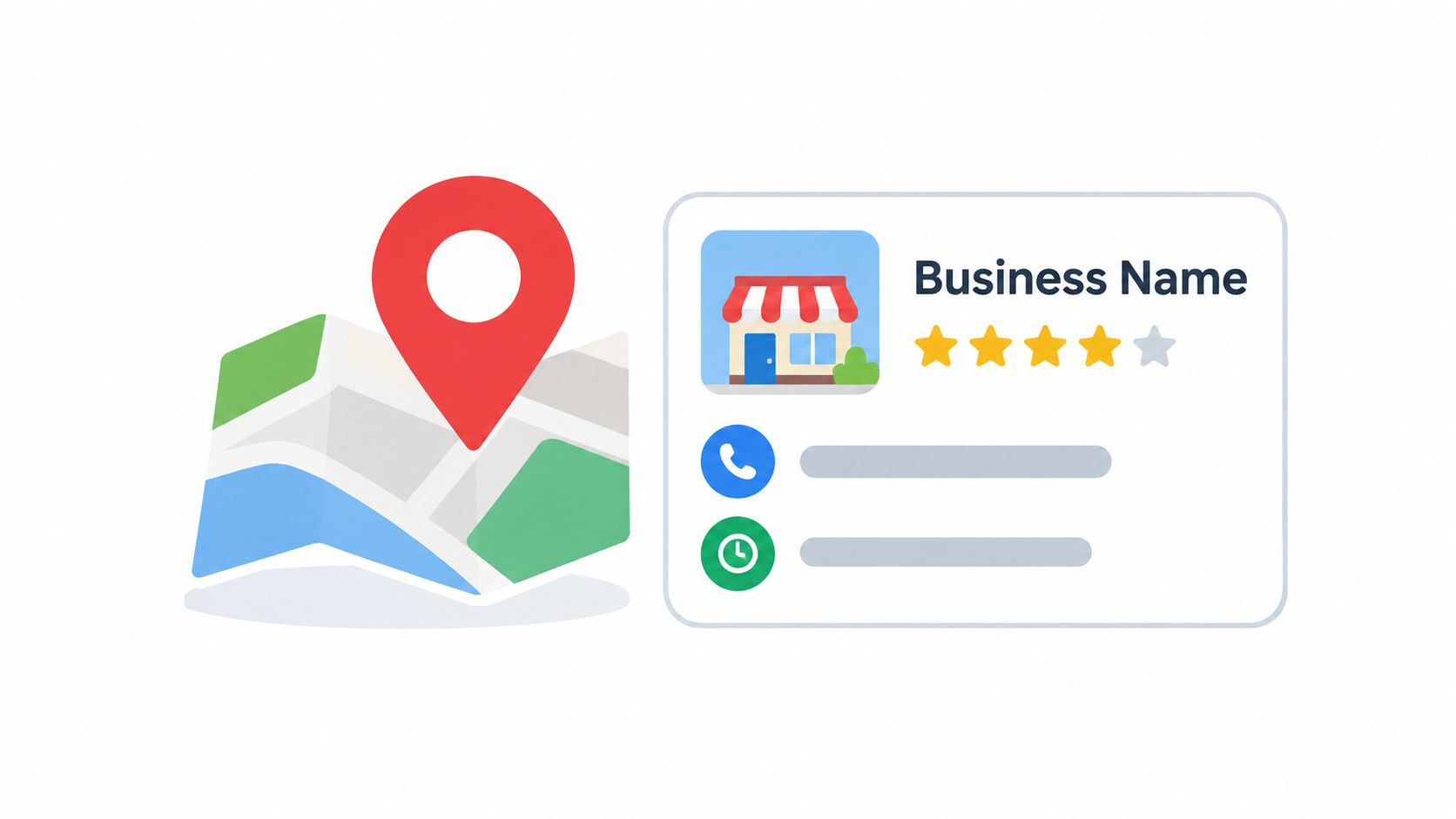
Fill the profile before you chase smaller wins
A strong setup starts with the primary category, secondary categories that fit, exact business name, real phone number, hours, services, photos, service areas, and verification. If you need a practical walkthrough, this guide on how to optimize Google Business Profile covers the mechanics.
Use realistic examples. A dental practice should list actual service categories such as general dentistry or implants only if those reflect real care delivered. An HVAC company should upload jobsite photos, trucks, team images, and office shots instead of generic stock graphics. A law firm should write a grounded business description and keep intake phone numbers consistent with the website.
Practical rule: Never create fake locations to rank in more cities. Use real offices or legitimate service-area settings.
A good maintenance rhythm is simple:
- Use the phone line: Match the main number on your website and major listings.
- Add recent photos: Show staff, office, equipment, and completed work.
- Answer reviews and Q&A: Keep the profile active and useful.
- Check hours often: Holiday and emergency-hour mistakes cost leads fast.
2. Conduct Keyword Research Aligned with Local Search Intent
Keyword research sets the order of operations for the rest of local SEO. If you target the wrong terms first, you can spend months improving pages that bring impressions but not calls.
Start with the services that produce real revenue. For a plumber, that usually means emergency repair, drain cleaning, water heater replacement, and sewer line work before broad terms like "plumbing services." For a family law firm, it may be divorce lawyer and child custody attorney before informational topics. This priority-first approach matters because later sections in the checklist depend on it. Page structure, internal links, location pages, and tracking only work well when the service intent is clear.
Analysts in the 2023 Local Search Ranking Factors survey at Search Engine Land identified dedicated service pages, internal linking, quality inbound links, and geographically relevant content as leading local organic signals. The practical takeaway is simple. Local keyword research should produce a page map, not just a list of phrases.
Start with the lead, not the keyword tool
A useful way to sort local intent is by what the person is trying to do:
- Ready to hire now: "emergency dentist Dallas," "AC repair near me," "car accident lawyer Fort Worth"
- Comparing options: "dental implants cost Dallas," "best roofer in Plano," "divorce attorney consultation Austin"
- Researching a problem: "why is my AC blowing warm air," "do I need a crown or filling," "what to do after a truck accident"
The first group usually deserves priority because it is closest to a phone call or form submission. The second group can support service pages or FAQ sections. The third group often fits blog content or support content, but only after the revenue-driving pages are mapped.
Then build clusters around one service and one location intent. An HVAC company might separate "AC repair in McKinney" from "AC installation in McKinney" because the customer need, urgency, and conversion path differ. A dental office should not force emergency dentistry, implants, and pediatric care onto one page just because they serve the same city. That creates weak relevance and muddy calls to action.
For process details, this guide to keyword research for local SEO covers the workflow in more depth.
What to collect before you create pages
Use keyword tools, but sanity-check them against real intake patterns. Google Keyword Planner, Ahrefs, Semrush, and Search Console are all useful. So are call logs, chat transcripts, and the phrases your office staff hears every week.
Look for four things:
Core service terms
The exact services people request, such as "brake repair," "root canal," or "probate lawyer."Local modifiers
City names, neighborhoods, nearby suburbs, and service-area phrasing that matches how customers describe the area.Urgency signals
Terms like "same day," "24 hour," "emergency," or "open now" when the business offers that service level.Existing traction
Queries already earning impressions in Search Console. These often reveal pages that are close to producing qualified leads with better alignment.
One caution matters here. High-volume broad terms often look better in a report than they perform in practice. "Dentist Dallas" may matter, but "emergency dentist Dallas" or "dental implants Dallas" usually tells you more about what the searcher needs and what page should serve them.
A solid keyword list should answer three operational questions: Which pages need to exist first, which locations deserve dedicated treatment, and which terms are likely to turn into booked work rather than passive traffic. That is the standard to use before you move into on-page optimization.
3. Optimize On-Page Content and AEO for Local Intent
Strong local rankings do not produce leads on their own. The page has to match the search, answer the immediate question, and make the next step easy enough that the visitor calls or fills out a form.
This is the point in the checklist where search visibility starts turning into inquiry volume.
A service page should carry one job. Help the right person decide, quickly, whether this business solves their problem in their area. If the page tries to target every service, every city, and every audience at once, it usually becomes vague. Vague pages rank inconsistently and convert poorly.
Start with the top of the page, because that is where intent alignment breaks down first. The title tag and H1 should reflect the service and local need clearly. The opening copy should confirm what the business does, where it does it, and what the visitor should do next. For an emergency plumber page, that means showing response area, hours, and contact options early. For a family law page, it may mean clarifying case types, office location, and consultation steps before any long-form explanation.
Then build the page around the questions that block action.
An emergency dentist page in Dallas should answer practical concerns such as what counts as a dental emergency, whether same-day treatment is available, how payment works, and what a patient should expect on arrival. A roof repair page in Plano should address storm damage signs, inspection timing, insurance documentation, and whether temporary tarping is available. Those answers help with AI-assisted discovery, but they also reduce hesitation before a call.
I usually treat on-page local optimization in three passes:
- Pass one: match the core intent. Use one primary topic per page, with one service and one local angle.
- Pass two: remove friction. Put service details, trust signals, and the main call to action where a hurried visitor can find them fast.
- Pass three: structure for retrieval. Add clean headings, concise answers, and schema so search engines and answer engines can interpret the page accurately.
Question-led subheads often work well because they mirror real intake language. If office staff keeps hearing "Do you offer same-day AC repair?" or "How long does a root canal visit take?" those exact concerns belong on the page. Used well, subheads improve readability and reinforce relevance. This article on using a keyphrase in subheading is a useful reference for keeping that balance natural.
A few page elements tend to matter more than teams expect:
- Specific service scope: Spell out what is included, excluded, or handled most often.
- Local proof: Mention the service area naturally and add location-relevant trust elements where appropriate.
- Visible conversion paths: Keep click-to-call, forms, and scheduling actions close to high-intent content.
- Credibility signals: Add author or reviewer context for legal, medical, and advice-heavy pages.
- Schema markup: LocalBusiness, Service, FAQPage, and Article markup can help systems parse the page.
Short answers help. So does restraint.
A page does not need inflated copy to perform well. It needs clear relevance, enough detail to qualify the lead, and a page structure that supports both traditional search and answer engines. That is how on-page SEO contributes to qualified calls and form fills instead of just better ranking reports.
4. Create Location-Specific Landing Pages for Multi-Area Service Coverage
If you serve multiple cities, one generic "areas we serve" page usually isn't enough. Service businesses need real location pages when search demand and operational reality justify them.
The mistake is obvious once you've seen it a few times. Companies clone one page, swap city names, and expect every suburb to rank. Those pages rarely build trust, and they often don't convert well because they don't sound connected to the place.
Make each location page earn its existence
A roofing company serving several DFW suburbs should create separate pages only for areas it serves well. Each page needs distinct copy, local references, driving or service context, nearby landmarks when relevant, proof of work in the area, and a call to action that fits the location.
A law firm with offices in Dallas and Houston should treat those as different local markets. Intake expectations, competition, nearby courts, and search language can differ. A dentist with one office but a wide draw area can still build city-targeted pages if the content reflects real service patterns and patient demand.
Useful page elements include:
- Unique local proof: Testimonials, project photos, staff notes, or examples tied to that area.
- Relevant service detail: Explain what people in that location usually need from you.
- Internal links that make sense: Connect the city page to the exact service pages available there.
- Accurate business details: Hours, phone, map context, and service-area language should match reality.
For home services, a page like "Emergency AC Repair in Longview" should read differently from one targeting Tyler or Jacksonville. The distance, response messaging, and neighborhood references won't be identical if the work is real.
5. Build Local Citations and Ensure Consistent NAP Across the Web
Citation work sits in the middle of the checklist for a reason. It usually will not create a sudden jump in leads by itself, but it protects the lead flow you earn from the work above it. If your Google Business Profile, website, Apple Maps listing, and directory profiles disagree on your name, address, or phone number, some prospects hesitate, some call the wrong line, and some never submit the form.
Treat this as an accuracy project, not a volume project.
A service business does not need hundreds of random directory listings. It needs the core profiles that customers and search engines reference to point to the same business identity. For a local attorney, that includes legal directories and state or bar-related profiles. For a contractor, it often includes licensing databases, trade associations, chambers, and the major map platforms. For a dental practice, healthcare directories and insurer-facing listings can matter as much as Yelp.
The practical sequence looks like this:
- Set the canonical NAP first. Choose one exact business name, one primary phone number, one address format, and one suite format.
- Fix your owned properties next. Update the website, Google Business Profile, Apple Maps, Bing Places, and major social profiles.
- Audit high-visibility third-party listings. Check Yelp, industry directories, local chambers, licensing boards, and any profile that ranks for your branded searches.
- Resolve duplicates and outdated records. Old practitioners, former office locations, tracking numbers, and alternate business names create confusion fast.
- Document the standard. Keep the approved NAP format in a simple internal record so staff, agencies, and vendors stop publishing variations.
Two details cause problems more often than business owners expect.
First, call tracking. Tracking numbers help attribute leads, but they need to be implemented carefully. Keep your main business number as the consistent reference point across key citations, then use tracking where it will not fracture your core identity.
Second, office changes. Rebrands, suite changes, and relocations ripple through the web for months if nobody owns the cleanup process.
For a roofer, an old emergency number on a directory can send a high-intent weekend caller into a dead line. For a law firm, a mismatched suite number can create doubt before intake starts. For a multi-location home service company, duplicate listings can split reviews and weaken map visibility. Citation cleanup is not glamorous, but it supports the part that matters. More qualified calls and fewer lost leads caused by basic trust problems.
6. Collect, Manage, and Respond to Customer Reviews Strategically
Reviews influence two outcomes at once. They affect whether you appear credible enough to contact, and they shape what kind of lead reaches out after finding you.
BrightLocal's 2024 survey found that 69% of consumers would feel positive about using a business if written reviews describe positive experiences, and 59% expect a business to have between 20 and 99 reviews. For local service businesses, that means the words inside the review often matter as much as the star rating. A five-star review that says "nice staff" helps less than one that mentions fast scheduling, clear pricing, or a successful repair.
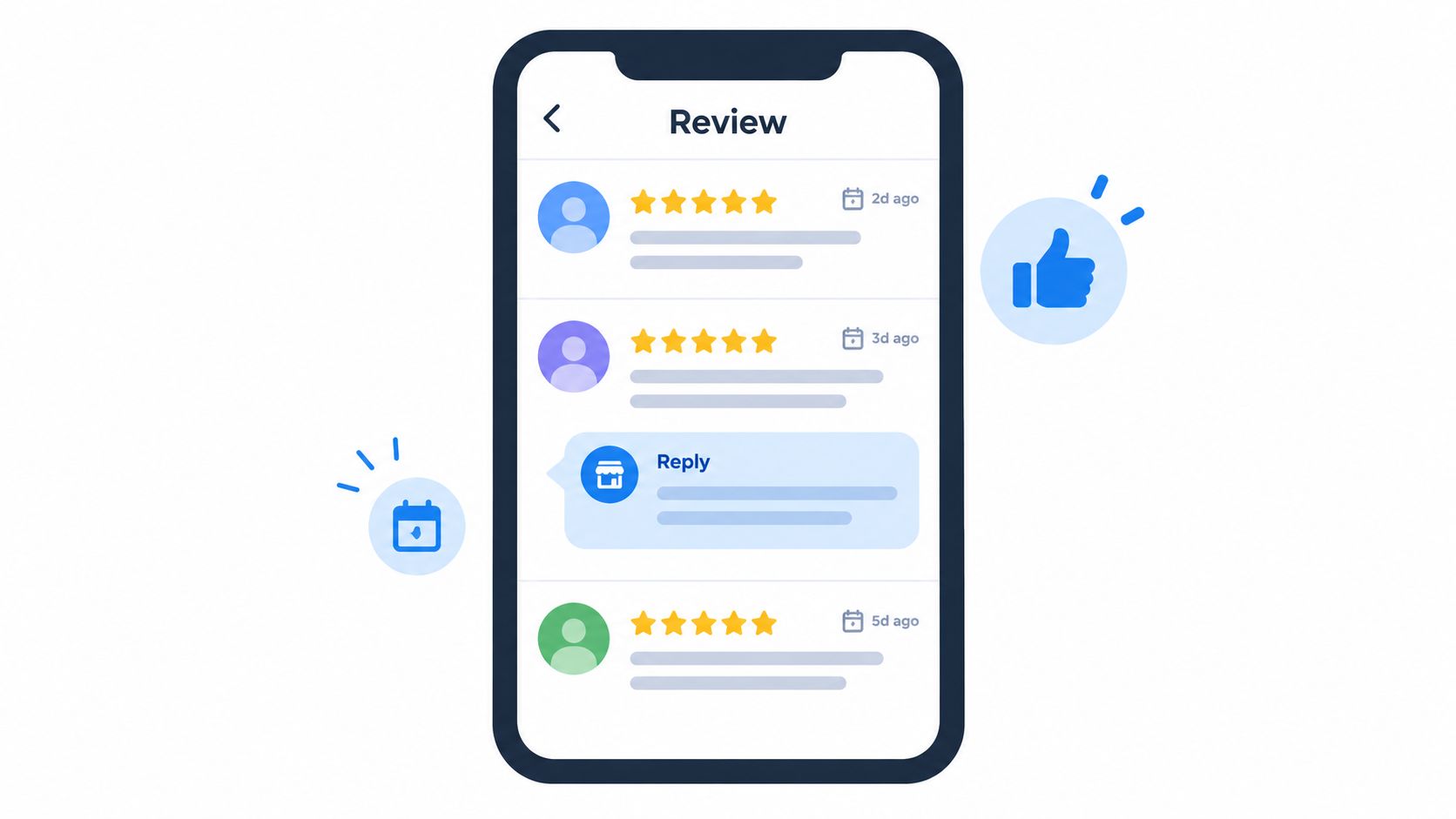
The priority is simple. Get a steady flow of recent, specific reviews before trying to polish reply templates or chase volume across every platform.
A good review process usually breaks into three operating decisions:
1. Choose the trigger point.
Ask at the moment the customer can clearly say the job is done well. For an HVAC company, that may be after the system is tested and running correctly. For a dental office, it may be after a successful visit and checkout. For a law firm, timing requires more care because client satisfaction and case sensitivity do not always line up with a standard follow-up sequence.
2. Control the path.
Use a direct review link in text or email so the customer does not have to search for your business. Every extra click lowers completion rates, especially on mobile.
3. Treat replies as conversion assets.
Prospects read owner responses to judge professionalism, accountability, and how your team handles problems. A short reply that references the actual service feels credible. A generic "thanks for your feedback" does not do much.
Negative reviews need a process, not improvisation. Acknowledge the issue, avoid arguing in public, and move the conversation to phone or email quickly. Then log the complaint internally. Reviews often surface intake delays, scheduling confusion, no-show technicians, or billing friction before those problems show up clearly in reporting.
One trade-off matters here. Aggressive review campaigns can raise count faster, but they also create compliance and brand risk if staff pressure unhappy customers, ask at the wrong moment, or use language that sounds scripted. Consistency beats intensity.
Use this as a working standard:
- Send review requests after a verified positive service moment
- Keep the ask short and personal
- Prioritize Google first unless industry rules or customer behavior justify another platform
- Reply to positive reviews with service-specific detail when possible
- Escalate negative reviews to the person who can solve the issue
- Track repeated themes by category, not just by star rating
For a roofer, multiple reviews that mention clean job sites and clear insurance communication can improve lead quality because they answer common objections before the estimate call. For a dentist, recent feedback about punctual appointments and gentle care can increase form submissions from anxious patients. For a law firm, thoughtful responses and careful timing help protect trust while still strengthening local visibility.
Reviews support rankings, but the business goal comes after the click. More qualified calls, fewer trust objections, and better-informed prospects.
7. Improve Website Technical SEO and Core Web Vitals for Local Search
Technical SEO sits in the middle of the local funnel. It supports visibility, but its real job is to protect the path from search to inquiry. If a location page is not indexed, a phone number is hard to tap, or a form confirmation never reaches staff, higher rankings do not turn into qualified calls.
Recent local audit guidance emphasizes fixing Search Console and GA4 access, indexing issues, Google Business Profile details, and broken calls, forms, and booking paths before expanding content. That sequence fits service businesses. There is no upside in publishing more pages if Google cannot crawl the right ones or if lead actions fail after the click.
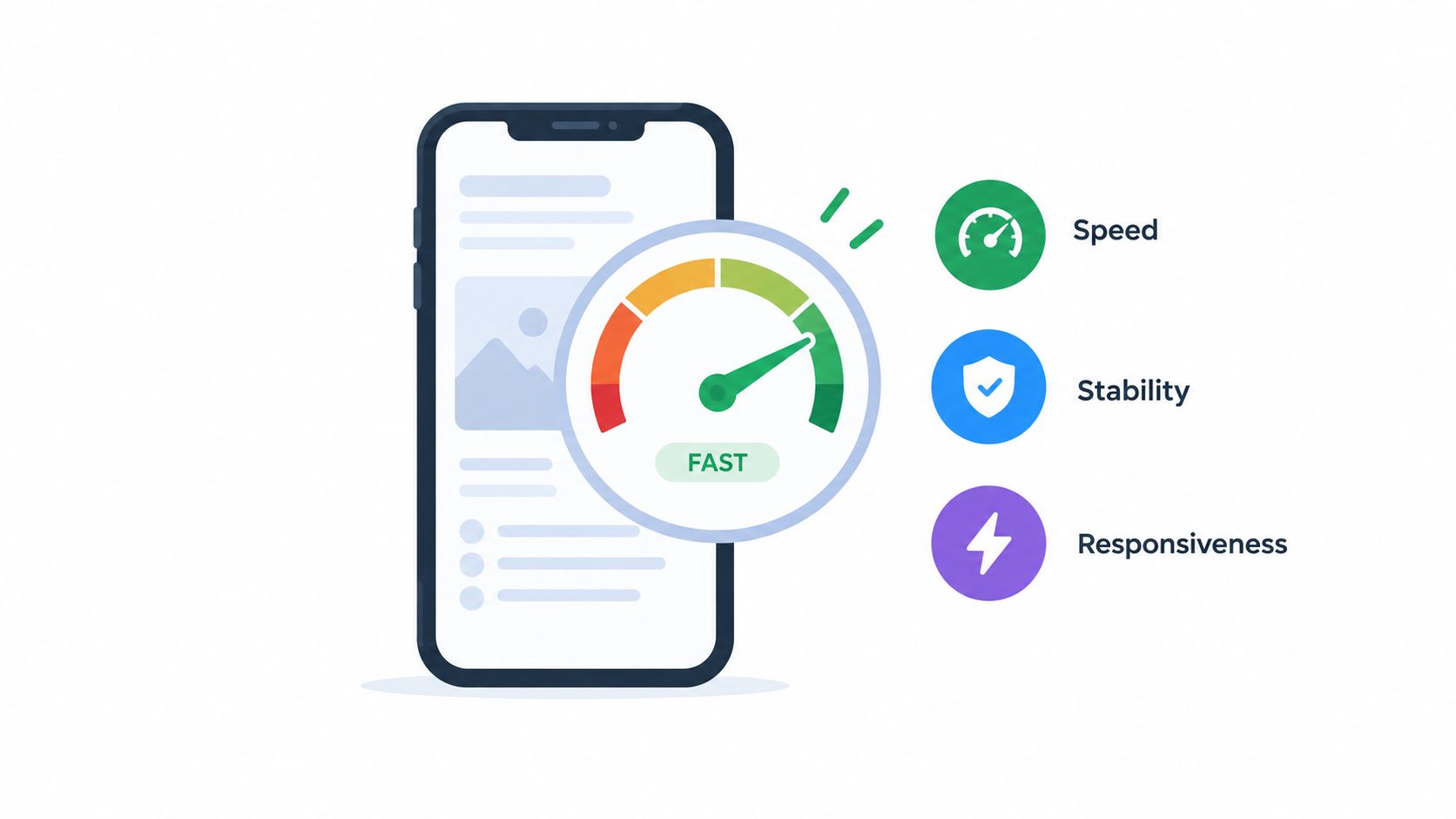
Start with revenue blockers, then clean up performance.
A law firm with a slow site can still get consultations if the call button works, pages load reliably on mobile, and key practice pages are indexed. The same firm will lose leads fast if a consultation form errors out or if a click-to-call link fails on iPhone. A dentist may tolerate a slightly heavy gallery page for before-and-after photos, but not on the appointment page. A roofer or HVAC company often has the opposite problem. Old themes, bloated plugins, and tracking scripts create unstable mobile pages during urgent, high-intent searches.
That is why I prioritize technical work in this order:
- Confirm key pages can be crawled and indexed. Check service pages, location pages, and contact pages in Search Console. Review noindex tags, canonicals, redirect chains, and XML sitemap coverage.
- Test the lead path manually on mobile. Tap every phone number. Submit every form. Complete the booking flow. Verify notifications reach the right inbox or CRM.
- Fix rendering and speed issues on high-intent pages. Focus on pages that attract local traffic and drive calls or forms, not low-value archive pages.
- Trim script and media weight. Remove unused chat widgets, duplicate trackers, autoplay video, and oversized images that slow first load or shift the page during interaction.
- Check internal links and page hierarchy. Important service and city pages should be easy to reach from navigation, footer, and relevant parent pages.
Core Web Vitals matter here because they often expose conversion friction. A poor Largest Contentful Paint score usually points to heavy hero images, video backgrounds, or slow server response on the pages people land on first. A weak Interaction to Next Paint score often comes from tag overload, chat tools, and booking widgets competing for browser resources. Layout shift is not just a metric problem. It causes mistaps on call buttons and forms, especially on mobile.
Use PageSpeed Insights and Search Console first. Then verify the user experience on an actual phone, on cellular, with no cached session. That last step catches problems tools miss.
The trade-off is straightforward. Aggressive design, extra tracking, and third-party tools can help marketing teams collect more data or add visual polish, but they often reduce page stability and mobile completion rates. For local service businesses, I would rather keep the contact experience fast and obvious than preserve a script that adds little operational value.
A technically sound site does not win local SEO by itself. It makes every earlier step in this checklist more likely to produce booked jobs, consults, and estimate requests.
8. Build High-Quality Backlinks from Relevant Local and Industry Sources
Local backlinks should support buying intent, not just visibility. The right links send two signals at once. They help search engines trust your market relevance, and they put your business in front of people already looking for a provider they can contact.
That second part gets overlooked. A chamber listing, supplier page, neighborhood publication, or association profile can produce referral traffic that turns into calls and estimate requests, even if the SEO lift is modest.
BrightLocal's business discovery trust research found that people put the most trust in Google, Google Maps, and a business's own website when researching local companies. Links help people find you, but the destination still has to close the click. If a sponsorship page sends a prospect to a weak homepage instead of a relevant service or location page, the link has less business value.
A practical sequence works better than chasing volume:
First, secure the links attached to business legitimacy. That includes chambers of commerce, trade associations, licensing bodies, supplier or manufacturer directories, and carefully chosen legal or medical directories where relevant. These are usually easy to get, realistic to maintain, and aligned with local trust.
Next, earn links tied to actual market presence. A roofer can sponsor a storm-readiness event or contribute comments to a local article about hail damage and insurance timing. A dental office can appear on community health event pages, school partnership pages, or referral partner sites. A personal injury firm can publish useful accident-process resources that local organizations or reporters may cite.
Then build a small pipeline of citation-worthy assets. Service-area cost guides, permit explainers, insurance FAQ pages, seasonal checklists, and neighborhood-specific service resources tend to attract better links than generic blog posts written to fill a calendar.
The trade-off is time. Real local links usually come from relationships, participation, or useful content, which takes more effort than buying placements or sending mass outreach. In my experience, that slower approach holds up better and creates more referral value. A paid link on a weak site may raise a metric for a while. A link from a supplier, association, or respected local publication is more likely to support rankings and send qualified visitors.
Use a simple filter before pursuing any opportunity:
- Would a real customer trust this site?
- Is the site relevant to the service, location, or industry?
- Could the link send an actual lead, not just SEO signals?
- Will the listing or page stay live and accurate over time?
A strong local link profile looks believable because it is believable. It grows from the same things that produce leads offline: reputation, partnerships, community presence, and useful information.
9. Set Up Conversion Tracking and Local Lead Attribution
Local SEO starts paying for itself when you can tie visibility to calls, forms, booked appointments, and signed jobs. Until then, higher rankings are only a partial win.
A local campaign usually creates activity in several places at once. Someone finds a Google Business Profile, clicks to the site, leaves, then calls two days later after searching the business name again. Another person lands on a location page, fills out a form, and becomes a poor-fit lead. If those paths are invisible, teams tend to overvalue traffic and undervalue the pages, locations, and keywords that produce revenue.
The practical goal is simple. Track lead actions first, then connect them back to source, service, and location.
For multi-location businesses, a recent local audit framework recommends measuring local-pack presence for core keywords, organic rankings for location and "near me" queries, share of voice against common local competitors, review differences by location, and Business Profile Performance actions such as searches, calls, direction requests, and website clicks. Use that visibility data alongside conversion tracking, not as a substitute for it.
Here is the setup I look for before calling local SEO reporting useful:
- GA4 events for real lead actions: Track form submissions, click-to-call taps, appointment starts, chat starts, and thank-you-page completions.
- Call tracking configured carefully: Use call tracking in a way that does not create NAP inconsistency across your main business listings.
- CRM or intake feedback: Mark whether leads were qualified, unqualified, booked, or closed.
- Location and service segmentation: Break reporting out by office, city page, and service type so patterns are visible.
The trade-off is complexity. Cleaner attribution usually means more setup work across GA4, call tracking, form tools, and the CRM. For a single-location service business, that can feel heavy. For a multi-location brand, skipping it usually costs more because weak pages and weak locations stay hidden behind blended totals.
A few examples show why this matters in practice:
An HVAC company should separate emergency repair calls from tune-up requests. The emergency page may draw less traffic but produce faster, higher-value jobs.
A dental office should distinguish appointment requests from insurance or billing questions. Both are contacts, but only one reflects local SEO bringing in new patients.
A law firm should track qualified case inquiries separately from general contact submissions. Branded traffic and informational traffic often look similar in analytics until intake quality is added.
One report can answer the question leadership cares about: which local SEO inputs are producing qualified inquiries by location and service line. That is the point of attribution. Rankings help create the opportunity. Tracking shows which opportunities turn into business.
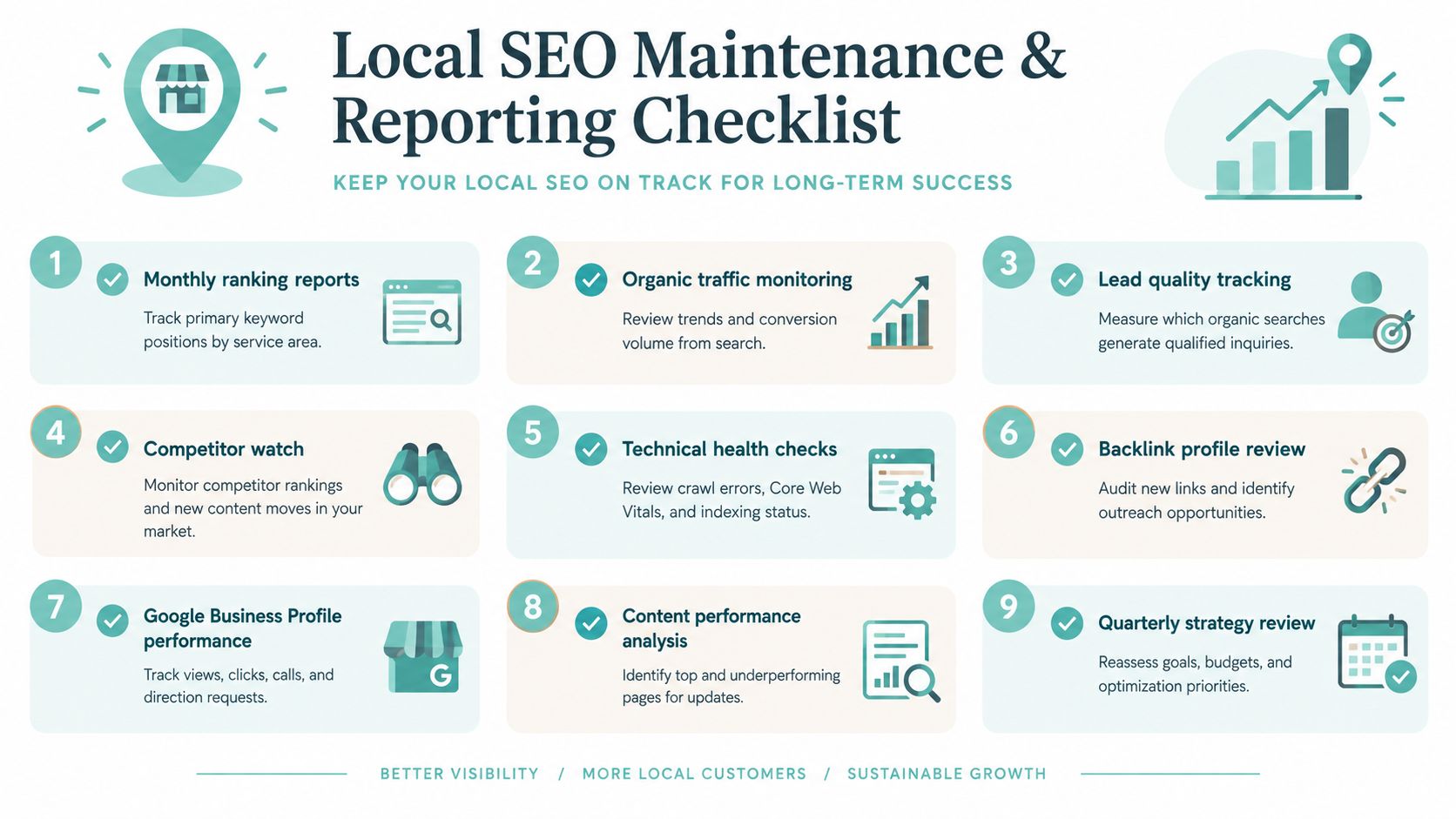
10. Implement an Ongoing SEO Maintenance and Reporting System
Local SEO work starts losing value when nobody owns the follow-through.
A cleaned-up Google Business Profile, stronger city pages, and better review coverage can all slip over time. Hours change. New photos stop getting added. Service pages go stale. Competitors publish better local content and pick up fresh links. If you only check performance after lead volume drops, you usually find the issue late.
The practical fix is a maintenance system with a clear order of operations. First, catch breakage that can block calls or forms. Then review visibility shifts for your priority services and locations. After that, decide what deserves actual work in the next month.
A useful rhythm looks like this:
Weekly pulse checks
Check for problems that affect lead flow right away:
- Google Business Profile suspensions, edits, or missing information
- Sudden drops in calls, form submissions, or direction requests
- New reviews that need responses
- Indexing or uptime issues on key local pages
Monthly performance reviews
Review whether local visibility is producing the right inquiries:
- Rankings for your highest-value service plus city terms
- Google Business Profile interactions
- Qualified calls and forms by service line or location
- Search terms that are generating traffic but poor-fit leads
- Obvious page issues such as weak calls to action, outdated offers, or thin local proof
Quarterly improvement work
Use a broader review to choose the next round of SEO tasks:
- Refresh weak location pages
- Fix citation drift outside your main listings
- Identify local backlink targets
- Add content for services or cities with clear demand but weak coverage
- Retire reporting noise that no longer helps decisions
That sequence matters because not every metric deserves the same response. A ranking drop on a page that never produced qualified leads is less urgent than a drop in booked calls from a city page that closes well. Rankings are an input. The maintenance system should help you protect and improve the pages, profiles, and listings that generate real inquiries.
Review quality belongs in this process too. BrightLocal's 2025 survey found that 42% of consumers now trust reviews as much as personal recommendations, down from 79% in 2020. For reporting, that means star rating alone is too shallow. Check whether recent reviews mention the actual service, location, speed, staff, or outcome a new customer cares about.
Three service-business examples make the reporting standard clearer. A plumbing company should watch whether drain cleaning pages still produce booked jobs, not just clicks. A multi-location dental group should compare inquiry quality by office, because one location may rank well but attract more insurance questions than new-patient appointments. A personal injury firm should review intake outcomes with SEO data, since a rise in form fills means little if case quality drops.
Keep the reporting simple enough that the team will use it, but specific enough to guide decisions. If a report cannot answer which locations and service pages are driving qualified calls, forms, and booked work, it is tracking too much of the wrong stuff.
10-Point Local SEO Checklist Comparison
| Item | Complexity 🔄 | Resource requirements ⚡ | Expected outcomes 📊 | Ideal use cases 💡 | Key advantages ⭐ |
|---|---|---|---|---|---|
| Claim and Optimize Your Google Business Profile | Low–Medium, verification + ongoing updates | Low, time for setup, photos, basic management | Higher map visibility, more calls, trust signals | Single-location or service-area businesses competing locally | Direct control of local listing; free; boosts local pack rankings |
| Conduct Keyword Research Aligned with Local Search Intent | Medium, analysis + geographic nuance | Medium, keyword tools and analyst time | Targeted, higher-converting traffic; content roadmap | Businesses refining content/PPC strategy for specific markets | Reveals high-intent local queries; guides page and GBP targeting |
| Optimize On-Page Content and AEO for Local Intent | Medium–High, content strategy + schema | Medium–High, writers, SEO expertise, schema implementation | Improved rankings, CTR, and answer-engine visibility | Sites needing better conversions and presence in answer results | Increases relevance and captures AI/featured answer opportunities |
| Create Location-Specific Landing Pages for Multi-Area Coverage | High, architecture and unique content per location | High, content creation, local assets, dev time | Multiplied ranking opportunities and localized leads | Multi-location businesses serving many cities/neighborhoods | Drives location-level relevance; supports localized messaging/testing |
| Build Local Citations and Ensure Consistent NAP | Medium, audit and correction workflow | Low–Medium, time or citation tools/services | Improved local authority and fewer listing conflicts | New businesses or those with inconsistent directory data | Strengthens local ranking signals and public trust |
| Collect, Manage, and Respond to Customer Reviews Strategically | Medium, process + continual management | Medium, review systems, staff time for responses | Higher conversions, improved rankings, stronger social proof | Consumer-facing services reliant on reputation (law, dental, HVAC) | Review volume/recency directly boost visibility and trust |
| Improve Website Technical SEO and Core Web Vitals | High, technical fixes and monitoring | High, developer time, hosting, performance tools | Faster pages, better mobile rankings, higher conversions | Sites with performance issues or mobile-first traffic | Directly impacts rankings and user experience metrics |
| Build High-Quality Backlinks from Relevant Local & Industry Sources | High, outreach and relationship building | Medium–High, outreach effort, content assets | Increased domain authority and competitive rankings | Competitive local markets needing authority signals | Durable ranking gains plus referral traffic and credibility |
| Set Up Conversion Tracking and Local Lead Attribution | Medium–High, multi-tool technical setup | Medium, analytics, call tracking, CRM integration | Clear SEO ROI; data-driven prioritization of pages/keywords | Businesses needing to measure leads and optimize spend | Connects SEO activity to revenue; enables informed decisions |
| Implement an Ongoing SEO Maintenance and Reporting System | Medium, recurring processes and analysis | Medium, reporting tools, analyst time, periodic audits | Early issue detection, continuous improvement, documented ROI | Any business investing in long-term local SEO success | Sustains gains, adapts strategy, and demonstrates value over time |
Make the Checklist a Working System
The best local SEO checklist isn't a pile of disconnected tasks. It's an operating system for lead generation. Start with the business identity layer first. Verify and complete the Google Business Profile, standardize NAP, and make sure the website reflects the same core facts. If those basics are wrong, everything built on top of them becomes harder to trust and harder to scale.
Then map demand to pages. Service businesses usually get the most traction when they connect keyword research to dedicated service pages and location pages instead of publishing generic content for vanity terms. A law firm needs clear practice-area and city intent. A dentist needs pages that match urgent and high-value treatments. A roofer or HVAC company needs pages built around service urgency, geography, and real operational coverage.
After that, remove the friction that kills leads. Fix indexing issues, test forms, check mobile click-to-call behavior, review booking paths, and confirm analytics access before adding more content. Many campaigns underperform. They improve visibility but don't improve intake because no one checked whether the phone rang, the email alert fired, or the form reached the office.
Trust and authority come next, but they shouldn't be treated as abstract branding exercises. Reviews need a steady request and response process. Citations need consistency. Backlinks should come from credible local and industry relationships, not shortcuts. For service businesses, these signals work best when they reinforce a website and profile that already communicate relevance, distance, and prominence clearly.
The final step is discipline. Review calls, forms, rankings, profile activity, and local visibility on a schedule. Weekly monitoring catches obvious issues fast. Monthly and quarterly reviews help you compare locations, service lines, and changes in lead quality. That's how local SEO becomes accountable to the business instead of turning into a reporting ritual about impressions and traffic.
If a company needs coordinated website design, local SEO, reputation management, technical implementation, and conversion tracking together, Digital Skyrocket is one relevant option to consider. Its fit makes the most sense when the business wants a new website plus ongoing SEO, not isolated directory cleanup or one-off marketing support.
Digital Skyrocket plans, designs, and optimizes lead-generating websites for service businesses that need local SEO tied to real inquiries, not just better ranking screenshots. If you want help turning this local SEO checklist into a working system across your site, Google Business Profile, reviews, and tracking, visit Digital Skyrocket.