

Subheadings get treated like a keyword checklist far too often. That mindset misses the point. A strong H2 is not a place to stuff the target phrase, it's a retrieval signal for readers, screen readers, crawlers, and answer engines that need to understand what a section resolves.
That's why the question isn't whether every subheading contains the exact phrase. It's whether the heading matches the paragraph beneath it closely enough to help a search engine, an AI extractor, and a rushed visitor all land on the same answer. Keyphrase in subheading becomes useful only when it serves that retrieval job cleanly.
Table of Contents
- Why the Keyphrase in Subheading Question Is the Wrong Place to Start
- How Search Engines and Answer Engines Read Your Subheadings
- Exact Match, Partial Match, and Semantic Variations
- Real HTML Patterns for Service Business Pages
- Writing Subheadings That Win Featured Snippets and AI Answers
- Accessibility and Conversion Implications for Local Service Sites
- Common Misconceptions and a Practical Checklist
Why the Keyphrase in Subheading Question Is the Wrong Place to Start
The worst advice on this topic starts with the heading itself, not the section. Writers ask, “Did I get the exact phrase into the H2?” and stop there. That can produce headings that technically satisfy a plugin while doing almost nothing for the reader or the page's actual intent. Yoast's own guidance is more selective than the cargo-cult version people repeat, it recommends using the focus keyphrase in one or several subheadings, but not forcing it into every heading, and it warns that the keyword use should stay balanced. Yoast heading guidance
The practical issue is simple. A heading is a promise about the next block of text. If the subheading says one thing and the paragraph beneath it answers something else, both users and search systems have to do extra work. That's a bad trade on local service pages, where visitors are often scanning for pricing cues, service fit, or proof they're in the right place before they call.
Practical rule: write the heading for the reader's question first, then ask whether the keyphrase fits naturally without distorting the section.
That rule matters more than a rigid insertion count. Yoast's heading guidance says one clear H1 should carry the page's main topic, H2s should cover the main ideas, and H3s should only appear when they improve clarity. Yoast headings overview When a page uses the structure well, the headings become a map, not a decoration. Search engines, answer engines, and people all use that map to infer topical relevance.
For service businesses, the conversion stake is direct. If the subheading hides the answer, the visitor may never reach the proof, the form, or the phone number. A clear H2 can keep a stressed homeowner, patient, or legal prospect moving. A mechanical keyword phrase can slow that movement down.
How Search Engines and Answer Engines Read Your Subheadings
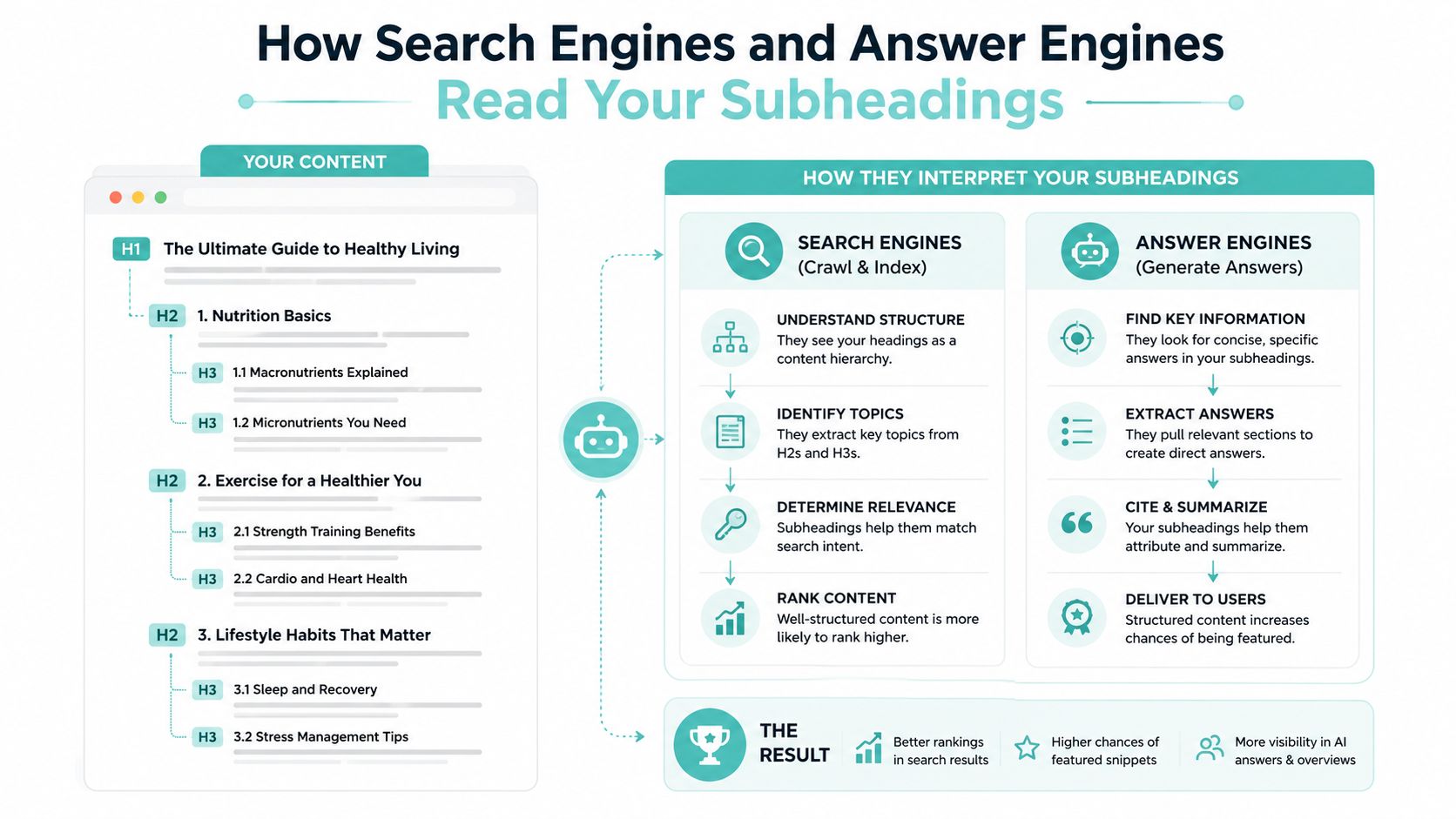
Headings are semantic markup, and that is where a lot of templates go wrong. If an H2 only looks large because CSS made it bigger, but the HTML does not express the structure clearly, you have styled text without adding retrieval value. Yoast's guidance is explicit that headings create the logical outline of the page, with one H1 at the top and H2s and H3s nested underneath in a sensible hierarchy. Yoast headings guidance For accessibility, that hierarchy matters. Screen readers expose headings as a navigation path, and users rely on that outline to jump to the section they need.
The document outline matters
Search systems also read the outline that headings create. Yoast notes that search engines and AI systems use headings to interpret the topic and structure of content. Yoast headings guidance The H2 is not just a design element, it is a passage candidate. A clean heading gives crawlers a better chance of understanding which section covers the core service, which section handles supporting questions, and which section drills into details. The clearer the outline, the less guesswork there is.
Heading order matters too. A page that jumps around, skips levels, or uses headings for visual flair breaks the document into noisy pieces. Yoast's guidance says H2s divide the content into main sections and H3s divide those sections further. Yoast headings guidance That hierarchy is the backbone. When it holds together, the page reads like a structured brief instead of a pile of paragraphs.
A heading does not need the exact phrase to help retrieval if the surrounding section is clearly about the same intent. It still needs enough specificity that a person can predict the answer before reading the body. That is the standard I use when I review service pages with designers or developers.
Why filler headings fail
Filler headings waste that potential. A label like “Learn more” or “Additional information” tells nobody anything, including the machine trying to identify the passage. That weakens usability and answer extraction. The same problem shows up when a heading tries to be clever instead of accurate.
For a practical look at how this fits into AEO, this answer engine optimization overview is a useful companion. The main takeaway is simple. Headings give an answer engine a clean entry point into the page's structure.
Exact Match, Partial Match, and Semantic Variations
The cleanest way to think about keyphrase in subheading is as a spectrum, not a binary test. Some sections deserve the exact phrase, some deserve a close variation, and some should use a more precise intent label because forcing the phrase would make the heading worse. Yoast's focus keyphrase guidance says the keyphrase should appear in the page title, first paragraph, one or several subheadings, and the meta description, and it also gives a body-copy density target of 1% to 2%. Yoast focus keyphrase guidance That doesn't mean every heading needs the phrase. It means the phrase needs a credible home in the sections that carry the topic.
When exact match earns its place
Use the exact match when the H2 introduces the primary section around the core concept. If the page is about “keyphrase in subheading,” then a primary H2 about that topic should say it plainly. Yoast's assessment for subheadings is strict enough that the keyphrase has to appear in the heading text itself, not hidden in attributes or markup. Third-party guidance also notes that more than half of the keyphrase words need to appear in the subheading for the test to register. Yoast-style subheading assessment
That strictness has a practical consequence. Long-tail phrases often need to be repeated across substantive H2s if the page really covers multiple aspects of the same intent. You can't tuck the term into one decorative heading and assume the rest of the page will carry the relevance. If the section is about the same topic, the phrase belongs there.
When semantic variation is the better call
Semantic variation is the better choice when the section answers a related sub-question. A service page might shift from the core phrase to a heading about “how to choose an H2 for local SEO” or “headings for answer engines.” Those are different questions, but they sit in the same topic cluster. Forcing the exact phrase into every branch of that cluster usually makes the page read repetitive and cramped.
If the heading is about the same intent, use the phrase. If the heading is about a narrower or adjacent intent, write the heading for that intent instead.
That's the reader-first decision rule in practice. Yoast's support material says whether to add the keyphrase depends on the paragraph connected to that heading. Yoast keyword in headings guidance In other words, the heading should match the content, not the other way around. If the content changes, the heading should change with it.
| Choosing a Subheading Match Strategy | ||
|---|---|---|
| Section role | Match strategy | Example H2 phrasing |
| Core topic section | Exact match | Keyphrase in Subheading Best Practices |
| Supporting topic section | Partial match | Using the Keyphrase in H2 and H3 Headings |
| Adjacent question section | Semantic variation | How Search Engines Read Heading Structure |
Real HTML Patterns for Service Business Pages
Markup is where the theory either ships or dies. I see the same mistake over and over on service pages. The headline team writes a polished promise, then the subheads drift into vague marketing language or become repeated keyword strings that no human would say out loud. Yoast's guidance is more grounded than that, it says to use some H2 or H3 headings with the keyphrase, not all of them, and to choose them based on the paragraph they connect to. Yoast keyword guidance That's the logic I'd hand to a writer and a developer on the same project.
Roofing service page
For a roofing page, the first H2 should usually carry the service intent cleanly. The supporting H2s can cover inspection, materials, financing, or storm damage without repeating the exact phrase each time.
<h1>Roof Repair in Tyler, Texas</h1>
<h2>Roof repair in Tyler for leaks and storm damage</h2>
<h3>Emergency tarping and temporary protection</h3>
<h3>Shingle replacement and flashing repair</h3>
<h2>How our roofing inspection process works</h2>
<h3>Visual checks from ground and roof level</h3>
<h3>Photo documentation for the homeowner</h3>
That structure keeps the core phrase visible while letting the section content breathe. Compare it with this anti-pattern:
<h2>Roof repair in Tyler, roof repair services, best roof repair</h2>
That version is harder to scan and sounds written for a plugin, not a person.
Personal injury landing page
A legal landing page needs even more restraint because the visitor is often anxious and moving fast. If the page is about a specific claim type, the H2 can state that claim plainly, then the subheads can unpack process and case evaluation.
<h1>Car Accident Lawyer in Dallas</h1>
<h2>Car accident lawyer for serious injury claims</h2>
<h3>When fault is disputed</h3>
<h3>What evidence matters most</h3>
<h2>What to expect after a consultation</h2>
<h3>Case review and next steps</h3>
<h3>Communication with your treatment providers</h3>
A page like that gives the reader a route through the content without overdoing the main phrase.
For sitemap planning on large service sites, this sample sitemap reference is useful because heading structure and page structure usually have to work together.
Dentist location page
A dentist location page often benefits from a service-plus-location H2, then narrower H3s for procedures or patient concerns.
<h1>Family Dentist in McKinney</h1>
<h2>Family dentist services for routine and restorative care</h2>
<h3>Cleanings and exams</h3>
<h3>Fillings, crowns, and urgent visits</h3>
<h2>New patient appointments and insurance questions</h2>
<h3>What to bring to your first visit</h3>
The location modifier does the local SEO work, while the supporting headings keep the page useful.
HVAC city page
HVAC pages work best when the main service heading is direct and the supporting H2s cover seasonal problems, repair paths, and installation options.
<h1>HVAC Company in Frisco</h1>
<h2>HVAC repair in Frisco for fast diagnostics</h2>
<h3>Air conditioning not cooling</h3>
<h3>Furnace issues in cold weather</h3>
<h2>Replacement options for aging systems</h2>
<h3>When repair stops making sense</h3>
That pattern gives Google a clean topical signal and gives the visitor enough structure to keep reading.
Writing Subheadings That Win Featured Snippets and AI Answers
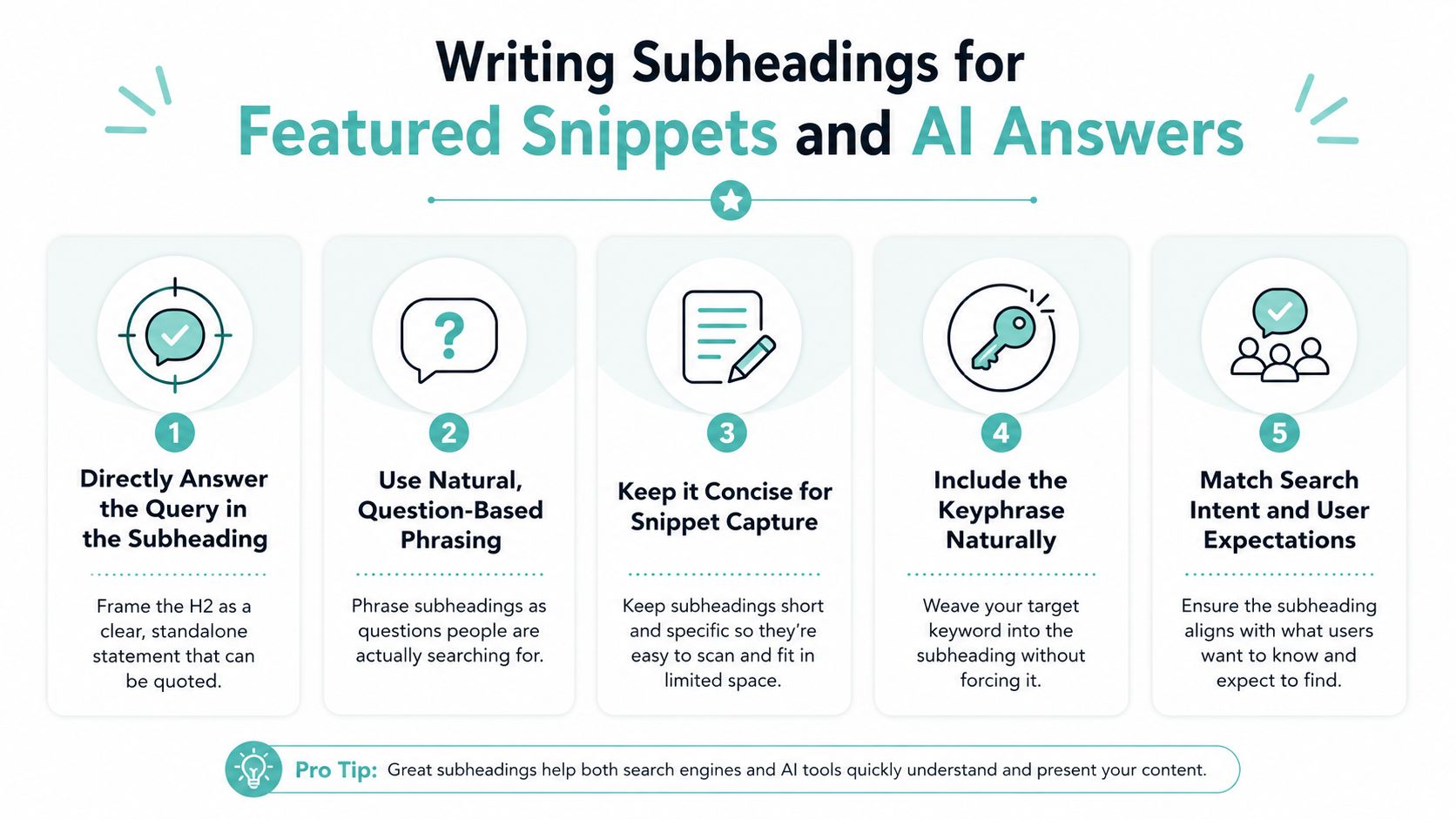
Subheadings are now a retrieval layer, not just an SEO checkbox. The sections most likely to get quoted are the ones that answer a real question quickly and cleanly. News SEO guidance has been pushing this for a while, question-style headings, a direct answer immediately under the heading, and enough supporting detail for the passage to stand on its own. Subheadings for search answer extraction
Question-style headings work better
A question-style H2 works because it mirrors the query shape many people use. Instead of writing a broad label, write the specific question the visitor is asking, then make the paragraph under it answer that question right away. That makes the passage easier for a search engine to lift and easier for a human to trust.
This is also where exact match can still help without becoming robotic. If the query is close to the core phrase, the H2 can include that phrase naturally as part of the question. The phrase becomes part of an answer unit, not a standalone keyword placement exercise.
For teams handling high-volume call intake, a contractor answering service is a reminder that subheadings and intake systems solve the same problem in different ways, they both have to surface the right answer fast.
Answer early, then expand
The first one or two sentences under the H2 matter more than most writers think. If the answer is buried after a long warm-up, the passage loses extractability. Start with the direct answer, then use the rest of the paragraph for nuance, trade-offs, or examples. If the topic has distinct parts, H3s can break them out cleanly without cluttering the H2.
A clean answer section often looks like this:
- State the answer immediately. Don't make the reader wait for the point.
- Use the H3s for named parts. Break out steps, criteria, or exceptions only when they add clarity.
- Keep the section on one intent. If the paragraph starts drifting into a second question, split it into a new H2.
That structure helps with classic SEO and answer-engine citation at the same time. It also keeps the page from turning into a string of keyword-like headers that all say the same thing in different wrappers.
Accessibility and Conversion Implications for Local Service Sites
On a local service page, a subheading does three jobs at once. It helps search engines classify the page, it helps assistive tech users move through the document, and it helps a rushed visitor decide whether to keep reading or take action. Headings are part of the page's working structure, not decoration, and screen readers rely on them to move efficiently through content without forcing users through every line. That makes the markup itself part of the user experience.
Headings as navigation landmarks
Clear headings create landmarks. A screen reader user can jump from one section to the next, and a scanner can do the same with their eyes. Vague headings break that flow. They do more than look weak, they make the page harder to orient.
This matters on service pages that group multiple services, service areas, or process steps. If the H2 is generic and the answer sits several paragraphs later, the visitor has to hunt for it. On a local page, that delay can be enough to lose the lead.
A heading should tell the user what comes next, not make them work for it.
The same principle applies when a page places a form, phone number, or intake paragraph near the heading. A clear H2 gives the reader a clean path from question to action, which is one reason a practical conversion rate resource can be useful alongside SEO guidance. On a local landing page, that path matters as much as the keyword target.
Conversion depends on clarity
A heading that stuffs in the keyphrase awkwardly can hurt conversion because it reads like it was written for search engines instead of customers. That weakens trust. A clear, human heading signals competence, and competence is part of the conversion funnel on legal, medical, and home service pages.
Structure and action are tied together. If a visitor has to decode the page before they can decide whether you are relevant, they are more likely to leave. If they can read the H2, understand the section, and see the CTA nearby, they can move faster.
Some teams use AI drafting tools to speed up section outlines, then edit hard for clarity and tone. If you want a practical overview before you let a draft go live, AI content generation tools for marketers is a useful reference point. That kind of drafting support only works when the final heading structure still reads naturally to a human.
Common Misconceptions and a Practical Checklist
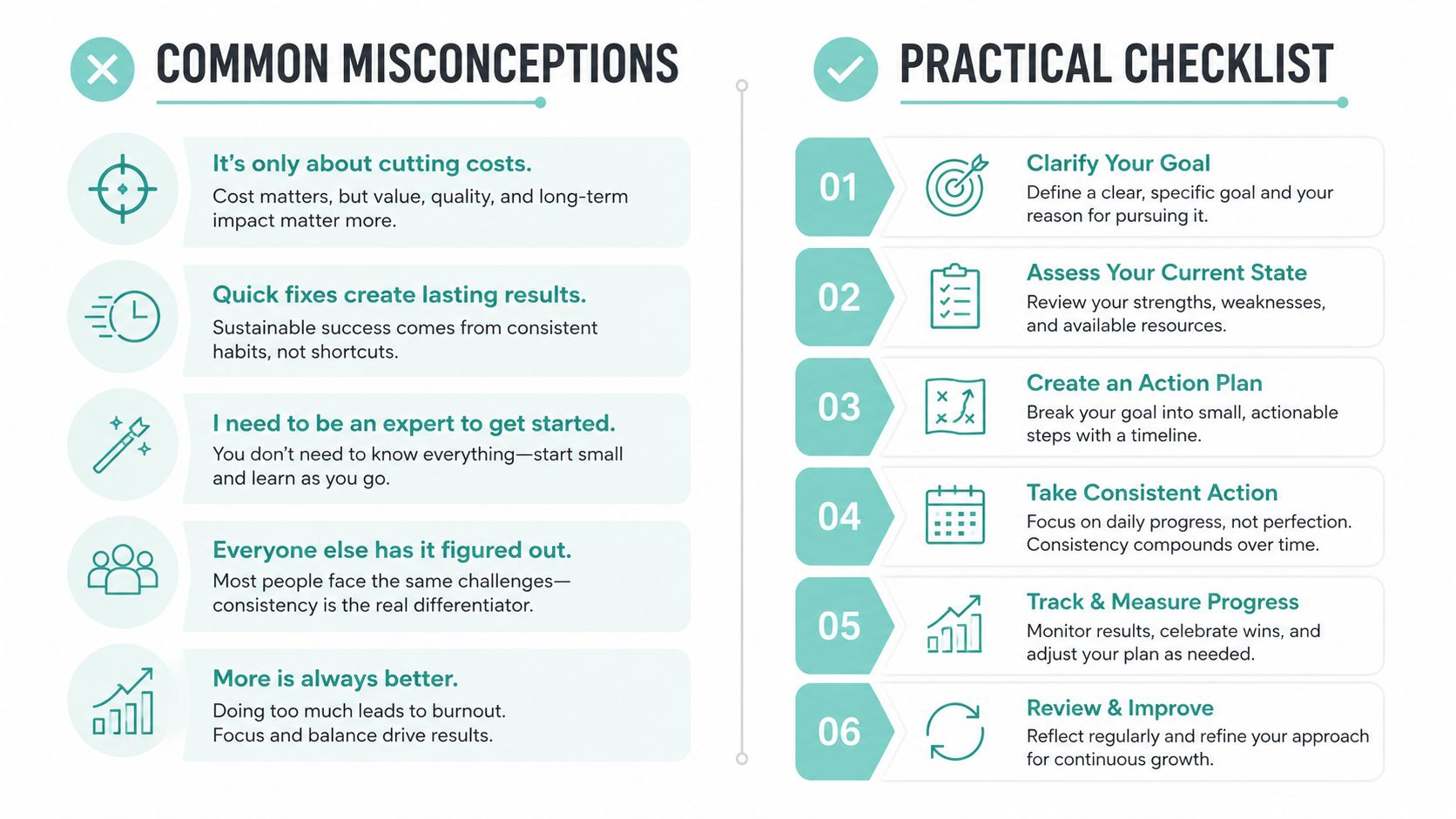
The biggest misconception is that every H2 should carry the exact phrase. It shouldn't. Yoast's guidance is clear that the keyphrase should appear in some subheadings, not all of them, and that the choice depends on whether the heading matches the connected paragraph. Yoast keyword guidance Stuffing the phrase into every H2 usually makes the page flatter, not stronger.
Another misconception is that density can rescue weak headings. It can't. Yoast's guidance gives a body-copy density target of 1% to 2%, but that's a support number, not a substitute for a heading that matches the section. Yoast focus keyphrase guidance A heading that mislabels the content still misleads the user.
The last one is visual-only thinking. Bold text, bigger type, or a stylized paragraph doesn't become an H2 because it looks like one. HTML semantics do the work.
Use this checklist before publishing:
- H1 check. The page has one clear H1 that states the main topic.
- Primary H2 check. The main H2s use the exact keyphrase or a clear semantic variant where it fits naturally.
- H3 check. Nested headings only appear when they make the section easier to scan.
- Content match check. Each heading accurately describes the paragraphs below it.
- Hierarchy check. The heading order stays logical across the page.
- Readability check. No heading sounds stuffed, vague, or written just to satisfy a plugin.
For a broader audit routine, WebAbility.io's audit framework is worth reviewing because heading quality usually sits next to accessibility, structure, and conversion in the same review pass.
Digital Skyrocket plans and builds lead-generating websites for service businesses, then aligns local SEO and answer engine optimization with conversion-focused page structure. If you need a site where keyphrase in subheading decisions are handled with the rest of the page architecture, visit Digital Skyrocket and see how the team approaches strategy, content, and implementation together.