A featured snippet can capture 8.6% of clicks while the traditional organic result in position one falls from 26% CTR to 19.6% when the snippet appears, according to an Ahrefs analysis summarized by Search Engine Land. That isn't a guaranteed traffic increase. It's a redistribution of attention across the search results page.
For local service businesses, that distinction matters. A roofing company, law firm, or HVAC contractor doesn't need visibility for its own sake. It needs qualified calls, quote requests, consultation forms, and other actions that create revenue. Featured snippet optimization works when it earns more valuable SERP share and supports those actions, not when it merely adds a “position zero” screenshot to a report.
Table of Contents
- What Featured Snippets Are and Why They Matter Now
- Finding the Right Snippet Opportunities
- Formatting Content to Match Snippet Types
- Measuring Snippet Impact Beyond Rankings
- Testing and Iterating Snippet Changes
- Featured Snippet Optimization for Service Businesses and Local SEO
- Common Pitfalls That Block Snippet Wins
What Featured Snippets Are and Why They Matter Now
Featured snippets appeared in 12.29% of Google queries in a study of 112 million U.S. keywords, as summarized in current featured snippet reporting. Google places these answer boxes above the conventional result title and link, giving one page prominent space before the standard listings.
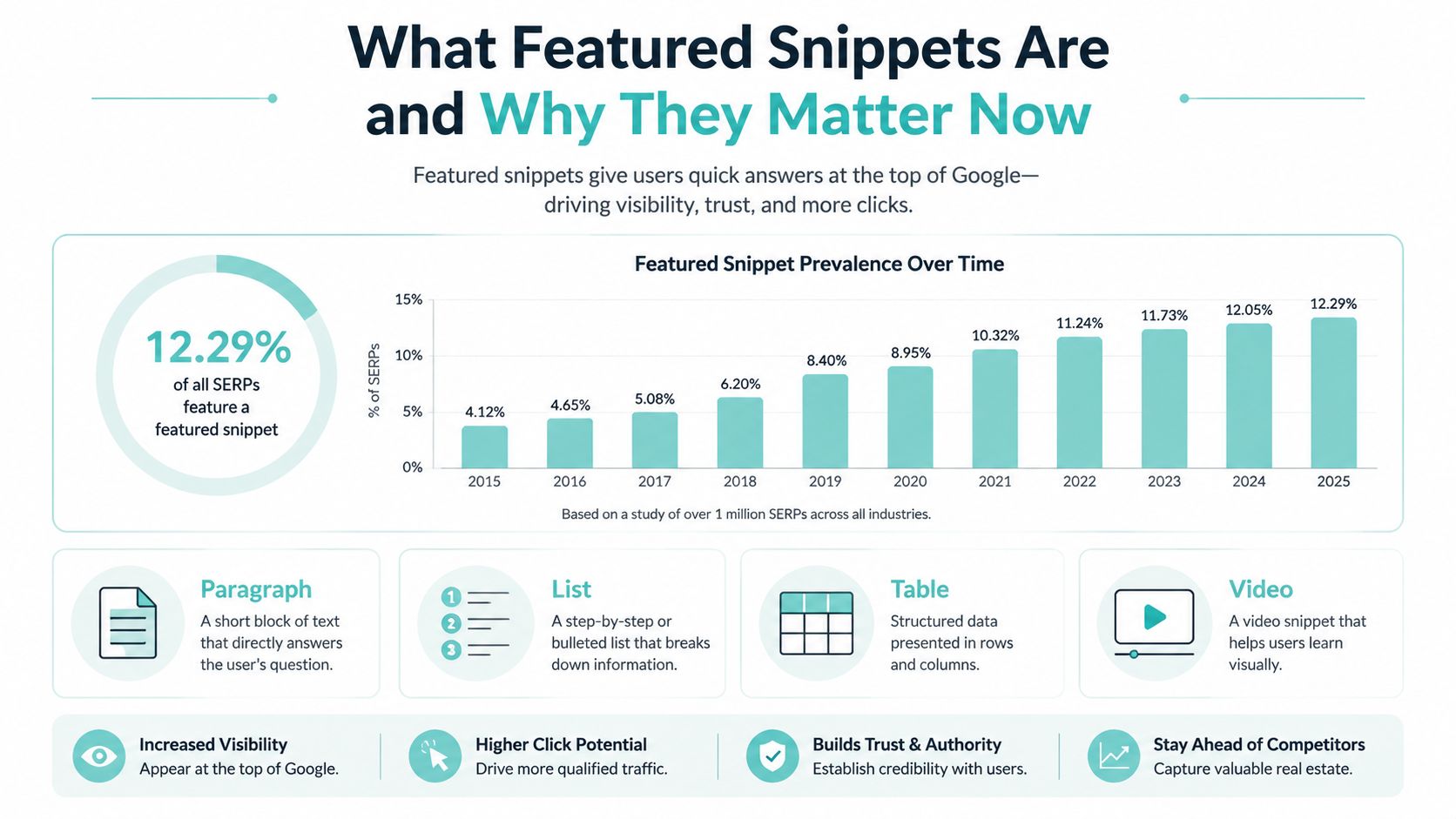
The main formats are paragraphs, lists, tables, and videos. Paragraphs account for roughly 70% of snippets, lists for 19.1%, and tables for 6.3%, based on research summarized by Search Engine Journal. Video snippets fill the remaining share in that four-format model and often suit demonstrations or action-oriented searches.
The box changes click distribution
A snippet changes how attention is divided across the results page. In the Ahrefs data, it captured 8.6% CTR, while the first organic result declined from 26% to 19.6% when the feature appeared, according to Search Engine Land's analysis. Winning the box can therefore shift clicks from a page that already ranked first.
For a roofing company, law firm, or HVAC contractor, that shift matters only when it produces qualified calls, quote requests, or consultation forms. A snippet can increase brand exposure and clicks, yet deliver little commercial value if the extracted answer resolves the search without a visit. Measure lead quality and conversion actions alongside impressions and clicks.
Practical rule: Treat a featured snippet as a measurable search-result layer that can shift as Google reassesses relevance, page structure, and competing answers.
Ownership can change when another URL provides a clearer response or better matches the query context. For a broader view of direct answers, compare GetIntel's Answer Engine Optimization (AEO) Guide with Digital Skyrocket's explanation of answer engine optimization.
Finding the Right Snippet Opportunities
Start with pages that already have a realistic chance to win. 99.58% of featured snippets come from URLs already ranking in Google's top ten, according to the Search Engine Journal summary of large-scale snippet research. Formatting a page that sits on page three is usually a poor use of editorial time because the page first needs stronger organic eligibility.
Build the opportunity list
Export queries from Google Search Console and identify pages ranking between positions two and nine. Those pages are close enough to the relevant result set that a clearer answer block may improve both extraction eligibility and user engagement.
Then qualify each query against business value:
- Local intent: Look for city, neighborhood, service-area, or “near me” language where the result page serves a real geographic market.
- Commercial relevance: Favor questions that help a prospect choose, compare, prepare for, or contact a provider.
- Existing snippet presence: Record whether Google already displays a paragraph, list, table, or video. An existing feature proves that the query supports an extractable answer format.
- SERP ownership: Exclude queries where a dominant brand or proprietary source leaves little room for a local service page.
- Question shape: Prioritize natural questions that can be answered directly, especially longer informational searches.
Longer queries deserve attention. The same research found that 55.5% of 10-word queries triggered a featured snippet, compared with 4.3% of single-keyword searches, as reported by Search Engine Journal. That doesn't mean every long query is valuable. It means specific questions often provide better formatting and intent signals than broad head terms.
Use SERP evidence, not guesses
Review People Also Ask questions, inspect competitor pages holding the box, and compare the extracted wording with the page's visible content. Search Console adds the site's actual query history, while a SERP monitoring platform can speed up broader discovery. Surnex's automated SERP feature discovery workflow can help uncover feature patterns that manual searches miss.
A page-one-first process pairs well with low-competition keyword research. Rank opportunities by lead relevance, current organic position, and the quality of the answer you can provide. The best target isn't the most visible snippet. It's the snippet attached to a query that precedes a call, consultation, estimate, or form submission.
Formatting Content to Match Snippet Types
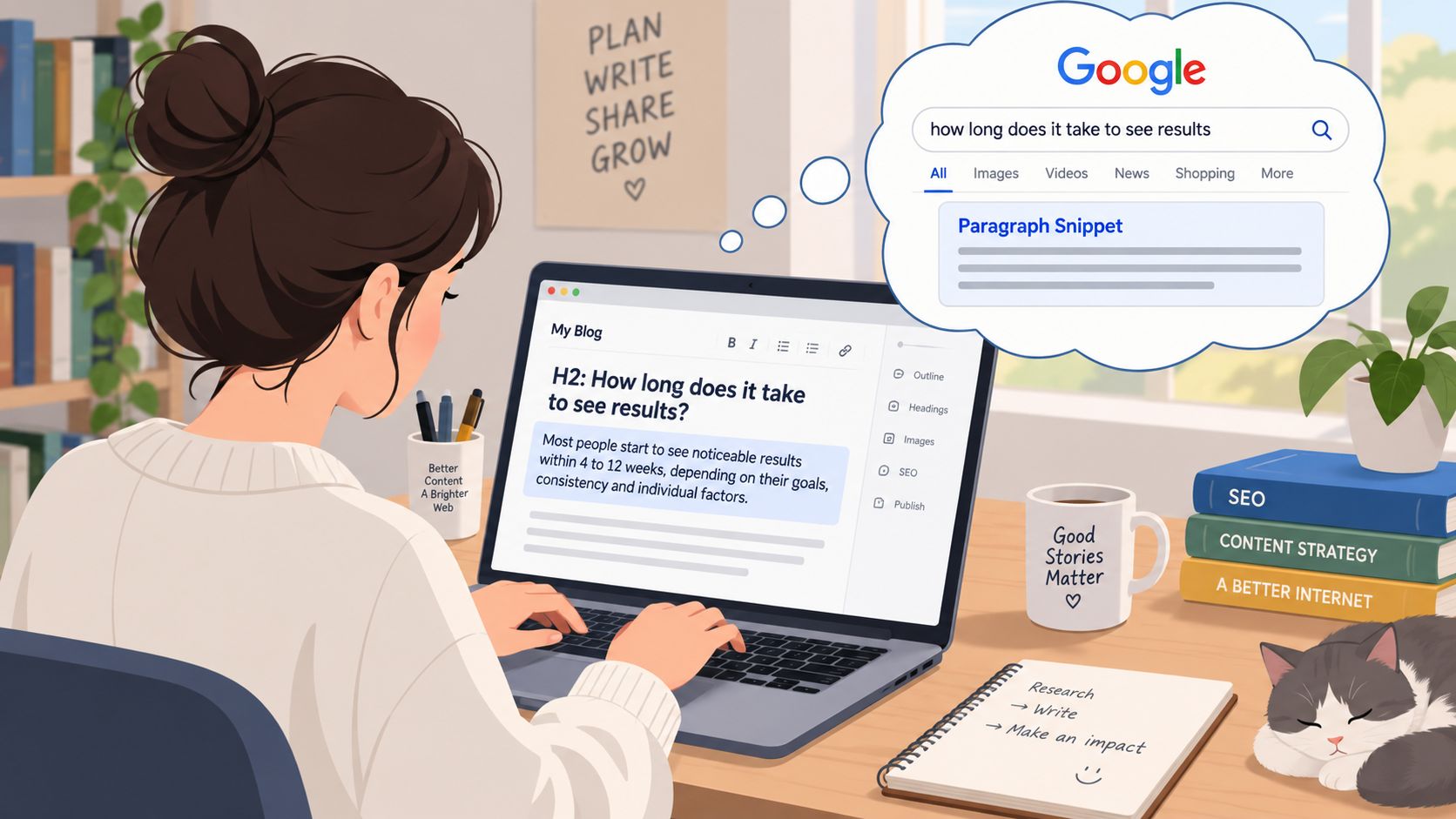
Google's result format gives you a practical starting point. Match the page section to the format already appearing for the query instead of forcing every answer into a paragraph snippet.
Paragraphs remain the common format, while lists and tables suit narrower query patterns. Treat those figures as directional rather than a promise. The format affects how much visibility your page can claim, but visibility alone does not guarantee more leads. For a local service business, connect each target query to a measurable action such as a call, estimate request, consultation, or form submission.
Match the answer to the question
For a paragraph snippet, phrase the heading around the search question and place a direct response immediately below it. A 40-to-60-word answer block provides a useful editorial range for a definition-style response, although Google may extract another passage. Make the opening objective and complete, then add examples, limitations, and service-specific detail below it.
List snippets require visible list structure. Use ordered lists for procedures or sequences, and unordered lists for collections without a required order. Keep items parallel and concise. A clear sequence helps both extraction and visitors deciding whether to contact the business.
Tables fit comparisons between entities or attributes. Use a genuine HTML table when readers need to compare services, materials, options, or characteristics. Do not turn a table into a disguised process or ranking. “Emergency repair versus scheduled maintenance” can support a service decision, while “steps to call a plumber” belongs in a list.
Use markup as support, not a shortcut
FAQ, HowTo, and QAPage schema can clarify meaning when the visible content matches the markup. Schema cannot repair vague answers, buried headings, or mismatched intent. Clean HTML, descriptive subheadings, useful lists, and a direct first sentence usually provide more practical support for extraction than decorative markup.
Use keyphrases in subheadings to connect a question with its answer without awkward repetition. For broader small-business context, the Wispra 2026 SME SEO guide complements format-specific work. Test the resulting SERP share against qualified calls and forms, because winning the box can redistribute visibility without increasing total clicks.
Measuring Snippet Impact Beyond Rankings
A page can own a featured snippet and still produce no lift in qualified leads. Measure the redistribution of SERP share against commercial outcomes, not the appearance of a “position zero” label. For a service business, that means checking whether the snippet influenced calls, form submissions, or visits from people likely to become customers.
The click pattern explains why rankings alone are incomplete. When a snippet appears, the first organic result's CTR dropped from 26% to 19.6%, while the snippet received 8.6% CTR, according to Ahrefs data summarized by Amra & Elma. Treat those figures as a reason to compare the whole result page, not as proof that every snippet increases traffic.
Use a lead-focused dashboard
Track impressions and CTR for the snippet-owned query, then compare them with the page's performance when it does not own the feature. Add assisted conversions, landing-page attribution, and branded search behavior. These measures show whether visibility contributed to a later inquiry, even when the initial click did not convert.
For local companies, phone calls and form submissions should carry more weight than sessions. A snippet on a query that also displays a map pack may increase brand exposure while taking clicks away from a page that previously generated calls or direction requests. Separate queries where the page ranks near the top from longer-tail groups where the snippet may expand overall visibility.
Use similar pages targeting related queries as a control set. The comparison will not isolate every Google change, but it is more credible than judging traffic from a simple before-and-after period.
| Metric | What It Measures | Why It Misleads | Snippet-Aware Alternative |
|---|---|---|---|
| Organic position | Where the blue link appears | It ignores the answer box and other SERP features | Combine position with owned snippet visibility |
| Sessions | Visits from search | It treats every visit as equally valuable | Segment sessions by qualified lead activity |
| Snippet impressions | How often the page appears in the feature | Visibility doesn't prove users clicked | Pair impressions with CTR and assisted conversions |
| Form submissions | Direct lead completions | It may miss calls influenced by the snippet | Add call tracking and assisted-conversion review |
The practical target is net SERP share tied to commercial outcomes. Losing low-value clicks while gaining qualified inquiries can represent progress. Winning the box while valuable calls decline points to a mismatch in the answer, title, or conversion path. Use those lead outcomes to decide whether the snippet deserves protection, a revised landing experience, or a different query target.
Testing and Iterating Snippet Changes
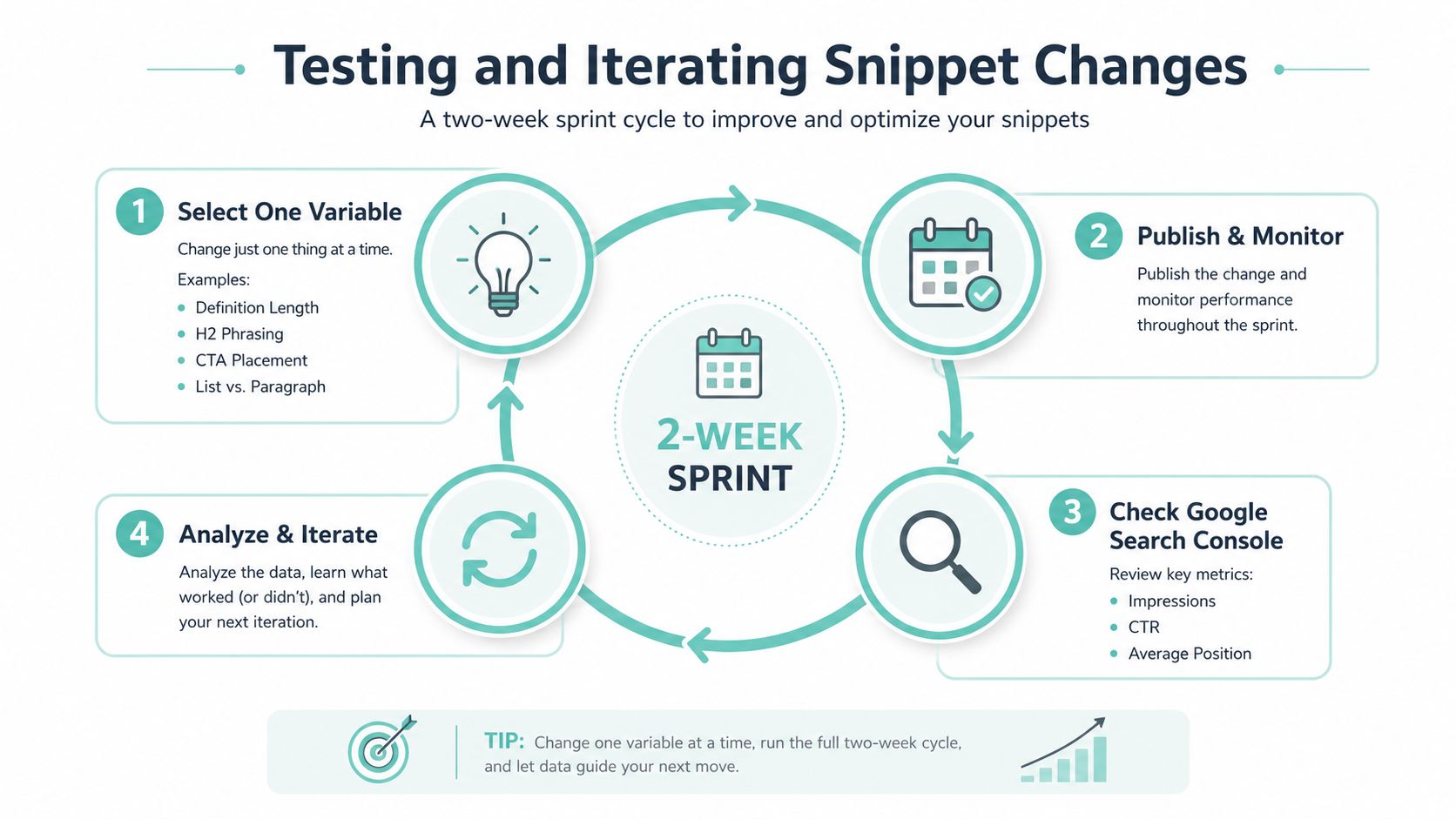
Snippet optimization works better as controlled editorial testing than as a one-time rewrite. Change one meaningful variable on a page, record the hypothesis, and leave competing elements stable long enough to interpret what happened.
A practical sprint can test definition length, list order, table columns, or the H2 wording that precedes extraction. Don't change all four together. If the page wins or loses the feature, you won't know which edit caused the movement.
A repeatable monitoring sequence
Publish the controlled edit, then open Google Search Console and inspect the exact URL in URL Inspection. Request indexing rather than relying only on the next crawl, especially when the page is strategically important.
Check the target SERP at 24, 72, and 168 hours as part of your test log. Those checkpoints are operational review points, not guaranteed Google processing times. Record the snippet owner, format, organic position, and whether the box appears at all.
If the result hasn't changed after seven days, test the next variable. If you lose an existing snippet, restore the prior version promptly and document the reversal. A simple change log should include:
- Date: When the edit went live.
- Hypothesis: What you expected Google to understand more clearly.
- Variable: The single element you changed.
- Result: The observed owner, format, position, CTR, and lead behavior.
Avoid simultaneous edits on pages competing for the same query cluster. Attribution noise makes a small site look more certain than the evidence supports. The strongest patterns usually emerge after you compare several controlled tests across similar service pages.
Featured Snippet Optimization for Service Businesses and Local SEO
Local service searches add another layer of competition. A query may show a featured snippet above organic listings while also presenting a map pack, local finder results, review content, and direct contact actions. Winning the box can improve visibility, but it can also shift attention away from the local result that generates the call.
Start with queries that include a city, neighborhood, service area, or natural local phrasing. A page answering “how often should a Dallas HVAC system be serviced?” has a different commercial path from a general maintenance article because the reader may be evaluating a nearby provider.
Align the page with the local entity
The service page, Google Business Profile, and broader site should describe the same business, services, and service areas. Keep name, address, and phone consistency across important business references, and make the primary service area clear in the title tag, H1, and opening paragraph where it reads naturally.
Schema can reinforce the page's subject when it accurately reflects visible content. Consider relevant LocalBusiness, Service, FAQPage, and Review structured data, but don't add markup for information the page doesn't substantiate. The visible answer still needs to satisfy the query directly.
For a law firm, that might mean answering a procedural question before presenting consultation options. For a roofer, it could mean explaining whether a symptom suggests repair or replacement, followed by a clear inspection path. For a dentist, the page may answer preparation or treatment questions while making location, accepted services, and next steps obvious.
Connect visibility to local actions
Track snippet performance against calls, quote forms, consultation requests, and direction-related behavior rather than sessions alone. Review and citation language should also support the same service and location associations, because inconsistent descriptions create uncertainty for both users and search systems.
Digital Skyrocket applies this type of work through website design, local SEO, answer engine optimization, and conversion refinement for service companies. It focuses on connecting structured service pages and local search foundations to qualified inquiries, rather than treating visibility as the final deliverable.
A local snippet is valuable only when the next action is clear and commercially useful.
Common Pitfalls That Block Snippet Wins
A top-ten ranking does not guarantee a featured snippet. Google still needs a clear, extractable answer that matches the query, fits the expected format, and sits on a page with credible business and local signals. A snippet win also redistributes SERP visibility rather than guaranteeing more traffic, so judge the change by qualified calls, quote requests, and consultations.
Diagnose the page before rewriting it
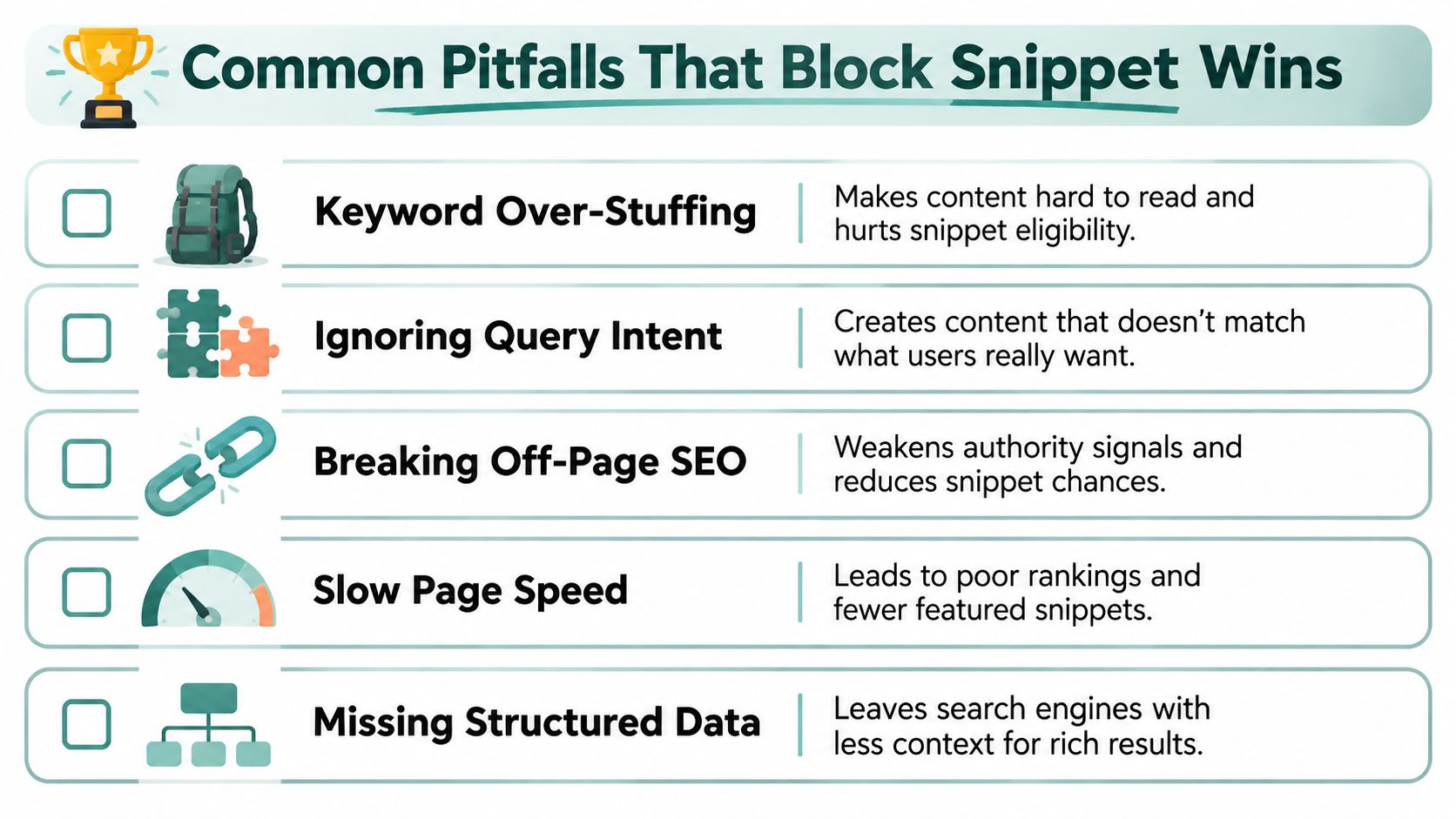
- Keyword over-stuffing: Repeating the target phrase can make the answer awkward and harder to extract. Use query language where it clarifies the subject, then write for the customer seeking the service.
- Ignored intent: Definition queries need definitions, comparison queries need comparable attributes, and local service questions need geographic relevance plus a credible next step.
- Weak authority signals: Better formatting cannot compensate for thin supporting content, unreliable references, or a site that lacks the strength to compete for the result.
- Missing or careless schema: Structured data does not create a snippet on its own. Inaccurate or incomplete markup can make the page and business harder to interpret.
- Mid-test rewrites: Changing headings, answer length, links, and calls to action together removes attribution. Keep the last stable version, then test one meaningful variable at a time.
Local service pages need a separate entity check. Conflicting NAP details, an outdated Google Business Profile, inconsistent service-area descriptions, and unclear hours can weaken the connection between the search and the business. A well-formatted answer will not repair contradictory local information.
Apply a confidence-based checklist
Check whether the page ranks in the top ten, answers the exact query, matches the format already appearing in the SERP, and provides enough context around the extract. Confirm that the title, H1, links, business details, and conversion path describe the same service and location.
Google's documentation explains that site owners can block featured snippets with nosnippet or reduce the available extraction with max-snippet. It also notes that too little available text may prevent a useful result. Review Google's featured snippet documentation before adding restrictive controls.
Treat each pitfall as a testable loss of selection confidence. Improve intent matching and page foundations, then measure whether the redistributed SERP visibility produces stronger local actions, not just a higher ranking.
Digital Skyrocket designs and search engine optimizes lead-generating websites for law firms, dentists, roofers, HVAC companies, and other service businesses. Its work combines local SEO, answer engine optimization, technical implementation, and conversion tracking. To connect snippet opportunities with calls and qualified inquiries, visit Digital Skyrocket to explore a fit meeting and evidence-based discovery process.