
Most advice on local citation building gets the order backward. Teams rush to submit listings, collect a pile of URLs, and then wonder why rankings flatten out after the easy wins. The bigger problem is usually citation hygiene, not citation hunger, because Google and the other major platforms need a clean, consistent business record before they can trust the rest of the footprint.
That's why the best projects start with a single source of truth, a real audit, and cleanup work on the listings already floating around the web. The public citations matter, but the internal record matters more, because every directory form, aggregator feed, and profile update pulls from the same core data. BrightLocal's historical study is a useful reminder that citation depth still correlates with visibility in competitive local results, with businesses in the top 10 averaging 81 citations, the #1 position averaging 86, and the #10 position averaging 75 (BrightLocal citation study).
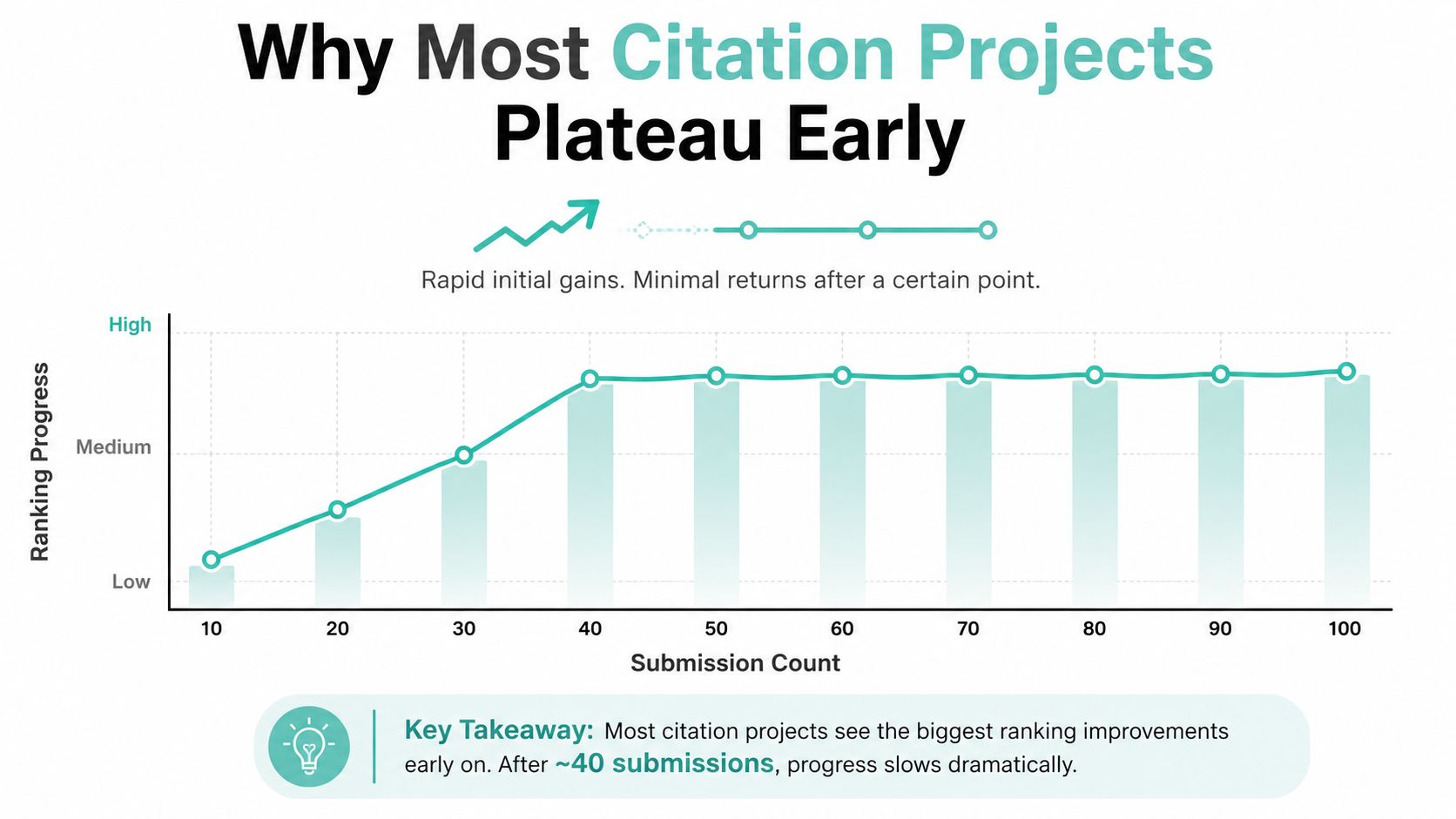
Table of Contents
- Why Most Citation Projects Plateau Early
- Running a Citation Audit Without Missing Anything
- Tier 1 Anchors and Data Aggregators Worth Prioritizing
- Handling Duplicates, Suppressions, and NAP Drift
- Submission Templates That Build Strong Listings
- Maintenance Cadence and Tracking
- Your Citation Building Checklist and Next Steps
Why Most Citation Projects Plateau Early
The mistake is treating local citation building like a volume game. A business gets a few dozen submissions live, sees some movement, and assumes the work is finished. That usually means the project is missing the true bottleneck, as existing inconsistencies keep diluting whatever authority the new listings were supposed to add.
BrightLocal's benchmark still gives a useful clue about citation depth. Businesses in the top 10 of Google Local averaged 81 citations, while the #1 spot averaged 86 and the #10 spot averaged 75. That spread does not prove every extra listing moves rankings on its own, but it does show that citation depth remains part of the local visibility picture, especially in crowded service areas. BrightLocal also found that Facebook appeared on 84% of citation profiles, Yelp on 80%, MapQuest on 72%, and both Yellow Pages and Manta on 71% in that study, which shows where baseline coverage has historically clustered.
Practical rule: if the business already has broken listings, new submissions usually add more noise than momentum.
The three-phase model that holds up
The cleanest way to handle this work is in three phases. First comes cleanup, where you create a canonical business record and fix the major conflicts already out there. Second comes anchor submissions, where you secure the core platforms and the major aggregators that can spread corrections downstream. Third comes niche growth, where you add the local, industry, and unstructured mentions that competitors often ignore.
Skipping phase one creates technical debt. A new submission on a directory that still mirrors an old address or a tracking-numbered phone line does not build trust, it multiplies the inconsistency. A good launch record should include the business name, address, phone, website, hours, categories, description, email, social profiles, and brand variants where needed, because modern citation records carry more than bare NAP. Guidance from current citation workflows stresses that one canonical record should drive everything, so every team member, vendor, and tool is working from the same data set, and the same NAP consistency rules should apply everywhere a listing appears, including the guidance in NAP consistency best practices and this local citation guide.
For service businesses, this matters even more when the business has moved, rebranded, or operates across multiple service areas. The core decision is simple. Lock the canonical name, address, phone, and website first, then decide how DBA wording, suite formatting, and marketing variations should appear before anyone touches a directory form.
A practical Texas-based record might look like a legal business name, a consistent DBA if customers know the company that way, a single main phone, one website, a mailing or office address if one exists, fixed hours, and a short list of service-area notes. If your team uses a CRM, shared drive, or AI-assisted drafting workflow, that record should live in one place and be treated like source data, not copy text.
For contractor lead generation context, best ways contractors get jobs is a useful adjacent read because it shows how local visibility supports actual inquiry flow, not just ranking vanity.
Running a Citation Audit Without Missing Anything
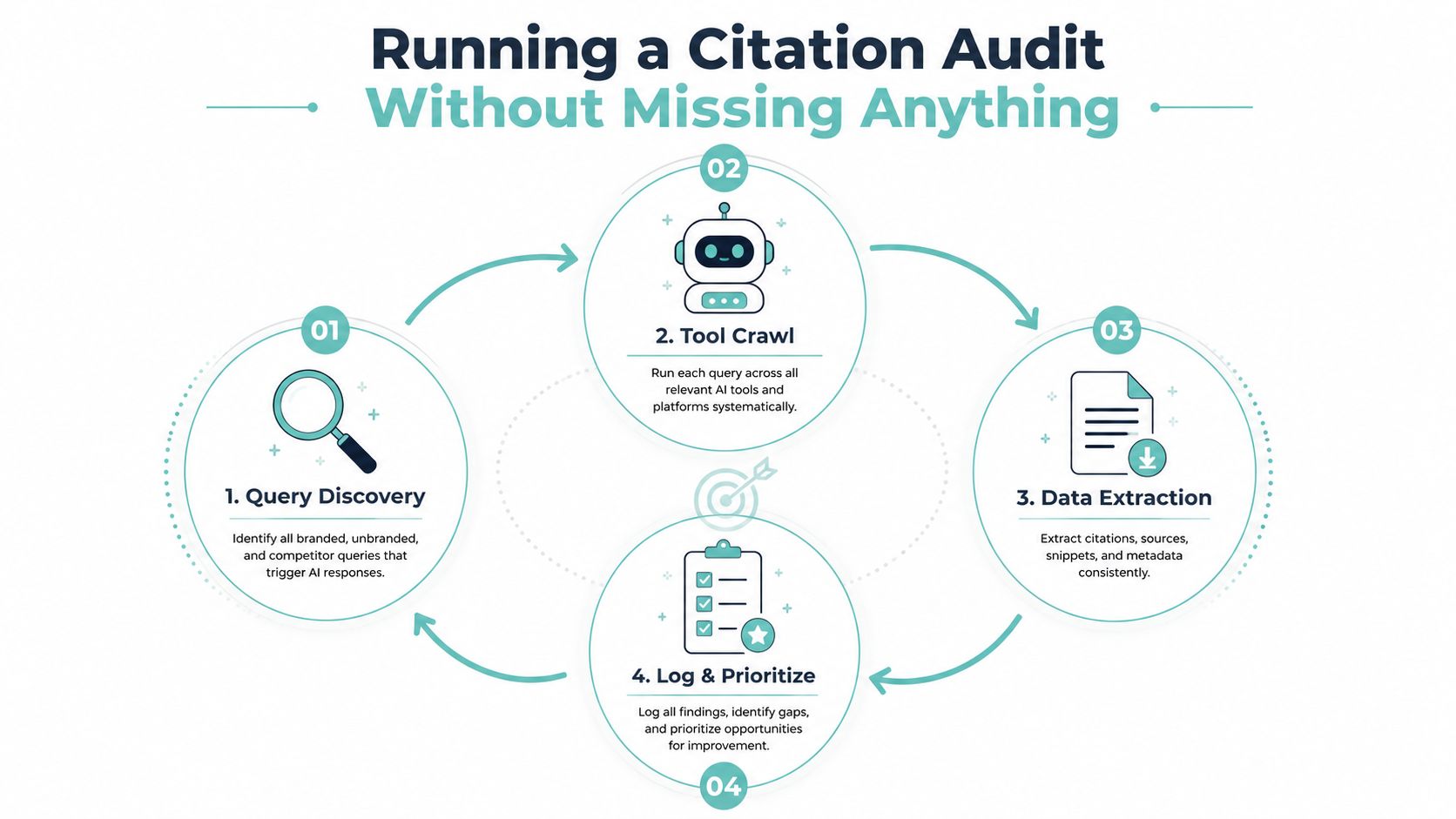
The audit is where the project gets honest. Before adding anything new, search the business the way customers, directories, and aggregators already might. Use the legal name, DBA, old phone numbers, prior addresses, suite numbers, misspellings, and brand variants. Then compare what comes back against your master NAPW record, because if the spreadsheet and the web disagree, the audit isn't done yet.
The audit log should capture the live URL, platform type, ownership status, exact NAPW, and a priority note. I also flag whether a listing is a duplicate, a stale record, a claimed profile, or a source that can feed data downstream. That last distinction matters because some fixes are tactical and others are structural.
What belongs in the audit log
- Canonical record fields: business name, address, phone, website, hours, category, and service-area notes.
- Source fields: listing URL, platform, login access, ownership status, and whether the record is structured or unstructured.
- Risk fields: duplicates, outdated phone numbers, address drift, suite inconsistencies, and obvious tracking-number contamination.
- Action fields: claim, suppress, merge, overwrite, or leave in place.
A multi-location business should keep variants separate but controlled. Each location needs its own canonical record, because mixing office addresses, service-area language, and old branch data is one of the fastest ways to create accidental drift. The linked NAP consistency guide is a solid operational reference for how teams keep that master record tight in practice, especially when multiple people touch listings at once. NAP consistency workflow
Search the old data on purpose. Most duplicate listings don't hide, they're just buried under retired phone numbers and past addresses.
I also recommend scoring each issue by business impact. A wrong main phone on a major platform matters more than a typo on a tiny niche directory. A duplicate on a high-authority source deserves attention before a low-value listing, because cleanup should follow priority, not convenience.
Tier 1 Anchors and Data Aggregators Worth Prioritizing
Not all citations deserve equal attention. The first fixes should go to the platforms that either hold major visibility on their own or push data into other ecosystems. That's why Google Business Profile, Apple Maps, Bing Places, Yelp, and Facebook sit at the top of the pile, along with the four major aggregators, Data Axle, Neustar Localeze, Foursquare, and Acxiom (expert local citation workflow).
| Source | Why It Matters | Primary Fields to Lock | Verification Signal |
|---|---|---|---|
| Google Business Profile | Core local visibility and trust anchor | Name, address, phone, hours, category | Live profile update and visible business details |
| Apple Maps | Major consumer map layer | Address, phone, website, hours | Listing appears in Maps with corrected data |
| Bing Places | Important search and map source | Name, address, phone, category | Approved listing in Bing Places dashboard |
| Yelp | High-consideration review and citation source | Name, phone, website, hours | Listing reflects the canonical record |
| Widely reused business identity source | Name, address, phone, social URL | Business page shows the same NAPW | |
| Data Axle | Aggregator with broad downstream reach | Canonical NAPW, category, website | Corrections appear in downstream syndication |
| Neustar Localeze | Aggregator that helps propagate fixes | Canonical NAPW and business classification | Sync confirmation or downstream parity |
| Foursquare | Feeds map and app ecosystems | NAPW, category, location data | Corrected record in ecosystem-dependent listings |
| Acxiom | Aggregator that supports data distribution | Canonical business details | Downstream listings start matching the master record |
The reason aggregators matter is propagation. Fix one source that feeds many directories, and you reduce the odds of fighting the same inconsistency in ten places later. That is why a submission strategy should start with anchors and aggregation, then move outward into niche directories and local mentions.
A good comparative guide to how directories support local visibility is how directories drive local growth, which is helpful background if you're deciding which directory formats deserve time and which ones are just noise.
How to verify a submission took hold
Look for the live profile, not just the submission receipt. If the platform has a dashboard, confirm the status there. If it syndicates to downstream apps, compare the corrected data against the master record later rather than assuming instant propagation.
The hard truth is that some listings look “done” while still holding stale fields behind the scenes. That's why Tier 1 fixes come before niche expansion. If the base layer is unstable, every additional submission inherits the same problem.
Handling Duplicates, Suppressions, and NAP Drift
Most citation projects lose time in cleanup, not submission. A business moves, changes its name, swaps phones, or gets pulled into an aggregator feed, and the old records keep showing up in different places. One directory may show the current profile, another the retired address, and another both versions at once. That creates clutter, but the main problem is trust. Search engines, data partners, and users all see mixed signals.
I start by sorting the mess into three workstreams. Same-platform duplicates usually need claiming and merging. Cross-platform duplicates often need suppression or removal through the directory's own process. Valid listings that drifted away from the canonical record need NAPW corrected, then checked again after the change propagates.
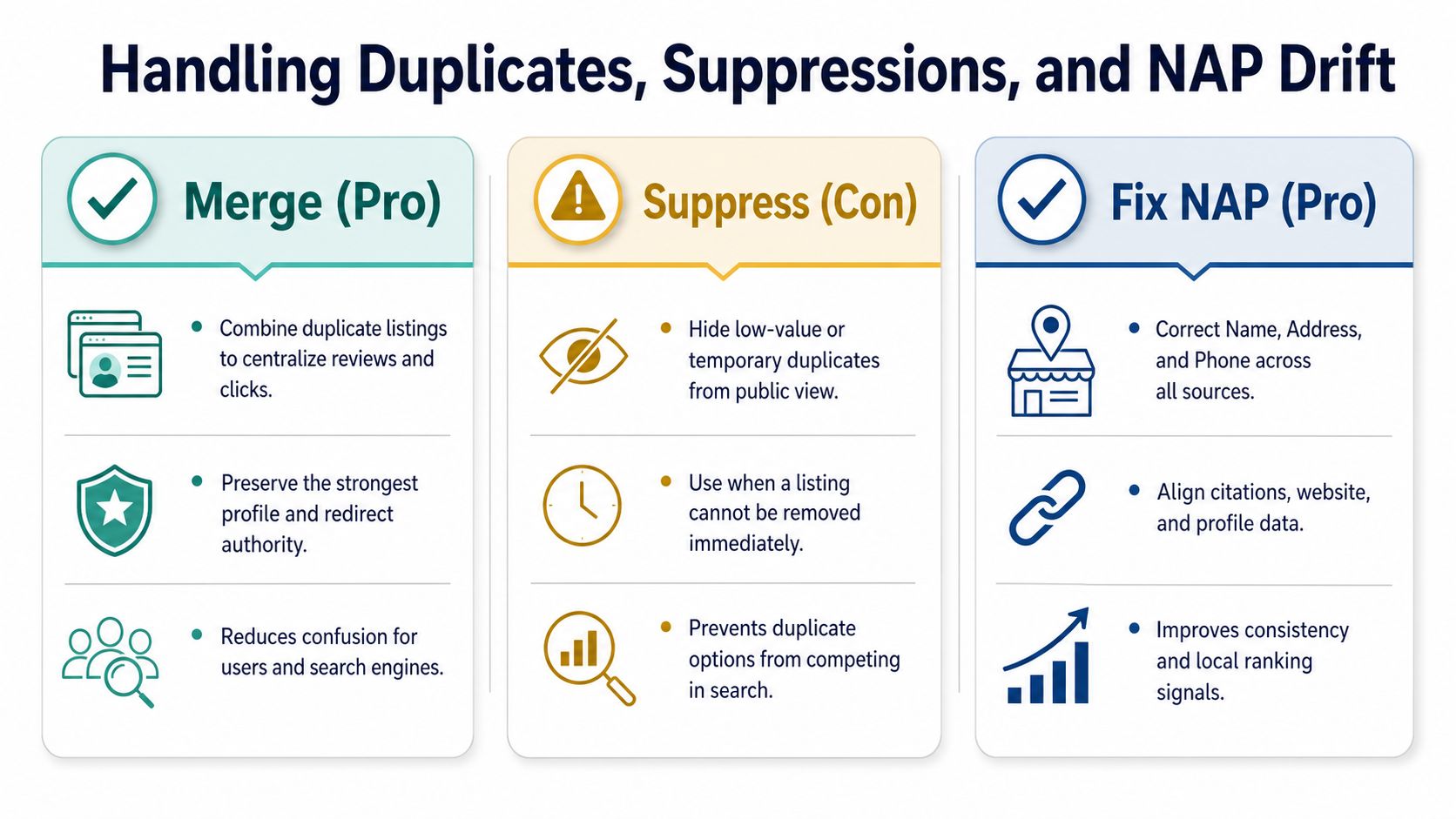
Decision rule for cleanup work
- Merge when the duplicate lives on the same platform and points to the same business entity.
- Suppress when the directory offers a clear removal path and the stale profile is competing with the correct one.
- Fix NAP when the listing is legitimate but no longer matches the canonical record.
Address changes deserve extra care, especially when a move has left multiple platforms pointing to different versions of the old location. Review how to change your business address in Google before updating the profile that most of your local ecosystem copies from.
Rule of thumb: if the listing can be claimed and corrected, do that before asking for removal.
Cleanup work rarely ends after one pass. An aggregator re-import can push old data back into listings that looked finished, so the first fix is only the start. Correct the source, confirm the downstream profiles, then check again after the feed cycle has had time to settle.
The goal is to stop the loop, not just cover up the symptom. Once the stale versions are gone or overwritten, later citation work has a cleaner base to build on, and that is the kind of consistency ranking systems can trust.
Submission Templates That Build Strong Listings
A strong submission starts before any form gets filled out. The first job is data governance, not copy-paste. If the name, phone, address, category, or service area is still drifting across existing profiles, adding another clean-looking listing just gives the inconsistency one more place to spread.
Use the template to standardize the record, not to decorate it.
Fill-in structure for a service-area business
- Core NAP: Use the exact canonical business name, main phone, website, and the address format you want to standardize across the web.
- Categories: Pick one primary category that matches the main service and add secondary categories only when they're relevant.
- Hours and exceptions: Set standard hours, then add holiday or closure exceptions where the platform allows them.
- Description: Write a short, plain-language summary of what the business does, who it serves, and where it works.
- Media and links: Use photos that match the current brand set, and make sure every linked social profile resolves cleanly.
- Attributes and services: Include service lists, business characteristics, and any field that helps a platform understand relevance.
That structure is the minimum. The test is whether every field reinforces the same business record, because directories use those signals to decide if a profile looks legitimate or half-finished. A sparse listing reads like someone rushed the submission. A complete one reads like the business has an owner.
The description should sound like an operator wrote it, not a keyword tool. Clear language helps the directory classify the business correctly, and it gives searchers enough context to trust what they found. Photos should match the current brand, too. If the profile image and the website look unrelated, the listing feels improvised and the cleanup work was probably incomplete.
For firms in regulated or high-trust niches, profile accuracy matters even more. The same discipline shows up in Google Business Profile SEO for personal injury firms, where trust signals and completeness have a direct effect on how the profile is perceived.
The highest-value citations are not always the biggest directories. Chambers of commerce, trade associations, local sponsor pages, event listings, and earned local press mentions can carry real weight when they show a defensible business reference. A chamber listing is worth the effort if it is real, local, and tied to a live member profile. A sponsor page matters when it includes the company name and a usable contact trail. A local blog mention becomes more useful when you respond with the corrected NAP and ask for the profile details to be aligned.
Those sources are harder to mass-produce, which is part of the point. They often reflect actual presence in the service area better than generic directories do, and they give the citation mix more local texture. After the anchor platforms are clean, that second wave is usually where the profile stops looking generic and starts looking like a real business footprint.
Maintenance Cadence and Tracking
Citation work breaks down when no one owns the record. I have seen clean submission plans stall because the team treated listings as a one-time project instead of a governed dataset. Monthly spot checks on the major anchors catch drift before it spreads. Quarterly audits catch duplicates, aggregator changes, and fresh inconsistencies. An annual review should line up with any brand, phone, or address change, because citation systems usually fracture at the same moment the business record changes.
What to track every month
- Anchor status: Confirm that Google Business Profile, Apple Maps, Bing Places, Yelp, and Facebook still match the canonical record.
- Duplicate alerts: Check for new versions of the business name, phone, or address.
- Profile completeness: Make sure hours, categories, photos, and descriptions have not been stripped or overwritten.
- Downstream parity: Compare the aggregator-fed platforms against the master sheet.
A sudden drop in impressions on the core profile, or a new wave of duplicate reports, is usually a symptom. The root issue is often a bad source feed, a stale vendor record, or a suppressed profile that never got resolved upstream. Fixing the visible listing alone can waste time and money, because the same bad data keeps resurfacing elsewhere.
The same pattern shows up in service-business work. A representative Texas project usually starts with a handful of anchor problems, then splits the duplicate queue into merge and suppress buckets. The quickest gains come from the largest data conflicts, not from chasing every minor directory by hand. Niche work then gets ranked by local relevance, and in one multi-location case that meant a regional home builders association, a Tyler-area chamber, and a small set of local sponsorship pages. Those sources were useful because they were locally defensible and hard for competitors to copy.
That trade-off matters. Generic submissions are easy to scale, but they are also easy to duplicate and easy to ignore. Local associations, sponsor pages, earned mentions, and real community references take more effort, yet they often carry more practical weight because they mirror actual market presence. A healthy citation system looks boring on purpose. The same business record appears everywhere, and there is less for competitors or platform imports to distort.
Your Citation Building Checklist and Next Steps
The cleanest 90-day plan starts with inventory, not submission. Build the canonical NAPW record, audit every current citation, fix the top anchors, then handle duplicates and stale data before opening new submission queues. After that, expand into niche directories, chambers, associations, sponsor pages, and unstructured local mentions that competitors can't mass replicate.
Printable order of operations
- Week 1: Create the canonical record and audit existing listings.
- Weeks 2 to 4: Fix Tier 1 anchors and major aggregator issues.
- Month 2: Resolve duplicates, suppress stale records, and verify downstream parity.
- Month 3: Add niche and local relevance sources, including chamber, association, sponsor, and press mentions.
- Ongoing: Maintain monthly spot checks and quarterly audits.
If a business has a single location and a small, stable footprint, in-house cleanup can work fine. If it has moved, rebranded, merged locations, or inherited a mess from prior vendors, the cleanup becomes a data-governance project and needs a tighter process. That's where outside help usually earns its keep, because the work isn't really submission anymore, it's source control.
The main takeaway is simple. Treat local citation building as a cleanup-first system, and the submissions get easier, cleaner, and more defensible. Treat it as a directory blast, and you'll spend the next year undoing your own work.
If you want a team that treats citation work as part of a broader local SEO system, Digital Skyrocket builds and cleans the foundation before chasing more listings. Visit Digital Skyrocket to see how a disciplined local SEO process can support better visibility, cleaner citations, and more qualified leads.