The most repeated advice on lead generation for roofing companies is to buy more traffic. More ads, more social posts, more door hangers. That advice wastes money when the phone number sits below a slow gallery and the site refuses to say what a job costs or how the crew will communicate. A roofing website is conversion infrastructure. Publishing price ranges and a written communication standard is a lead tactic, not a gift to the homeowner who wants to haggle.
I would start with the cheapest fix that captures people already searching, then earn the right to spend on ads.
Table of Contents
- Which Lead Channels Win Roofing Jobs First
- Google Business Profile and Answer Engine Visibility
- Mapping Roofing Searches to the Right Pages
- Turning Roofing Page Visitors into Calls
- Publishing Pricing and Process Transparency
- Running Review, Referral and Partner Programs
- Tracking Roofing Leads and the KPIs That Matter
- Launch the 90-Day Roofing Lead Plan
Which Lead Channels Win Roofing Jobs First
Roofing companies do not need every channel at once. Start with the sources that reach nearby homeowners ready to hire, then invest in channels that take longer to build.
The U.S. market is crowded and local. IBISWorld estimates about 112,814 roofing-contractor businesses in 2026, with industry revenue of $103.6 billion. Your first goal is to be the obvious choice within your service radius, not to attract the most website visits.
Search behavior supports that priority. In Google and Ipsos research of more than 5,000 U.S. smartphone users, 4 in 5 used search engines to find local information. 50% of smartphone local searchers visited a business within one day, compared with 34% of people searching on a computer or tablet. 18% of smartphone local searches led to a purchase within one day, versus 7% of non-local searches. That makes map results and pages for urgent roofing needs stronger early priorities than broad traffic campaigns. Paid search can bring calls quickly, but keep it behind channels you can measure until call tracking shows a cost per qualified lead your business can sustain.
For a roofing company, the Google Business Profile is the front door in search results. The website is where a homeowner checks the work, service area, and next step before calling.

Channel ranking
| Channel | Buyer Intent Captured | Speed of Results | Main Cost | Primary KPI |
|---|---|---|---|---|
| Google Business Profile and map pack | Emergency and 'near me' searches | Fast once verified | Staff time for updates and posts | Calls and direction requests from the profile |
| Local service-area pages | Repair, replacement and inspection searches by city | Slow, then compounds | Page creation and upkeep | Organic phone calls and estimate requests by page |
| Website conversion optimization | Visitors already on the site | Fast after launch | Design and testing time | Mobile call and form conversion rate |
| Review acquisition | Trust at the decision stage | Steady, compounds | Staff time for requests | Reviews per month and average rating |
| Referral and partner programs | Warm introductions from insurers, realtors and property managers | Variable | Relationship time | Referred inquiries and booked jobs |
| Paid search run with a partner | Immediate high-intent clicks | Immediate | Ad spend | Cost per qualified lead |
Google Business Profile and map pack capture urgent local searches. Keep the profile current, and track its calls and direction requests to see whether it is producing inquiries.
Local service-area pages target planned repair, replacement, and inspection work by city. They take longer to produce results, so judge each page by its organic calls and estimate requests, not by how many pages you publish.
Website conversion optimization helps turn existing visitors into calls or estimate requests. A hidden phone number makes paid and organic traffic less useful. Track the mobile call and form conversion rate after changes.
Review acquisition supports homeowners comparing contractors. Ask for reviews after closed jobs, then monitor monthly review volume and average rating.
Referral and partner programs can bring warm inquiries from insurance agents, realtors, property managers, and HOA contacts. They depend on relationship time, and results vary with the strength of those relationships.
Paid search can deliver high-intent clicks immediately, but ad spend rises as soon as bids run. Use call tracking and judge the campaign by cost per qualified lead, not clicks alone.
With a limited budget, start with the profile and urgent-service pages. Then improve conversion and review requests, build referral relationships, and add paid search when you can track qualified calls.
Google Business Profile and Answer Engine Visibility
In the 2025 Local Consumer Review Survey of 1,026 U.S. adults, 81% said they used Google to find reviews in 2024. That single habit makes review count and rating on Google the first reputation priority, ahead of any directory you pay to join.
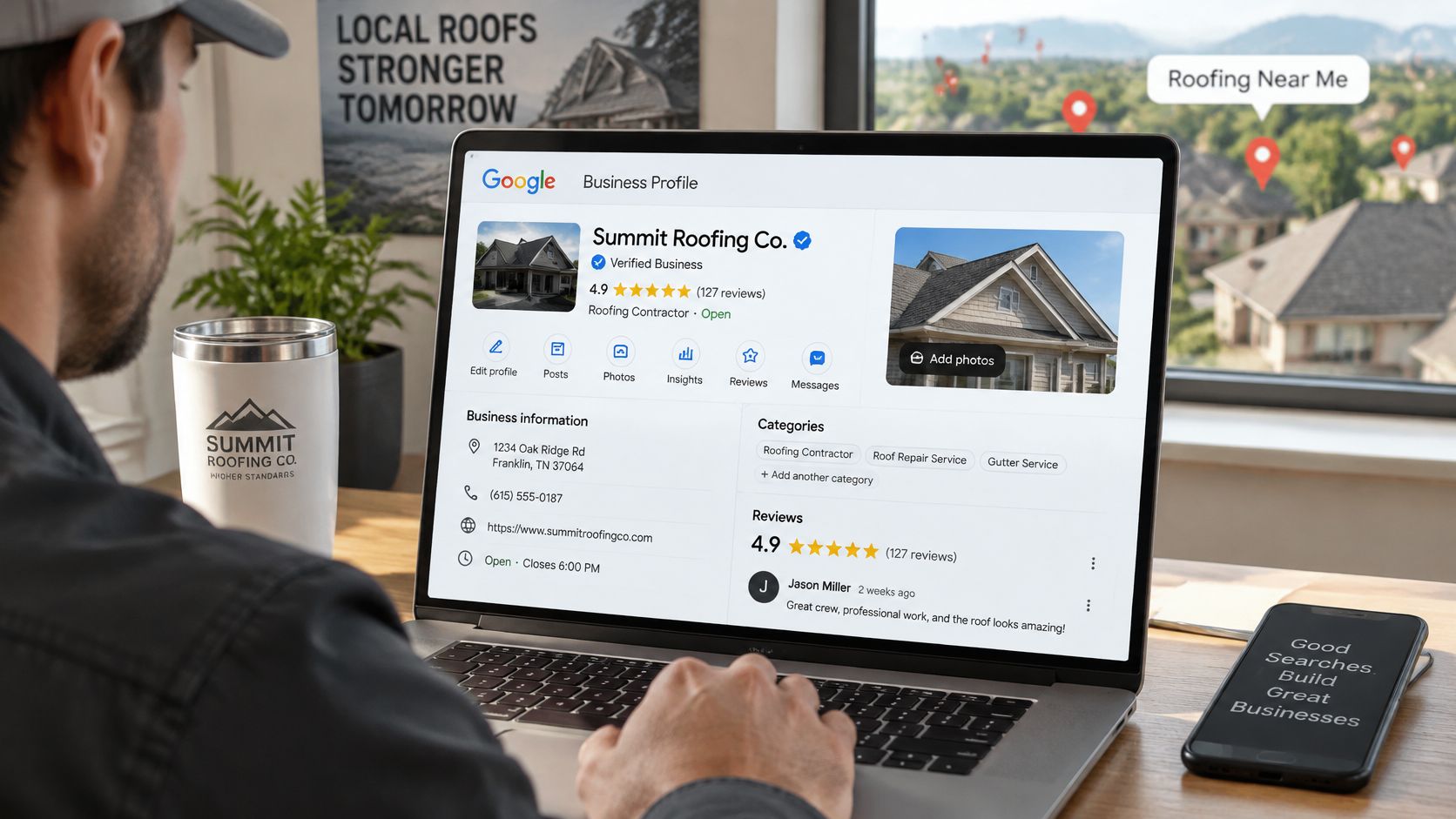
The profile is a shop window. Homeowners read it, and answer engines read the same signals. Verified name, address, and phone, categories, services, service areas, hours, photos, and reviews. If those details disagree with the website, both people and answer tools treat the business as unfinished.
What belongs on the profile
Set the primary category to roofing contractor. List services that match how people search. Repair, replacement, inspection, and storm damage. Add service areas by city and ZIP code, not a vague county name. Publish hours, including emergency availability if a crew answers after dark. Upload photos of completed jobs every week, with captions that name the city and the work, such as "asphalt replacement in Longview after hail."
Profile posts and Q&A can carry the same pricing and process questions the website answers. A short post that says a typical repair quote follows an on-site inspection, and that someone returns calls the same business day, gives the map listing a reason to be tapped.
For a fuller checklist of categories, services, and photo habits, use this guide on how to optimize a Google Business Profile.
Answer engines and the mistakes that get listings pulled
Answer tools cite businesses they can verify. On the site, write a direct answer under a clear question heading, such as "How much does a roof replacement cost in Tyler?" Keep the business name, address, and phone identical on the website, the profile, and every directory.
Practical rule: One legal name, one phone number, one address format, everywhere.
Three mistakes show up constantly.
- Duplicate listings: Old DBA names and a second pin at the warehouse split reviews and confuse directions.
- Keyword-stuffed names: "ABC Roofing Best Roofer Near Me Cheap" is a suspension risk, not a ranking trick.
- Unanswered reviews: Silence reads as a crew that disappears after the check clears.
Monthly audit
Once a month, open the profile and check five items. Categories and services still match what you sell. Service areas still match where trucks go. Hours, including storm coverage, are current. New job photos are up. Every new review has a reply. Screenshot the public listing so you can see what changed if Google edits a field on its own.
Mapping Roofing Searches to the Right Pages
Roofing buyers do not all want the same page. Urgent leak searches, price research, and "is this company real" checks need different proof and a different next step.
| Search Query Type | Buyer Stage | Page to Build | Conversion Action |
|---|---|---|---|
| 'roofer near me' or 'emergency roof leak repair' | Urgent need | Emergency repair page with city name | Tap-to-call above the fold |
| 'roof repair [city]' | Problem known, choosing a provider | Service-area repair page for each city | Request an inspection |
| 'storm damage roof inspection' | Insurance concern and timing pressure | Storm damage and claims guide | Phone call or inspection booking |
| 'roof replacement cost [city]' | Researching price | Pricing guide with ranges by project type | Estimate request |
| 'metal vs asphalt shingles' | Early research | Material comparison guide | Email signup or consultation request |
| '[company name] reviews' | Verifying before calling | Reviews and project proof page | Call or estimate request |
Urgent and local repair
"Roofer near me" and "emergency roof leak repair" are people with water in the house. The page needs the city name, a phone number above the fold, and a callback promise the crew can keep, such as a return call within 30 minutes during posted hours. A homepage slider about craftsmanship loses that call.
"Roof repair [city]" is a homeowner who already knows the problem and is choosing a provider. Build a real service-area page for each city you serve. Use local project photos and crew details. Swapping a city name into a template is obvious, and it does not answer whether you work there.
Storm spikes and earlier research
Say hail hits a town on a Tuesday night. By Wednesday morning, "storm damage roof inspection" searches jump, and out-of-area crews buy ads. A company with a claims guide and an inspection booking form captures calls a generic homepage loses. The page should explain documentation, what an inspection includes, and that you do not control the carrier's decision.
"Roof replacement cost [city]" and "metal vs asphalt shingles" attract earlier visitors. They are not ready to book a crew today. A pricing guide and a material comparison can move them into an estimate request or a consultation without pretending they are emergency leads. When you publish ranges, tie them to how the estimate is built. Tools such as Exayard roofing estimating software help a sales lead keep square count, pitch, and material choices consistent so the number on the page and the number in the proposal do not contradict each other.
Someone searching the company name plus "reviews" is verifying you before they dial. That page should show project proof and a direct way to call.
Page checklist
Every page in this map needs five things.
- City: Name the place you will roll a truck.
- Service: One job type, not a menu of everything you have ever done.
- Proof: A local photo, a license, or a review about that kind of work.
- One primary call to action: Call, inspection, or estimate, not all three competing.
- A link to the next stage: Emergency page to repair page, repair page to pricing, pricing page to inspection.
Build from the top of the table down. Emergency and city repair pages pay back sooner than material essays.
Turning Roofing Page Visitors into Calls
A roofing website is conversion infrastructure. If a mobile visitor cannot find the number or understand the next step quickly, more traffic will not solve the problem.
First screen
Open the homepage and emergency page on a phone. The first viewport should show the company name, the city served, a tap-to-call button, a request-an-inspection button, and one proof element, such as a star rating or license number. Move anything buried below the fold. A person with an active leak should not have to search for the phone number.
Google's mobile-page analysis found that when load time increased from one second to ten seconds, the probability of a mobile visitor bouncing increased by 123%. It also found that increasing page elements from 400 to 6,000 was associated with a 95% decline in conversion probability. Faster mobile loading tends to support better conversion, so strip out anything that delays the first useful screen.
Compress project photos, serve modern formats, and keep heavy galleries and chat widgets off the initial load. Set image dimensions so the phone number stays put as the page loads. Defer scripts that are not needed to display the call button.
A slow, polished desktop layout still loses the after-storm searcher. A focused web design for roofers project should treat the phone viewport as the product, not a smaller copy of desktop.
Forms and calls to action
Keep the form to four to six fields: name, phone, address, and a short problem description, with an optional photo upload for storm or leak damage. That gives the office enough information to triage without making a caller complete a long questionnaire. The confirmation page should state the next step and the expected response time, such as “A coordinator calls you within one business hour.”
Give each page one primary action. Put a phone link in the header and footer, and add a sticky call button on mobile so the number stays reachable while someone reads.
If the crew cannot meet the response time on the confirmation page, change the promise before changing the button color.
Test order
- Fix speed first. Compress images, remove noncritical widgets, and check loading on a phone.
- Then check the call to action. Make sure the company name, city, call button, inspection option, and proof element appear in the first viewport.
- Then refine the form. Keep the core fields and make photo upload optional.
- Track conversion by device after each change, so a desktop gain does not hide a mobile loss.
Change one thing at a time. If you redesign the page, shorten the form, and move the call button in the same week, you will not know which change brought in the calls.
Publishing Pricing and Process Transparency
Hiding every price does not protect margin. It sends buyers to the competitor who shows a range and explains what moves it.
In 2024, 66% of homeowners surveyed by Roofing Contractor said they would call a roofing contractor that made pricing available on its website. A later 2025 nationwide homeowner survey found that 78% of respondents were more likely to call a contractor whose website displayed pricing transparently, while about 76% of contractors did not publish pricing online. The gap is the opportunity. You are not posting a coupon. You are stopping a qualified caller from shopping three other sites just to learn a realistic band.
What each range must say
| Project Type | What the Range Should Explain | Variables to Name | Process to Show |
|---|---|---|---|
| Roof inspection | Inspection fee, if charged, and what the report contains | Roof access, size and photo documentation | Scheduling and report timeline |
| Roof repair | Typical range for common repairs | Pitch, access, material and decking damage | Diagnosis, written quote and repair date |
| Roof replacement | Range by square footage and material | Tear-off, decking, underlayment, permits and labor | Inspection, estimate, contract and installation |
| Storm damage and insurance claim | What the estimate includes compared with the carrier scope | Deductible, adjuster visit and supplements | Documentation and claim support steps |
| Maintenance plan | Annual or seasonal fee | Number of visits and included repairs | Scheduling and renewal |
Write a range without a fixed promise. State the basis, such as a typical single-story asphalt replacement in your labor market. Name exclusions, such as rotten decking, skylights, or code upgrades. Say plainly that an inspection confirms the scope. Do that on every row, not only on replacement.
Name the variables that move price. Roof size, pitch, material, tear-off, decking, permits, and local labor costs. A visitor who sees those factors stops treating your number as a bait price.
Self-qualification and claims
Put a short checklist on the page so weak fits sort themselves.
- Roof age and number of stories.
- Material preference, if they have one.
- Insurance claim status, including whether an adjuster has visited.
- Timeline, including active leaks versus a planned replacement.
On storm work, describe what your estimate includes compared with the carrier scope, and how you document supplements. Do not guarantee a payout. Say you support the claim with photos and measurements, and the carrier decides coverage.
Page order that converts. Range, price variables, what is included and excluded, financing if you offer it, then a request-an-inspection button. The inspection is the close, not a number locked in from a web form.
Running Review, Referral and Partner Programs
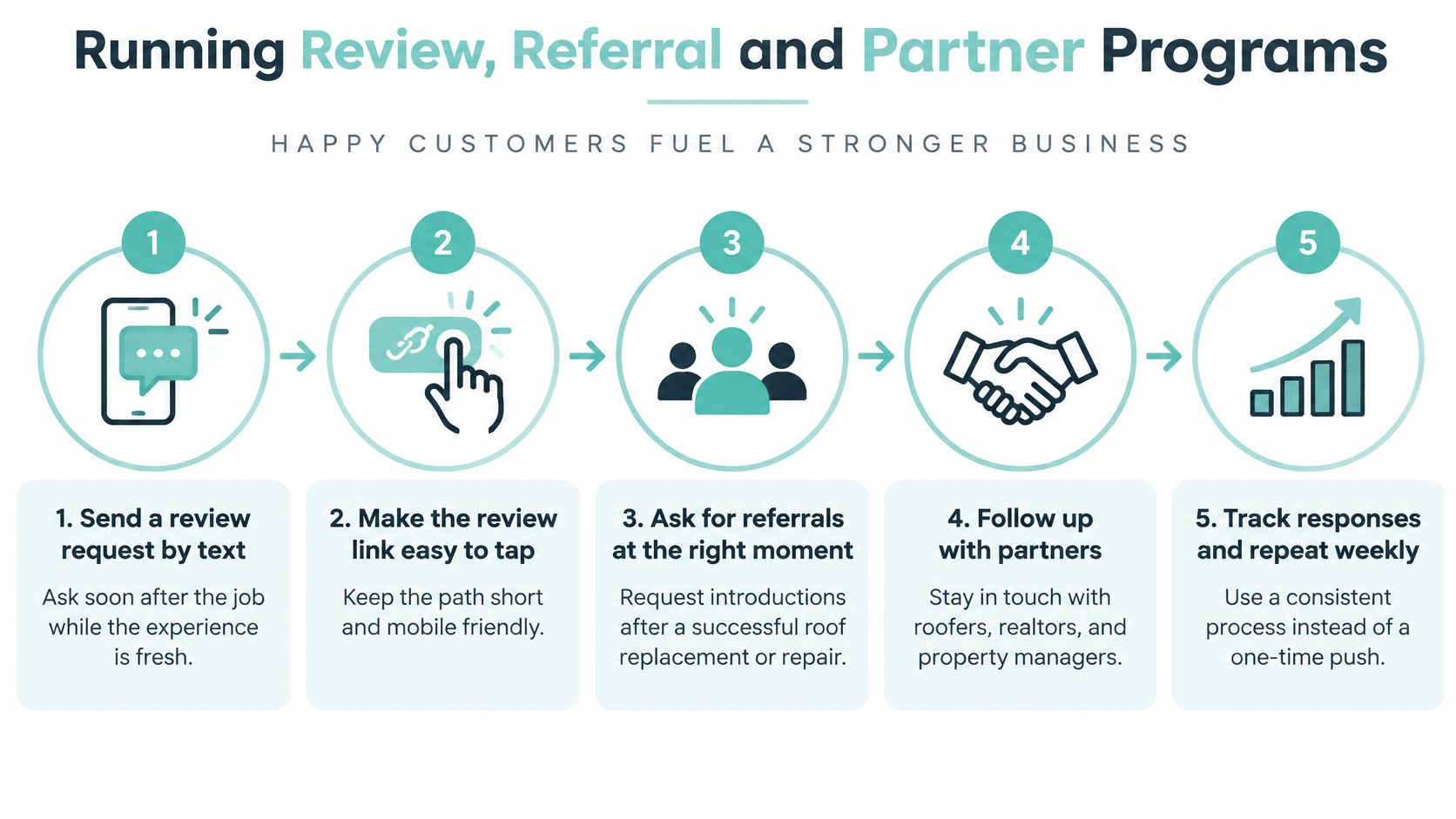
Reviews, referrals, and partner leads fail when they are a one-time push after a slow month. They work as a routine tied to job close.
In the same 2025 homeowner research published by Roofing Contractor, 40% of respondents named poor communication as the biggest challenge when working with a roofing contractor, and 67% said online reviews were very or extremely important. Another 2025 local-search survey in that coverage found reviews and ratings were the most valued information in local-business discovery at 33.6%, ahead of contact details and hours at 29.5%. Communication proof belongs next to the stars, not in a separate slogan.
The weekly routine
Say the crew closes jobs on Friday afternoon. The office does not wait until "sometime next week."
- Send a review request by text with a direct link within 24 hours of job close. Friday's jobs get the text Saturday morning, while the homeowner still remembers the crew in the driveway. Email alone sits unread.
- Ask about the whole experience. Prompt them on communication, schedule, and clean-up, not only the finished roof. Those details are what the next buyer is afraid you will botch.
- Reply to every review within 48 hours. Thank the customer and name the crew lead when it fits. A reply is part of the public record.
- Publish a communication standard on the website. Response time, update frequency, photo documentation, change-order steps, warranty escalation, and the responsible contact. Review requests should invite customers to describe that experience.
- Build a referral list. Insurance agents, realtors, property managers, and HOA boards each get a one-page brief on service area and how you handle claims. You are making their job easier, not asking for a favor with no context.
- Hold a quarterly partner check-in and track referred inquiries by source so you know which relationships produce booked jobs.
A practical script for the text, including what not to say, sits in this note on how to ask for reviews.
Never offer incentives for reviews, and never filter requests by who seemed happy. Incentives and cherry-picking create policy problems and thin, unbelievable praise. Ask everyone who finished a job, reply to the rough ones, and let the pattern of communication show up in public.
Tracking Roofing Leads and the KPIs That Matter
Total organic sessions mislead. A storm week can double traffic from people reading a hail article who never call, while a thin emergency page produces the jobs. Track leads by channel, landing page, and device, or you will fund the wrong work.

Working dashboard
| Metric | Definition | Where to Track | Starting Benchmark |
|---|---|---|---|
| Organic phone calls by page | Calls from organic visitors, by landing page | Call tracking numbers per service page | Set from 30-day baseline |
| Estimate form submissions | Completed estimate or inspection forms | Form source field in the CRM | Set from 30-day baseline |
| Booked inspections | Inquiries that became a scheduled inspection | CRM pipeline stage | Set from 30-day baseline |
| Close rate | Booked inspections that became signed jobs | CRM reporting | Set from 30-day baseline |
| Cost per booked job | Total channel cost divided by booked jobs | Spend records and CRM | Set from 30-day baseline |
| Google reviews count and rating | New reviews per month and average rating | Google Business Profile | Set from current count |
| Profile calls and direction requests | Calls and direction taps from the profile | Google Business Profile insights | Set from 30-day baseline |
| Mobile conversion rate | Share of mobile sessions that call or submit a form | Analytics segmented by device | Set from 30-day baseline |
Give each service page its own call tracking number. Put a source field on every form and set it at first contact. Use a CRM stage for booked inspections so "we talked" is not counted as a job. Review profile insights monthly beside the website numbers.
Attribution traps and cadence
A call after a Google search might be a branded search, a referral who looked you up, or a returning visitor. If the source field is filled in after the sale, the channel that "won" is whichever salesperson remembers. Set the source when the lead is created, and do not overwrite it when they call back.
National averages will not tell you if your close rate is healthy. Record 30 days of calls, forms, profile actions, and reviews before you change pages or bids. Targets come from that baseline.
- Weekly: Calls and form submissions by page and device.
- Monthly: Close rate and cost per booked job.
- Quarterly: Channel mix, including partner referrals next to organic and paid.
Read each row as a question. Which page produces calls? Which source books inspections? Does mobile convert, or only desktop? If close rate is strong and call volume is thin, add the next city page. If calls are strong and close rate is weak, the handoff to sales is the problem, not the marketing.
Launch the 90-Day Roofing Lead Plan
Use the dashboard you just defined. Do not restart the channel debate.
Days 1 to 7. Verify the Google Business Profile and look for duplicate listings. Confirm the business name, address, and phone match the website and directories. Screenshot the mobile first viewport. Save 30 days of calls, forms, profile insights, and review count as the baseline. Before any partner email goes out, run the from-address through an email tester so inspection reminders do not land in spam.
Days 8 to 30. Finish categories, services, city and ZIP service areas, and emergency hours. Publish the emergency leak page, one city repair page, and the storm inspection page. Install one call-tracking number per page. Text a review link within 24 hours of job close.
Days 31 to 60. Publish the pricing ranges and the communication standard. Cut the form to name, phone, address, and problem. Retest the sticky call button on a phone.
Days 61 to 90. Brief five insurance agents or property managers. Compare calls, booked inspections, and close rate with the baseline. Strong calls with a weak close rate mean fix the sales handoff. Low calls mean add the next city page before buying ads.
Digital Skyrocket is a web design and local SEO agency with offices in Tyler and Dallas. Owners who want web design in Tyler, TX can start on the homepage, and teams farther east can look at a web design agency in Longview, TX for the same kind of service-area build.
Digital Skyrocket plans and builds lead-generating websites for roofing companies, with local SEO, answer-engine-ready pages, and conversion work tied to calls and inspection requests. If your profile, city pages, or pricing content are not producing qualified inquiries, visit Digital Skyrocket and ask for a discovery session on a roofing site rebuild.