In 2025, 56% of 3,964 U.S. adults surveyed by Tebra said they began searching for a healthcare provider on Google, according to SEO Guarantee's report citing Tebra. For a dental practice, that search can be the moment a stranger starts comparing treatments, location, hours, and trustworthiness, before deciding whether to call.
SEO dental marketing connects those searches to a useful page and a real way to book. It brings together local search visibility, service and city pages, reviews, website performance, and a clear phone or appointment path. Rankings matter, but a ranking without a booking path won't fill the chair.
Table of Contents
- Why Patients Start With a Search
- The SEO Dental Marketing Priority Stack
- Google Business Profile and City Service Pages
- Reviews That Build Trust Without Breaking Rules
- Page Speed Content and Answer Visibility
- Conversion Paths That Turn Visits Into Calls
- A 90 Day Implementation Roadmap
- What to Report Each Month
- How to Choose the Next Website and SEO Partner
Why Patients Start With a Search
Consider a single-location practice with loyal patients but a quiet new-patient phone line. Someone nearby searches “emergency dentist” or “dental implants” plus a city. The practice may offer exactly the service they need, but if its website doesn't make that service, location, and next step clear, the searcher can choose another provider before calling.
That's the practical purpose of SEO dental marketing: help the right people find the practice, give them enough relevant information to judge whether it fits, and make it easy to take action. The work is not just buying ads, posting on social media, or adding blog posts that don't connect to a service or location. It's organizing the practice's online presence so a search for a treatment or a nearby dentist can lead to a relevant answer and a genuine inquiry.
Start with the decision the searcher is making
Some patients search to understand a symptom or treatment. Others already know what they want and are comparing local options. A person reading about dental implants may need an informative procedure page; someone searching for an emergency dentist in a named city needs to find availability, hours, and a phone number quickly. Those are different needs, so they shouldn't be sent to the same generic homepage.
A practice website should help a prospective patient verify the essentials without hunting. The relevant service should be named plainly, the clinician's role and credentials should be understandable, and the page should explain what to do next. If the practice accepts certain insurance plans or offers payment options, clear information can answer questions that might otherwise prevent a call.
For readers who want a patient-facing example of local discovery, find a Fair Lawn dentist offers context on how someone might approach a “dentist near me” search. For a practice owner, the lesson is straightforward: being found is only the first part of acquisition. The page must also give the searcher a reason to trust the practice and an obvious way to reach it.
Track the outcome in calls, appointment requests, and booked new patients, not just ranking reports. That keeps the work tied to the business problem that matters: a qualified searcher has to become a real conversation with the practice.
The SEO Dental Marketing Priority Stack
| Tactic | Why it comes first | Owner | Number to watch |
|---|---|---|---|
| Google Business Profile | Relevance, distance, and prominence decide the local pack | Front desk plus marketer | Calls, direction requests, booking clicks |
| Service and city pages | Dentist-plus-city queries favor practice sites over directories | Writer and developer | Sessions and form starts on those URLs |
| Review operations | Proximity and review quality outweigh raw rank for many health searchers | Owner sets policy; staff ask after visits | New reviews, recency, rating, theme log |
| Technical experience | Slow or shifting mobile pages lose the call | Developer | LCP 2.5s, INP 200ms, CLS 0.1 at the 75th percentile |
| Procedure content for answers | Clear services, credentials, and city help Google and AI summaries | Content lead | Inquiries from those pages, not vanity mentions |
| Conversion path | A ranking without phone, hours, or a form does not book the chair | Designer | Call clicks, forms, booked new patients |
Google reported that 76% of people who searched for something nearby on a smartphone visited a related business within one day, a finding about nearby businesses broadly rather than dental practices specifically, as summarized in healthcare local SEO statistics. It's a useful reason to treat local visibility as an appointment opportunity, not just a branding exercise. But the order of work matters: a profile and relevant landing page are of little value if a searcher can't confirm the practice's details or contact it.
Google identifies relevance, distance, and prominence as the primary factors in local search rankings. Its guidance says prominence can be influenced by links from other websites and by the quantity and quality of reviews, so stuffing a city name into a page isn't a complete local strategy. The profile needs accurate details, while the website needs pages that fit the actual services and communities the practice serves.
Patient decisions aren't made on ranking position alone. In a representative survey of 1,227 U.S. consumers who had recently searched for a local business, 48% of people searching for health or medical businesses considered address or proximity, 30% considered having the most or best reviews, and 32% prioritized clear, complete information such as hours, address, and phone number. Only 16% of local searchers overall identified ranking position as a decision factor, according to BrightLocal's consumer search behavior study. That's why the stack makes trust, usability, and leads part of SEO rather than treating them as separate work.
Before choosing two priority queries, pull the last 90 days of Search Console queries. Keep only searches that match a service the practice can provide in the named city. If the team can't fund all six priorities right away, start with a complete profile, two high-intent service-and-city pages, and a consistent, compliant review request.
Google Business Profile and City Service Pages
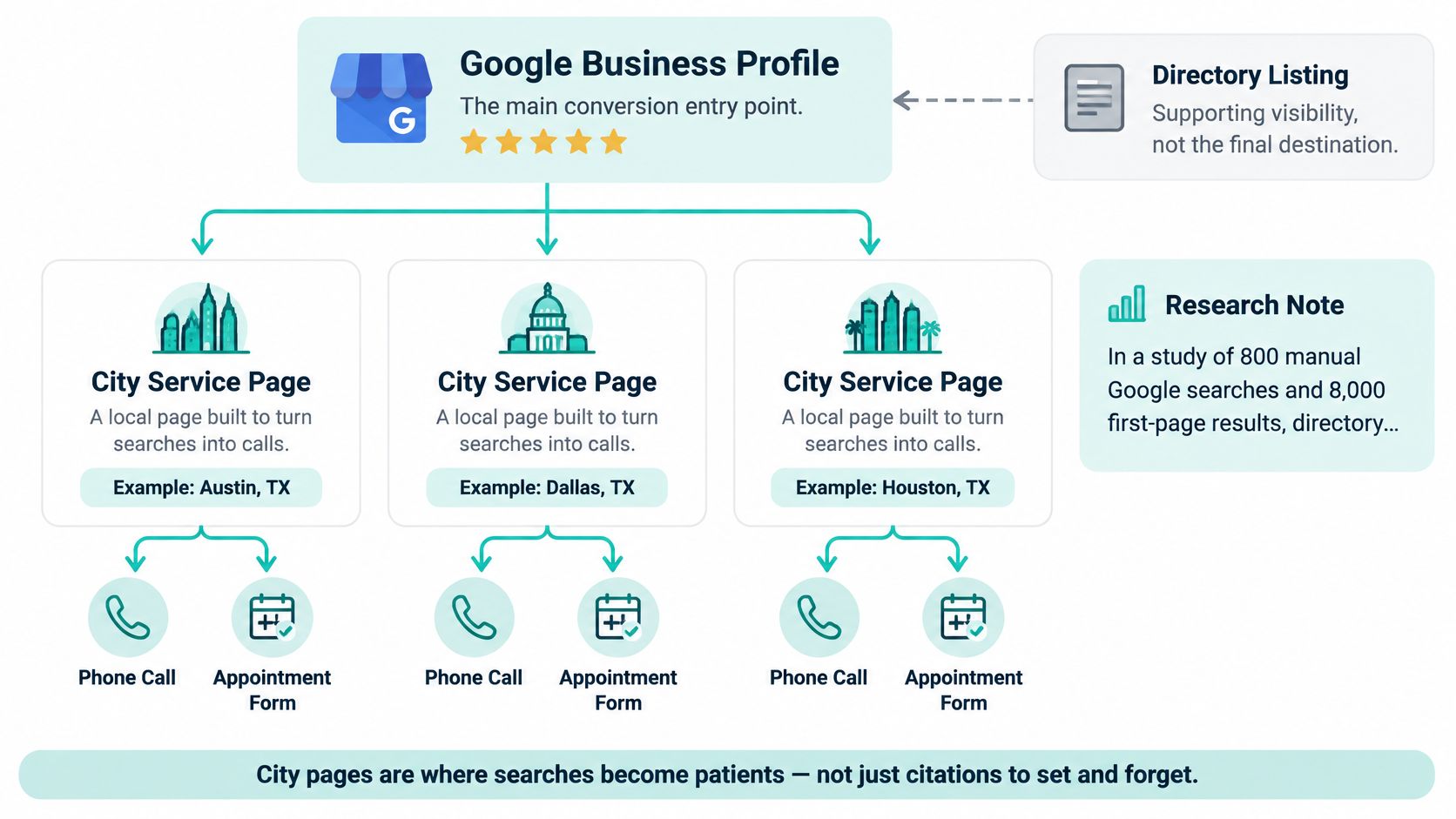
Google Maps, organic results, and AI answers are separate places patients may encounter a practice. A complete Business Profile helps patients assess the listing in Maps, while service-city pages give the website a place to answer searches such as “dental implants in [city].” For “dentist [location]” searches, directory pages represented 3% of first-page results in a BrightLocal study of 800 manual Google searches covering 8,000 first-page results. For “best dentist” searches, directory visibility rose to 34%. The difference makes it useful to build relevant website pages for service-and-city queries and keep third-party listings accurate for comparison searches.
Build pages for real services and real places
Create indexable pages for services the practice provides in places it serves. Depending on the practice, those could include emergency dentistry, pediatric dentistry, dental implants, and a general dentist page for the primary city. Each page should reflect a real service area and explain the care available there. A city name alone gives a page little value to a prospective patient.
Include the details a patient needs to decide whether to call:
- The service and patient outcome: Explain what the practice offers and the concern it can address.
- The clinician: Identify the provider and include relevant credentials.
- The location details: Keep the name, address, and phone consistent with the Business Profile.
- Practical appointment information: State hours and relevant insurance or payment information.
- One clear next step: Add an appointment call to action that leads to the right contact or booking option.
Link related service, city, and contact pages so patients can move from learning about care to contacting the practice. For planning this structure, see Digital Skyrocket's guide to location landing pages.
Complete the profile and validate the page
Check the Business Profile's primary category, services, service area, hours, and photos. Patients should be able to recognize the practice and find its contact details. On the website, use LocalBusiness structured data for details such as hours and departments, then validate the markup and check the page through URL Inspection. Structured data can clarify business information, but it does not replace useful visible copy or guarantee a particular search display.
| Asset | Required fields | Check after launch |
|---|---|---|
| Google Business Profile | Primary category, services, service area, hours, photos | Match name, address, and phone to the site and preview the listing |
| Service-city page | Patient outcome, clinician credentials, hours, insurance or payment notes, one appointment call to action | Load the URL on a phone and confirm the booking path is easy to find |
| LocalBusiness structured data | Hours and departments | Validate the markup and check rendering with URL Inspection |
| Third-party directory listings | Same name, address, and phone as the profile | Confirm listings cover comparison queries such as “best dentist” |
The LLMrefs guide to San Francisco SEO offers a city-specific example of local search optimization. After publishing, check two places on a phone: the Business Profile and the highest-intent city page. Confirm that both show consistent details and a working route to an appointment.
Reviews That Build Trust Without Breaking Rules
A high star count can hide a stale or vague review profile. BrightLocal reports that 97% of consumers read reviews before choosing a local business and that Google's share of review-source usage fell from 83% to 71% in its survey, with people also checking sites such as Healthgrades, Vitals, and Zocdoc (BrightLocal survey figures discussed in an industry article about how patients choose a dentist). Many patients consult more than one review site, so a practice's reputation can't be judged by its Google rating alone.
Ask consistently, without steering the answer
Use one neutral process to invite eligible patients to share feedback after a visit. Staff should use the same wording regardless of how satisfied a patient seemed, and the request should never offer a reward for a positive rating. For example:
“If you'd like to share feedback about your visit, you can leave an honest review on one of our review profiles. Your feedback helps us understand what's working and what we can improve.”
Keep a list of the platforms the practice maintains, and don't filter requests based on who staff think will leave a favorable review. Reviews can also surface recurring concerns, such as wait times, anxiety support, financing clarity, emergency availability, or communication. Use those themes to make service-page explanations and appointment information clearer, rather than stuffing keywords into a profile.
Protect patient privacy in public replies
Never confirm publicly that a reviewer is a patient. Thank the person for writing, invite them to contact the practice privately, and avoid mentioning treatment, diagnosis, insurance, or other personal details. Even if a reviewer shares private information first, keep the clinical conversation off the public thread.
Review testimonials, before-and-after stories, and incentivized feedback before publishing. The Federal Trade Commission's guidance on health-related advertising and endorsements says advertisers are responsible for misleading endorsements and testimonials. A testimonial must not imply results the practice cannot substantiate. If a result is unusually dramatic, clearly and prominently explain what typical consumers can expect; disclose any material connection, including an incentive.
Recent, specific, privacy-safe feedback gives prospective patients more useful context than a padded average. Practices can also explore reputation management for dentists to support a consistent review process. Start with the neutral script, ask eligible patients consistently, and leave the rating entirely up to them.
Page Speed Content and Answer Visibility
“Optimize the site” often bundles three different jobs: measuring real visits, making pages usable, and helping content appear in search answers. Those jobs need separate checks. Google Maps visibility, organic page performance, and AI-generated answers are different discovery surfaces, so one ranking report can't measure all three.

Measure what patients experience
Google's Core Web Vitals define good performance as Largest Contentful Paint (LCP) at 2.5 seconds or less, Interaction to Next Paint (INP) at 200 milliseconds or less, and Cumulative Layout Shift (CLS) at 0.1 or less. These thresholds use field data from visits and are evaluated at the 75th percentile, as described in Google's Core Web Vitals documentation. A desktop test by a developer won't tell you how the page performs for actual patients on their devices and connections. Check field results in Search Console for the templates that matter, including service pages and appointment forms.
Accessibility belongs in the same build conversation. The American Dental Association advises practices to discuss accessibility with their developer and consider recognized standards, including WCAG 2.0 Level AA, in its guidance on the Americans with Disabilities Act. In practical terms, patients should be able to move through with a keyboard, use screen readers with properly labelled controls, distinguish text through sufficient contrast, access captions where needed, and complete forms without confusion.
Treat AI answers as their own measurement problem
AI-mediated discovery is still difficult to measure consistently. Industry reporting on dental practice marketing claims that 47% of patients have used AI chatbots to find a healthcare provider, up from 31% nine months earlier, while 16% of practices are actively adapting. The same reporting cautions that the figures come largely from industry commentary and don't establish a reliable ranking formula. Don't budget for speculative tactics such as keyword-stuffed conversational copy.
Focus instead on inputs a practice controls: clear procedure pages, clinician credentials, a specific service area, consistent third-party references, structured data, and current reviews. Then check an AI answer manually for a procedure-plus-city query and record whether the practice is named. A mention is not a new-patient lead unless a call or form can be connected to it. For an introduction to turning AI summaries into influence, consider how answer visibility can support a clear patient decision without mistaking mentions for booked appointments.
A useful procedure page answers one concern, names who performs the treatment, and gives the patient a sensible next step. Keep that purpose in view whether the page needs a technical repair, clearer writing, or a better appointment route.
Conversion Paths That Turn Visits Into Calls
A ranked page can still fail as a patient-acquisition tool if it makes the visitor search for a phone number or guess how to book. Start by checking the top three money pages on a phone. For each one, note every step between the search result and a completed appointment request.
The first screen should show the practice name, city, hours, and a tap-to-call number. Put the booking button where a patient can see it without scrolling, then repeat it on longer pages so the next step stays easy to find. Keep forms short: ask for a name, phone number, preferred time, and reason for the visit. Move insurance questions to the call if they aren't essential to making the initial request.
Make every form field clearly labelled and usable with a keyboard. That supports both the booking process and accessibility. Avoid pop-ups that obscure the first screen on mobile, especially if they interrupt the searcher before they've seen the practice details.
Test one change at a time, such as placing a clinician photo beside the booking button or moving a financing note above the form. Record call clicks, form starts, form completions, and booked new patients for each page. If clicks rise but booked patients don't, investigate the quality and usability of the path before declaring a win.
A 90 Day Implementation Roadmap
Keep the work focused on getting two relevant pages and the profile in shape before expanding into more content. The sequence below assigns one deliverable to each block, so the practice can see what must be completed before the next stage begins.
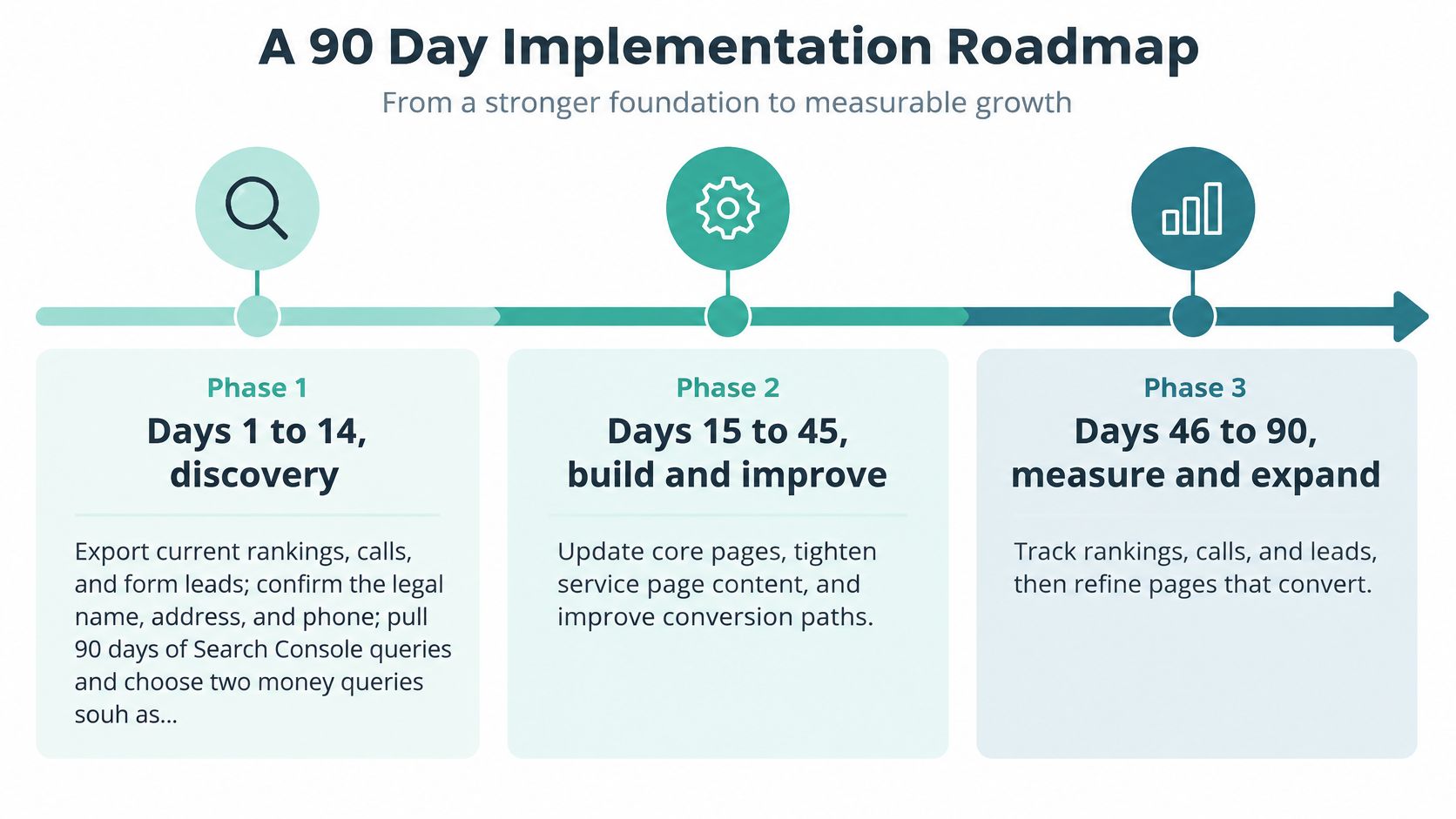
Days 1 to 14, discovery. Export current rankings, calls, and form leads. Confirm the practice's legal name, address, and phone number, then review the last 90 days of Search Console queries. Choose two money queries, such as emergency dentist and dental implants in the primary city, only if the practice can treat those patients there. Deliverable: a baseline sheet.
Days 15 to 30, profile and two pages. Correct the Google Business Profile's categories, hours, services, and photos. Publish or rewrite the two priority pages so they include clinician credentials and one clear booking route. Deliverable: two live pages matched to the profile.
Days 31 to 45, reviews. Start a neutral post-visit review request, train staff not to confirm patient status in public replies, and claim the secondary review profiles that matter to the practice. Deliverable: a reply script and a list of claimed profiles.
Days 46 to 60, technical fixes. Repair the page templates that fail field Core Web Vitals. Check the form and menu for problems that prevent keyboard or screen-reader use. Deliverable: a passing template checklist.
Days 61 to 75, expansion. Add another service or city page only if the first two generate inquiries. Include clinician information a patient can verify rather than unsupported claims. Deliverable: one new page with verifiable clinician proof.
Days 76 to 90, review. Read the monthly report, investigate pages that receive impressions without calls, and document what changed in booked new patients. Deliverable: the owner note.
A solo marketer shouldn't start blogging in the first month if the profile and priority pages still need work. An agency should be able to show a similar calendar before design begins. A new website that launches without a completed profile, useful money pages, and a working booking path risks recreating the same quiet-phone problem.
What to Report Each Month
| Surface | Metric | Cadence | Good signal |
|---|---|---|---|
| Google Business Profile | Calls, website clicks, direction requests | Weekly | More actions on priority services |
| Organic landing pages | Sessions by service and city URL | Monthly | Traffic matches treatable queries |
| Reviews | New reviews, recency, rating, themes | Monthly | Recent specific feedback and private replies |
| Technical templates | Field LCP, INP, and CLS | Monthly | Good at the 75th percentile of visits |
| Leads | Calls, forms, booked new patients by source | Weekly | Inquiry trend tied to a service |
| AI answers | Named or not named for procedure plus city | Quarterly | A mention that also shows up as a call or form |
Keep the report to one page and read it in the same order each month. Profile actions show whether local listings prompt people to engage; service-and-city landing pages show whether the site attracts searches the practice can serve. Reviews belong in the report as a quality check, including recency and themes, not just as a count.
Technical status should use field results for the main page templates. For AI answers, record whether the practice is named for a selected procedure-plus-city search, then compare that observation with calls and forms. The mention alone doesn't establish that an AI answer generated an inquiry.
Owner-ready reporting: “Implant page sessions rose, eight calls came from that page, and three became new patients.”
That sentence connects a page to outcomes the practice can understand. “We're number four for dentist” does not tell the owner whether the ranking generated a call, whether the caller could book, or whether the practice gained a patient.
If calls drop while rankings rise, inspect the basics before publishing more content. Confirm that the phone number, hours, form, and appointment path are accurate on the pages patients use. Give the front desk and owner the same report so both teams can identify where inquiries stall.
How to Choose the Next Website and SEO Partner
Use four tests before comparing proposals. A suitable partner should be able to rebuild or seriously rework the website, maintain local SEO, manage reviews within privacy and advertising rules, and report profile actions, page inquiries, and new patients each month. A proposal limited to social posts or ads won't meet those requirements.
Ask whether the firm already serves another dentist in the same city. A practice shouldn't fund a vendor that also optimizes its direct local competitor. Ask for a fit meeting and a discovery report before agreeing to a redesign, and use a practical guide to choosing an SEO agency to shape the questions you take into that conversation.
Digital Skyrocket offers website design and ongoing SEO for service businesses, including local search, answer-focused pages, reputation management, and conversion improvements. East Texas practices comparing web design options can review web design agency in Longview, TX and web design in Tyler, TX. If the current site is accurate, fast, and already bringing in qualified inquiries, keep the team and fix the weakest part of the process instead of hiring.
Digital Skyrocket builds lead-generating websites and provides ongoing SEO, local search, reputation management, and conversion improvements for practices that want search visibility to lead to real inquiries. Visit Digital Skyrocket to discuss a website and SEO plan built around the services and cities your practice can serve.