Your crew does good work, your vans are recognizable, and your website looks professional. Yet when you check the map results for an electrician in your town, competitors keep appearing while your phone stays quiet. The problem may not be your workmanship or even your website design. Customers and search engines may struggle to confirm what you do, where you work, and why they should trust you.
Local SEO for electricians works best as a connected system: your Google Business Profile identifies the business, service pages explain the work, citations confirm your details, and reviews provide independent evidence. The final test isn't a ranking screenshot. It's whether the right customer can find you, verify your expertise, and call from a phone without friction.
Table of Contents
- How Google Ranks Electricians in Your Area
- Set Up and Verify Your Google Business Profile
- Find the Searches Electricians Win
- Build Service-Area Pages Google Will Treat as Useful
- Citations and Schema That Confirm Your Details
- Reviews That Show Specific Expertise
- Choose Your First Three Fixes This Quarter
How Google Ranks Electricians in Your Area
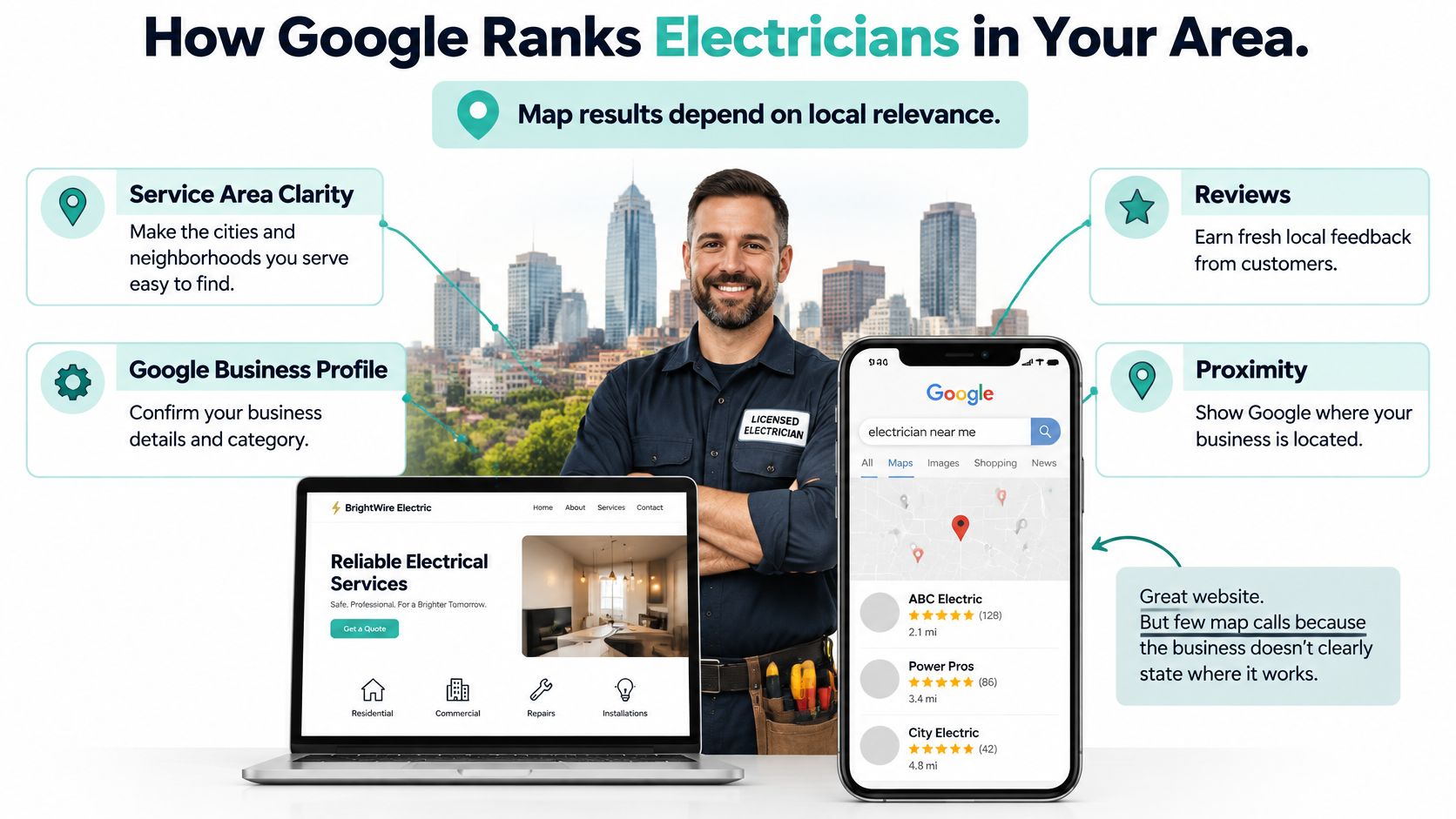
Say you're a licensed electrician in a mid-sized city. Your website has polished photography and a contact form, but your profile describes only general electrical services, and your website barely mentions the towns you serve. A good-looking site doesn't resolve that uncertainty.
Google's local ranking guidance identifies relevance, distance, and prominence as the primary local ranking factors, and says review quantity, positive ratings, and links can contribute to local visibility. Treat these as separate diagnostic questions rather than interchangeable SEO tasks.
Local ranking factors and what electricians should fix
| Ranking factor | What Google measures | Electrician action |
|---|---|---|
| Relevance | How closely the Business Profile matches the search | Accurate service categories, a description naming real jobs, and correct hours |
| Distance | How far the business is from the searcher or the searched location | Defined service areas and city-specific pages instead of one regional page |
| Prominence | How well known the business is across the web | Reviews, links and mentions from trusted local sites |
Distance needs a qualification: listing a city doesn't move your business closer to its residents. Geographic content helps explain coverage, but it doesn't override physical proximity. Don't interpret service-area settings as a ranking-radius control.
Diagnose the weakest factor
A complete profile with little independent evidence can still struggle on prominence. Strong reviews won't make an unclear service description relevant to someone seeking an EV charger installer.
Use this breakdown of Google Maps ranking factors to separate missing business information from authority gaps. Seek legitimate local mentions through trade associations, suppliers, community projects, and business partnerships, not bulk link packages.
For a practical spot check, search your main service plus your town from a phone away from your office. Record your location, the query, and the businesses that appear. This isn't a definitive ranking report, but it helps you identify whether competitors explain their services better, operate nearer the search location, or show stronger evidence of customer trust.
Set Up and Verify Your Google Business Profile
Your profile should describe the business you operate today, not the territory or emergency schedule you hope to offer later. Assign ownership to a company-controlled Google account so an employee's departure doesn't interrupt access.

Configure the business accurately
Claim the existing listing. Search for your company before creating anything new, then confirm the business name against your real-world branding and electrical-license records. Don't add city names or services that aren't part of the actual business name, and resolve any legitimate legal-name or trading-name differences.
Choose the closest primary category. Start with Electrician if it accurately describes your core business, then select additional categories only when they're available and describe work you perform. Add panel upgrades and EV charger installation to the services list rather than assuming every job type has its own category.
Set the service-area model correctly. Under Google's service-area business guidelines, a business that doesn't receive customers at its address should hide that address, generally maintain a single profile for its central location, and specify up to 20 service areas, with overall coverage generally within about two hours of driving rather than a radius alone. Don't create a separate profile for every town you want to reach.
Write a factual description. Name the work you handle, such as troubleshooting, rewiring, panel replacement, or commercial electrical repairs, and describe licensing accurately. Repeating electrician and city names makes the description harder to read without explaining anything useful.
Enter dependable hours. Match published availability to your actual answering and dispatch arrangements, including holiday changes. Don't advertise emergency availability if callers reach an unattended voicemail.
Upload recognizable job photography. Use your vans, team, finished installations, and job sites with customer permission and identifying details removed. Stock photographs may look polished, but they don't help someone recognize your company or assess your work.
Complete the verification method Google provides. Keep your business documents and location evidence available, then check the published profile on a phone. Don't assume that submitting verification means every field displays correctly or that no further action is needed.
Keep licensing references trade-specific
Licensing information belongs in a broader business-records check, not a keyword exercise. Bear Valley Plumbing & Heating's guide to California plumbing business licensing requirements is a related-trade resource for owners exploring plumbing operations, but it isn't authority for an electrical license or another state's rules.
Finish by comparing the profile with your website. Your category terminology, service-area names, and operating hours should agree, with matching wording wherever practical.
Find the Searches Electricians Win
Separate searches by the decision the customer is trying to make. Urgent searches include electrician near me and emergency electrician in [city]. Planned-project searches include panel upgrade in [city] and EV charger installation, while research searches concern cost, suitability, and project scope.
According to WebFX's home-services search analysis, Electrician Near Me averaged 102,816 monthly U.S. searches from January 2023 through December 2024. That's national demand, not a forecast for your town, but it supports giving this intent a dedicated, mobile-first service page with an obvious call button.
Electrician search patterns, intent and the page that should target each
| Search pattern | Intent | Page to target |
|---|---|---|
| electrician near me | Urgent call now | Main service page with a mobile call button |
| emergency electrician in [city] | Same-day repair | Emergency service page for that city |
| panel upgrade in [city] | Planned quote | Panel upgrade page with a pricing range and permit note |
| EV charger installation [city] | Planned install | EV charger page with a local installation example |
| how much does a panel upgrade cost | Research | Guide with price factors and a quote link |
Publish a pricing range only when your own estimating records support it. Explain the scope behind it, including equipment, service changes, access, and permit handling, rather than borrowing a national price that doesn't describe your jobs.
Build the list from customer conversations
Ask whoever answers your phone to record the customer's wording before translating it into trade terminology. Someone describing a breaker that won't stay on may need troubleshooting, but won't necessarily search for electrical diagnostics.
- Collect real questions. Use estimate requests, technician notes, and missed calls to identify concerns your pages don't answer.
- Check search suggestions. Review Google autocomplete and related questions for each service, then keep phrases that match your work.
- Qualify the geography. Pair a service with a city only when your crew serves that market.
Use local SEO keyword research to map these phrases to existing pages before commissioning new content.
Practical rule: Give each page a primary search intent. Use related phrases naturally in headings and answers, rather than asking the homepage to rank for every job in every town.
Build Service-Area Pages Google Will Treat as Useful
Publishing the same electrician page repeatedly with a different city name isn't a local strategy. Google's spam policies identify doorway abuse as pages targeting similar queries that funnel visitors toward another destination, including pages aimed at particular cities or regions.
The alternative isn't abandoning location content. It's making each page useful enough that a customer from that town can make a hiring decision without searching elsewhere on your site.
Prioritize places that already generate qualified calls or fit your dispatch capacity. For an owner serving Tyler, Longview, or surrounding markets, the question isn't how many towns fit into a footer. It's which markets justify dedicated information and attention.
Decide whether the city deserves a page
Before writing, identify several facts that distinguish the location from your other markets. Useful differences might include actual neighborhood coverage, documented local projects, relevant inspection arrangements, or the types of properties you regularly service.
Don't invent local expertise from assumptions about housing age. Confirm permit and inspection details with the relevant authority before publishing them, and describe travel or response windows only when dispatch can support them.
For an example of a narrowly defined service topic, Total Plumbing & Hot Water Systems addresses when to call a blocked drain plumber. The editorial lesson for electricians is specificity: explain the problem and the appropriate service, rather than filling a local page with generic company claims.
Give the page a working structure
- Availability and response expectations. Explain how customers confirm emergency dispatch, without guaranteeing an arrival time you can't control.
- Services with local examples. Describe relevant work and include permission-cleared project photographs.
- Coverage details. Name the neighborhoods or surrounding communities you reach.
- Customer evidence. Include authentic feedback from that area when available, without inventing a local connection.
- A direct next step. Provide the phone number and a quote form on the page itself.
A consistent layout is fine. Recycled substance is the problem. Apply these location-page SEO principles to improve the customer's decision, not merely to add another indexed URL.
Create a dedicated city page when you can explain something meaningfully different about serving that city. Otherwise, mention it clearly on a broader coverage page.
List the cities in your profile and check that each has either a useful dedicated page or an explicit mention within broader service-area content.
Citations and Schema That Confirm Your Details
Citations are business listings that contain your name, address, and phone number, commonly shortened to NAP. Their practical value is confirmation: a customer checking a directory should find the same business and reach the same company.
Work through listings in this priority order:
- Google Business Profile
- Apple Maps
- Bing Places
- Yelp
- Better Business Bureau
- Your state licensing board listing
- Your local chamber of commerce
- Home-services directories where you already maintain a profile
Don't purchase a directory package before checking your existing records. An old suite number, an abandoned phone line, or unexplained differences between Smith Electric and Smith Electric LLC deserve attention before obscure new listings.
Audit the records people can find
Create a shared spreadsheet containing each listing's URL, business name, displayed address, phone number, and correction status. Record the information exactly as displayed, then distinguish harmless formatting differences from incorrect details.
Correct outdated records and investigate duplicates before removing anything. For a service-area business, use platforms' address-hiding options where available rather than publishing a private address just to make every listing look identical.
Validate the website's machine-readable details
LocalBusiness structured data expresses business information in a format search engines can process. Google's LocalBusiness documentation describes the address as a physical business location, recommends applicable properties, and directs site owners to validate markup with the Rich Results Test and correct critical errors.
For a genuine staffed location, check the name, address, telephone, hours, and appropriate business type against visible website content. Describe service coverage accurately where the implementation supports it, but don't confuse a service area with a physical branch.
A home-based electrician shouldn't expose a hidden residential address through page code just to satisfy a validator. Markup doesn't make an ineligible location legitimate, and validation doesn't guarantee enhanced search results.
Keep the approved business details in that shared sheet. Use it whenever someone updates a directory, edits a contact page, or reviews records each quarter.
Reviews That Show Specific Expertise
Recent, detailed feedback gives customers more to evaluate than an old collection of stars. A 2026 consumer-survey summary published by Search Engine Journal reports that 97% of consumers read local-business reviews, about 41% always read them, and roughly three-quarters give greater weight to reviews from the past few months; it also reports Yext's finding that 28% check review platforms after an AI recommendation.
That doesn't establish a universal ranking formula for review freshness. It does make a strong case for maintaining current evidence of your work instead of treating reputation as a completed setup task.

Request useful feedback without scripting it
Send a neutral invitation after the job is complete and any relevant final inspection is resolved. Use the platform's own review link where review solicitation is permitted, and follow each platform's rules.
- Ask openly. Invite customers to describe the problem and how the work turned out, without supplying a prewritten testimonial.
- Avoid manipulation. Don't offer incentives, request only positive ratings, or direct dissatisfied customers away from public review options.
- Protect privacy. In replies, acknowledge the service and general area only when appropriate; never reveal an address, account issue, or private job detail.
The most informative reviews naturally describe the property, problem, urgency, communication, workmanship, and outcome. Don't turn those details into a mandatory keyword checklist for customers.
Connect reputation with AI verification
Yext's consumer search report states that 42.7% of global consumers used an AI tool for local search in the past month, and 53% of people receiving an AI recommendation subsequently verify the business on Google or Bing. Those checks lead back to the business details and customer evidence you're maintaining.
Ranking and recommendation aren't the same outcome. Don't assume map visibility guarantees inclusion in an AI answer, or that schema guarantees a recommendation. Publish clear licensing information, service-specific project evidence, and direct answers about emergency availability, permits, panels, and chargers.
Review feedback monthly, tag recurring complaints, and improve the corresponding FAQs or service processes. Track answer-engine mentions separately from Google actions so you can distinguish discovery from verification.
Choose Your First Three Fixes This Quarter
Start with the phone experience. In Google's local-search study, 50% of consumers who searched locally on smartphones visited a store within one day, compared with 34% of computer or tablet searchers. Those are store visits, not electrical-service bookings, but they support prioritizing visitors who need to act promptly.
Open your top service page using mobile data, not just office Wi-Fi. Try calling, requesting a quote, and confirming coverage with your thumb.

Remove the barriers between discovery and a call
- Make calling immediate. Put a click-to-call number in the header and a sticky call control on phones, without obscuring page content.
- Show operational essentials. Keep hours, coverage, and genuine emergency availability visible near the opening screen.
- Shorten the quote form. Start with name, contact details, and a description of the problem; collect the remaining job information during follow-up.
- Place proof near the decision. Show accurate licensing and insurance information beside the contact path, plus permission-cleared project photos labeled by city.
- Reduce loading friction. Compress oversized photographs, remove unnecessary scripts, and test the actual page rather than relying on a desktop preview.
A strong profile can still fail commercially if the website hides the number, the form breaks, or nobody answers. Track call-button clicks, submitted forms, answered calls, qualified inquiries, and booked jobs separately. A button click isn't a completed conversation.
Choose work by the gap, not the trend
Fix incomplete profile information first. If reviews have stopped arriving, assign the request routine to a named person. If your biggest markets lack useful coverage content, improve those before expanding into more cities.
90-day order for the first local SEO fixes
| Weeks | Focus | Output to finish |
|---|---|---|
| 1 to 2 | Google Business Profile and citations | Verified profile and one shared NAP sheet |
| 3 to 6 | Top service page and one city page | Mobile-first service page with click-to-call and one distinct city page |
| 7 to 12 | Reviews and schema | Monthly review routine and validated LocalBusiness markup |
This is a work schedule, not a ranking deadline. Begin requesting reviews as jobs finish rather than waiting for the final phase to contact customers.
Digital Skyrocket's typical clients include electricians alongside roofers, HVAC contractors, plumbers, insulation companies, general contractors, landscaping companies, and law firms. For these businesses, lead quality matters more than traffic that falls outside the service area.
This week, export or copy your current profile details, service areas, and phone number into your audit sheet. Compare them with your top service page, identify the first substantive mismatch, and assign its correction.
Digital Skyrocket offers an SEO Audit service and website work supported by Local SEO, On-Site SEO, and Off-Site SEO. If you're ready for a new website and ongoing SEO that connect your electrical services, coverage, reputation, and mobile contact paths, visit Digital Skyrocket to discuss fit and the gaps to address first.