
Approximately 87% of U.S. attorneys had a website in 2010, according to a law-technology survey discussed in the ABA's historical review of lawyer advertising. Owning a website stopped being a competitive advantage long ago. For an injury firm, the harder job is getting the right person to the right page, giving them accurate information, and turning that visit into a qualified, signed case.
Injury attorney SEO should connect search visibility, attorney review, and intake economics from the start. That applies whether you manage a small practice in East Texas, coordinate multiple offices around Dallas, or compete in another U.S. market. Rankings matter, but they aren't a substitute for cases your firm can realistically accept.
Table of Contents
- Map Injury Searches to the Pages That Should Win Them
- Write Pages That Pass Attorney Advertising Review
- Build Local Prominence Through Profiles, Reviews and Links
- Fix Speed, Schema and Indexing Problems
- Structure Pages So Answer Engines Can Quote Them
- Measure Qualified Cases Instead of Rankings
- Confirm Your First 90-Day Plan
Map Injury Searches to the Pages That Should Win Them
In 2025, 84% of surveyed U.S. consumers said they searched for local businesses online daily, according to Rio SEO's Local Search Consumer Behavior Study, based on more than 1,000 consumers. An injury firm needs pages that match those local searches without treating every visitor as someone who's ready to hire.
Sort searches into urgent need, early research, value and cost questions, firm comparisons, and brand checks. Injury type and geography then sharpen the page assignment. Someone searching after a truck collision needs different evidence and reassurance than someone checking an attorney's credentials.
Injury search types and the page each one needs
| Search pattern | Reader stage | Page to build | Must include |
|---|---|---|---|
| car accident lawyer [city] | Urgent need, ready to call | Practice-area page with local office details | Office address, phone, intake hours, case types handled |
| what to do after a car accident | Early research, no lawyer chosen | Educational guide with named attorney byline | Evidence checklist, state deadlines with review date, not-legal-advice note |
| how much is my injury case worth | Value and cost research | Fee and case-evaluation explainer | Contingency fee terms, what affects value, no outcome promises |
| truck accident attorney near me | Comparing nearby firms | City and practice service page | Attorney bios, verified local court experience, review profile link |
| slip and fall lawyer | Specific injury type | Injury-type page | Common causes, evidence to preserve, verified state-specific limitation period |
| [firm name] reviews | Brand verification | Attorney and office pages | Bar admission details, review profile, verifiable credentials |
The car-accident search calls for a direct route to intake. The educational search needs a useful evidence checklist before a consultation pitch. Neither visitor benefits from landing on a generic homepage and having to reconstruct the navigation.
Value questions require an explanation of uncertainty, not an invented settlement calculator. For context on how a practice presents help with pursuing compensation after serious injuries, the Law Office of Bryan Fagan, PLLC provides a Texas-focused resource. Keep your own explanation grounded in the cases, jurisdictions, and fee arrangements your firm handles in practice.
Assign ownership before writing
The truck-accident page must help readers compare relevant experience. The slip-and-fall page should address that incident's evidence needs, while branded searches should lead to verifiable attorney and office information.
Assign one canonical page to each distinct intent, then connect supporting guides through descriptive internal links. A structured keyword research process for lawyers helps separate genuinely different needs from minor wording changes.
Planning rule: A firm with a thin page for every city name can end up with several weak pages where a smaller set of substantial pages would serve readers better.
Export the last 90 days of Search Console queries as your working audit window. Tag queries by injury type, city, and reader stage, then build the page list before commissioning copy.
Write Pages That Pass Attorney Advertising Review
A persuasive page isn't ready to publish until an attorney can defend its claims. The ABA's explanation of lawyer advertising rules describes Rule 7.1's prohibition on false or misleading communications, Rule 7.2's treatment of recommendations and specialist claims, and Rule 7.3's restrictions on solicitation. State requirements need their own review.
Start with a claims register. Log the source, approving attorney, publication date, jurisdiction, and scheduled re-review date for every statistic, testimonial, verdict reference, and comparison. A missing entry should block publication, not become a task someone promises to finish afterward.
Turn compliance into a publishing workflow
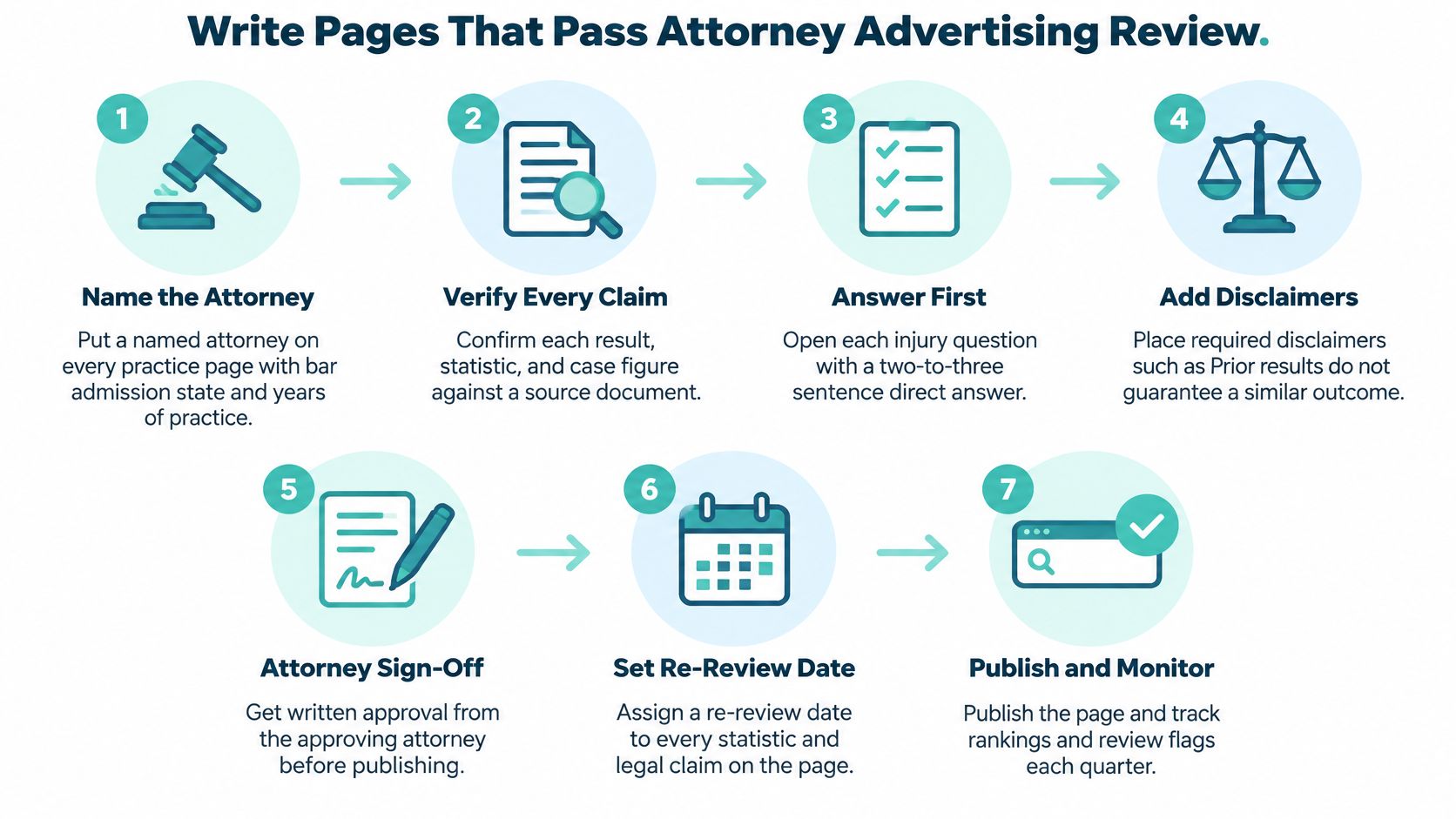
Name the responsible attorney. Readers need to know who stands behind the legal explanation. Put a named author or reviewing attorney on every practice page, with verified bar admission states and years of practice, and distinguish authorship from review.
Verify deadlines and jurisdiction. A deadline without context can mislead someone whose claim involves an exception or a different defendant. Identify the governing jurisdiction, verify the applicable rule against an authoritative legal source, display the review date, and assign a re-review date before publishing.
Explain the actual fee arrangement. Fee language should help a prospective client understand the engagement, not merely encourage a click. Describe the contingency basis if offered, explain whether attorney fees depend on recovery, and state how litigation costs are handled rather than treating fees and costs as interchangeable.
Replace superiority claims with evidence. Words such as best, top, and guaranteed create claims that a reader may interpret more broadly than intended. Use checkable facts instead, such as verified practice history, admissions, or courts where the attorney has appeared, without implying that experience guarantees a result.
Separate education from individualized advice. A general guide can't account for every reader's facts. Label educational material appropriately, distinguish it visually from intake, and have counsel approve any disclaimer about prior results rather than assuming a footer cures misleading copy.
Check certification language precisely. A practice focus isn't automatically a recognized specialty. Use specialist or certification descriptions only when the attorney holds the relevant credential and the wording satisfies applicable jurisdictional requirements.
Protect the intake pathway. People may submit sensitive medical and incident details when asking for help. Use a secure form, restrict access to submissions, and keep injury descriptions out of URLs, analytics event parameters, and advertising audiences.
The editorial handoff should make responsibility visible rather than leaving approval buried in a chat thread.
Approve the rendered page
Get written attorney sign-off on the finished page, including headings, captions, testimonials, buttons, and mobile layout. A compliant draft can become misleading when a designer removes qualifying language or places an unrelated result beside a consultation offer.
Keep the next step visible above the fold. An injured reader should see the phone button or consultation option before scrolling, without having to dismiss intrusive overlays or move past a results carousel.
Build Local Prominence Through Profiles, Reviews and Links
Google says local results principally depend on relevance, distance, and prominence, with links and reviews contributing to prominence in its local ranking guidance. Better copy can improve relevance, but it can't move an office closer to a searcher. Nor can a page-only strategy replace a credible local presence.
Claim and verify each eligible Google Business Profile. Google's business-details documentation explains that verified owners can manage addresses, contact information, business types, and photos that may appear in Search and Maps. Choose the most accurate available primary category, then maintain services, hours, photos, and phone details.
Local prominence signals and the usual failure
| Signal | What to verify | Common failure |
|---|---|---|
| Google Business Profile | Verified status, primary practice category, hours and photos for each eligible office | One listing for several offices, or an unverified profile |
| Name, address and phone consistency | Same firm name, suite number and phone across site, profile and legal directories | Old suite numbers or call-tracking numbers in citations |
| Reviews | Steady flow over months, owner replies within days, requests that don't depend on rating | Bursts followed by silence, or incentives tied to stars |
| Links | Bar association listings, chamber memberships, community sponsorships, local news | Paid link farms and reciprocal directory swaps |
| Office and city pages | Unique staff, photos, directions and approved local case examples where available | Near-duplicate pages with only the city name changed |
The profile category supports relevance. Accurate office details establish location, while reviews and appropriate links contribute to prominence. Office pages should substantiate the business information rather than stretch it.
Say a firm has eligible offices in Tyler and Dallas. Maintain separate operational records for each office's address, staff, hours, and contact routing. Don't use a service-area description to imply a physical office that doesn't exist.
Build evidence that belongs to the market
Audit citations for old suite numbers and tracking numbers copied into directories. Keep a stable published business number and configure call tracking deliberately so measurement doesn't scatter conflicting contact information.
For reviews, set an operational target of responding within a few days, without confirming confidential client relationships or discussing case facts. Request feedback consistently, never condition the request on expected sentiment, and avoid incentives tied to ratings. A documented reputation management process for personal injury attorneys keeps this work from becoming an occasional campaign.
For a geographically specific content reference, Nares Law Group LLC's page about compensation for Aurora truck accident victims illustrates the combination of location and injury intent. Your page still needs evidence specific to your own firm.
Pursue legitimate bar listings, chamber participation, community relationships, and newsworthy contributions. Paid link farms and directory swaps aren't substitutes for those relationships, and near-duplicate city pages don't establish local credibility.
Fix Speed, Schema and Indexing Problems
A faster homepage doesn't fix a slow consultation page. Test the mobile pages that receive injury searches in practice, including the form, call button, consent controls, and scripts loaded after interaction.
Google's mobile page-speed analysis found that bounced mobile sessions had DOM-ready times 55% slower than sessions that didn't bounce. That's an observed association in its analyzed sample, not a promised conversion lift from a speed project. DOM-ready measures receipt and parsing of HTML; full-page load measures completion of the remaining resources.
Test the intake journey first
Use PageSpeed Insights and Chrome DevTools to identify server delays, render-blocking resources, and unnecessary JavaScript. Check Core Web Vitals within the same audit rather than treating performance as a separate design initiative.
- Deliver useful HTML early. Make the service explanation and contact option available without waiting for a heavy animation or chat widget.
- Reduce script overhead. Review duplicate analytics tags, unused plugins, review widgets, and third-party embeds before replacing the visual design.
- Test the actual form. Confirm labels, error messages, submission confirmation, and phone links work on a real mobile device.
A page isn't operationally fast if its headline appears quickly but its consultation form remains unusable.
Confirm that Google can access the page
Run priority practice and office URLs through Search Console's URL Inspection. Check crawl access, indexing status, the selected canonical, and whether a login or accidental noindex directive prevents discovery.
Google's LocalBusiness structured-data documentation recommends validating markup with the Rich Results Test and inspecting URLs, and notes that crawling and re-indexing can take several days. Mark up only supported details visible on the page, such as the firm's name, address, and hours, and follow eligibility requirements for review information.
Schema isn't a ranking guarantee. Request recrawling after meaningful deployment changes, then schedule a follow-up inspection rather than assuming validation means immediate visibility.
Finish with canonical and XML sitemap checks. Each intended practice or office page should have a coherent canonical assignment, and the sitemap should contain only indexable URLs you want discovered. A focused technical SEO audit for law firms should distinguish template-wide defects from isolated page errors so you fix the cause rather than repeatedly patching symptoms.
Structure Pages So Answer Engines Can Quote Them
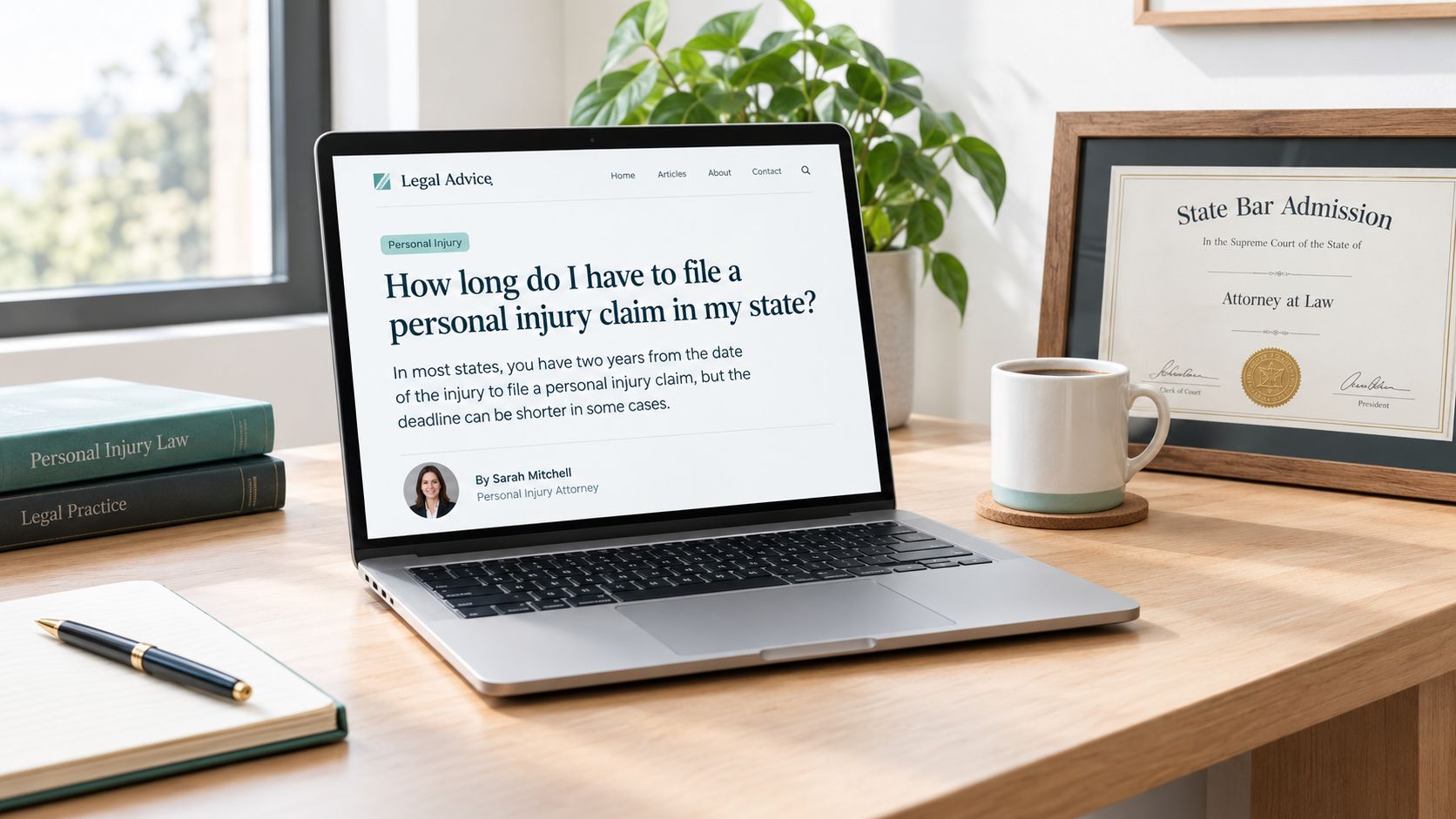
Answer systems can quote a page accurately only when its legal guidance is clear and properly qualified. Start each question with a short, direct answer, then explain jurisdiction, exceptions, and practical next steps. No format guarantees a citation. Show the reviewing attorney and last-reviewed date where readers can readily find them.
Make each answer independently understandable
For a heading such as “How long does a driver have to file a claim after a crash?”, name the jurisdiction before stating a verified deadline. Distinguish an insurance claim from a lawsuit, and explain when the circumstances call for individual legal review.
Use intake notes and call dispositions to identify follow-up questions, removing identifying details first. Topics might include preserving evidence, speaking with adjusters, documenting medical care, and preparing for a consultation. Keep FAQs tied to actual reader needs rather than adding speculative questions to lengthen a page.
Consistency supports trust. Keep firm names, attorney credentials, and office descriptions aligned across pages, so a concise answer does not conflict with the biography or location page.
Use automation without outsourcing responsibility
Lawyers remain responsible for reasonable oversight of nonlawyer vendors and for meeting their professional obligations. Apply that principle to every stage of automated content production:
- Drafting support: AI can organize an outline or suggest questions based on approved, nonconfidential material.
- Legal verification: An attorney checks each legal assertion against appropriate authority and the relevant jurisdiction.
- Publication approval: The named reviewer signs off, claims are connected to the register, and unresolved issues are held back.
Editorial judgment: Automation is useful when it reduces production work without removing accountable review.
The workflow should preserve a clear record of who checked the law and approved publication. That matters as much as producing an answer that can be quoted.
Apply the same review to intake vendors. Check where submissions go, who can access them, and what the system tells visitors. Review routing and payment arrangements with ethics counsel when needed. Treat answer-engine optimization, intake quality, and ethical review as one publishing process, with each page serving a clear, compliant path to a qualified matter.
Measure Qualified Cases Instead of Rankings
A ranking report can't tell you whether the firm signed an appropriate case. Build measurement backward from retention, then use search and engagement metrics to diagnose where prospects drop out.
Before changing the site, record organic impressions, non-branded clicks, calls, forms, and qualified-case rate for each target market. Keep ethical review in the operating scorecard too: the ABA's digital advertising ethics guidance explains restrictions around misleading communications, referrals, and specialization that remain relevant to online acquisition.
Injury SEO metrics, where to pull them, and what they reveal
| Metric | Where to pull it | What it tells you |
|---|---|---|
| Qualified-lead rate | Intake form and call disposition fields | Share of SEO leads that meet case criteria |
| Cost per qualified matter | Monthly SEO spend divided by qualified matters | Cost of a usable lead, not cost per click |
| Calls and forms by landing page | Call tracking and analytics events | Which pages produce intakes |
| Non-branded clicks | Google Search Console | Growth from people who don't already know the firm |
| Retained cases by source | Case management system | Whether SEO leads actually sign |
| Profile actions | Google Business Profile insights | Local demand from map and profile searches |
Define qualified with the attorneys and intake team before reporting it. Relevant criteria may include jurisdiction, incident type, representation status, conflicts, and facts requiring attorney assessment. Count a completed intake only when the call or submission reaches the qualification step, not when someone merely presses Submit.
Follow cohorts through to retention
Attach landing page, source, and medium to the lead record without copying confidential narrative into analytics. Use disposition fields and, where lawful and appropriately disclosed, call recordings to distinguish missed calls, unsuitable inquiries, qualified matters, and retained cases.
Compare monthly acquisition cohorts so a lead that signs later remains connected to its original acquisition period. Separate branded demand from new discovery, and avoid adding profile actions and website conversions together as though they were unique people.
Judge landing pages against the firm's target cost per qualified matter, then check retained-case outcomes. Keep investing where economics and case quality fit the target. Rework pages that attract unsuitable calls, and investigate intake handling before blaming SEO when qualified prospects don't sign.
Confirm Your First 90-Day Plan
Use the opening quarter to establish a reliable acquisition system, not to promise a ranking deadline. Give each task an owner, a completion check, and a place to record the result.
Sequence the work around dependencies
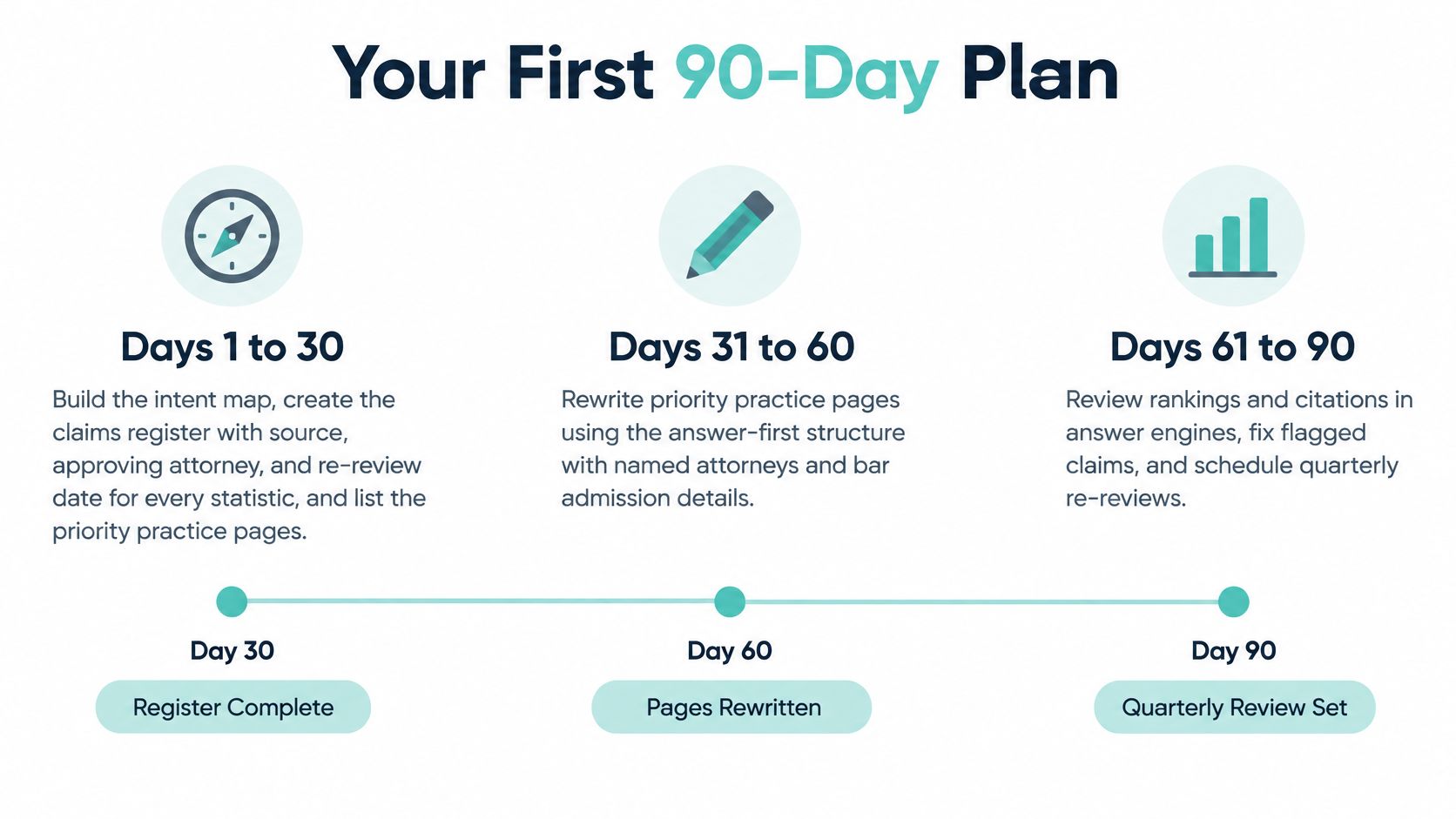
- Days 1 to 30: Build the intent map and claims register, including source, approving attorney, and re-review date. Audit Google Business Profiles and citations, record the baseline, and identify the practice pages with the strongest business relevance.
- Days 31 to 60: Rewrite priority practice and attorney pages, consolidate duplicate city content where appropriate, and implement supported LocalBusiness markup. Retest mobile intake pages after template and script changes.
- Days 61 to 90: Publish attorney-approved, answer-first FAQs and pursue a small shortlist of legitimate bar, chamber, or community link opportunities. Compare landing-page cost per qualified matter, inspect answer-engine references where observable, resolve flagged claims, and schedule quarterly reviews.
Make the rebuild decision conditional
Some firms need better content and tracking, not a replacement website. Others have templates that prevent meaningful speed improvements, accessible forms, or maintainable structured data.
Scope a rebuild only after the audit demonstrates template problems. A partner providing web design in Tyler, TX can rebuild around the intake flow when that's justified, but a new visual identity alone won't repair weak qualification or inaccurate legal content. Preserve useful URLs, working attribution, and proven conversion paths during any migration.
Digital Skyrocket offers new websites paired with ongoing SEO, local visibility work, reputation management, and conversion-focused improvements for service businesses and law firms. Personal injury firms outside Texas seeking that combined engagement can visit Digital Skyrocket to discuss fit and discovery, starting with the technical barriers and intake outcomes that should determine the scope.