
Profile and technical changes can show within days to weeks, dependable local rankings usually take several months, and qualified lead growth follows once rankings and reviews stabilize. But if your business reaches a strong position on Google and the phone still doesn't ring, which timeline needs attention?
That's the gap behind the question “How long does local SEO take?” Business owners often measure the whole investment against a ranking deadline, even though getting discovered, earning competitive positions, and turning searchers into customers are different problems.
For a roofer in Longview, a dental practice in Dallas, or a service company elsewhere in the U.S., the useful answer isn't a guaranteed finish date. It's a set of milestones that shows whether Google can find the business, whether customers see it, and whether those customers have enough confidence to inquire.
Table of Contents
- Typical Local SEO Timelines at a Glance
- Indexing and Redesigns Stretch Local SEO Timelines
- Relevance, Distance and Prominence Set the Pace
- How Your Starting Point Changes the Timeline
- Why Rankings Alone Do Not Bring Leads Yet
- Metrics to Track Month by Month
- Set Your Local SEO Timeline Before You Commit
Typical Local SEO Timelines at a Glance
Expect early signals within days to weeks, dependable local rankings over several months, and lead growth as visibility, review momentum, and conversion improve.
The distinction matters because implementation and evaluation don't happen on the same schedule. Your team can publish a stronger service page or correct business information immediately. Google still has to process those changes and decide how they affect search results.
Google Search Central's guidance on improvements says some changes can affect results within a few days, while others can take several months as its systems assess whether a site consistently provides helpful, reliable content. That's a planning range, not a local ranking guarantee.
Local SEO milestones and typical timing
| Milestone | Typical timing | What to expect |
|---|---|---|
| Business profile and technical changes | Days to a few weeks | Changes appear after Google reviews or processes them |
| Page discovery and indexing | A few days to a few weeks | A live page may not yet be searchable |
| Dependable local rankings | Several months | Positions settle after repeated crawling and evaluation |
| Redesign with new URLs | A few weeks or more | Larger sites often take longer for new URLs to replace old ones |
| Qualified lead growth | After rankings stabilize | Progress relies on review momentum, demand, and conversion rate |
These are milestones, not service-level promises. A profile correction appearing publicly doesn't mean the business has earned a better position. Likewise, finding a new page by searching its exact address doesn't show that it competes for a valuable service query.
A redesign adds another qualification. When page addresses change, Google must process the relationship between the old and new URLs. A successful launch therefore needs both a working website and a clean transition in search.
Read the timeline as a sequence of evidence
The strongest early evidence is technical: important pages are accessible, eligible for indexing, and associated with the right business information. Later evidence is competitive: visibility expands across relevant searches rather than briefly improving for an isolated keyword.
The business evidence comes from inquiries. A campaign that brings more visitors but no additional suitable opportunities needs a different diagnosis from a campaign whose pages still aren't indexed.
Planning rule: Fast implementation is something your team can control. Fast ranking is something it can influence, but not promise.
Your starting point, competition, site size, content quality, technical health, and changes to URLs or business information all affect the pace. Use a monthly checklist to separate work completed from results observed, rather than treating a quiet week as proof that the entire campaign has failed.
Indexing and Redesigns Stretch Local SEO Timelines
A shop can open in a mall on Monday, but shoppers won't find it in the directory until someone lists it. Even then, a directory listing doesn't mean shoppers will see it recommended first.
A website works similarly. Published, indexed, and competitive are different states. Launching a polished WordPress site completes the publishing work, not Google's processing or ranking work.
The sequence between publication and ranking
- Discovery: Google finds the URL through a link, sitemap, or another discovery route.
- Crawling: Google requests the page and retrieves its accessible content.
- Analysis: Google processes the text, images, and other files.
- Indexing: Google stores eligible information in its search index.
- Ranking: The indexed page can compete for relevant searches.
Google's crawling and indexing guidance says crawling can take a few days to a few weeks, and Google cannot predict or guarantee when a URL will be crawled or indexed. A page being live is therefore not evidence that every stage has finished.
The redesign process makes those handoffs easier to understand:

Why a relaunch can delay a clean assessment
Say a law firm replaces its practice-area URLs during a redesign. Google may still show old addresses while it processes the replacements. The firm shouldn't interpret that transition alone as evidence that its new content is ineffective.
Technical mistakes create a different problem. Missing redirects, canonical tags pointing to retired pages, blocked content, and thin service descriptions can prevent Google from processing the intended version correctly. Conflicting business details also deserve attention, especially when the redesign accompanies a move or rebrand.
An XML sitemap helps Google discover URLs, but it doesn't guarantee indexing or improve rankings, according to Google's crawling and indexing FAQ. Submitting it is a useful task, not a shortcut around technical or content problems.
Before launch, record existing landing-page traffic, search queries, indexed pages, and lead activity. Map each retired URL to its closest relevant replacement, then test redirects and canonical tags on the live site.
After launch, use Google Search Console's Page indexing report and URL Inspection tool to investigate important pages. Check whether Google can access the page, whether it selected the intended canonical, and whether internal links point directly to the new address.
A website migration SEO checklist helps keep those checks connected to the launch rather than leaving them for a later recovery project.
Finally, keep non-branded impressions, rankings, calls, and form submissions separate in reporting. A brief ranking jump immediately after launch isn't durable success. Look for sustained improvement after Google has processed the changes across several reporting cycles.
Relevance, Distance and Prominence Set the Pace
Some local SEO tasks change what Google understands about your business. Others build evidence that people recognize and trust it. Neither changes where a searcher is standing.
Google's local ranking guidance identifies relevance, distance, and prominence as the main factors behind local results. These explain why identical work can produce different outcomes across nearby markets.
Local ranking factors and how fast each moves
| Factor | What it measures | How fast it moves | What speeds it up |
|---|---|---|---|
| Relevance | How closely the profile and pages match the query | Often faster | Complete profile, service-specific pages, consistent business information |
| Distance | How far the business is from the searcher | Fixed by location | Dedicated nearby-area pages support relevance, but don't change physical distance |
| Prominence | Links, directories, reviews, review scores, and organic position | Generally slowest to build | Accurate citations, earned links, and a steady review process |
Relevance is the most direct editing opportunity. If your profile barely describes your services and your website combines unrelated offerings on a vague page, you can make the business easier to understand. Use accurate categories, detailed service information, and pages that answer the questions buyers have.
Distance requires expectation-setting rather than a technical fix. A business serving a suburb isn't necessarily close to every searcher there. Dedicated area pages can explain genuine coverage and compete for relevant organic searches, but they don't move the business closer on the map.
Prominence involves recognition beyond your own website. You can correct directory listings and make review requests part of normal operations, but you can't instantly reproduce an established competitor's independent links and customer history.
Forecast the competitive gap, not just the task list
Consider a roofing company targeting its home suburb and a large neighboring city. A forecast might allow for suburb-level movement within weeks while reserving many months for a competitive citywide term. That's a scenario to validate against competitors, not a promised schedule.
The reason is straightforward: clearer service information may resolve the suburb's main relevance gap, while citywide competitors may also have stronger review and link profiles.
A nearby search result and a citywide search result aren't interchangeable tests of the same campaign.
Build the forecast by grouping keywords by geography and intent. Compare the businesses visible for each group, then set separate milestones for profile completeness, service-page coverage, reviews, and earned recognition.
The practical value of understanding Google Maps ranking factors is knowing which constraint you're addressing. More page edits won't solve every prominence gap, and more reviews won't erase geography.
How Your Starting Point Changes the Timeline
A brand-new website, an established business undergoing a redesign, and a company with weak reviews shouldn't receive identical forecasts. Their next useful milestones are different, even when they sell the same service in the same city.
A new domain needs evidence that Google has discovered and processed its important pages before early positions mean much. An established site with changed URLs needs proof that its existing search presence has transferred correctly. A business with limited customer feedback needs a credible review process alongside website improvements.
Diagnose the actual starting position
| Starting position | Main uncertainty | Evidence to collect |
|---|---|---|
| New website | Whether useful service pages are being processed and shown | Indexing status and relevant non-branded impressions |
| Redesigned website | Whether Google is associating old pages with the right replacements | Redirect checks, canonical selection, and landing-page trends |
| Weak review profile | Whether searchers have enough confidence to inquire | Review count, average rating, recency, and inquiry quality |
Before committing, create a one-page baseline:
- Classify the website: Record whether it's new, redesigned, or established, including any planned URL changes.
- Compare customer feedback: Review the leading competitors in your target suburbs. Note review count, average rating, and the date of recent feedback.
- Check business identity: Confirm that the business name, address, and phone number are accurate across the website, Business Profile, and important directories.
- Separate search markets: Group target queries by suburb, neighborhood, and citywide intent instead of averaging them together.
Use the baseline to choose the next action
If important pages aren't eligible for indexing, fix that before commissioning more location content. If visibility is improving but inquiries remain weak, inspect customer confidence and the contact process instead of assuming the campaign needs more keywords.
This applies whether you're targeting East Texas, DFW, or another U.S. market. The relevant comparison is the businesses appearing for your buyers' searches, not an industry-wide timeline that ignores your starting position.
Why Rankings Alone Do Not Bring Leads Yet
Ranking gives a customer the opportunity to evaluate you. It doesn't settle the decision.
Review-focused reporting summarized in a Google Business Profile community discussion indicates that 83% of consumers used Google to find local-business reviews in 2025. That finding concerns review discovery, not a guaranteed conversion rate, but it explains why search visibility and customer confidence need separate attention.
A business can appear prominently and still lose inquiries to a competitor whose reviews offer stronger reassurance. Searchers may also leave because they can't confirm the service area, understand the offer, or find an obvious way to contact the business.
Keep the customer decision separate from the ranking report
There are distinct milestones: technical visibility, when pages become searchable; local ranking visibility, when the business appears for valuable queries; and qualified-lead growth, when suitable customers take action.
Reviews affect that final decision as well as local prominence. Their value isn't limited to the average rating. Specific descriptions of completed work can help a buyer understand whether the business handles the problem they have.
A steady review process also takes continued participation from actual customers. Rewriting a page is an internal task; building a representative body of feedback requires completed work and voluntary responses.
Remove the reasons a visible business gets passed over
- Ask after completed work: Make an honest review request part of the job-completion or client follow-up process. Don't offer incentives or restrict requests to customers you expect to be positive.
- Respond thoughtfully: Address praise and concerns professionally without exposing private customer information.
- Clarify coverage: State the service area on the Business Profile and relevant landing pages so unsuitable prospects can self-select out.
- Shorten the form: Request the information needed to evaluate and return the inquiry, rather than turning first contact into a lengthy intake exercise.
- Make calling straightforward: Place a clear, tappable call button near the top of mobile service pages and test it.
- Inspect the handoff: Check missed calls, response delays, and whether inquiries reach someone who can help.
Conversion insight: When qualified searchers already see your business, improving reassurance and response habits may matter more than winning another ranking position.
Demand, seasonality, pricing, call handling, and conversion rate all influence when inquiries become booked opportunities. Reporting should therefore connect rankings to calls, forms, and outcomes, not treat traffic alone as proof of business growth.
Metrics to Track Month by Month
Use reporting windows to organize attention, not to promise results on a fixed date. The schedule below is a management checklist, not a Google-published delivery timetable, and lead tracking should begin at launch rather than wait for a later window.
Metrics to track by reporting window
| Window | Track | Healthy sign |
|---|---|---|
| Weeks 1-3 | Indexed pages, profile edits, crawl errors | Key pages are discovered with no crawl errors |
| Weeks 4-12 | Non-branded impressions and rankings for service-area queries | Steady rise in impressions across target areas |
| Months 3-6 | Map visibility, Business Profile actions, calls, and form submissions | Inquiries grow alongside rankings |
| Months 6 and beyond | Qualified leads, review volume, and average rating | Lead volume and review momentum keep rising |
The checkpoints move from technical eligibility to commercial outcomes:
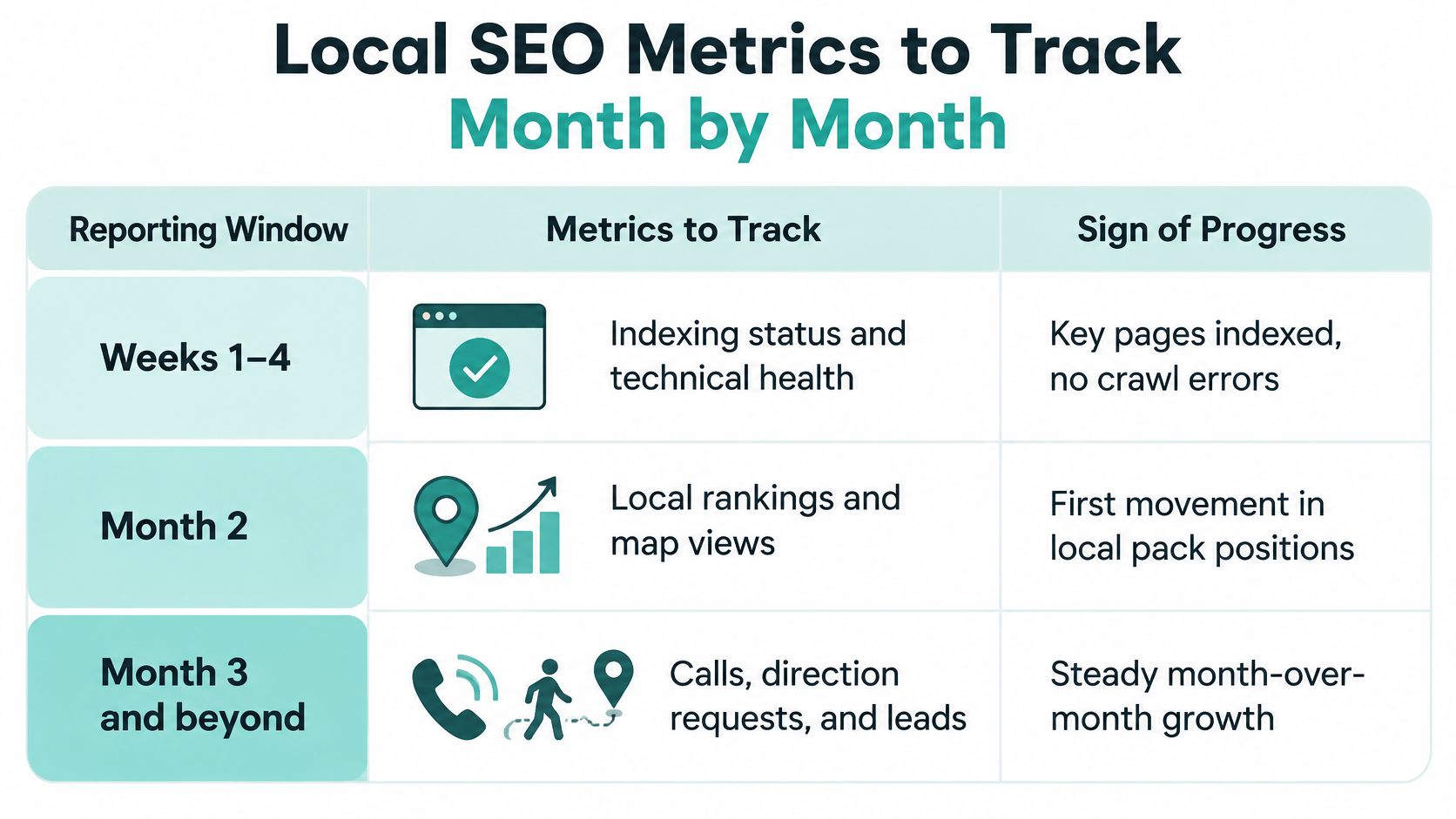
For discovery, inspect important service pages individually in Search Console. A total indexed-page count can hide the fact that an essential revenue-generating page is missing while less important pages are included.
For visibility, filter branded searches from service-related queries where practical. People searching your company name already know something about you; growth in those searches doesn't necessarily demonstrate better discovery among new customers.
Run the same monthly checks
- Confirm page coverage: Review indexing status for priority services and investigate unexpected exclusions or crawl problems.
- Compare non-branded impressions: Examine query groups and landing pages against the baseline, keeping geographic intent separate.
- Record profile actions: Log available calls, direction requests, and website clicks from Business Profile performance.
- Count inquiries: Reconcile tracked calls and forms with actual inquiries so spam, duplicates, and unsuitable requests don't inflate the result.
- Follow the outcome: Record which inquiries became qualified opportunities and which became booked work.
- Update review measures: Track review volume and average rating, and read the feedback for recurring service concerns.
Search Console, Google Business Profile performance, and Google Analytics 4 answer different questions. Search Console describes search visibility and clicks; profile reporting describes available profile interactions; analytics helps connect website visits with on-site actions.
Use Google Analytics SEO reports alongside intake records rather than expecting a website dashboard to explain every customer decision. Label calls and forms consistently so the owner and marketing director aren't comparing different definitions of a lead.
A weak reporting period should prompt a specific question: did visibility fall, did fewer visitors contact the business, or did the business book fewer of those inquiries? Each points to a different response.
Judge trends across several reporting cycles. A single weekly ranking check, a branded-search spike, or a temporary position change is too narrow to support a budget decision by itself.
Set Your Local SEO Timeline Before You Commit
Which date is the commitment about: launch, stable rankings, or reliable inquiries?
Those are three clocks. Discovery sets the baseline. Ranking follows indexing and how hard the local market is. Lead growth depends on whether people who already see the business choose to call. Reviews set that last pace more than a map position does. A business can rank well and still book little work when recent reviews are thin or the page does not convert.
Agree on the baseline, milestones, and reporting definitions before budget is committed. Separate the website launch from search performance, and connect continued work to indexing, visibility, calls, forms, and qualified opportunities.
A successful Fit Meeting at Digital Skyrocket leads to a Discovery Meeting. That session analyzes current Google search traffic, reports existing keyword rankings and which terms bring visitors, and considers the clients the business could reach with improved positions. Those figures are the starting line.
Separate the build schedule from the search schedule
An average-size website goes live 2 months after the project begins, provided the company has the information it needs from the client. That date is a production milestone. Competitive rankings are not due on launch day.
Early signals can appear in weeks. Stable rankings often take several months. Leads come after both, once visitors trust the business enough to inquire. Review volume and rating move that lead clock after visibility is already in place.
Digital Skyrocket strategizes, designs, builds, writes, and optimizes the site rather than only adjusting a site someone else built. If ongoing work stops after a client cancels, the website will start to decline in ranking and may convert less well.
Write down what counts as a qualified inquiry, who checks intake outcomes, and how a technical fault will be separated from a competitive or conversion problem. A ranking gain is not the same event as booked work.
Digital Skyrocket builds new websites with ongoing SEO, reputation management, and conversion improvements for service businesses. Visit Digital Skyrocket to start a Fit Meeting and establish a local SEO timeline grounded in current search visibility, competitors, and lead-generation goals.