A lot of HVAC owners are in the same spot right now. The phones ring when it’s brutally hot or freezing cold, referrals still matter, and word of mouth still brings in work. But there are also long stretches where you know customers are searching online first, comparing three companies in a few minutes, and making a decision before your dispatcher even gets a chance to call back.
That changes how digital marketing for HVAC companies needs to work. You don’t need every channel. You don’t need trendy tactics. You need the basics locked down so a homeowner can find you, trust you, and contact you fast.
The companies that win online usually do three things well. They show up in local search. They send traffic to a website that makes calling easy. They build enough review proof that a stranger feels comfortable hiring them. Everything else is secondary.
Table of Contents
- Why Your Next Job Will Come From Google
- The Three Pillars of HVAC Digital Marketing
- How to Budget and Prioritize Your Marketing Spend
- Your First 90 Days An Implementation Roadmap
- Adding Fuel with Paid Ads and Social Media
- Measuring What Matters to Prove Your ROI
- Your Roadmap to More Booked Jobs
Why Your Next Job Will Come From Google
A homeowner’s AC quits in the afternoon. They don’t drive around looking for yard signs. They pull out their phone, search for help, tap a few listings, and call the company that looks credible and easy to reach.
That moment is where a lot of HVAC revenue is won or lost.
For local service businesses, digital discovery isn’t a side channel anymore. Over 86% of consumers rely on the internet to find a local business, and 98% use it to research specific local businesses, according to this industry summary on local business search behavior. For HVAC, that matters even more because the search often happens when the need is urgent and the buyer is ready to act.
If your company doesn’t show up clearly in search, maps, and review-driven listings, you can still be a great contractor and still lose the lead.
Most HVAC owners don’t have a lead problem first. They have a visibility problem, then a trust problem, then a follow-through problem.
Google has also become more answer-driven. Homeowners ask longer questions now. They search for symptoms, not just brand names or service labels. That’s one reason structured service pages, FAQ content, and local relevance matter more than they used to. If you want a broader look at how search is shifting, this guide to AI SEO for small businesses is useful context.
The point is simple. Digital marketing for HVAC companies works when it matches buying behavior. Show up when the problem is urgent. Look trustworthy immediately. Make contacting you frictionless.
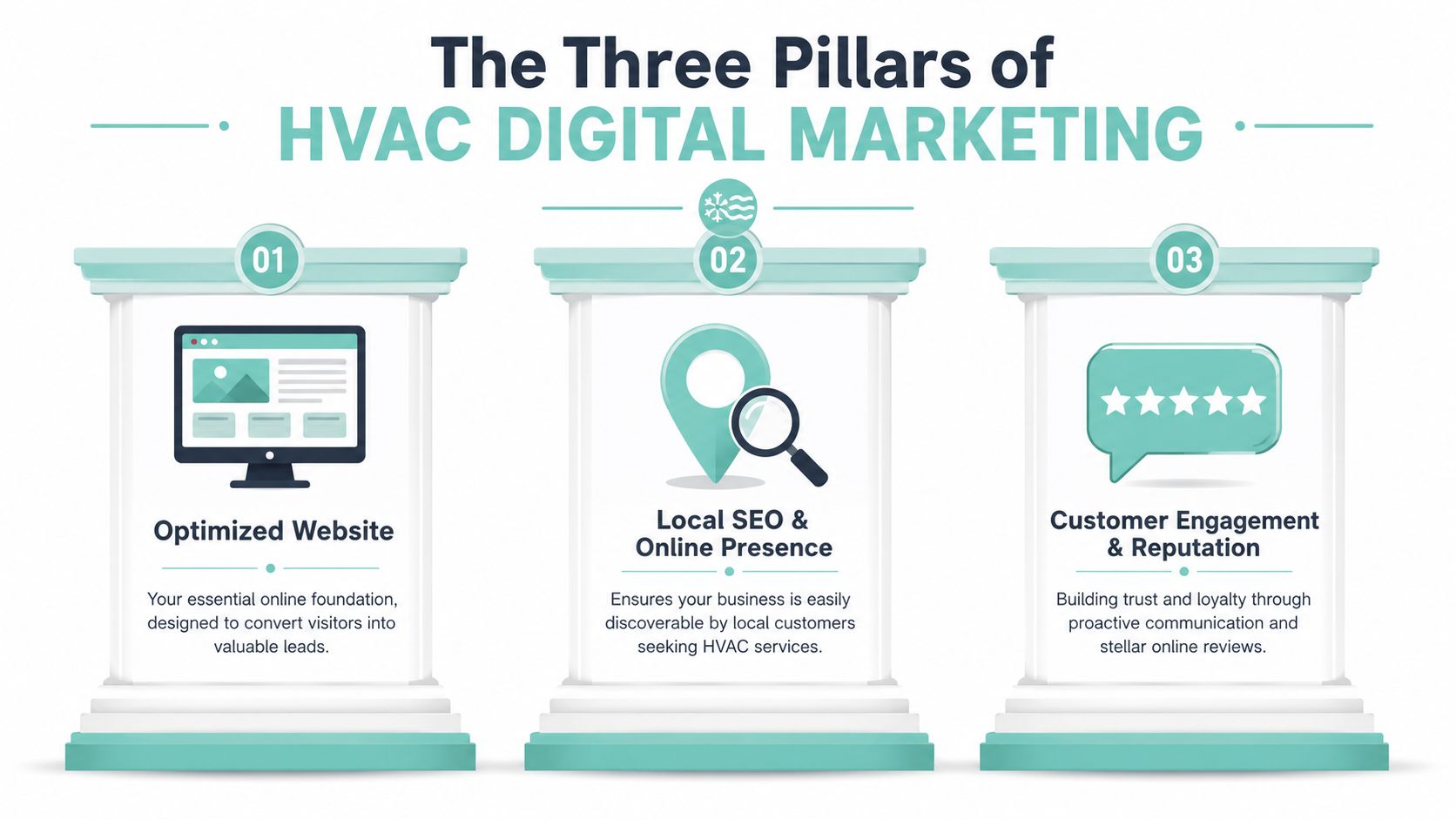
The Three Pillars of HVAC Digital Marketing
The best HVAC marketing systems are not complicated. They rest on a few assets you control and improve over time.
Your website has to help people act fast
Most HVAC websites fail because they act like brochures. A visitor lands on the page and has to hunt for the phone number, guess which cities are served, or click through a menu that makes sense only to the business owner.
A good HVAC website does the opposite. It answers the immediate questions fast.
- What do you do: AC repair, furnace replacement, heat pump service, maintenance, emergency calls.
- Where do you do it: clear city and service-area coverage.
- Why trust you: reviews, photos, guarantees, licensing details, and real team credibility.
- What should I do next: call, request service, or book an estimate.
Mobile usability is the first technical reality to respect. Smartphones account for 63% of organic search visits in the United States, which is why this HVAC marketing resource on mobile behavior makes the point that slow or confusing mobile experiences directly cost leads.
That means your site should prioritize:
- Tap-to-call visibility: the phone number should be obvious at the top of the screen.
- Short forms: ask only for what your team needs to respond.
- Fast page paths: emergency visitors should reach the right service page immediately.
- Service-page clarity: one page for one core intent usually converts better than a catch-all page.
Local SEO decides whether you get seen
Your website is the hub, but local SEO is what gets people there.
For HVAC companies, local SEO usually comes down to a few unglamorous pieces executed well. Your Google Business Profile needs to be complete and current. Your business name, address, and phone details need to match across directories. Your website needs dedicated pages for core services and the cities you serve. And those pages need content that matches what homeowners are trying to find.
That doesn’t mean stuffing city names everywhere. It means building a logical site structure. One page for AC repair in one market. One page for furnace installation in another. Clear internal links. Clear headings. Real proof. Real photos. Useful information.
A lot of owners spread money across too many tactics before fixing this foundation. That’s backwards. If you’re investing in search visibility, a focused SEO service for lead generation should improve the site structure, local signals, and service-page relevance before anyone talks about flashy add-ons.
Practical rule: If a page doesn’t target a real service in a real market and make contact easy, it probably shouldn’t be a priority page.
Reviews close the gap between visibility and trust
Search gets you considered. Reviews get you called.
When homeowners compare HVAC providers, they usually don’t read every word on your website. They scan your rating, your review recency, and whether other customers describe your team as responsive, professional, and easy to work with. Reviews operate like digital word of mouth. They’re one of the few trust signals that matter before a conversation ever starts.
What works is a system, not occasional effort.
- Ask at the right time: right after a completed job, while the experience is still fresh.
- Make it easy: send a direct review link by text or email.
- Respond to every review: especially the negative ones, calmly and professionally.
- Look for patterns: if reviews keep mentioning communication problems, that’s not a marketing issue. It’s an operations issue.
The three pillars work together. Local SEO gets you found. The website turns attention into action. Reviews reduce hesitation.
How to Budget and Prioritize Your Marketing Spend
Most HVAC owners don’t need a bigger marketing budget first. They need a clearer sequence for where money should go.
What a healthy budget usually looks like
A commonly cited HVAC marketing guide says companies in a growth phase typically invest 8% to 12% of revenue in marketing, with 60% to 70% of that budget going to digital channels. The same guide also notes that many firms see meaningful local search improvement within 3 to 6 months. You can review those benchmarks in this HVAC marketing budget guide.
That doesn’t mean every company should force itself into the same template. A newer business entering a competitive market may need to build its digital foundation aggressively. An established company with a strong referral base may need to fix weak spots rather than expand everywhere at once.
The practical lesson is that digital marketing for HVAC companies should be budgeted like an investment stack, not a pile of unrelated expenses.
| Phase | Focus | Channel Allocation | Primary Goal |
|---|---|---|---|
| Phase 1 | Foundation | Website improvements, local SEO setup, review process | Make the business visible and credible |
| Phase 2 | Expansion | Service pages, location pages, citation cleanup, reputation management | Increase qualified search presence |
| Phase 3 | Acceleration | Paid search support, seasonal campaigns, landing page refinement | Capture additional demand faster |
| Phase 4 | Optimization | Tracking, call attribution, conversion improvements | Improve lead quality and cost efficiency |
A practical order of operations
If the website is weak, reviews are inconsistent, and your Google Business Profile is neglected, spending heavily on top-of-funnel channels usually creates waste.
Start with the channels that compound.
-
Website and conversion basics
Fix mobile layout, contact paths, service page clarity, and trust elements. -
Local SEO and location relevance
Build the service-area structure that helps Google understand where and how you operate. -
Review generation and response process
Turn good customer experiences into visible proof. -
Paid support when the foundation is stable
Use it to add speed, not to compensate for a broken funnel.
Budget follows maturity. If the foundation is weak, more spend often magnifies inefficiency instead of growth.
Owners often ask whether SEO or paid ads should come first. The honest answer is that SEO should come first as the operating foundation, while paid ads can be layered in once the destination pages and follow-up process are good enough to justify the spend.
Your First 90 Days An Implementation Roadmap
Execution matters more than theory. A simple sequence beats a scattered push across ten channels.
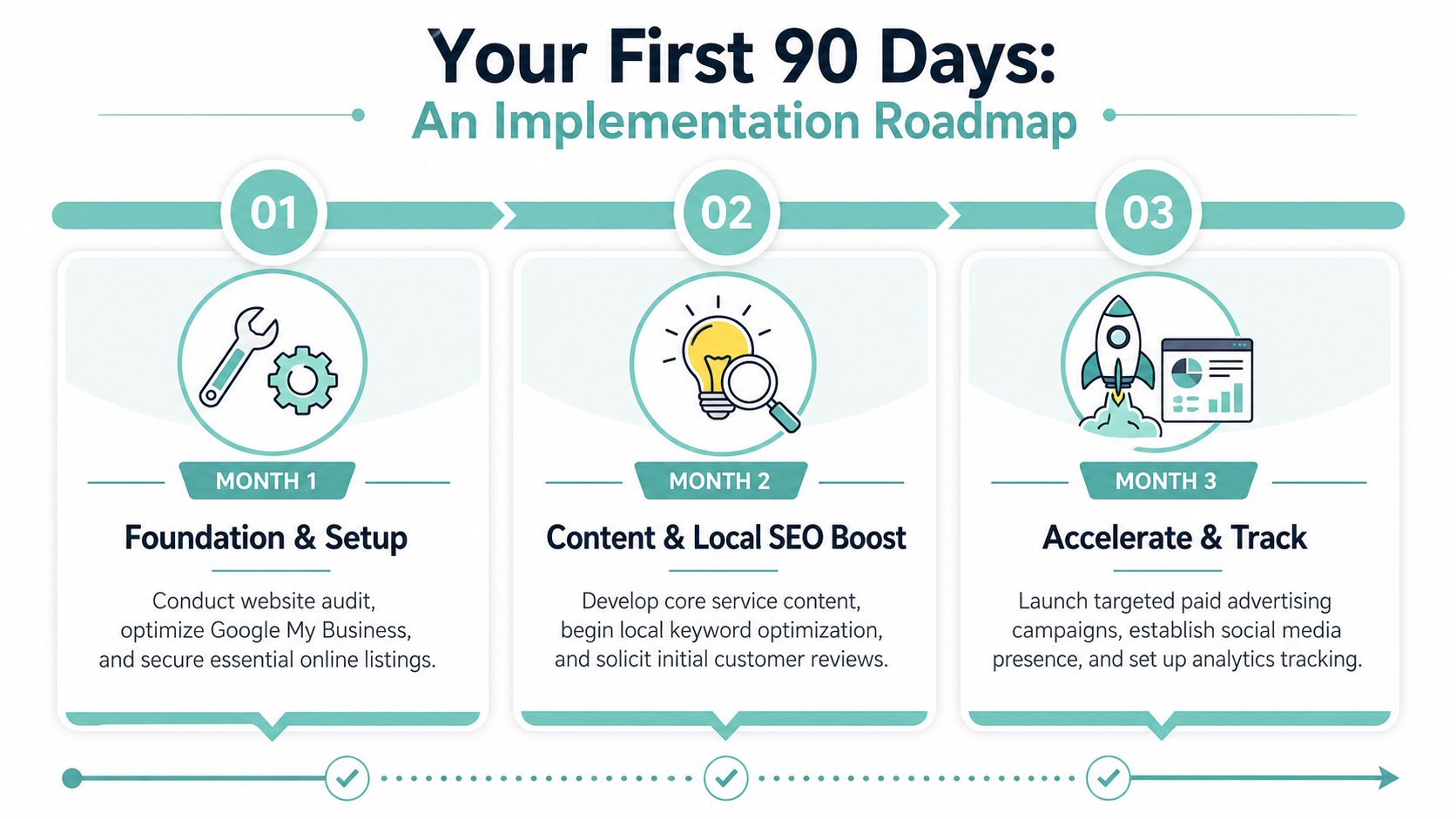
Month 1 foundation and setup
The first month is about getting control of the basics.
Start with a website audit. Check your home page, your service pages, mobile navigation, form flow, page speed, and whether the main call to action is obvious. Look at the site like a panicked homeowner would. If someone needs AC repair right now, can they tell within seconds that you handle it and can they contact you without friction?
Then review your Google Business Profile and major listings. Make sure the business information is accurate, categories reflect what you do, and service areas are clear. Add real job photos. Remove anything outdated.
You also need a review system in place before more traffic arrives.
- Create a repeatable ask: decide who requests reviews and when.
- Use direct links: reduce the number of steps for the customer.
- Assign ownership: one person should monitor responses and follow-up.
- Document the process: if it’s informal, it won’t stick.
Month 2 content and on-page improvements
The second month is where many HVAC sites finally become useful search assets.
Build or revise core service pages first. AC repair, heating repair, system installation, maintenance, and any high-value specialty services should each have their own page. If you serve multiple markets, create city-specific pages only when they can be written with real local relevance.
Good HVAC pages usually include:
- Specific service intent: what problem the page solves.
- Local relevance: the city or area served.
- Trust elements: reviews, credentials, photos, FAQs.
- Strong calls to action: call now, request service, schedule an estimate.
This is also the right time to expand into common homeowner questions. If customers keep asking why an AC is blowing warm air, whether a system should be repaired or replaced, or how often maintenance is needed, those questions belong on the site.
A strong service page doesn’t try to impress Google first. It helps a homeowner decide whether to call you.
Month 3 authority trust and tracking
By month three, the basic structure should be in place. Now you tighten the signals around it.
Clean up local citations. Look for inconsistent listings. Continue adding fresh reviews through the process you started in month one. Publish helpful updates to your Google Business Profile. Make sure every core page has a clear next step and a tracked action.
This is also where tracking needs to become practical, not academic. You should know which calls came from the website, which form submissions turned into real conversations, and which pages drive actual inquiries.
A simple month-three checklist looks like this:
-
Review quality and recency
Keep the review flow active and respond quickly. -
Citation consistency
Align your business details across key directories. -
Conversion tracking
Set up form and call tracking so lead activity isn’t a guess. -
Page refinement
Improve weak pages based on actual user behavior.
A lot of HVAC companies never get past random acts of marketing. This roadmap fixes that by building one durable layer at a time.
Adding Fuel with Paid Ads and Social Media
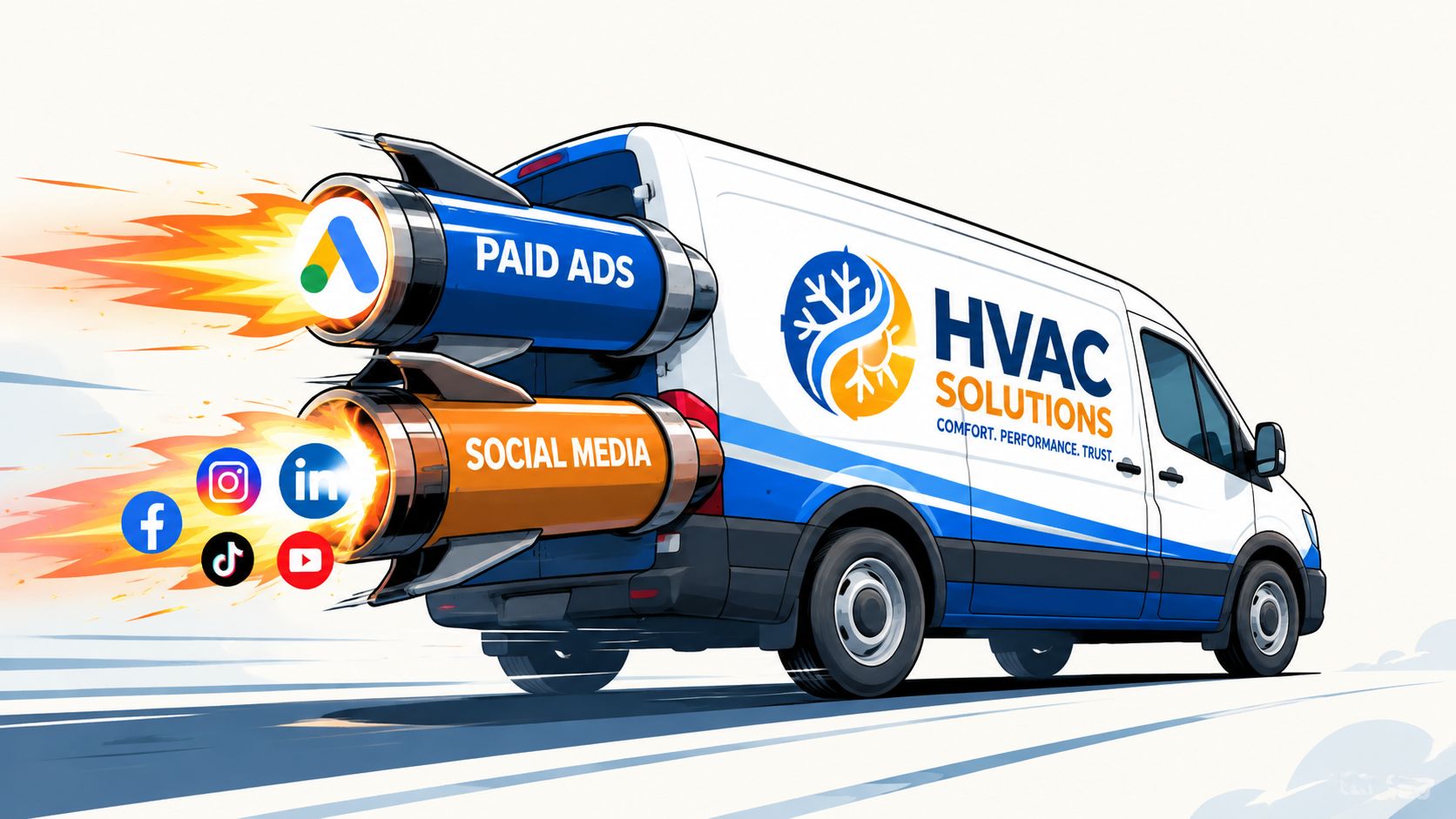
Paid ads and social media can help. They just shouldn’t be asked to rescue a weak foundation.
When paid ads make sense
Paid search is useful when you need faster visibility for urgent, high-intent queries. It can be especially effective during peak seasons, in competitive markets, or when you’re launching into a new area and organic visibility is still developing.
But paid traffic is unforgiving. If the landing page is generic, the mobile experience is clunky, or nobody follows up quickly, you pay for interest without converting it into booked work.
That trade-off matters because ad clicks don’t fix operational gaps. They expose them.
A better way to think about paid ads is as an accelerator for a system that’s already functional. If your local pages convert, your review profile is strong, and your team responds fast, paid search can add volume. If those things are weak, it usually adds expense.
What social media is actually good for
Social media usually plays a different role for HVAC companies. It’s less about direct emergency lead capture and more about staying familiar in the market.
Useful social content tends to be simple:
- Real job photos: installs, repairs, before-and-after work.
- Technician visibility: put actual people behind the brand.
- Homeowner education: filters, seasonal prep, common warning signs.
- Local trust signals: community involvement and customer feedback.
What doesn’t work well is treating Facebook or Instagram like a digital flyer board full of generic promotions.
If you want those channels handled, it often makes sense to use specialized partners. Some firms focus narrowly on owned assets like web design, local SEO, and reputation management, then coordinate with vetted outside teams for paid media and social execution when needed. That division usually produces better work than asking one generalist vendor to do everything.
Measuring What Matters to Prove Your ROI
If your marketing report is mostly traffic charts and vague updates, you still don’t know whether marketing is working.
The numbers that matter
For HVAC owners, the useful questions are operational.
Did the campaign generate qualified calls? Did those calls turn into booked appointments? Did the website produce form submissions from the right service areas? Which pages help close trust gaps, and which pages leak attention?
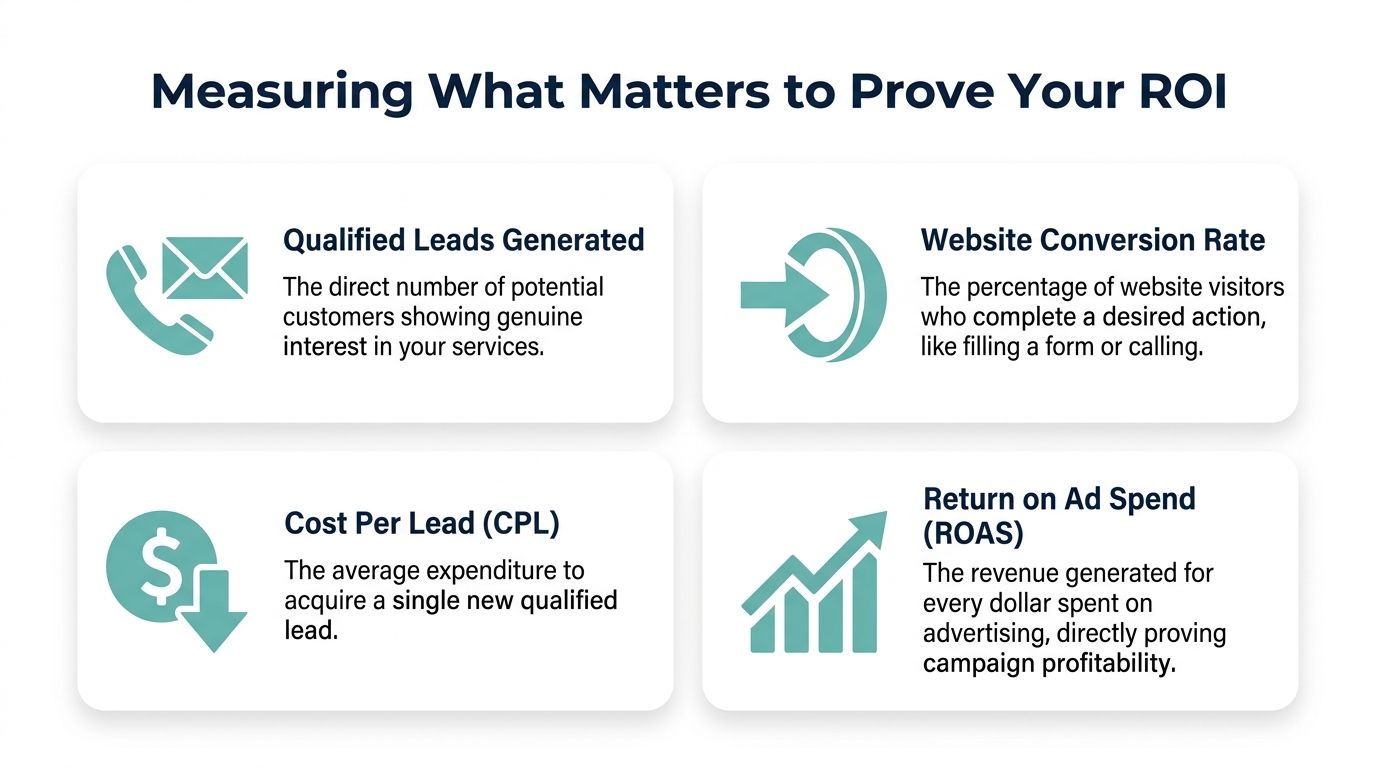
A useful scorecard usually includes:
- Qualified leads generated: not just raw inquiries, but real prospects.
- Tracked phone calls: because many HVAC jobs start with a call, not a form.
- Website conversion rate: whether visits turn into actions.
- Cost per lead: especially important when paid traffic is involved.
- Booked-job quality by source: which channels produce work your team prefers.
If you’re building your reporting process, this article on how to build powerful marketing frameworks gives a good high-level model for tying metrics back to decisions.
What a useful report should show you
A strong report doesn’t just summarize activity. It makes budget decisions easier.
For example, if organic service pages are producing strong call volume but one emergency repair page gets traffic without many conversions, you don’t need more theory. You need page-level changes. That may mean stronger trust proof, a simpler mobile layout, or clearer calls to action. That’s where conversion rate optimization services fit. They focus on improving what happens after the click.
The metric that matters most is not whether people visited your website. It’s whether the right people contacted your business and your team turned that contact into a booked job.
One more point matters here. Avoid agencies that hide behind dashboards full of impressions, rankings, and branded search screenshots while never connecting those metrics to actual lead flow. In digital marketing for HVAC companies, reporting should tell you what to keep, what to cut, and what to fix next.
Your Roadmap to More Booked Jobs
Most HVAC companies don’t need more marketing noise. They need a cleaner system.
That system starts with a website built to convert on mobile, local SEO that helps your business appear where customers are actively searching, and a review process that turns completed jobs into trust signals for the next buyer. Once those pieces are in place, paid ads and social media can support growth instead of covering up weak fundamentals.
This approach is slower than chasing whatever tactic is popular this month. It’s also more durable. Search visibility compounds. Better pages keep working. Review momentum strengthens every other channel. Over time, that foundation gives you more control over lead flow and less dependence on constant short-term fixes.
If you’re evaluating help, look for a partner that stays focused on the assets that matter most. Digital Skyrocket works on web design, local SEO, and reputation management for service businesses, and it limits conflicts by working with clients outside of Texas for this type of engagement. If your company is in a market like Florida, Arizona, or California and you want a practical foundation-first strategy, you can explore its approach to home services marketing.
Real progress usually comes from doing fewer things better. Get found. Build trust fast. Make contacting your team easy. Then improve the parts of the funnel that still leak revenue.
If you want a no-obligation conversation about improving your website, local SEO, or review strategy, Digital Skyrocket can help you map out a practical plan built around more qualified HVAC leads, not more marketing clutter.