You've probably seen this pattern before. A law firm publishes blog posts, a roofer adds city pages, a dentist writes another “what to expect” article, and the monthly report celebrates more impressions. Yet the phone isn't ringing with better cases, the forms aren't producing qualified jobs, and nobody can explain which page generated the appointment.
That's the wrong way to think about organic growth in 2026. Service businesses need fewer vanity visits and more qualified inquiries, booked appointments, and trusted brand mentions in search-generated answers. The practical question isn't only how to improve organic traffic. It's how to make search visibility produce measurable business activity.
Table of Contents
- Why Organic Traffic Is the Wrong Goal for Service Businesses
- Run a Discovery and Audit Before You Touch Anything
- Fix the Technical Foundations That Hold Rankings Back
- Build a Content and On-Page SEO System
- Earn Links, Citations, and AI Overview Visibility
- Turn Organic Traffic Into Real Leads With CRO
- Measure, Report, and Run a 90-Day Priority Plan
Why Organic Traffic Is the Wrong Goal for Service Businesses
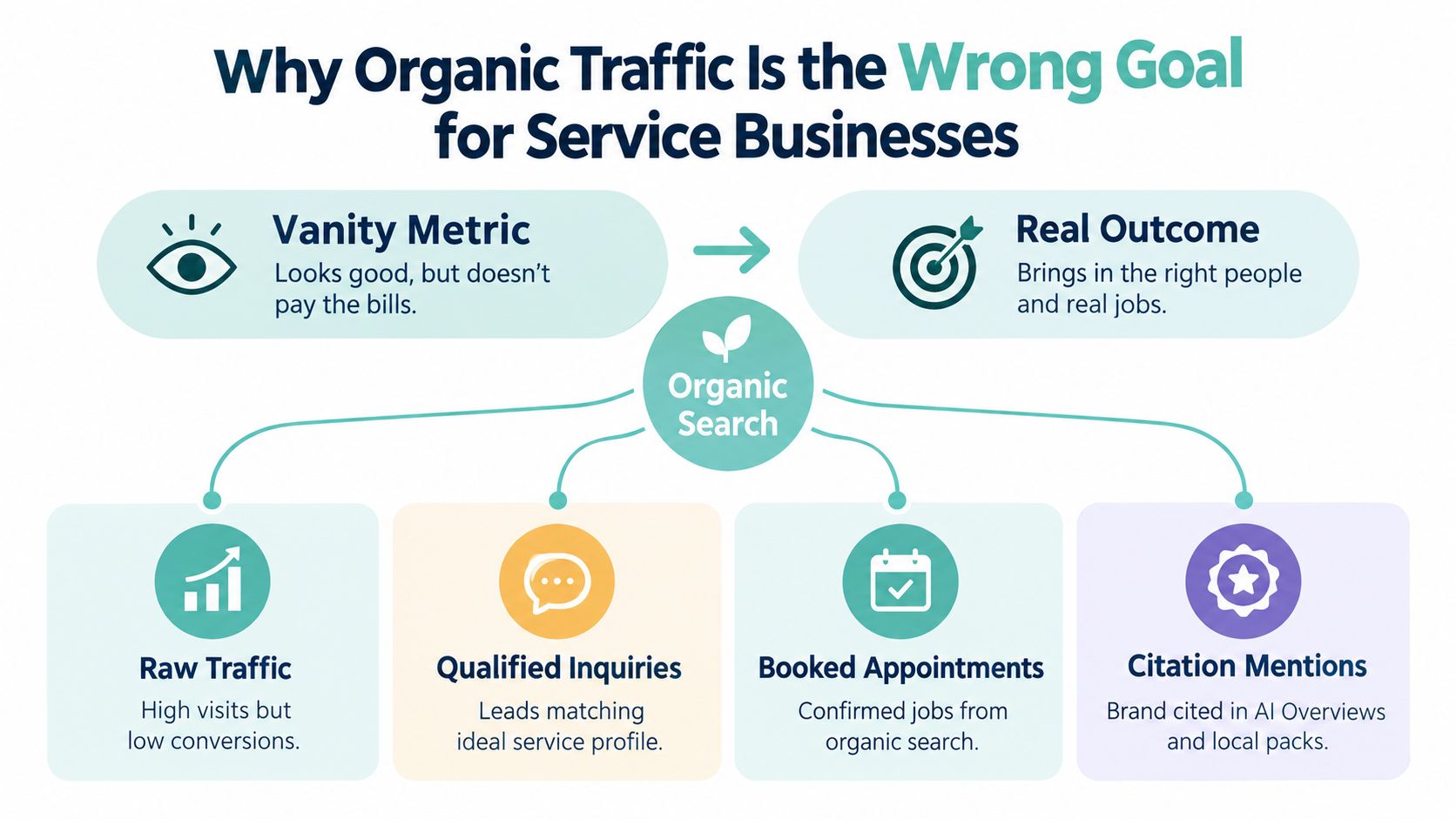
Raw sessions are a weak success metric for a local service company. A roofing business doesn't need anonymous visitors from outside its service area. A personal injury firm doesn't need readers who are researching a case type it doesn't handle. An HVAC company doesn't benefit much from traffic to a generic article if the page gives the visitor no clear route to request service.
Ranking position still matters because click opportunity drops sharply near the top of the results. A 2026 Google organic CTR study based on millions of U.S. SERPs found that position 1 averaged 20.02% CTR, position 2 averaged 10.36%, and position 3 averaged 3.89% across SERP types, as reported in this Google organic CTR benchmark. Independent academic analysis found a similar pattern, with a top-ranked result at 9.28% CTR, position 2 at 5.82%, and position 3 at 3.11% in a separate dataset.
That gap makes rankings valuable, but rankings are still only an input. The outcome is a qualified conversation. You should judge a page by whether it attracts the right person, answers the right service question, and creates a trackable next step.
The four outcomes that matter
- Qualified inquiries: Leads match your ideal service, location, and case or job profile.
- Booked appointments: Calls and forms turn into scheduled consultations, inspections, or visits.
- Revenue-producing pages: CRM data shows which organic landing pages create closed business.
- Citation visibility: Your business or content appears as a trusted source in AI Overviews, local results, and answer engines.
The working system has five connected layers: technical foundations, on-page and content systems, links and answer engine optimization citations, conversion rate optimization, and measurement. Ignore one layer and the report can look healthy while the business outcome remains poor.
Google's results also increasingly answer questions without sending users away. Pew reported that users clicked traditional links 8% of the time when AI Overviews appeared, compared with 15% on standard results, according to this report on AI search summaries and website clicks. Your pages need to earn the click when one is available, and earn the citation when Google answers first.
Run a Discovery and Audit Before You Touch Anything
The first mistake most agencies make is opening a keyword tool before understanding the business. Start with the commercial reality. Identify the services that produce profitable work, the locations the company can serve, the types of leads it rejects, and the pages that already attract meaningful search demand.
Create a clean baseline in GA4 and Google Search Console. Tie organic landing pages to calls, form submissions, booked appointments, and qualified lead status rather than stopping at sessions. Export the last 16 months of Search Console data so you can see seasonality, page decline, query changes, and ranking movement instead of reacting to a short-term fluctuation.
Build the baseline
Separate branded and non-branded queries. Branded clicks tell you whether people already know the company. Non-branded clicks show whether SEO is creating new demand for phrases such as “emergency roof repair,” “Dallas personal injury lawyer,” or “AC repair near me.”
Then isolate pages ranking from positions 4 through 20. These URLs are often better opportunities than new content because they already have relevance, indexation, and some authority. Pair their position with impressions, CTR, landing-page conversion activity, and lead value.
Run a fast crawl in Screaming Frog or Sitebulb. Check status codes, duplicate titles, missing H1s, canonical tags, redirect chains, orphan pages, indexability directives, internal links, and oversized media. Follow that with a content audit. Score each URL for intent match, freshness, originality, local relevance, and conversion path.
Review the backlink profile and local citation footprint at the same time. Look for relevant publications linking to competitors, inconsistent business details, missing profiles, unlinked brand mentions, and weak entity signals.
Score the work before assigning it
Use a simple sheet that forces the team to prioritize commercial opportunity rather than whoever asks loudest.
| URL | Current Position | Monthly Impressions | Lead Value | Effort Score | Priority |
|---|---|---|---|---|---|
/service-page |
|||||
/location-page |
|||||
/guide-or-faq |
Give priority to pages with clear intent, meaningful impressions, realistic ranking room, strong lead value, and manageable effort. Document the reason for every decision.
For a practical technical checklist to support this audit, use the technical SEO audit checklist. The point isn't to collect an impressive issue count. It's to identify the small set of changes that can improve discoverability, click-through behavior, and qualified lead flow.
Fix the Technical Foundations That Hold Rankings Back
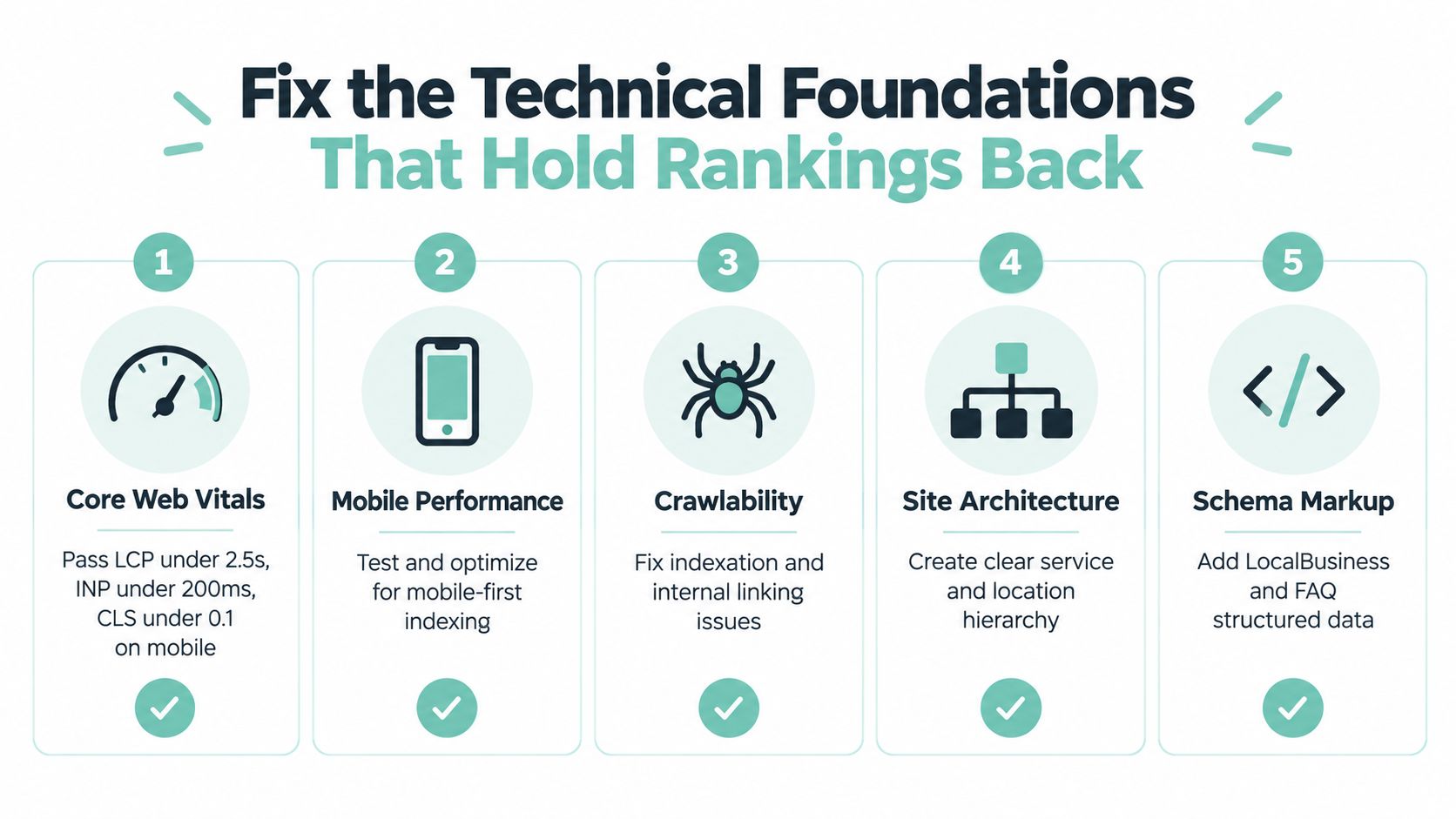
Technical SEO rarely wins a competitive market by itself, but technical failures can prevent strong content from competing. Service-business websites often lose opportunity through slow mobile templates, duplicate location pages, broken internal links, redirect chains, and important service URLs that aren't properly indexable.
Start with field data. Google's Core Web Vitals assessment passes a page group only when the 75th percentile is good for all required metrics. Google's published thresholds are LCP at or below 2.5 seconds, INP below 200 milliseconds, and CLS below 0.1, as documented in Google's Core Web Vitals assessment guidance. Focus on mobile templates first, especially the hero image, booking widgets, chat scripts, font loading, and layout shifts caused by missing dimensions.
Make crawling predictable
Keep robots.txt intentional. It should block unnecessary crawl paths, not accidentally exclude service pages or assets needed for rendering. Build XML sitemaps by content type when the site is large enough to justify separation, such as services, locations, attorneys, doctors, or blog content.
Use canonical tags to consolidate duplicate or near-duplicate URLs. Create a redirect map before redesigns and URL changes. A direct redirect is cleaner than a chain that sends users and crawlers through several obsolete URLs.
Control indexation with purpose. Thin location pages, internal search results, filter combinations, and parameterized URLs shouldn't enter the index merely because the CMS generated them. A small set of strong pages is easier to maintain than a large inventory of interchangeable pages.
Give search engines usable entity signals
Use structured data that matches the page and the business. LocalBusiness, Service, FAQPage, and Review schema can clarify what the organization does, where it operates, which service is described, and which reviews belong to the entity. Don't mark up content that isn't visible or reviews that aren't genuine.
Internal links should follow the customer journey. Link broad service hubs to specific services, service pages to relevant locations, and informational guides to money pages. Vary anchor text naturally, but make the destination clear. An HVAC article about heat pump repairs should link directly to the relevant repair page, not force users through a generic services page.
Before publishing content, confirm that key URLs are crawlable, indexable, internally linked, mobile-usable, fast enough in field data, and represented accurately in structured data.
Build a Content and On-Page SEO System
Content should start with service intent, not a publishing quota. Map each commercial page to the reason someone searches. An emergency page needs urgency and response information. A high-intent service page needs scope, process, eligibility, and a direct next step. A comparison page needs decision support. An FAQ cluster needs precise answers to recurring customer questions.
For every page, define one primary keyword, two supporting terms, the exact question the page must answer in its first 60 words, and the CTA that closes the loop. That discipline prevents a common failure: writing a page that ranks for a broad topic but never addresses the decision the visitor needs to make.
Write for the query and the customer
Rewrite title tags around the benefit and service. Google doesn't publish a fixed character limit for title tags. It truncates title links as needed to fit available screen width, so test display behavior across devices rather than blindly targeting a universal count, as explained in this title tag pixel-width guide.
Keep H1s concise, use H2s that mirror customer language, and answer the primary question early. If the search is “how much does a roof inspection cost,” don't bury cost factors beneath a long brand introduction. If the search is “can I sue after a rear-end collision,” answer the basic legal issue immediately, then explain exceptions and the intake process.
Avoid producing thin AI-generated pages that rearrange competitor language. A useful local service page includes original proof, process detail, real constraints, service-area knowledge, and honest pricing guidance where appropriate. Case-study pages should use real job or matter information, with permission and privacy protections.
Refresh authority before creating more inventory
Existing URLs often deserve attention before another blog post. HubSpot's historical optimization program reported an average 106% increase in monthly organic search views on updated posts, with monthly leads doubling and one article recording a 240% conversion-rate lift after a keyword-focused rewrite, according to this content refresh strategy analysis. Those outcomes don't guarantee the same result for every site, but they support a clear operating rule: audit pages that already have visibility before assuming the answer is more publishing.
Run a quarterly decay review. Flag pages losing clicks quarter over quarter, then refresh them.
- Update evidence: Replace outdated facts, examples, service details, and references.
- Improve intent alignment: Compare the page with the actual results and questions searchers see.
- Strengthen structure: Tighten the introduction, add direct FAQs, improve headings, and make sections extractable.
- Repair pathways: Add internal links to newer service and location pages.
- Republish carefully: Preserve the URL and document the changes so performance can be evaluated.
Build local systems around service-area pages, neighborhood hubs, and real case-study writeups. Each page should have a distinct reason to exist. Publishing dozens of near-identical city pages creates maintenance debt and weakens trust.
For a deeper framework connecting content decisions to lead generation, see content marketing for leads.
Earn Links, Citations, and AI Overview Visibility
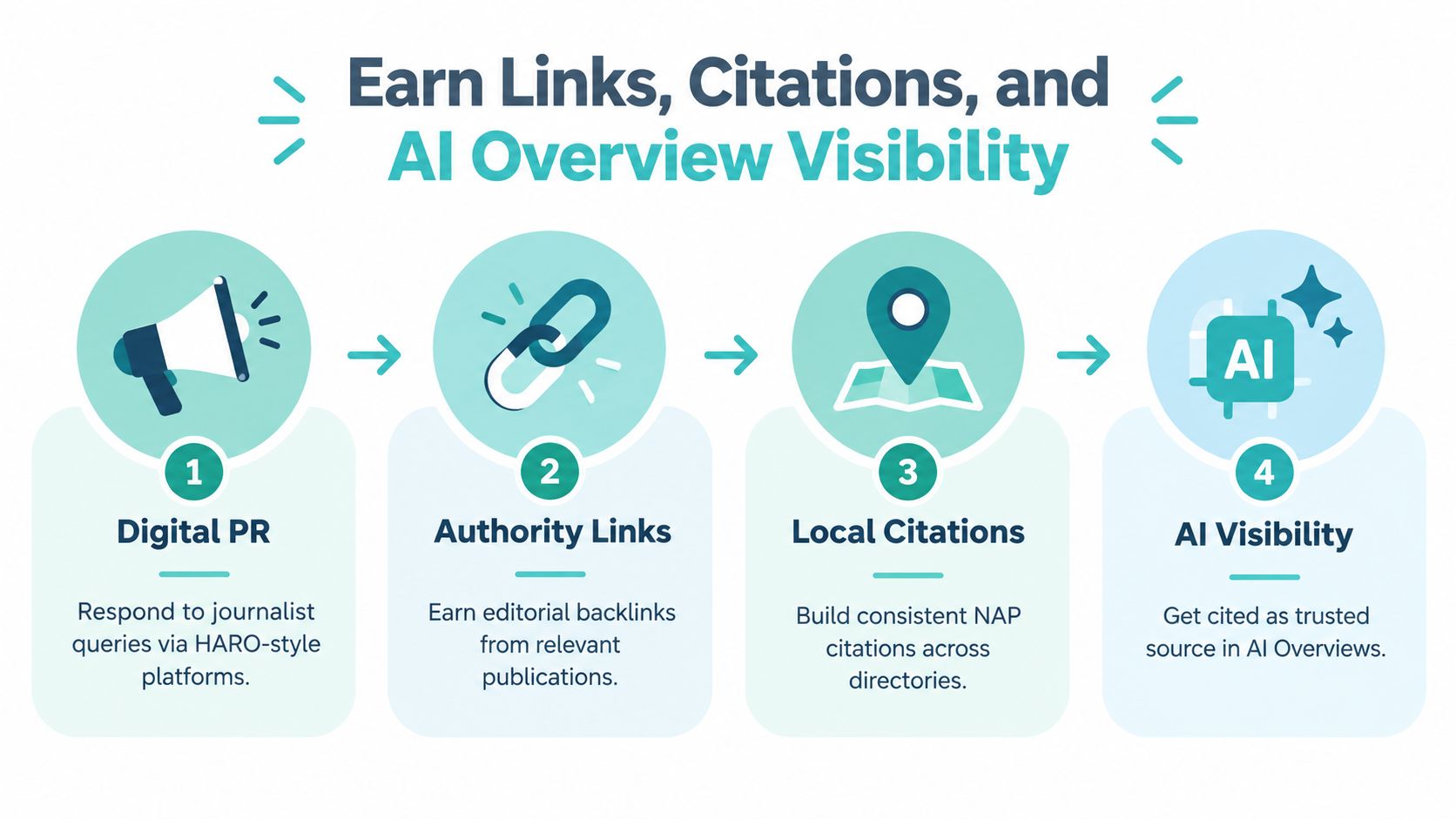
Links, local citations, and AI Overview mentions belong in one authority system. They all help external systems verify that the business exists, serves a real market, and has useful information worth referencing. The tactics differ, but the underlying requirement is the same: publish evidence other people can trust.
Start with digital PR that a local service company can execute. Respond to journalist queries through HARO-style platforms, provide informed commentary within the company's real expertise, and pitch original data from completed jobs. A roofer might analyze common storm damage patterns from its own work. A law firm might publish a carefully reviewed explanation of a recurring legal issue. A dentist can contribute practical information to local health or community coverage.
Earn relevant authority
Prioritize local news, trade publications, chambers, neighborhood organizations, professional associations, and credible industry roundups. Don't buy a pile of generic directory links. A relevant mention from a publication serving your market is more useful than a mass submission to websites with no connection to your customers.
Audit NAP consistency across the top 50 directories, prioritizing platforms that Google and Apple surface in local discovery, as described in this organic traffic benchmark guidance. Correct business names, addresses, phone numbers, URLs, categories, and service-area details. Keep a record of ownership and login access so the cleanup doesn't disappear when a vendor changes.
Make pages easy to cite
AI systems often need a concise passage that directly answers a question. Use clear definitions, explicit entity signals, descriptive author information, business schema, and FAQ blocks with one-sentence answers followed by useful detail.
Track brand mentions with and without links. Monitor which queries in your niche trigger AI Overviews, then inspect the pages being cited. Look for patterns in structure, specificity, authorship, sourcing, and local relevance. Improve the page that should own the answer instead of publishing a separate article for every variation.
Maintain a monthly outreach gap list. Identify relevant publications and organizations that mention competitors but not your company, then pitch a real resource or useful contribution. The objective isn't to imitate a competitor's backlink count. It's to close specific authority gaps that support your most valuable services and locations.
Turn Organic Traffic Into Real Leads With CRO
A page can rank well and still waste the visit. Service businesses should build the conversion path before chasing more search volume, especially on pages already receiving relevant traffic.
Give each money page one primary CTA above the fold. On mobile, make click-to-call obvious. On desktop, use a short form with only the fields needed to qualify and route the lead. A sticky action bar can keep the next step visible as visitors scroll, but it must remain easy to dismiss and shouldn't obstruct the content.
Match proof to the service
A personal injury page needs credibility and intake clarity. A roofing page needs evidence of workmanship and a simple inspection request. A dental page needs information that reduces appointment anxiety. A local HVAC page should make service coverage and response expectations easy to understand.
Useful proof can include license numbers, before-and-after photos, review information, qualifications, and a clear one-line guarantee when the business offers one. Replace “Contact Us” with action-specific language such as “Book a Free Roof Inspection,” “Request a Same-Day Quote,” or “Schedule a Consultation.”
Practical rule: Every important organic landing page should make the next action obvious without making the visitor hunt for a phone number.
Track every form and call as a GA4 conversion. Use call tracking numbers that connect the lead to the landing page, keyword, and city while preserving accurate business information everywhere else. Connect the CRM so the team can distinguish a submission from a qualified lead and a qualified lead from a closed job.
Test one meaningful variable per page at a time. Start with pages that attract relevant visitors but have a weak conversion path. Test CTA language, form length, proof placement, headline clarity, or mobile call controls. Don't redesign every page at once, or you won't know which change affected lead quality.
A purpose-built conversion-focused web design service can integrate page structure, calls to action, form flows, and analytics during the build rather than treating CRO as a late cosmetic exercise.
Measure, Report, and Run a 90-Day Priority Plan
A defensible SEO report connects visibility to business activity. Track qualified organic sessions, non-brand click share, calls and form submissions attributed to organic landing pages, booked appointments, and citation appearances in AI Overviews. Use rankings and impressions as diagnostic signals, not as the final score.
A useful reporting rhythm stays light but consistent:
- Weekly: Spend 15 minutes checking the dashboard for major technical errors, lead tracking failures, unusual drops, and new qualified inquiries.
- Monthly: Review 30-day movement by page, query type, service, location, and lead quality.
- Quarterly: Reset priorities based on decay, new competitors, service changes, closed-job data, and AI Overview visibility.
The 90-day sequence
Days 1 through 30 should cover discovery, the baseline, technical audit, tracking validation, and quick fixes. Select priority URLs before assigning new content.
Days 31 through 60 should focus on refreshing priority service and location pages, improving internal links, and cleaning up local citations.
Days 61 through 90 should add relevant link and AEO outreach, complete the CRO layer, and evaluate the first measurement cycle. If you're comparing providers, use a practical guide to compare marketing agencies for small business and ask each agency how it connects organic work to qualified leads.
Avoid the usual vanity traps. Total sessions, average position, and impression counts can rise while lead quality falls. The most common failures are chasing volume over intent, publishing new content before refreshing existing pages, ignoring call and form attribution, and skipping the quarterly reset.
Digital Skyrocket plans, builds, and optimizes lead-generating websites for law firms, dentists, roofers, HVAC companies, and other service businesses, combining technical SEO, local SEO, AEO, and CRO around qualified inquiries. Visit Digital Skyrocket to discuss a discovery process that connects search visibility to calls, forms, appointments, and measurable business growth.