
At 9 p.m., a homeowner hears water running behind the wall, grabs a phone, and searches for an emergency plumber. They aren't comparing brand palettes or reading a long company history. They want to know who serves their area, whether the business looks trustworthy, and how quickly they can make contact. If the page loads slowly, hides the phone number, or forces them through a cluttered menu, the searcher may call the next company instead.
That moment captures the essence of plumber website design. A plumbing website must earn visibility in local search, then turn urgent, mobile intent into calls, booking requests, or form submissions. The strongest sites treat design, technical performance, local SEO, answer engine optimization, and conversion rate optimization as one operating system rather than separate marketing tasks.
Table of Contents
- Why Plumber Website Design Directly Determines Your Phone Calls
- Essential Pages Every Plumber Website Needs
- Mobile-First Design and Speed Benchmarks for Plumbing Sites
- Local SEO and Answer Engine Optimization for Plumbers
- Project Timelines and Costs for Plumber Website Builds
- How to Vet a Plumber Website Designer
- Your Action Plan for a High-Performing Plumber Website
Why Plumber Website Design Directly Determines Your Phone Calls

A burst pipe creates a different browsing environment from a planned bathroom remodel. The visitor may be standing beside a leak, using one hand to search and the other to move belongings away from the water. That user needs a large, tappable phone number, a clear emergency message, and immediate proof that the plumber serves the right town.
The mobile context is substantial. A 2026 contractor-web-design benchmark reported that 65% to 75% of home-service traffic typically arrives on mobile, while emergency plumbing-style searches can exceed 80% mobile traffic. The same benchmark said more than 60% of local searches happen on mobile devices, making fast layouts, thumb-friendly controls, and click-to-call placement foundational for plumbing businesses. The contractor mobile benchmark explains why a desktop-first brochure site is structurally mismatched with modern service demand.
Practical rule: If a visitor can't understand your service, location, trust signals, and next action from the first screen, the design is making the customer work too hard.
A high-performing homepage usually answers four questions before the visitor scrolls:
- Can you solve this problem? Name the service or emergency clearly.
- Do you work here? Put service-area text in visible, indexable copy.
- Can I trust you in my home? Show reviews, licensing or insurance information, and real business imagery.
- How do I reach you now? Make the phone number tappable and repeat the primary action without overwhelming the page.
Conversion mechanics matter as much as search rankings. A page can attract qualified visitors and still waste that demand if the call button is buried, the form asks unnecessary questions, or a chat widget covers the interface. Research and conversion guidance for service businesses consistently point toward reducing friction between intent and contact, which is why SEO and conversion optimization for service businesses should be treated as part of the website build, not a post-launch patch.
Essential Pages Every Plumber Website Needs
A plumber website needs more than a polished homepage. Each important search intent should lead to a page that explains the service, establishes relevance for the location, and gives the visitor a logical next step.
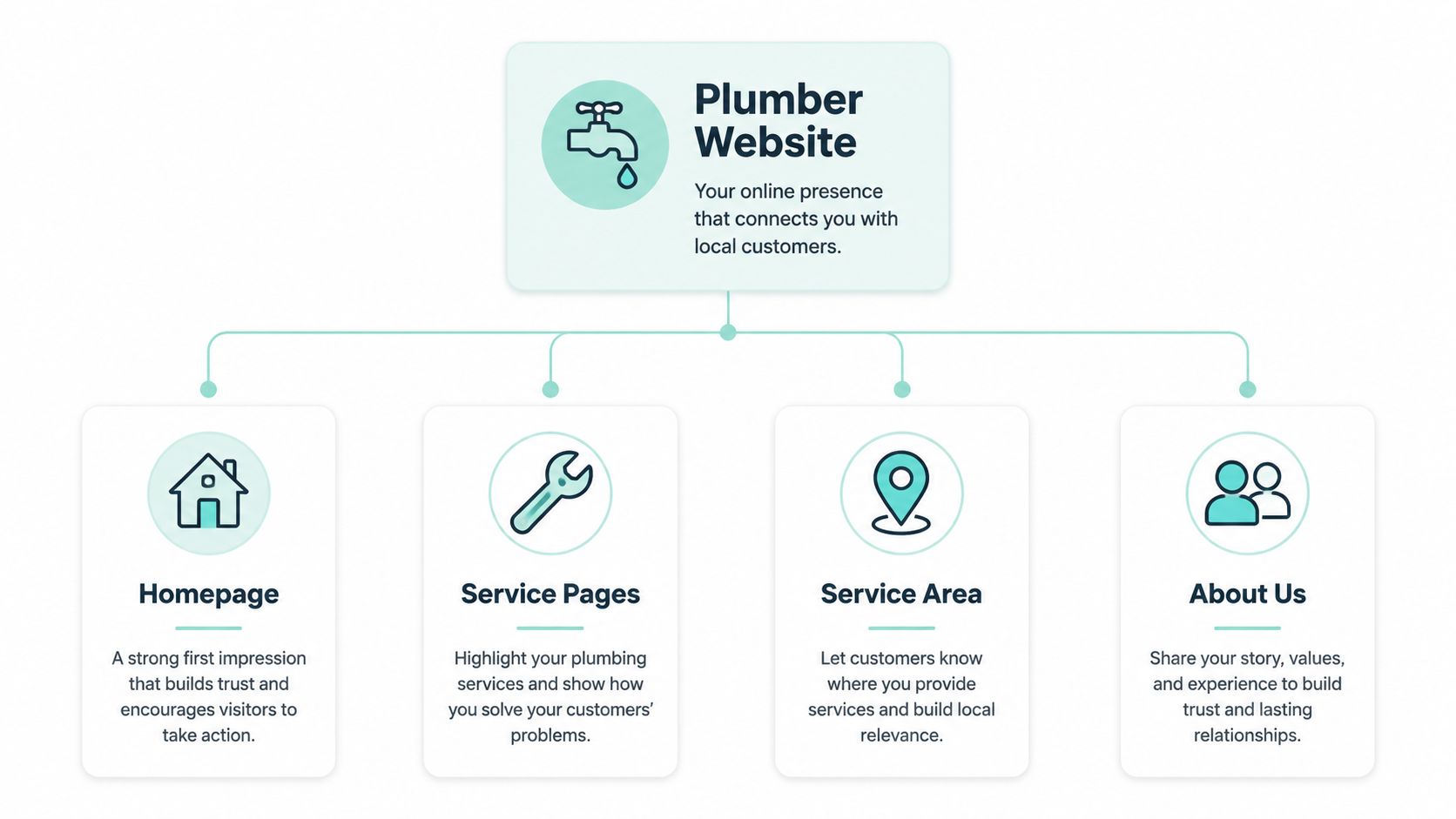
Homepage
The homepage is the fastest trust test. State your primary services, service area, emergency availability where applicable, and phone number near the top. Use one strong primary action, such as Call for Emergency Service, then support it with a secondary path for scheduled work, such as Request a Quote or Book Service.
Avoid generic headlines such as “Welcome to Our Plumbing Company.” A location and outcome are more useful, for example, “Emergency Plumbing and Water Heater Repair in Tyler.” The copy should sound specific enough to confirm that the visitor has found a relevant provider.
Service pages
A single services page forces unrelated visitors into the same funnel. Dedicated pages for drain cleaning, water heater repair, sewer line work, leak detection, fixture installation, and emergency plumbing let you match the page to the problem being searched.
Each page should explain symptoms, likely causes, what the service includes, when to call, and how to contact the business. Keep emergency pages call-first. For planned work, a quote form or booking flow can sit beside the phone option.
Service area pages
Service area pages capture demand from towns, neighborhoods, and nearby communities. They shouldn't be duplicate pages with only the city name changed. Include local information, service limitations, travel considerations, relevant jobs, and links to the services offered there.
A clean sitemap helps users and crawlers understand the hierarchy. Use this sample sitemap for a website as a planning reference, then adapt the structure to your services and market.
About, reviews, and trust pages
The About page should identify the people behind the business, not just repeat a mission statement. Explain experience, qualifications, licensing or insurance status, and what customers can expect when a technician arrives. Real photos of the team, vehicles, or work environment usually communicate more credibility than generic stock photography.
Place reviews near conversion points, including service pages and booking forms. A dedicated testimonials page can support deeper validation, but don't make visitors hunt for proof.
FAQ and contact pages
FAQ content should answer practical objections about timing, pricing, licensing, service areas, warranties, and emergency response. The contact page should offer a tappable phone number, a short form, business hours, and clear expectations about what happens after submission.
For businesses managing estimates across jobs, an operational resource such as Exayard plumbing estimating software can support the process after a lead enters the business. The website still needs to make that first contact simple.
Mobile-First Design and Speed Benchmarks for Plumbing Sites
A plumbing website should be designed on a phone-sized screen before desktop styling receives attention. That reflects where urgent demand occurs and forces better decisions about hierarchy, tap targets, forms, and content density.
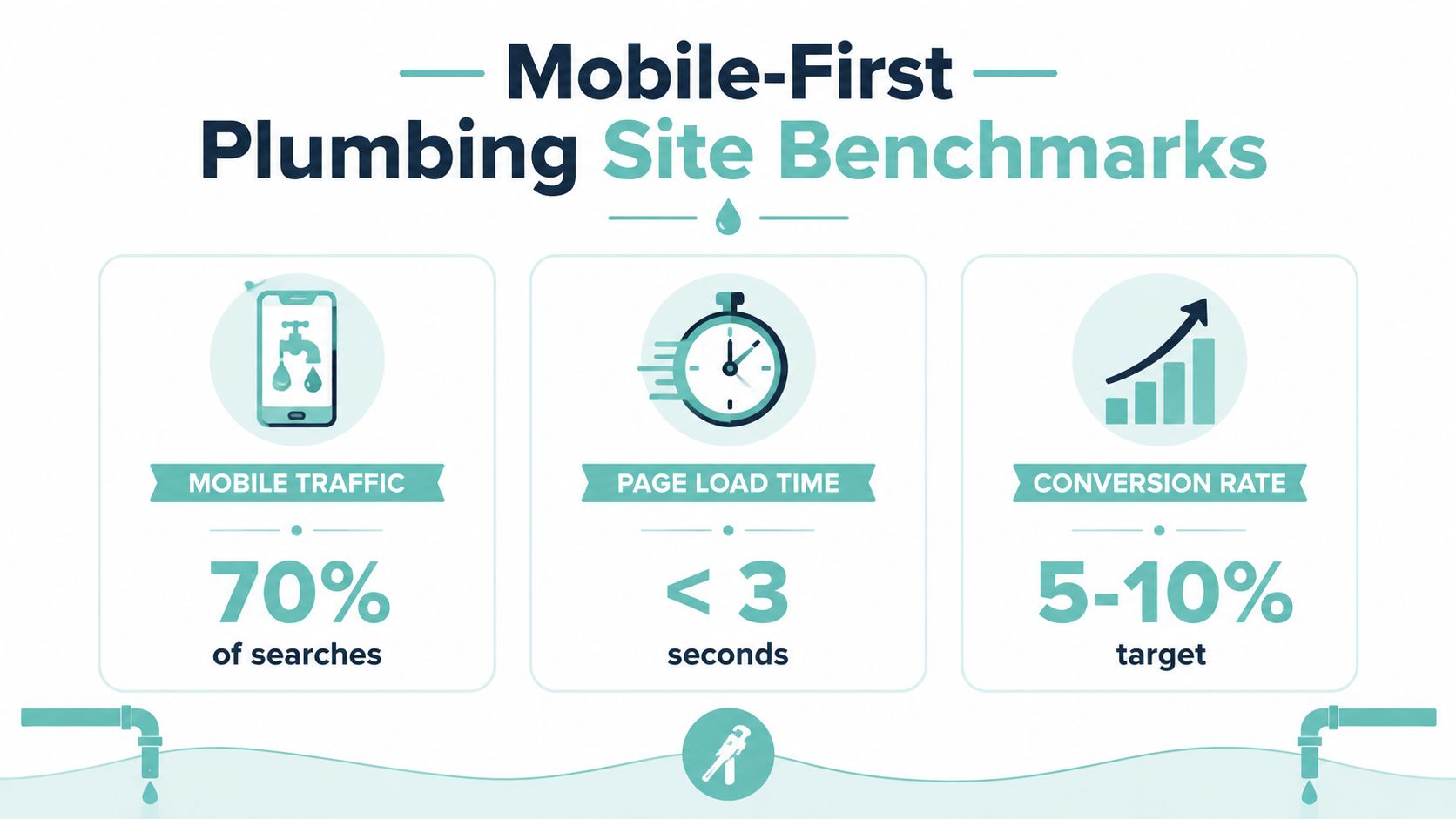
The contractor benchmark cited earlier places home-service mobile traffic at 65% to 75%, with emergency plumbing searches potentially above 80%. That makes the mobile interface the primary intake experience for many leads, not a smaller version of the desktop site.
The mobile interface should prioritize action
Use a sticky bottom bar with Call, Book, or Request Service options when it doesn't obstruct content. The phone number should be a real tap target, not text embedded in an image. Keep the navigation short, and group services by the way customers describe problems, such as “no hot water” or “blocked drain,” rather than internal business categories.
Forms deserve the same discipline. A 2026 form benchmark reported a 17.3% cross-industry median form conversion rate, while normalized mobile lead-generation forms converted at 8.7% compared with 12.8% on desktop, a difference of about 32%. The 2026 form conversion benchmark supports a practical conclusion: mobile plumbing forms should request only information needed to route and respond to the inquiry.
Ask for the customer's name, contact details, location, service type, and a concise description. Save detailed diagnosis for the phone call or technician visit.
Treat speed as a conversion requirement
One benchmark found pages loading under 2.5 seconds averaged 6.8% conversion, compared with 2.1% for pages slower than 4.5 seconds. Google research also states that 53% of mobile visitors abandon pages that take longer than 3 seconds to load. The contractor conversion benchmark and Google's mobile speed playbook connect page performance directly to lead behavior.
Core Web Vitals provide concrete technical targets:
- Largest Contentful Paint: 2.5 seconds or less
- Interaction to Next Paint: 200 milliseconds or less
- Cumulative Layout Shift: 0.1 or less at the 75th percentile of real users
These thresholds come from Google's Core Web Vitals guidance for local SEO. Compress hero images, specify image dimensions, defer noncritical scripts, and reserve space for chat tools, banners, and review widgets. A page that shifts while someone tries to tap the phone button feels unreliable, even when the underlying business is excellent.
Local SEO and Answer Engine Optimization for Plumbers
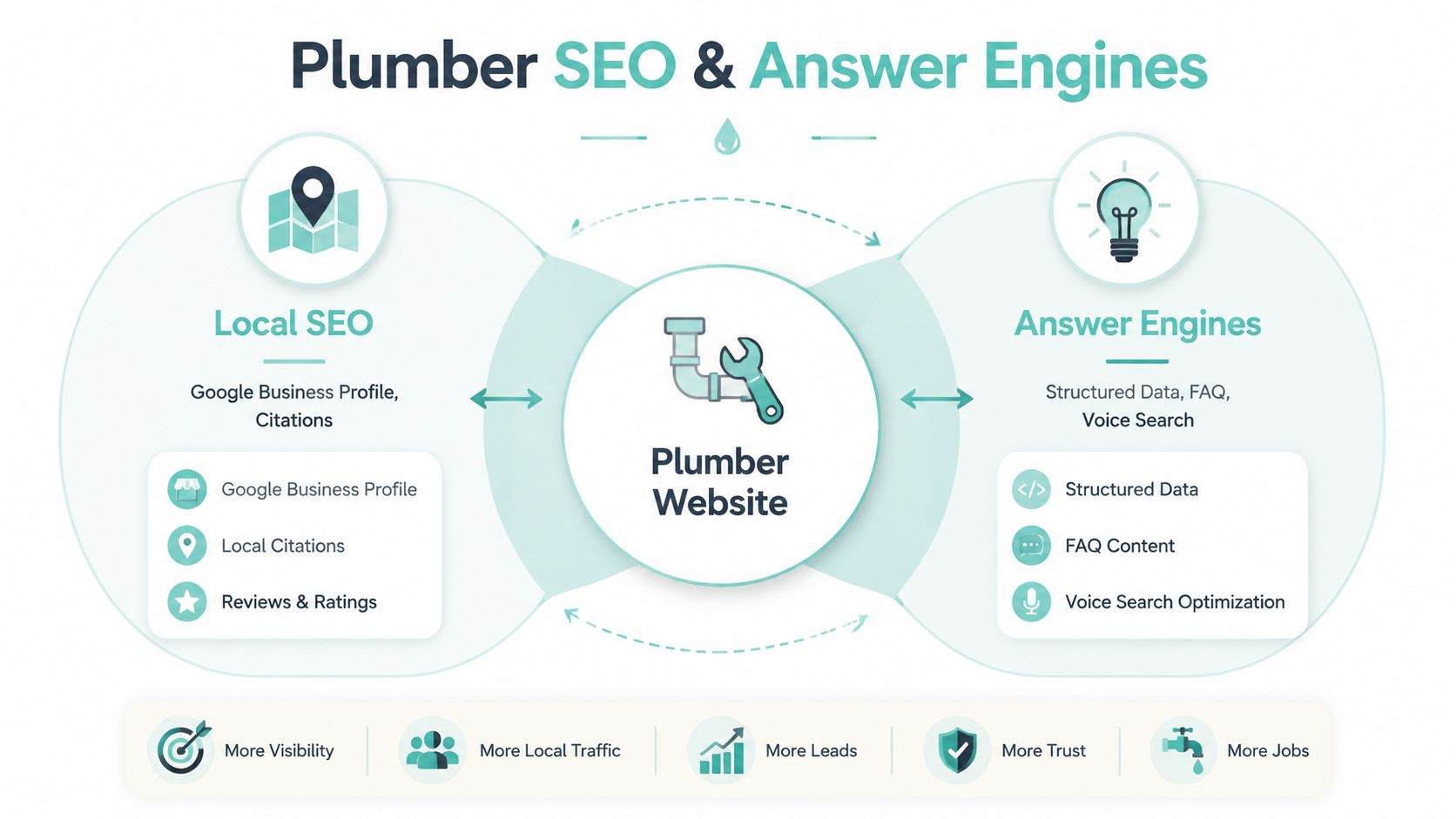
Local SEO and answer engine optimization work best when the website contains clear, consistent, structured information. Google needs to connect the business with a place and service. Answer engines need concise information they can interpret and use when responding to a question.
Start with the fundamentals. Keep the business name, address, phone number, hours, service areas, and categories consistent across the website and local listings. Fully maintain the Google Business Profile, connect it to relevant service pages, and use location language naturally in headings and body copy. Avoid stuffing city names into awkward sentences or publishing thin pages that provide no local value.
A plumber's website should also make its expertise easy to extract. Answer engines tend to work better with direct questions, clear answers, descriptive headings, and structured data that accurately reflects the visible page content. A page answering “How quickly can you respond to a burst pipe?” should lead with a concise service-specific answer, then explain availability and the next step.
Build FAQs around hesitation, not keywords
One recent plumbing-site audit claims 58% of plumbing websites don't have an FAQ section, while also reporting that FAQ pages can increase conversions by 21%. The plumbing website anatomy audit provides the figures, but the practical lesson is broader: FAQs shouldn't be a generic SEO appendix.
Place questions where they help the visitor decide:
- Service pages: What does drain cleaning include? When is replacement more sensible than repair?
- Emergency pages: Do you answer after hours? What should a homeowner do before the technician arrives?
- Pricing content: What affects the cost? Do you provide estimates before work begins?
- Trust sections: Are technicians licensed and insured? Do you offer warranties?
- Location pages: Which neighborhoods do you serve? Are there service-area limitations?
Write each answer in plain language, then provide a next action. A pricing answer that ends without a phone number or quote option leaves the visitor informed but unconverted.
For teams mapping opportunities across local markets, local SEO use cases can help frame how location data supports broader search planning. Use schema markup carefully. FAQ, LocalBusiness, Service, and Breadcrumb structured data should describe what users can see, not promise visibility in a particular search feature.
A useful answer engine optimization framework treats content clarity, technical accessibility, local relevance, and conversion paths as connected priorities. A page that answers a question but doesn't establish service area or contact options has solved only part of the customer's problem.
Project Timelines and Costs for Plumber Website Builds
Website proposals often become confusing because agencies mix strategy, design, development, copywriting, hosting, and ongoing optimization into one vague package. Compare the work included, not just the headline price.
A small template-based site can move quickly when the business supplies approved copy, photos, service details, and access to existing assets. The trade-off is limited flexibility and a greater risk that the site resembles other local contractors. It may be adequate for a basic presence, but it usually requires careful customization to support distinct emergency and scheduled-service paths.
A custom website with SEO foundations takes longer because the team must define information architecture, write or revise service pages, develop local content, build responsive templates, and implement analytics. That extra work matters when the website needs to support multiple services, towns, forms, calls, and ongoing search growth.
A full-service lead-generation build adds technical performance work, conversion testing, reporting, and ongoing SEO or AEO. It isn't a one-time design purchase. The business is funding a system that must be measured and refined after launch.
| Engagement Model | Typical Cost Range | Timeline | Best For |
|---|---|---|---|
| Template-based build | Lower investment | Shorter launch cycle | A new business needing a credible basic presence |
| Custom design with SEO foundations | Mid-range investment | Several project phases | An established plumber replacing an outdated site |
| Lead-generation website with ongoing optimization | Higher initial and continuing investment | Build followed by ongoing work | A competitive local market where calls and rankings need continuous improvement |
Because the verified data doesn't establish universal dollar ranges or fixed schedules, treat any proposal with specific costs as a project estimate, not an industry rule. Ask whether the price includes copy, page templates, technical SEO, analytics, redirects, form tracking, and post-launch support.
Budget for maintenance after launch. Services change, technicians join or leave, hours shift, reviews accumulate, and search behavior evolves. A site that never receives updates eventually stops reflecting the business it represents.
How to Vet a Plumber Website Designer
A designer who produces attractive pages isn't automatically equipped to build a lead-generation website. Start by asking how they translate search intent into page structure. If the answer focuses only on colors, logos, and animations, the conversation is happening at the wrong level.
Ask for evidence tied to business outcomes
Request examples involving plumbers, HVAC companies, roofers, or other local service businesses. Look for evidence of work across mobile UX, service-page architecture, local SEO, forms, calls, and technical performance. A portfolio screenshot can't prove that a site generates qualified inquiries.
Ask how the agency tracks phone calls, form submissions, booking requests, rankings, and organic traffic. You should understand what gets measured before the redesign begins and how the team will distinguish a traffic increase from a lead-quality improvement.
Test their process before you sign
A serious partner should be able to explain discovery, research, content planning, design, development, quality assurance, launch, and iteration. Ask who writes the service pages, who handles technical SEO, and whether conversion optimization is included or sold later as an unrelated add-on.
Use these questions to expose weak proposals:
- Who owns the website and content? Confirm that you can access your domain, analytics, pages, and assets.
- How will emergency and scheduled work differ? The answer should address calls, forms, booking, and page hierarchy.
- How do you test mobile performance? Look for Core Web Vitals monitoring and real-device checks, not a desktop-only demonstration.
- How do you handle service-area pages? Reject copied city pages with no local substance.
- What happens after launch? Clarify support, reporting, updates, SEO, AEO, and conversion improvements.
- Do you work with direct competitors nearby? Exclusivity can protect your strategic information and reduce conflicts.
Be cautious with agencies that promise rankings on a fixed schedule, rely on stock imagery for every trust element, or treat a website as finished the day it goes live. A practical selection process includes a discovery audit, a defined scope, transparent ownership, and a clear plan for learning from actual visitor behavior.
Your Action Plan for a High-Performing Plumber Website
Start with an audit, not a redesign request. Open the current site on a phone and ask someone unfamiliar with the business to find the emergency number, service area, licensing information, and booking path. Test the main forms, check whether calls are tracked, review the highest-traffic pages, and identify where visitors leave without contacting the business.
Next, create the structure. Separate emergency services from planned work, assign dedicated pages to important services, map locations to useful area pages, and place FAQs beside the objections they answer. Define one primary action for each intent, then write the content before decorative design decisions take over.
Build for the visitor. Compress media, protect Core Web Vitals, use responsive layouts, keep forms short, and make tap targets obvious. Add trust signals above the fold, but don't fill the first screen with competing badges, sliders, pop-ups, and chat prompts.
After launch, measure behavior rather than relying on opinions. Track rankings, organic traffic, calls, form submissions, booking activity, page speed, and lead quality. Review the data regularly, then refine headlines, service-page paths, forms, sticky actions, FAQs, and trust placement based on what customers do.
The most useful plumber website design isn't the one with the most visual effects. It's the one that helps a worried homeowner identify the right service, trust the business, and make contact without hesitation, while giving search engines and answer engines enough clear information to understand the company.
Digital Skyrocket plans, designs, develops, and optimizes lead-generating websites for service businesses, combining technical SEO, local SEO, AEO, and conversion-focused UX. Visit Digital Skyrocket to start a discovery conversation about your plumber website and identify the highest-impact opportunities for more qualified inquiries.