You can feel this problem before you can name it. The rankings are moving, Search Console looks healthier, and traffic finally starts to climb, but the phone still isn't ringing the way you expected. For a law firm, roofer, or HVAC contractor, that's the moment the core issue shows up, because more visibility isn't the same thing as more signed cases or booked jobs.
The mistake is usually structural, not tactical. SEO brings the right people to the site, but if the page is slow, vague, or makes them work too hard to call or submit a form, the visit dies on arrival. seo and conversion optimization has to work as one system for service businesses, because a ranking only matters if it turns into an inquiry that the office can close.
Table of Contents
- The Core Problem Behind Most Service Business Websites
- How SEO and Conversion Optimization Fit Together
- Five High-Impact Areas Where SEO and CRO Overlap
- Measuring SEO and CRO with One Shared Dashboard
- A Prioritized 90-Day Checklist for Owners and Agencies
- How Three Service Businesses Apply the Same System Differently
- Why the Next Dollar Belongs in CRO and AEO, Not More Content
The Core Problem Behind Most Service Business Websites
A typical call I see starts the same way. An owner says the site is finally getting impressions, maybe even some clicks, but the intake team still has plenty of dead air and the calendar is not filling the way the dashboard suggested it should. That gap is rarely about “bad SEO” alone. It's usually a site that was built to be found, but not built to persuade.
For local service businesses, that mistake gets expensive fast because the market is usually narrow. A law firm may only need one steady stream of good cases in a metro area, a roofer may be competing for a handful of storm-intent jobs, and an HVAC company may care far more about the next twenty calls than about broad brand visibility. When every qualified lead matters, ranking well without a conversion path is just a nicer-looking leak.
Why rankings don't close the deal by themselves
Organic search still sends a large share of website traffic, and Google still controls most of the search market, so visibility matters. The upside is obvious. The catch is that the click is only the beginning of the revenue path, not the end of it.
The first organic result also receives about 27.6% of clicks (SEOWorks statistics), so even small ranking gains can matter a lot. But if the visitor lands on a page that buries the phone number, asks too much from the form, or never makes the next step obvious, that traffic never turns into revenue. That's why rankings are a starting line for service businesses, not a finish line.
For a local firm, that gap is easy to miss because the ranking feels like progress. It is progress, just incomplete. A page that ranks and fails to convert still costs time, ad spend, and labor, and the owner usually ends up paying again later to fix what the first build missed.
Why local service sites feel the pain faster
Service buyers usually don't browse casually for long. They search with intent, compare a small set of providers, and then move quickly if the page makes sense. That means weak pages fail fast, and strong pages can outperform far bigger brands in the same market.
Practical rule: if the page can't answer three things quickly, what you do, where you do it, and how to contact you, it's underbuilt for local search traffic.
That same pressure shows up in newer search behavior too. People asking an AI tool or search assistant for a provider still need a page that answers the question clearly and makes contact easy. Answer engine optimization only helps if the page can be understood and trusted enough to surface in the first place.
The historical lesson is simple. SEO captures demand, CRO turns that captured demand into calls, forms, and consultations. When those jobs are split across different teams or vendors, the business ends up celebrating traffic while intake stays flat. That's not a marketing problem in the abstract, it's a revenue system problem.
How SEO and Conversion Optimization Fit Together
SEO and CRO sound separate because the industry talks about them separately. In practice, they belong to one revenue system, the question is what happens after the click. SEO earns visibility for searches that already exist, and CRO turns that visibility into a phone call, a booked estimate, or a case evaluation.
A search like “personal injury lawyer Tyler TX” is not casual browsing. The person has a problem and wants a provider who looks credible enough to contact. The page has to satisfy the search, but it also has to reduce hesitation. The old split between “rankings work” and “conversion work” breaks down fast in that situation.
What SEO does for a service business
SEO brings in intent that already exists. That matters because search traffic usually arrives with more commercial intent than casual discovery traffic. In practice, the lead quality is often stronger because the search itself has already filtered out people who are not ready to act.
That is why service pages, location pages, and comparison pages deserve so much attention. They are not just content assets, they are sales surfaces. If the query shows buying intent, the page should answer quickly, prove trust, and make the next action obvious.
What CRO does once the visitor lands
CRO removes friction from the page. That can mean simplifying the form, making the call button easier to tap, putting trust signals where people will see them, or rewriting the CTA so it matches the buyer's urgency. It also means not asking one page to do too many jobs at once.
The classic mistake is treating CRO as a final polish step. That is backwards. If a page ranks for the right query but the offer is unclear, the site is bleeding value at the page level. If the page converts well but nobody finds it, the business has built a good storefront on a dead-end street.
A useful way to frame it is simple. SEO earns the visit, CRO earns the action. That connection matters most in local services, where the path from search to contact is short and the competition is usually local, not national. The cleaner the handoff, the more qualified the lead flow.
For teams building pages that need to answer searchers and still drive contact, Answer Engine Optimization is a useful companion to the SEO side of the work.
Five High-Impact Areas Where SEO and CRO Overlap
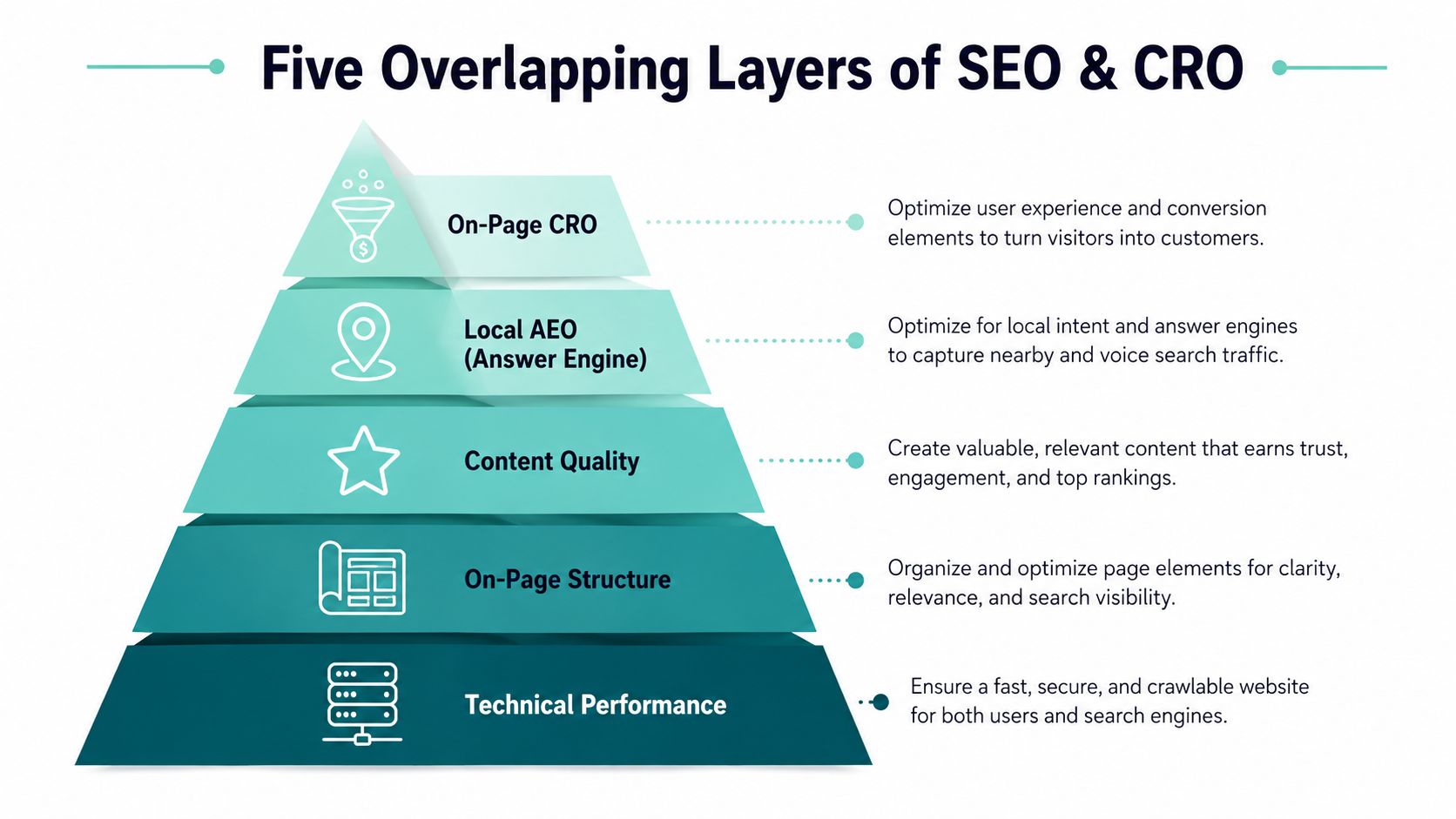
The biggest lift usually comes from the same five layers, but they don't all matter equally. For local service businesses, I rank them by expected impact like this, technical performance, on-page structure, content quality, local AEO, and on-page CRO. That order reflects how often I see one weak layer suppress both visibility and conversions at the same time.
1. Technical performance
Speed is not a cosmetic issue. One widely cited ecommerce benchmark found that a 0.1-second improvement in load time increases retail conversion rates by 8.4% and average order value by 9.2% (Anchor Group). Another benchmark says a one-second delay in mobile load time can reduce conversion rates by up to 20% (Lumar). Those numbers explain why slow pages hurt both ranking and revenue at the same time.
For service sites, the first fixes are usually image compression, caching, minification, and CDN use. Google's Core Web Vitals targets also matter here, with guidance that treats Largest Contentful Paint under 2.5 seconds, Interaction to Next Paint under 200 ms, and Cumulative Layout Shift under 0.1 as baseline thresholds to monitor alongside crawlability and conversion rate (HubSpot).
2. On-page structure
The second layer is how the page is organized. A service page needs a clear hierarchy, obvious service-area context, trust signals near the decision point, and a path that gets the visitor from problem to contact without wandering through half the site. Internal linking matters here, but it should move people toward the next useful decision, not just spread authority around.
3. Content quality
Good content doesn't mean more words. It means the page sounds like a real local provider, not a templated SEO page with the city name swapped out. The strongest pages answer objections in the same language buyers use, then support that answer with service details, proof, and a specific next step. For a deeper framework on page architecture, this guide to internal linking best practices is worth folding into the build.
4. Local AEO
Answer engines, map results, and zero-click experiences are changing what “visibility” means. Pages need to be readable by systems that summarize, extract, and surface answers before someone lands on the site. For local service companies, that means making service-area messaging, trust signals, and clear service descriptions easy to parse.
5. On-page CRO
The page either converts or hesitates. A single clear CTA usually beats competing actions, and landing pages with one clear CTA convert 266% better than pages with multiple competing CTAs (SearchLab). Video can also help, with landing pages using video increasing conversion by an average of 86% in that same benchmark (SearchLab).
The page doesn't need more persuasion everywhere. It needs the right persuasion in the right spot.
Measuring SEO and CRO with One Shared Dashboard
The cleanest dashboards I've built for service businesses don't separate “SEO metrics” from “conversion metrics.” They connect the whole path, from search visibility to signed work. That keeps the owner from asking whether traffic is up or leads are up, because the core question is whether visibility is producing revenue.
Track the path from impression to close
The minimum useful chain is straightforward, qualified impressions in Search Console, organic sessions, calls from organic, form submissions from organic, qualified leads, and then signed cases or booked jobs. Once those are in one reporting view, ranking changes become diagnostic instead of ceremonial. A page that gets impressions but no leads needs a different fix from a page that gets leads but too little traffic.
Use three sources, not ten
Google Search Console tells you which queries are gaining impressions and which pages are sitting in striking distance. Call tracking shows whether the organic visit led to a real conversation. CRM-stage data tells you which leads were worth the time. Heatmaps and session recordings can help, but they're secondary to those three sources because they don't show revenue by themselves.
Practical rule: if a metric can't connect to the intake team or the CRM, it's a diagnostic, not a decision-maker.
That matters even more now that answer engines and SERP features can influence demand without always producing a clean click trail. A service business can't afford to celebrate sessions while ignoring qualified lead volume, because the site isn't being judged by Google alone. It's being judged by the office phone, the calendar, and the signed agreement.
The point of the shared dashboard is not more reporting. It's better decisions. Once the team can see which pages drive actual opportunities, the SEO work gets sharper and the CRO work gets less theoretical.
A Prioritized 90-Day Checklist for Owners and Agencies
The first 90 days should go after the bottlenecks that affect both rankings and inquiries. I don't start with content calendars when the site is slow, the call tracking is broken, or the contact path is unclear. Fix the base first, then scale the pages that deserve more attention.
Days 1 to 30, fix the friction
Start with performance work, image compression, caching, minification, and CDN setup. Then confirm Core Web Vitals, because those metrics tell you whether the site is stable enough to support both search visibility and conversion completion. At the same time, install call tracking and make sure form fills are flowing into the CRM.
Days 31 to 60, tighten the page architecture
Service pages need a cleaner hierarchy. Location pages should read like real service-area assets, not copied variations. Schema markup, trust signals, and a clear CTA should all live where a buyer can see them without hunting. If a page is supposed to convert, it should look like the only sensible place to take the next step.
Days 61 to 90, refine the conversion path
Forms, call buttons, and scheduling flows get tested. If a page is getting the right traffic but weak response, cut competing actions and make the primary path obvious. Test one change at a time so you can tell whether the lift came from the page or from the intent of the traffic.
The work after that compounds, content expansion, strategic internal linking, and targeted authority building. But for most service businesses, especially local ones with one client per market, the early gains come from making existing pages do a better job. A page doesn't need to be the prettiest in town. It needs to make it easy for the right visitor to say yes.
How Three Service Businesses Apply the Same System Differently
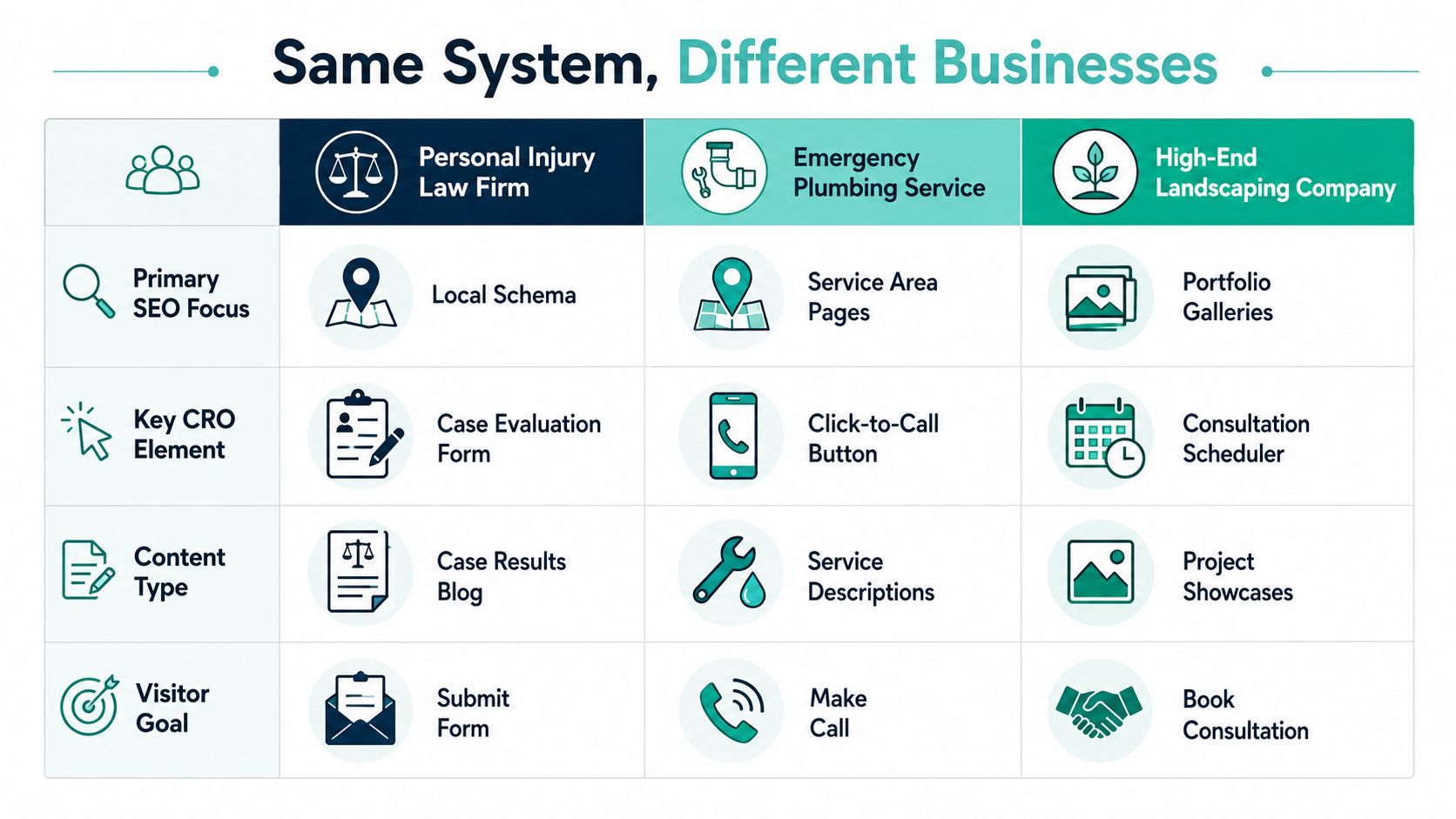
The system stays the same, but the buying journey changes the page. A personal injury firm doesn't need the same intake flow as a roofer, and a roofer doesn't need the same trust architecture as an HVAC company. The mistake is copying one template across every service and expecting the market to forgive it.
Personal injury law firm
An injury site should be built around case evaluation, not general contact. Emergency-intent traffic needs a fast path to a call, an after-hours routing plan, and trust signals that answer the buyer's fear about legitimacy and responsiveness. Attorney bios, case results, and intake clarity matter because the visitor is often stressed and looking for a reason to stop comparing firms.
Roofing contractor
Roofing traffic often arrives with storm damage, roof repair, or replacement intent. That means service-area pages and storm-focused pages need to do real work, and photo galleries or before-and-after examples should help both ranking and reassurance. In this industry, proof has to show visible workmanship, not just say “we're experienced.”
HVAC company
HVAC is more seasonal and more scheduling-driven. Generic contact forms are usually weaker than a clear booking flow, especially when the visitor wants service quickly. Service-area pages generally outperform city-stuffed pages because they match how people search and how they want help.
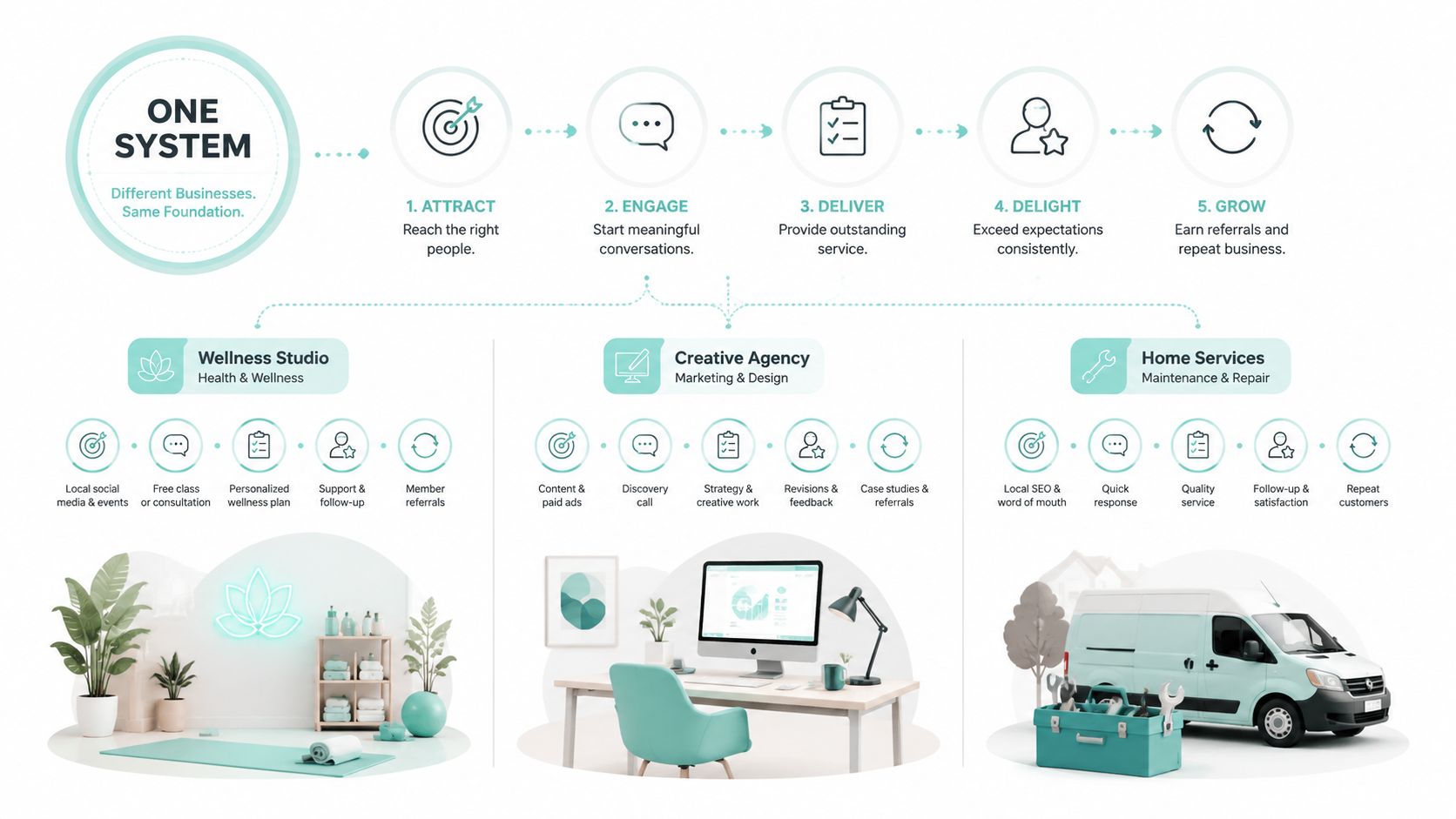
That's the pattern. The SEO/CRO system is universal, but the trust signals, calls to action, and conversion paths have to fit the buyer's urgency and the service type. If the page architecture doesn't match the way the job gets sold, the ranking won't save it.
Why the Next Dollar Belongs in CRO and AEO, Not More Content
Once a service site has basic visibility, the next marginal dollar usually belongs in conversion work and answer-engine work, not another batch of blog posts. That is especially true when the existing pages already earn impressions. The bottleneck is usually the page inventory, not the lack of new articles.
The content instinct is easy to understand. When leads are weak, owners assume they need more traffic. In practice, many of those pages are already close enough to matter, and they need a better conversion path more than they need another 1,500 words. That's where conversion rate optimization earns a higher return.
The testing side also matters. SearchLab notes that mature programs run far more tests and improve faster than teams that only test occasionally, which is a good reminder to treat high-traffic service and location pages like landing pages and test them with intent. A law firm, roofing company, or HVAC contractor does not need endless new articles if the main service pages are leaking calls, forms, and booked appointments.
For service businesses, the win is not sessions. It is signed cases, booked installs, and qualified consultations. If the current pages are close, fix the experience. If answer engines are already shaping visibility, make the pages easy to parse and worth citing. That is where the next dollar usually earns its keep.