
740,920 monthly searches and about $1.8 million in equivalent Google Ads value sit inside the home-builder keyword cluster, which is why seo for home builders isn't a branding exercise, it's a demand-capture system for a high-consideration purchase. When buyers are already searching for builders, neighborhoods, floor plans, and timelines, the site that shows up first doesn't just get attention, it gets the next conversation.
The trap is that many builder sites still look like portfolios first and lead systems second. That's expensive, because a gorgeous gallery that loads slowly or hides the service area behind vague copy won't win the inquiry. The builder who earns the click, answers the intent, and makes it easy to call or submit a form usually wins the lead.
Table of Contents
- Why Search Demand Makes SEO a Priority for Builders
- Targeting High-Intent Local Keywords That Convert
- Building a Content Architecture That Scales Across Markets
- Fixing the Technical Performance Issues That Kill Conversions
- When Google Business Profile Is Enough and When It Falls Short
- Measuring What Matters From Rankings to Revenue
Why Search Demand Makes SEO a Priority for Builders
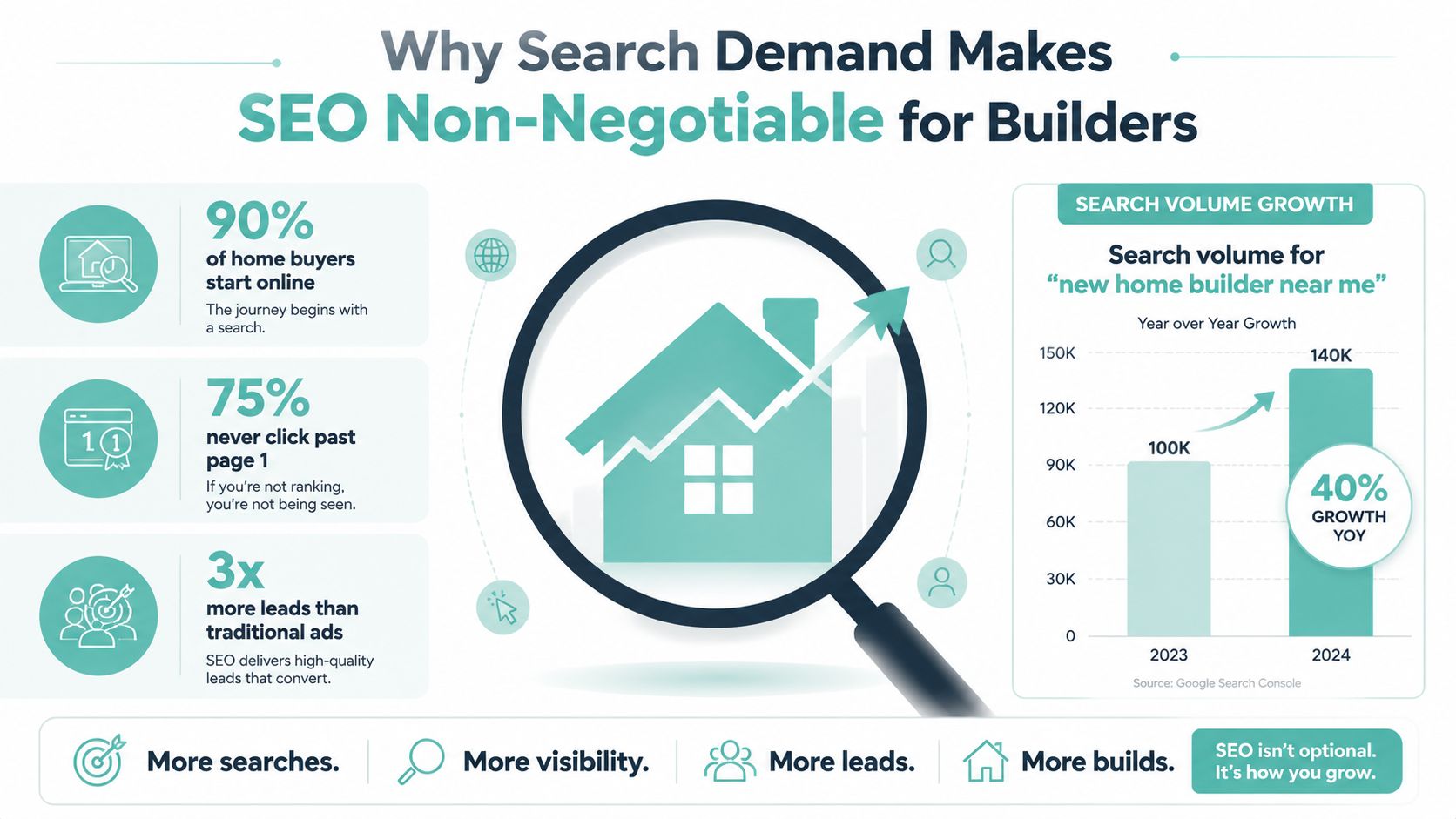
The first reason builders need SEO is simple, there is a lot of search demand to capture. One home-builder keyword analysis found roughly 740,920 monthly searches and estimated that volume at about $1.8 million per month in equivalent Google Ads value, which shows how much buyer attention lives inside search before a salesperson ever enters the picture. SEO for home builders and keyword demand analysis
Intent beats awareness in this market
A custom home or major remodel is a considered purchase. Buyers compare builders, examine project photos, check reviews, and research local fit long before they make contact. That is why SEO matters more here than in many other local industries, because search behavior already reflects serious intent.
The old model of relying on brand recall or word-of-mouth alone leaves too much revenue on the table. The builder who appears when someone searches a city, suburb, or neighborhood query gets a shot at the shortlist. The opportunity is spread across local intent, not one national head term.
Search is where the decision process starts
A second construction SEO review reported that 70% of construction-related service searches begin on Google, and that 68% of construction firm websites receive fewer than 500 monthly visitors without SEO optimization. That gap explains why search visibility is not a nice extra, it is infrastructure for lead generation. Construction SEO statistics review
The same review noted a 61% traffic increase over 12 months for firms that invested in SEO, which is the kind of movement that changes the conversation inside a sales team. It also shows why search optimization compounds over time instead of switching on like paid media. For builders balancing organic growth with paid demand capture, that same principle shows up in proven SEO and PPC for roofers, where the strongest programs align intent, visibility, and follow-up instead of relying on one channel alone.
Practical rule: if buyers can search for the exact thing you sell, the website has to be built around that query pattern, not around internal company categories.
The trade-off is clear. Beautiful branding helps once someone is already on the site, but search visibility determines whether they ever arrive. Gallery-heavy websites often slow down the page, bury service pages under project imagery, and make it harder for buyers to find the right next step. In home building, that is often the difference between being considered and being invisible.
Targeting High-Intent Local Keywords That Convert
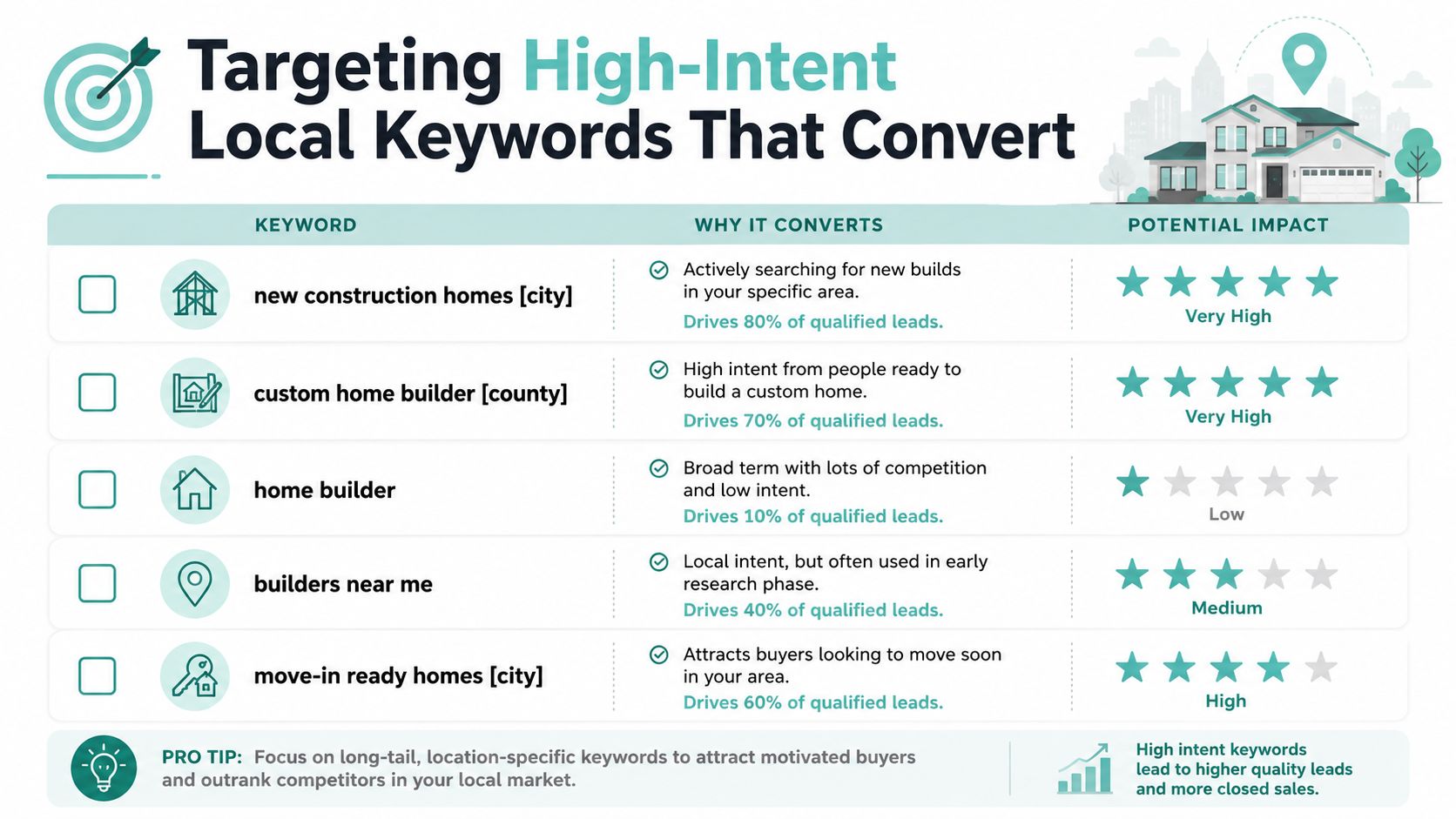
Broad head terms waste attention because they don't tell Google, or the buyer, where you work. A phrase like “home builder” on its own is too vague for most local firms, while “home builder [city]”, “custom home builder [county]”, and “general contractor [neighborhood]” reflect the way people search when they're ready to compare vendors. Local keyword examples for home builders
Start with transaction-ready language
A good keyword map separates curiosity from buying intent. Someone searching for permits or construction timelines is useful to educate, but the person searching for new construction home builder [region] is usually closer to a quote request, consultation, or lot inquiry. That's where page priority should begin.
Service-specific variants matter too. Searches such as “kitchen remodel [city]”, “home addition contractor [city]”, and “move-in ready homes [city]” can serve different revenue streams, but only if each term maps to a real page with specific proof. The worst mistake is stuffing every service into one generic homepage and hoping Google sorts it out.
Build the keyword map around your service area
The fastest way to waste SEO effort is to chase keywords that don't match your footprint. If you work in three suburbs and one county, the site should reflect that geography in a structured way instead of pretending the business serves an entire metro equally. That means tracking location modifiers, project types, and buyer questions together.
For research, a low-competition discovery process can help surface smaller, winnable terms before you invest in larger pages. A useful internal starting point is how to find low competition keywords, then layer those insights onto your actual service map and sales process.
Rule of thumb: if a keyword doesn't match a real sales conversation you've had, it probably doesn't deserve a priority page.
A good comparison from another home-services niche helps illustrate the mindset. The same logic used to compare Trex and TimberTech works here, because buyers don't want abstract category language, they want specifics tied to a real decision. Builders should think the same way, with pages built around the exact phrasing buyers use when they're narrowing options.
Building a Content Architecture That Scales Across Markets
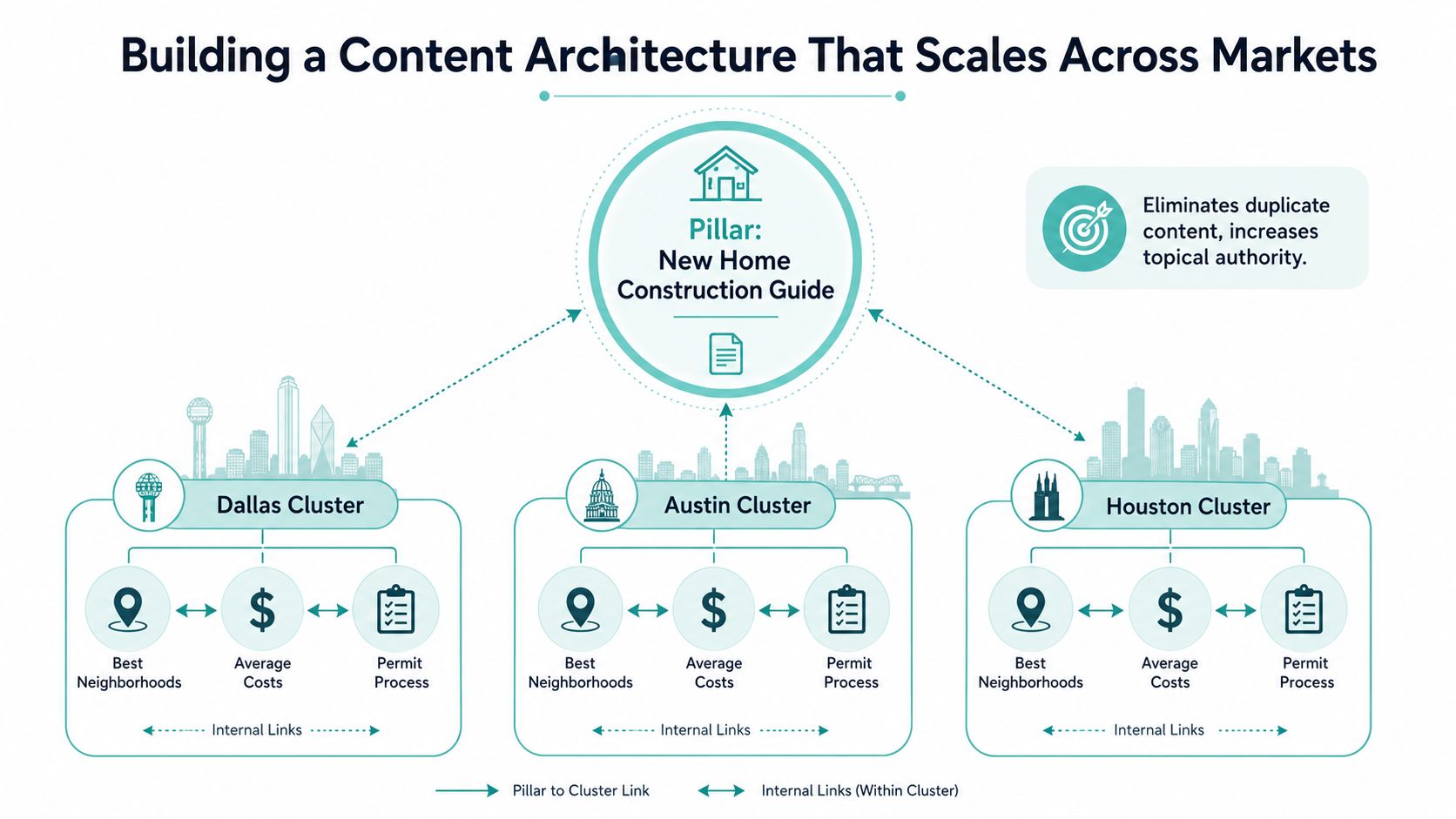
A builder site that tries to rank in multiple markets without structure usually ends up with thin city pages and duplicated project blurbs. A stronger approach is a pillar page plus 8 to 12 supporting cluster pages, each tied to a distinct intent such as a service page, neighborhood guide, cost guide, timeline guide, or project case study. Content architecture guide for home builders
Use one core pillar, then branch by intent
The pillar page should carry the main service story, such as custom homes or new construction. The cluster pages should answer narrower questions and feed internal links back to the pillar using descriptive anchors like “custom home process” or “new home construction guide.” That gives search engines a clear topical map and gives buyers a cleaner path to the page that should convert.
The goal isn't volume for its own sake. It's to build enough depth that a prospect can move from broad interest to specific confidence without leaving your site. A neighborhood guide can answer local fit, a cost guide can address budget concerns, and a timeline guide can reduce friction before the first call.
Make every project page feel real
Template duplication is where a lot of builder websites break down. If each community page uses the same gallery captions, the same boilerplate intro, and the same sentence about “quality craftsmanship,” the site looks manufactured instead of experienced. Search engines notice that sameness, and buyers do too.
Unique descriptions matter more than teams usually think. Write out what made a project specific to that lot, that climate, or that client's priorities. A page that says something real about a hillside build, a narrow infill lot, or a kitchen plan for a growing family has far more value than a stock inventory page.
The same discipline applies when you're trying to educate buyers about financing and feasibility. A resource like how to secure builder financing fits naturally beside project pages and process content because it addresses a real point of friction in the buyer journey.
Keep the site from collapsing into duplicate inventory
A scalable architecture has to protect against repetitive local pages. One builder page for Dallas, another for Austin, and another for Houston can work, but only if each one has local proof, distinct projects, and content that reflects the market. Otherwise, you're publishing near-copies and asking Google to reward sameness.
That's also where internal linking earns its keep. Project pages, neighborhood pages, and educational pages should point back to the service pillar with relevant anchors, while the pillar points outward to the supporting pages. A useful planning reference is a sample sitemap for website structure, because the architecture has to be intentional before the writing ever starts.
Fixing the Technical Performance Issues That Kill Conversions
Beautiful builder sites often lose leads because they're built like showroom walls instead of sales tools. Large image files, autoplay video backgrounds, and script-heavy page builders can slow initial render enough to frustrate mobile visitors, and mobile is where a lot of local research happens. The fix isn't to strip out all visuals, it's to protect the pages that matter most.
Start with the pages that should make money
Revenue pages come first. That means the homepage, core service pages, top location pages, and any floor plan pages that already attract serious intent. If those pages are slow, the site is handicapping its own lead flow before a visitor even sees the contact form.
The practical workflow is straightforward. Compress and correctly size images before upload, remove video backgrounds when they slow the page, keep floor plan layouts usable on a phone, and strip scripts that don't help a buyer move forward. The standard is not whether the page looks impressive in a design review, it's whether someone can load it quickly, scan it comfortably, and act without friction.
Treat mobile usability like a conversion requirement
Builders tend to showcase a lot of visuals, but phones aren't forgiving of heavy media. A responsive layout has to keep floor plans readable, forms simple, map embeds usable, and buttons easy to tap. If the page needs pinching, zooming, or waiting, some buyers will just leave and call another firm.
Practical rule: if a high-intent page feels “pretty but heavy,” assume it's costing you form fills until testing proves otherwise.
It's also common to over-animate galleries and hero sections while neglecting the basics. A slower first render can make the site feel unreliable, even if the underlying craftsmanship is excellent. That perception matters because trust starts before the form submission.
A structured usability review helps here, especially when a site has been redesigned by a team focused on visuals. A practical tool like website usability testing can reveal where people stall, which pages load poorly on phones, and where the CTA gets lost in the layout.
Don't confuse design polish with technical readiness
A site can look expensive and still be difficult to use. That's the trade-off many builder sites miss, because gallery-heavy pages impress stakeholders but don't always convert visitors. Technical performance isn't decoration, it's part of the sales path.
The best builder sites balance media with discipline. They still show the work, but they don't let the work bury the call to action or slow the visitor down. That's the difference between a digital brochure and a lead-generating site.
When Google Business Profile Is Enough and When It Falls Short
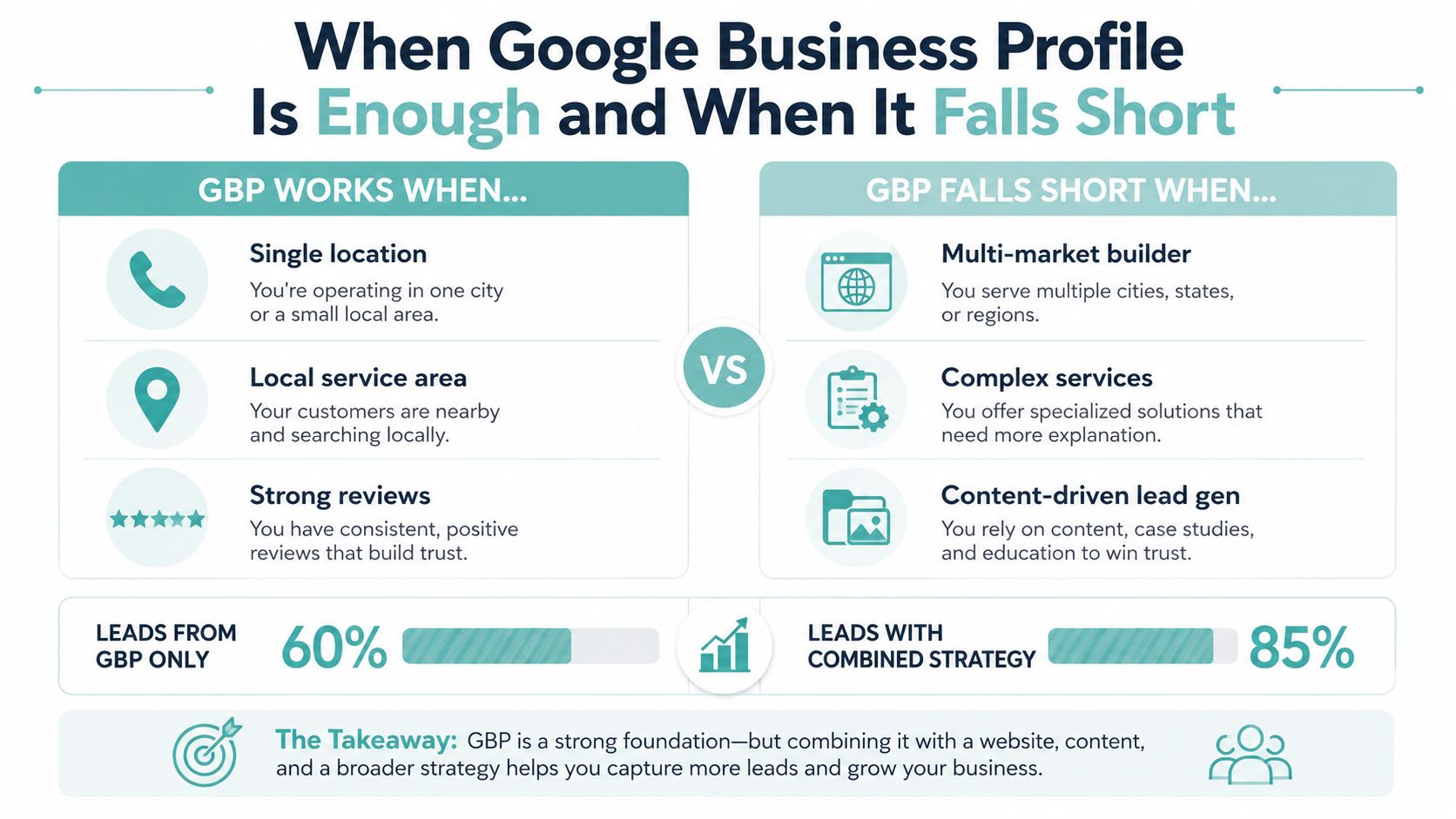
Google Business Profile can carry a local builder in some markets, but it doesn't solve everything. The question is whether your business is operating in a single-location, highly local service area where map visibility is enough, or in a broader market where website content has to do more of the persuasion. The gap matters because builder buyer journeys are visual, trust-driven, and often involve multiple decision-makers.
Use GBP when the business model is tight and local
GBP is strongest when the builder serves a clearly defined area, has a steady review cadence, and can show current project photos and accurate business information. That combination helps the map listing do more of the trust-building before someone ever reaches the website.
In that setup, GBP often functions like the front door. The buyer sees the location, reads the reviews, checks the photos, and uses the profile to confirm the business is real. For a smaller service area, that may be enough to trigger the first call.
Lean more on the website when the sales cycle is broader
GBP starts to fall short when the business spans multiple markets, serves several product types, or needs more explanation before a prospect is comfortable reaching out. In those cases, the website has to carry project proof, process detail, neighborhood relevance, and conversion pathways that a map listing can't provide.
That's where many builder teams underinvest. They polish the profile, but they leave the site thin, assuming Google will do the rest. In competitive metros, that's a risky bet because the map pack alone can't answer every trust question a buyer has.
GBP can open the door. The website has to close the sale.
The allocation decision should be market-based, not ideological. If the map pack is bringing calls and the site converts those visits, keep strengthening GBP. If the market is crowded or the business spans multiple service lines, build the website so it can win organic rankings and explain the difference between one project and the next.
Measuring What Matters From Rankings to Revenue
Rankings are a means, not the scorecard. What matters is whether organic visibility turns into form submissions, phone calls, consultation requests, and lot inquiries from the right pages. If the site attracts traffic but doesn't create conversations, the content or call to action is broken somewhere.
Track leads back to page groups
The cleanest measurement setup ties each lead type to a page cluster. A call from a neighborhood guide, a consultation request from a custom home service page, and a lot inquiry from a community page should not all be lumped into one bucket. When each page type has its own conversion path, you can see what drives demand.
Baseline data matters too. Before changes go live, capture current ranking positions, organic traffic, and lead volume so the impact doesn't get lost in memory. That way, later reporting can show movement in a way an owner can understand without a technical translation layer.
Report the story in business language
Owners don't need a spreadsheet full of vanity metrics. They need to know which keywords are moving, which pages are generating calls, and where the site is leaking interest. A clean report should connect content updates, internal links, review activity, and lead activity to the same objective, more qualified inquiries.
The practical insight is that rankings alone rarely tell the full story. A page can rank well and still underperform if the CTA is weak, the form is awkward on mobile, or the page doesn't answer the buyer's main objections. Conversely, a page with moderate rankings can still produce quality leads if it's structured around intent and trust.
When builder sites are measured properly, the work gets easier to prioritize. You stop guessing which gallery page matters and start seeing which service page, neighborhood page, or process guide is doing the heavy lifting.
Digital Skyrocket builds and optimizes lead-generating websites for service businesses, and that includes the SEO structure, technical performance, and conversion paths home builders need to turn search demand into inquiries. If you want a site that ranks for local intent instead of just looking polished, visit Digital Skyrocket and start a conversation about a site built to bring in qualified leads.