In 2024, 58.5% of U.S. Google searches and 59.7% of EU Google searches ended without a click to an external website (SparkToro's zero-click search study). That changes the commercial question for every law firm, roofer, HVAC company, and dentist competing in search. Ranking a page still matters, but ranking alone doesn't guarantee that a prospect will visit your website, read your offer, or call your office.
An answer engine optimization agency should therefore do more than make a business visible in AI-generated answers. It should help the business become a trusted source, earn relevant mentions, attract the users who do click, and turn those visits into qualified inquiries. A citation without a conversion path is a visibility win, not necessarily a marketing win.
Table of Contents
- The Zero-Click Reality and the Rise of AEO
- What an Answer Engine Optimization Agency Actually Does
- How AEO Complements Traditional and Local SEO
- Core Technical and Content Services for Lead Generation
- Measuring Success Beyond Traditional Rankings
- Red Flags and Selection Criteria for Service Businesses
- Your Hiring Checklist for an AEO Partner
The Zero-Click Reality and the Rise of AEO
Traditional SEO followed a familiar path: a prospect searched, reviewed results, clicked a page, and contacted a business. Answer engines now place summaries, direct answers, local information, and follow-up prompts between the searcher and the website. For service businesses, that changes how visibility turns into pipeline.
The same SparkToro study translated its findings into 360 open-web clicks per 1,000 U.S. searches and 374 per 1,000 EU searches. It also reported that roughly 37% of searches ended the session, while about 22% led to a different query. Many searchers now get enough information to stop, refine their question, or choose a next step without opening a traditional result.
Commercial implication: Your page may influence a buyer even when analytics never records a visit.
A first answer can shape a service business's shortlist. A homeowner asking which roof damage needs immediate repair may see guidance before comparing contractors. Someone asking what to do after a car accident may encounter information that affects which law firms appear credible. A person seeking emergency HVAC repair may use an assistant to narrow the options before visiting a website.
That visibility creates a conversion problem. An answer engine may cite a roofing company, law firm, or HVAC provider without sending a click, and a citation alone does not create a call or consultation. The business still needs a clear service page, relevant proof, accurate contact information, and a next step that supports the decision the answer has started.
AEO addresses that gap by making a business understandable and citable across answer surfaces. Traditional SEO still supports crawlability, relevance, authority, and organic discovery. This guide to what answer engine optimization means for modern search provides useful context, but the working distinction is direct: SEO seeks qualified visits from search results, while AEO also seeks qualified visibility before the visit.
An answer engine optimization agency should connect citation opportunities to commercial outcomes. Its work should identify prospect questions, build pages that answer them clearly, strengthen the business entity behind those answers, and assess whether visibility contributes to calls, forms, consultations, and booked work. The agency is not replacing SEO. It is adapting search strategy for situations where the answer appears before the click.
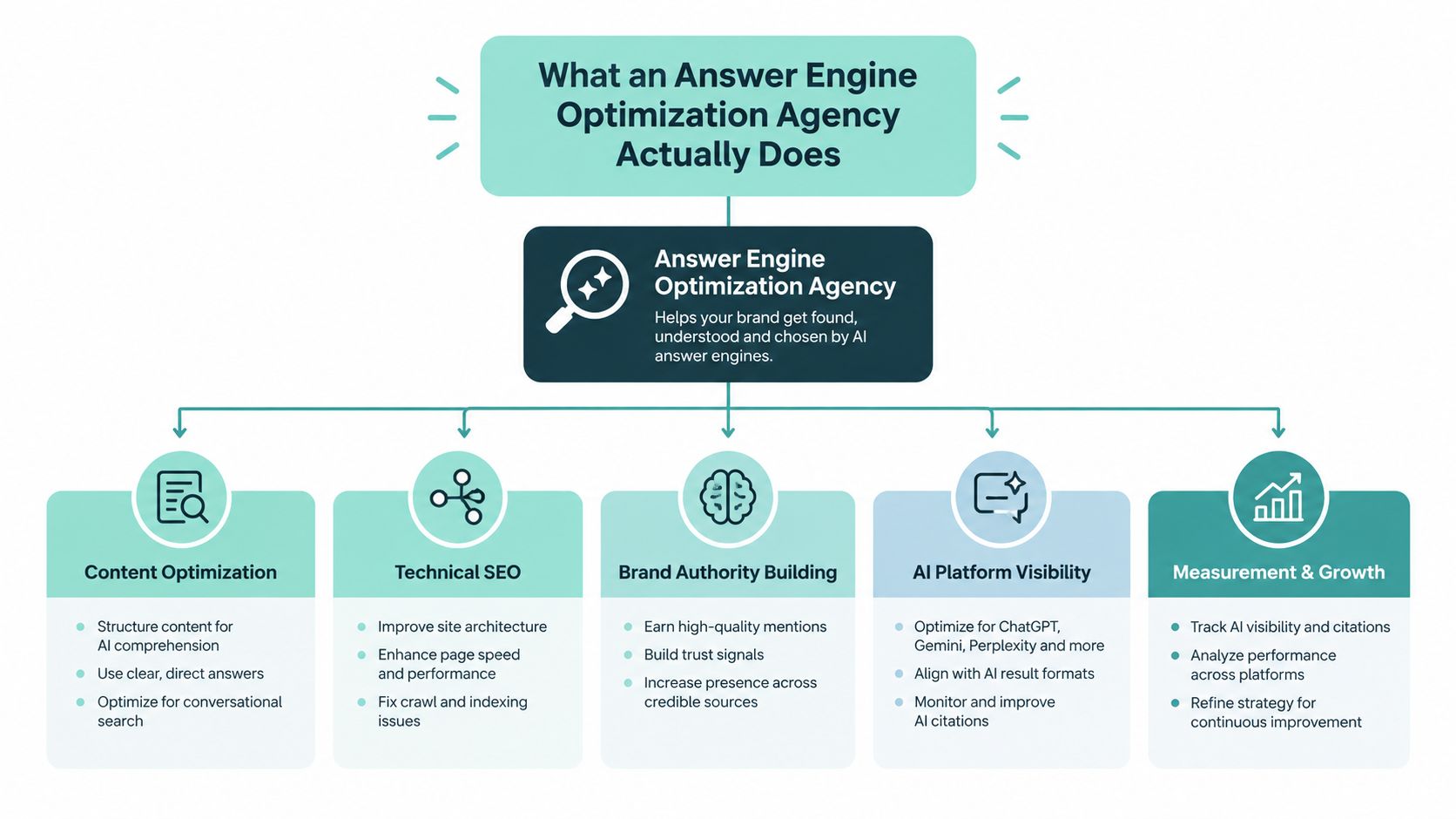
What an Answer Engine Optimization Agency Actually Does
An AEO agency engineers information so that both people and machines can understand it quickly. Generative systems need to identify discrete claims, connect them to entities, assess their context, and decide whether they're useful enough to include in an answer. A page buried beneath vague introductions, oversized paragraphs, and unsupported assertions gives those systems more work to do.
A practical framework divides page organization into macro-structure, meso-structure, and micro-structure. The research framework on document architecture and AI citation performance treats those layers as meaningful to citation eligibility independent of the subject matter itself.
Macro, meso, and micro structure
Macro-structure is the page's overall purpose and hierarchy. A roofing service page should make its service, service area, audience, and next step clear. Meso-structure organizes the major questions within that page, such as symptoms, process, costs explained qualitatively, timing, warranties, and reasons to choose a qualified provider. Micro-structure handles the individual answer blocks, definitions, lists, supporting evidence, and wording that a system can extract as a self-contained passage.
That architecture differs from keyword stuffing. Repeating “roof repair in Dallas” throughout a page doesn't explain what the company does, whom it serves, or why a prospect should trust it. AEO requires entity clarity, not mechanical repetition. The page should state who the company is, what service it provides, where it operates, which problems it solves, and how a visitor can take the next step.
Answer first, context second
The AEO best-practice guidance from HubSpot recommends an inverted pyramid. Put the direct answer first, then add context, examples, qualifications, and related detail. Match the format to the result type already appearing for the query. A numbered process deserves a numbered list. A definition may work best as a concise paragraph followed by elaboration.
A competent agency turns this method into an operating process:
- Prompt research: Map the questions prospects ask at discovery, comparison, and hiring stages.
- Content modeling: Group related questions into service pages, location pages, FAQs, guides, and supporting resources.
- Claim design: Write clear statements that identify the business, service, location, process, and qualifications.
- Technical delivery: Make important content visible in the page source and accessible to crawlers, including systems that handle JavaScript poorly.
- Conversion alignment: Place calls, forms, consultation requests, and trust elements where high-intent visitors can act.
The AI search optimization services overview is useful as a reference point for the difference between adding an FAQ section and rebuilding a website around answer retrieval and lead generation. A few question blocks won't compensate for weak service pages, unclear local relevance, or a confusing intake process.
How AEO Complements Traditional and Local SEO
AEO, traditional SEO, and local SEO address different parts of the same buying journey. A law firm needs topical relevance for legal questions, geographic relevance for the markets it serves, and clear answer content for conversational prompts. A roofer needs service authority, local proof, and pages that help an assistant understand which repair or replacement situation the company handles.
The disciplines overlap, but their primary jobs aren't identical.
| Discipline | Primary Focus | Target Query Type | Key Success Metric |
|---|---|---|---|
| SEO | Relevance, crawlability, authority, and organic page visibility | Broad informational and commercial searches | Qualified organic visits and service-page engagement |
| Local SEO | Geographic relevance, business profile accuracy, reputation, and local discovery | “Near me,” city, neighborhood, and service-area searches | Qualified local calls, direction requests, and inquiries |
| AEO | Clear, retrievable answers and entity-level trust across answer surfaces | Conversational, question-based, and follow-up prompts | Relevant citations, answer visibility, assisted inquiries, and conversions |
Where the signals reinforce each other
Local SEO gives answer systems reliable context about a business. Consistent business information, service areas, reviews, location pages, and locally relevant references help establish that the company is a real entity serving a particular market. Traditional SEO provides the site architecture and authority needed for pages to be discovered, interpreted, and compared with other sources.
AEO adds a layer of answer readiness. It turns vague service descriptions into direct explanations, connects questions to specific pages, and makes important claims easier to extract. A personal injury firm may need an informational page answering what to do after an accident, then a local page explaining where its attorneys serve, followed by an intake path designed for someone ready to discuss a case.
AEO shouldn't sit in a separate department that ignores the Google Business Profile, service pages, reviews, and intake process. Those assets support the same trust system.
Third-party authority matters too, but its value depends on the query. Informational prompts may benefit from expert contributions, clear citations, and reputable publications. “Who should I hire?” prompts require stronger commercial and local signals, including a credible business profile, relevant reviews, consistent entity information, and evidence that the company serves the stated market.
That creates a practical trade-off. A business can invest heavily in educational content and earn answer visibility while leaving its contact process weak. It can also focus on map rankings while failing to answer the detailed questions that shape consideration. The strongest program coordinates all three disciplines, then assigns each page a job in the path from question to inquiry.
Core Technical and Content Services for Lead Generation
A lead-focused AEO program should produce tangible work, not just a report describing where a brand might appear. The deliverables usually begin with a technical and content audit, then move into page restructuring, entity clarification, schema validation, authority development, and conversion testing.
Build pages that answer and persuade
Service pages should open with a direct explanation of the service and the customer problem it addresses. Supporting sections can cover process, eligibility, locations served, common questions, qualifications, expectations, and the next step. Each block should stand on its own without becoming so short that it loses useful context.
A law firm, for example, may need separate content for accident types, legal questions, service areas, attorney qualifications, and consultation expectations. An HVAC company may need distinct pages for installation, maintenance, emergency repair, indoor air quality, and system replacement. Combining every service into one generic page makes it harder for a user and an answer engine to identify the right response.
Use schema carefully
FAQPage, HowTo, Article, and Organization schema can provide machine-readable context, but markup doesn't rescue inaccurate or invisible content. Google states in its documentation for AI features that pages don't need special AI files or AI-specific schema to appear in those features. The visible page content still matters, and structured data must match that text.
Industry guidance cited by HubSpot's generative engine optimization overview reports that cleanly structured pages earned 2.8 times higher AI citation rates in one study, while pages using three or more schema types were about 13% more likely to be cited. Those findings support disciplined implementation, not indiscriminate markup. An agency should validate whether each schema type accurately describes visible content and whether it helps clarify the business, article, process, or questions on the page.
A practical service scope includes:
- Technical inspection: Review rendering, crawl access, headings, internal links, indexability, performance, and analytics instrumentation.
- Structured content: Create answer-first introductions, concise Q&A blocks, useful lists, definitions, and locally specific explanations.
- Entity consistency: Align organization details, authorship, services, locations, and contact information across owned properties.
- Authority development: Identify relevant third-party mentions, professional references, reviews, and publications that can validate the business.
- Conversion work: Improve calls to action, form fields, phone visibility, consultation pages, and mobile usability.
For attorneys evaluating the relationship between visibility and intake, the Ares lead generation playbook offers useful context on building a broader lead-generation process around legal services. The same principle applies to home services: content must support a real sales operation, not merely win an answer.
Local schema is one implementation detail within that larger system. This guide to local business schema markup can help teams understand how structured business information should support, rather than contradict, the visible experience.
Measuring Success Beyond Traditional Rankings
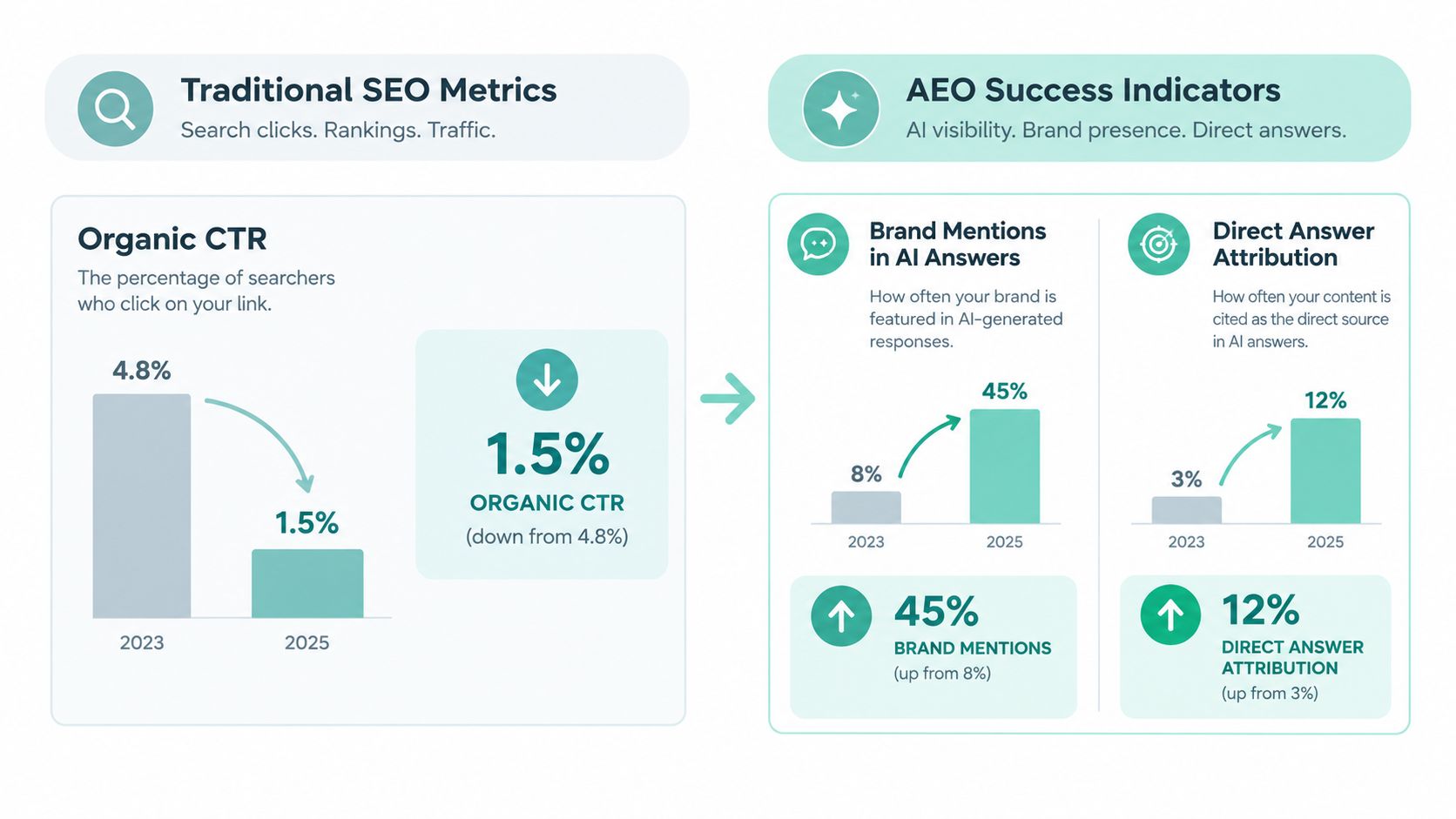
A citation isn't a signed client. It may create familiarity, influence a later branded search, assist a referral decision, or send a small number of highly motivated visitors. It may also produce no measurable lead if the cited page doesn't offer a clear next action or if the business can't connect the inquiry to the original discovery path.
AI referral traffic is now measurable enough to include in reporting. A 2026 benchmark report from Conductor found that AI referral traffic represented 1.08% of all website traffic across the 10 industries studied. That remains a modest share, but it confirms that answer engines can send trackable visits and deserve a defined measurement layer.
Separate visibility from pipeline
An agency should report visibility indicators and commercial outcomes separately. Useful visibility reporting can include:
- Citation monitoring: Record whether target services, locations, and questions generate relevant brand mentions.
- Source mapping: Identify which pages and third-party references appear to support those answers.
- Query coverage: Track whether the business appears for discovery, comparison, and hiring prompts.
- AI referral analysis: Segment referral traffic by source where analytics can identify it.
Lead reporting needs a different lens. Track calls, form submissions, consultation requests, booked appointments, qualified inquiries, and closed outcomes where the business can provide that data. Add source fields to forms, use call tracking responsibly, preserve landing-page information, and ask new leads how they found the company. These methods won't capture every assisted interaction, but they improve the quality of attribution.
Measurement rule: Hold the agency accountable for business outcomes that it can influence, while keeping citation visibility as a leading indicator rather than treating it as revenue.
The conversion experience determines whether an answer mention has commercial value. A visitor who lands on a generic homepage after researching an urgent legal or HVAC question must still find the relevant service, location, proof, and contact option immediately. A well-structured answer page should guide the next action without forcing the prospect to repeat the original search.
Avoid setting a single universal benchmark for every business. A local emergency service and a complex legal practice have different sales cycles, query patterns, and qualification requirements. Compare performance against the business's baseline, target markets, service priorities, and lead quality.
Red Flags and Selection Criteria for Service Businesses
The AEO market attracts agencies that rename familiar SEO deliverables without changing the strategy. A new label on a keyword report isn't a new operating model. Service businesses should ask how the proposed work will affect answer visibility, local trust, page experience, and inquiry quality before signing a long engagement.
Several promises deserve immediate skepticism:
- Guaranteed AI citations: No agency controls how Google, ChatGPT Search, Perplexity, or another answer engine selects and displays sources. A credible partner can define target queries, improve eligibility, and report observed visibility. It can't guarantee inclusion.
- Schema as the entire strategy: Markup can clarify content, but it doesn't replace visible expertise, useful answers, local relevance, or a persuasive conversion path.
- Hidden text or manipulation: Tactics designed to show different information to machines and users create quality and trust risks. Durable AEO depends on consistency.
- Impressions without commercial context: A large visibility report means little if it doesn't identify the service, market, query, page, and resulting action.
- No discovery process: An agency that starts publishing before understanding services, intake rules, locations, competitors, and qualified-lead definitions is guessing.
What a mature partner asks first
A serious partner should want to know which services produce profitable work, which cases or jobs the business accepts, where it operates, how quickly staff responds, and which inquiries should be excluded. It should inspect analytics, rankings, existing content, review patterns, technical constraints, and the path from first visit to consultation.
It should also explain trade-offs plainly. A visibility-first campaign may prioritize broad informational coverage and authority building. A lead-first campaign may concentrate on high-intent service pages, local proof, forms, calls, and attribution. Both can be valid, but the agency should state which one it's funding and why.
Exclusive industry or service-area representation can reduce direct conflicts, especially for local firms competing on the same queries. It isn't a substitute for skill, but it gives the agency a clearer incentive to build differentiated local authority rather than reuse generic content across competing businesses.
Request a sample strategy, a technical audit format, source-mapping methodology, reporting example, and explanation of how the agency handles content approvals. The right partner won't hide behind jargon. It will show how a page moves from a prospect's question to a credible answer and then to a measurable inquiry.
Your Hiring Checklist for an AEO Partner
Take this checklist into the discovery call. The answers should be specific to your business, not recycled statements about “owning the AI search.”
Establish the commercial objective
Ask which services, locations, and lead types the agency will prioritize first. Confirm how it defines a qualified inquiry, how your team will share closed-outcome data, and whether the campaign is designed for visibility, lead generation, or a deliberate combination of both.
Inspect the research process
Request the prompt and query research method. The agency should show how it identifies customer questions, follow-up prompts, competitors, service entities, local modifiers, and decision-stage language. It should distinguish a homeowner looking for general guidance from one ready to request an inspection.
Test technical depth
Ask the team to explain how it will review rendering, crawlability, internal linking, headings, page hierarchy, analytics, and structured data. Confirm that schema will match visible text. Google's guidance makes clear that special AI markup isn't required, so a proposal centered on secret files or proprietary tags should concern you.
Demand a conversion plan
Ask where calls to action will appear, how forms will be improved, what information intake staff needs, and how mobile visitors will contact the business. A citation can create demand without producing a lead if the landing page doesn't make the next step obvious.
Review authority and reporting
Find out how the agency will map third-party mentions, reviews, professional references, and local entity signals. Request reporting that separates:
- Answer visibility: Which prompts and services produce relevant mentions?
- Source evidence: Which pages or external references support those mentions?
- Referral behavior: Which answer surfaces send identifiable visitors?
- Lead outcomes: Which calls, forms, consultations, or appointments show commercial value?
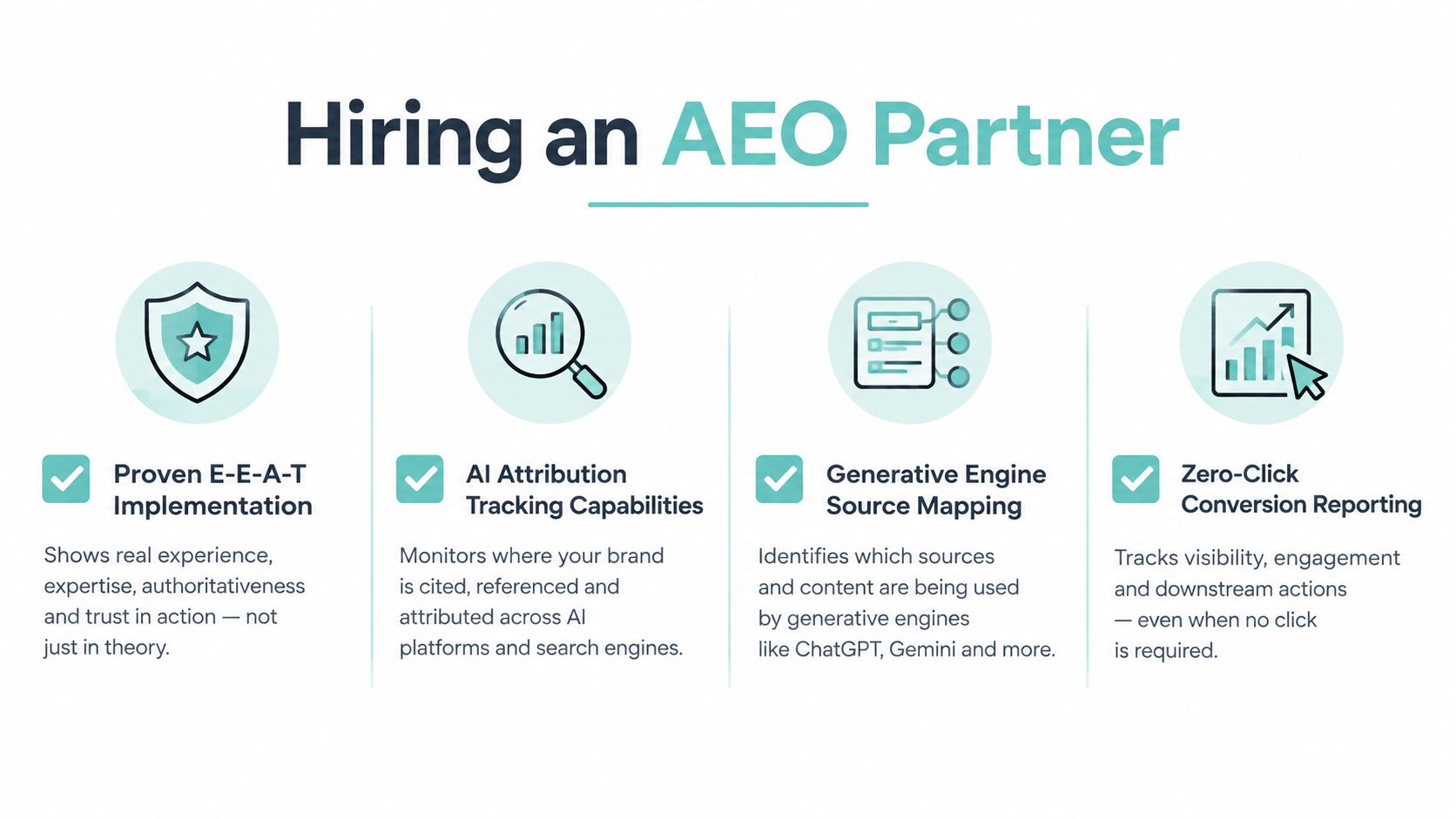
Finally, ask who will execute the work, how approvals operate, what happens when an answer engine changes its presentation, and how often the strategy is revised. Favor a partner that combines content structure, technical SEO, local authority, and conversion optimization. The strongest proposal will connect every deliverable to a service, market, customer question, or pipeline outcome.
Digital Skyrocket builds and optimizes lead-generating websites for law firms, dentists, roofers, HVAC companies, and other service businesses, combining technical SEO, AEO, local search, and conversion optimization. Visit Digital Skyrocket to discuss a website and ongoing search strategy built to turn answer visibility into qualified inquiries.