
Attorney reputation is a top hiring factor for 86% of legal consumers, making reputation management a core intake and search visibility driver rather than a secondary branding task. A potential client may discover your firm through search, compare several attorneys, and decide whether to call before reading more than a few lines of your website.
Table of Contents
- Why Reputation Drives Law Firm Intake Now
- Building an Audit and Monitoring Workflow
- Review Acquisition and Ethical Response Workflows
- Handling Negative Reviews and Removal Requests
- Linking Reputation to Local SEO and AEO Strategy
- Ongoing Reporting and Crisis Response Playbooks
Why Reputation Drives Law Firm Intake Now
A prospective client is comparing three attorneys after a stressful event. They open each Google Business Profile, scan the latest reviews, look for patterns in the responses, and check whether the firm appears active and credible. Practice area pages still matter, but reputation signals often shape whether the visitor trusts those pages enough to submit a form or make a call.
That behavior isn't theoretical. The Solicitors Regulation Authority reported that 88% of consumers generally used price comparison and review sites before buying something, while 22% had used a review website specifically for legal services. The same SRA research on legal services quality indicators found that 44% of law firms actively encouraged clients to post reviews, while 56% did not, and around half of respondents routinely monitored review sites for comments about their firm.

The business case becomes clearer when reputation is connected to intake. A firm that consistently earns reviews, responds professionally, and maintains accurate profiles gives searchers more evidence to evaluate. A firm that ignores its listings leaves outdated information, unanswered criticism, and competitor reviews to define the comparison.
Practical rule: Treat every public profile as part of the intake path, not as a separate branding asset.
The shift has been developing for years. A 2014 survey reported by The National Law Review on how clients use online legal reviews found that 57% of respondents used online legal reviews, and 83% of those users relied on them to find a new lawyer. Yelp! was the most-used review source at 61%, followed by Martindale-Hubbell at 20%, Avvo at 10%, and Super Lawyers at 9%.
Those figures establish an important pattern. People don't only use reviews to confirm a decision they've already made. They use them to decide whom to contact in the first place. That makes reputation management for law firms an operating discipline involving monitoring, client communication, local SEO, compliance, and escalation planning.
Building an Audit and Monitoring Workflow
You can't manage reputation from memory. Start with an inventory that records every public profile connected to the firm, each attorney, every office, and every significant practice area.
Create the baseline before changing anything
Claim and verify the firm's Google Business Profile, then inspect attorney-specific listings and legal directories such as Avvo, Martindale-Hubbell, Super Lawyers, and Justia. Record the business name, address, phone number, website, hours, attorney names, practice descriptions, profile ownership, review count, rating, and most recent review date.
Don't limit the audit to profiles the marketing team already knows about. Search the firm name, attorney names, office locations, and common misspellings. Review branded search results, social profiles, news references, and forum discussions. The purpose isn't to respond to every mention. It's to identify where a potential client might encounter inconsistent or damaging information.
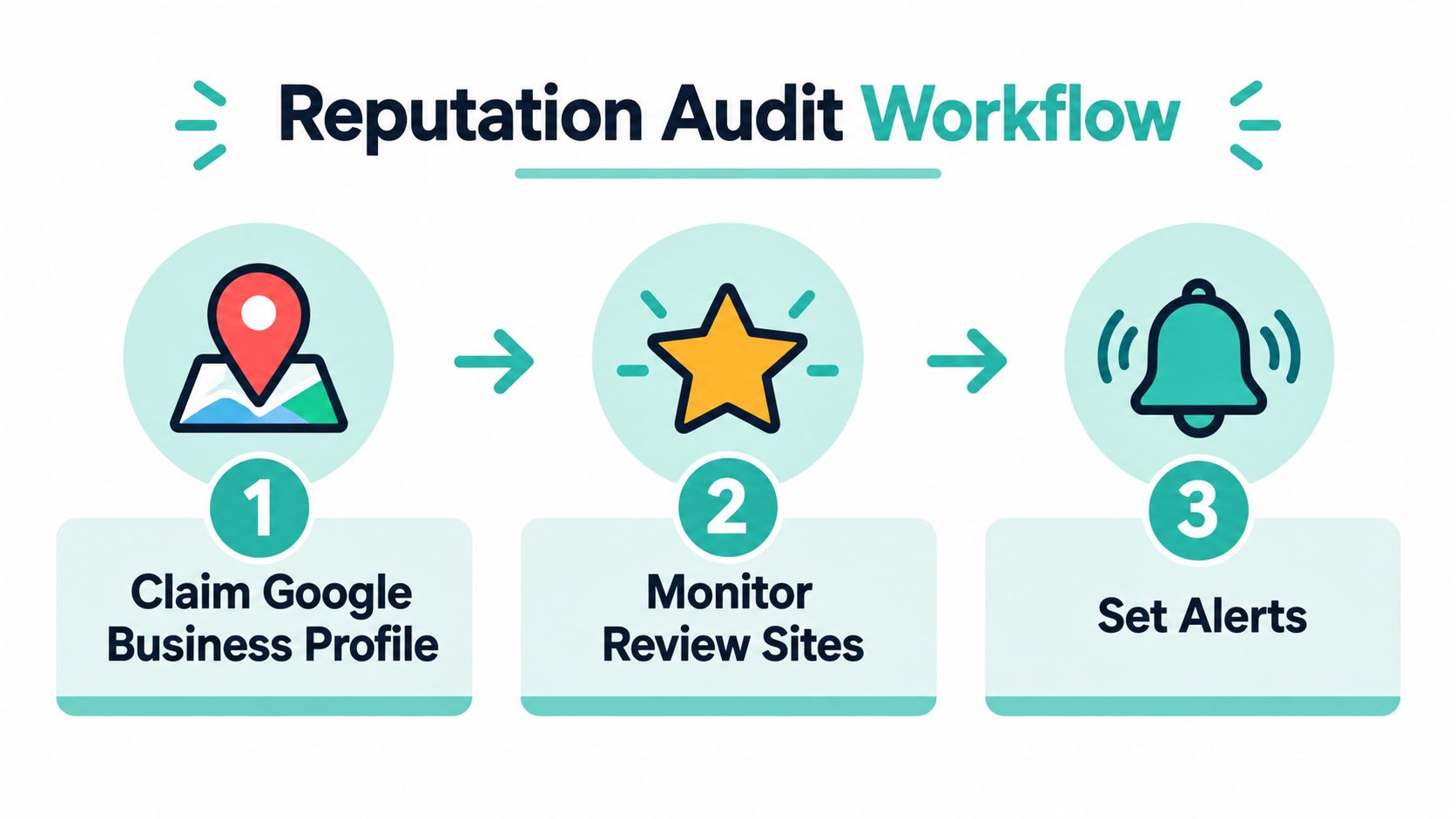
Use a shared log with clear ownership. A small firm may manage it in a spreadsheet, while a larger practice may connect review platforms, alerts, CRM data, and task management software. A law firm virtual assistant can help maintain profile records, route alerts, and prepare a first-pass issue log, provided an attorney or designated manager controls confidential information and final responses.
For firms that want a broader monitoring framework, online reputation monitoring should cover more than star ratings. Include review mentions, search-result changes, directory edits, sentiment patterns, and answer-engine references where those signals are available.
Track movement that leadership can use
Review the baseline monthly and record:
- Review volume: Note the number of new reviews by platform, office, and practice area.
- Recency: Identify whether public feedback is current or has gone quiet.
- Average rating: Use it as context, not as the only measure of health.
- Response rate: Track how consistently the firm acknowledges public feedback.
- Response time: Separate prompt handling from delayed cleanup.
- Location and service trends: Compare offices and practice areas to find uneven performance.
- Intake connection: Compare reputation activity with calls, forms, consultations, and local-search engagement.
The European Business Review guidance on online reputation management for law firms recommends tracking review volume, recency, average rating, response rate, response time, and location or practice-area trends each month, then connecting those measures to inquiry volume and local-search engagement. That turns reputation from an impressionistic discussion into a management report.
Assign daily or weekly monitoring to a named person, then reserve a monthly review for partners or marketing leadership. Escalate allegations involving misconduct, confidentiality, discrimination, fraud, threats, or active disputes immediately. Routine monitoring should prevent surprises, not create a new source of them.
Review Acquisition and Ethical Response Workflows
The strongest review programs don't ask every client for praise at random. They create a predictable, neutral feedback process around appropriate client milestones, then give people a simple way to share an honest experience.
Begin by confirming the applicable state bar rules and the firm's internal policies. A request should never promise a result, suggest that a client must leave a positive review, or offer compensation in exchange for favorable language. Use the same invitation for clients with positive, mixed, or unresolved experiences. Filtering only happy clients can make the process look manipulated and may create compliance problems.
Ask at a useful moment
Choose a milestone when the client has enough perspective to evaluate the service. Depending on the matter, that may be after a case closes, after a meaningful deliverable, or after the firm completes a clearly defined stage of work. The right moment varies by practice area. A personal injury client, an estate-planning client, and a business client won't experience the matter on the same timeline.
A compliant request can be short:
Thank you for working with our team. If you'd like to share an honest account of your experience, you can use this review link. Your feedback is voluntary, and please don't include confidential information.
Send the request through a channel the client already uses, such as email or SMS, where permitted and properly consented to. The Google review link creation guide can help the team remove unnecessary clicks, but convenience shouldn't replace a clear explanation that the review is voluntary.
The SRA found that 44% of firms encouraged clients to post reviews, while 56% did not, which shows that asking remains inconsistent across the profession. A repeatable workflow helps a firm avoid both extremes, silence on one side and aggressive solicitation on the other.
A useful resource for training staff is this practical guide to why client reviews matter for law firms. Use it to explain why honest feedback supports trust, while reminding the team that no employee should coach a client on wording or pressure someone who declines.
Respond without creating a second problem
Positive responses should thank the reviewer and reinforce the type of service provided without revealing matter details. “Thank you for sharing your experience with our team” is safer than describing the legal issue, outcome, settlement, or personal circumstances.
Negative responses require restraint. Acknowledge the concern, avoid confirming the person is a client, and invite private contact through an appropriate channel. Never argue about the facts of a matter in public, even when the review appears unfair. The response is written for future readers as much as for the reviewer.
The FTC's consumer guidance warns that online reviews may be fake or written by people with personal ties to a lawyer. It recommends checking state bar status, actual accomplishments, and past work experience rather than treating reviews as conclusive proof of quality. Reputation supports due diligence. It doesn't replace it.
Handling Negative Reviews and Removal Requests
A negative review should enter a triage process, not trigger an emotional reply. First preserve the evidence. Save the review URL, screenshots, date, reviewer name, related correspondence, and any information showing whether the person appears to be a client. Restrict access to matter details to people who need them.
Sort the issue before choosing the response
Use three practical categories:
- A legitimate criticism: Respond briefly, acknowledge the concern, and move the conversation offline without discussing confidential facts.
- An inaccurate but policy-compliant review: Consider a measured public response and an internal service review. Disagreement alone usually isn't enough to justify removal.
- A policy-violating review: Collect evidence and report it through the platform's formal process.
Google's framework allows firms to flag reviews that are fake, from non-clients, or otherwise prohibited, but it doesn't remove a review only because the business dislikes it. The lawyer reputation management guidance on reporting problematic reviews supports an evidence-based approach rather than blanket takedown requests.
A report should identify the specific policy issue. “This review is damaging” isn't a policy violation. Evidence that the reviewer wasn't a client, posted the same content across unrelated businesses, disclosed a personal affiliation, or used threats is more useful. Keep the submission factual and avoid uploading confidential case documents unless professional and legal requirements clearly permit it.
Know the legal and ethical boundaries
The FTC's final rule identifies six deceptive practices businesses must avoid: fake or false reviews, incentivized reviews, insider reviews and testimonials, company-controlled review websites, fake social media indicators, and review suppression. The Google support guidance covering prohibited review practices provides a practical reference point for firms building internal controls.
Don't ask employees, friends, referral partners, or affiliated professionals to pose as clients. Don't offer gifts for positive reviews. Don't threaten a client with legal action because they posted criticism, and don't suppress honest negative feedback by directing only selected clients to public platforms.
A concise public response might say that the firm takes concerns seriously, can't discuss confidential matters in a public forum, and invites direct contact with the office. If the post contains threats, extortion, doxxing, or allegations that could create immediate legal exposure, involve counsel and preserve the record before anyone replies.
Linking Reputation to Local SEO and AEO Strategy
Reputation works best when the firm's profiles, website, structured data, and client experience tell the same story. Searchers should find consistent office information, attorney identities, practice areas, credentials, and contact paths whether they begin on Google, a legal directory, or an answer engine.
Google matters first for many firms because it concentrates legal review visibility. Birdeye's 2026 review benchmark reports that Google accounts for more than 87% of reviews in the legal industry, while its legal guide says 80% of law firm reviews appear on Google. The same Birdeye guide to legal reputation management reports that email plus SMS produced up to 2x higher review volume than email alone in a benchmark of 1,500 U.S. law firm locations, and that email was used by over 70% of firms for review requests.
Those figures support a practical priority, not a universal prescription. Optimize the Google Business Profile first, then maintain relevant legal directories and attorney profiles. Use email and SMS only where consent, privacy rules, and professional obligations allow. A channel that produces more requests but creates complaints or compliance risk isn't a successful channel.

Make the evidence consistent
Audit the firm's name, address, phone number, hours, service descriptions, attorney names, and office relationships across profiles. On the website, connect attorney biographies, practice areas, locations, contact details, and author information so search systems can interpret who provides what service and where.
Schema markup can clarify entities and relationships, but it can't repair contradictory public information. Don't add review markup that violates search-engine guidelines or represents third-party ratings inaccurately. Structured data should describe visible, accurate content rather than manufacture authority.
A focused guide to Google Business Profile for lawyers can help firms work through profile ownership, practitioner details, categories, and local optimization decisions. Google classifies lawyers as individual practitioners, and practitioner profiles may display professional titles such as JD or Esq. The lawyer online reputation guidance on practitioner profiles explains why the distinction matters: the profile represents a real professional, not merely an abstract firm listing.
AEO adds another reason to keep the foundation clean. Answer engines may combine website content, public profiles, directories, and reviews when forming an answer about a firm. They can also expose contradictions quickly. Clear service pages, accurate entity information, useful frequently asked questions, and authentic review language give those systems better material than vague claims or disconnected listings.
Ongoing Reporting and Crisis Response Playbooks
A reputation program should give partners a short, decision-ready view of what changed and what needs attention. It shouldn't become a monthly export of numbers that nobody uses.
Build the dashboard around operational questions:
- Are new reviews arriving consistently? Break the view down by office and practice area.
- Is the firm responding reliably? Show response rate and response time, with unresolved items highlighted.
- Is public information accurate? Track profile edits, duplicate listings, incorrect hours, and outdated attorney details.
- Are reputation signals connected to demand? Compare inquiries and local-search engagement with reputation activity without claiming that one metric caused the other.
- Where is risk increasing? Flag recurring complaints, unusual review patterns, sudden mentions, and disputes involving attorneys, partners, or the firm.
Review the operational queue frequently and give leadership a monthly summary. A quarterly strategic review can examine whether the firm's strongest practice areas, locations, and attorneys are represented accurately across search and directory ecosystems. Keep an audit trail of who approved requests, responses, edits, and escalations.
Prepare for narratives beyond reviews
High-stakes reputation risk can begin with a partner departure, merger, client-selection controversy, politically sensitive matter, allegation of misconduct, or viral post. Industry commentary in 2026 describes continuing pressure from mergers, lateral departures, and representation-choice controversies, with implications for both client trust and talent recruitment. The AmLaw 100 reputation-management commentary for 2026 also identifies AI-generated content, deepfakes, and generative search as accelerants for harmful narratives.
Create a crisis playbook before the crisis:
- Name the incident owner. One person coordinates facts, approvals, and updates.
- Classify the risk. Separate routine criticism from confidentiality, safety, regulatory, employment, or litigation concerns.
- Preserve evidence. Save URLs, screenshots, timestamps, messages, and relevant internal records.
- Confirm facts. Involve the responsible partner, risk team, ethics counsel, or outside counsel as appropriate.
- Set the message boundary. Decide what the firm can say without confirming confidential information or speculating.
- Use one approved response. Keep public statements concise and consistent across channels.
- Monitor the next wave. Track new reviews, search results, media references, and false claims after the initial response.
Never let an untrained employee improvise a public defense of an active matter. A calm acknowledgment, a private contact route, and disciplined documentation usually protect credibility better than a detailed rebuttal. Reputation management for law firms succeeds when routine review operations and exceptional risk response follow the same principle: act quickly, protect confidentiality, and say only what the firm can support.
Digital Skyrocket helps law firms connect reputation monitoring with website strategy, local SEO, AEO, and conversion-focused intake systems. If your firm needs a structured review and search visibility program, visit Digital Skyrocket to discuss a fit meeting and discovery process.