The most repeated advice about roofing websites is that the hero image decides everything. Get a drone shot of fresh architectural shingles at golden hour, the thinking goes, and the phone rings by itself. Browse ten contractor homepages and you'll see what that advice produces: a beautiful photo, a slogan, and no reason for a nervous homeowner to trust you more than the five other roofers open in her other tabs.
She decides in seconds, long before she reads a word about underlayment or a 25-year warranty. What she's scanning for is practical. Can she call you from the driveway? Do you work on her street? What happens after she taps the button? In 2025, 62% of homeowners said they use online search engines to find roofing contractors, according to Roofing Contractor's State of the Industry homeowner survey, which means the page is doing the first interview.
This list judges seven live roofing sites on that interview, through three lenses. Trust signals above the fold, meaning the numbers and credentials that answer "are you real" in the first screen. Local SEO structure, meaning the city pages and internal links sitting behind the map result. The path from landing to estimate request, meaning how many taps and form fields separate her problem from your calendar.
The seven answers differ because the businesses differ. Pick the pattern closest to your customer mix, not the one with the nicest photography.
Table of Contents
- 1. Houston Roofing & Construction
- 2. Roofing Giant
- 3. Bill Ragan Roofing
- 4. Lyons Roofing
- 5. Baker Roofing Company
- 6. Whipple Roofing
- 7. Joe's Roofing
- How the seven roofing websites compare on structure, conversion paths, and local SEO
- Steal the Structure, Not the Design
1. Houston Roofing & Construction

Most roofing sites try to talk to everyone on one page. This Houston company splits the audience first, with separate sections for residential, commercial, and multifamily work, so a property manager never has to scroll past a slideshow of somebody's three-tab shingles to find the flat-roof crew.
That structure matters more than it looks. The 2022 Economic Census profile counted 24,082 employer establishments in the roofing-contractor industry under NAICS 238160, with about $69.906 billion in reported revenue, and that classification also captures roof coating and skylight installers. When tens of thousands of businesses can answer the same search, the site that names its specialty first wins the click that matters.
What the page does well
- Segment-first navigation: three customer types, three front doors, no guessing which link belongs to you.
- Local proof: Houston-specific copy and service-area detail sit beside reviews and company credentials instead of hiding on an About page.
- Contact without hunting: phone and estimate request stay visible on every path.
- Inspection guidance: the site explains repair-versus-replacement thinking, which lets a homeowner form a question before she calls.
That inspection content is the piece I'd copy first. It gives a nervous buyer a way to reason, and reasoning buyers convert at a higher rate than panicked ones.
Practical rule: publish what your inspection actually delivers, including what the inspector photographs and what the written report contains.
Where it stops short
- No published price ranges: anyone who wants a ballpark has to call, which filters out the comparison shopper.
- Single-market focus: a strong structure to copy, not a template for a company running five metros.
Conversion is what decides whether any of it pays. One roofing lead-generation case study reported a redesign lifting a contractor site from 1.2% to 6.8% conversion, with qualified monthly leads rising from 35 to 252. Those results came from a combined paid search, local SEO, profile, and CRO program, so treat them as a target rather than a promise for a design change alone.
Site: Houston Roofing & Construction. The architecture behind this pattern is covered in our guide to roofing website design.
2. Roofing Giant

A Dallas-Fort Worth company that treats the website as a tool rather than a brochure. The tell is the pair of buttons at the top: one for the homeowner who thinks something is wrong, one for the shopper comparing prices. Two buyers, two doors, no shared landing page.
Hail is why that fork exists in this market. Verisk data cited in the State of America's Roofs report puts average residential roof replacement cost at $17,631 in 2025, with total replacement cost value reaching $23 billion, and severe hail affected at least 20% of roofs in 16 states in 2025, up from 12 states in 2024. The homeowner searching the morning after a storm and the one planning a spring reroof are different people with different urgency, and the page respects that.
The tools that earn the visit
- Roof-cost calculator: gives a starting range before anyone asks for a phone number.
- Deductible calculator: answers the question homeowners take to their insurer, not to a contractor.
- Hail-damage self-check: lets someone look for granule loss and dented vents before booking.
- Illustrated guides and a project gallery: real DFW roofs rather than licensed stock imagery.
- Inspection that includes photo documentation and a written report: states the deliverable instead of hinting at one.
That last bullet is the most valuable item on the page and the rarest in the category. A homeowner who knows she'll receive photos and a report has a reason to book that a homeowner reading "free estimate" does not.
A calculator that ends with "book an inspection" converts. A calculator that ends with a number and nothing else starts an argument.
Where it stops short
- Choice overload: calculators, guides, galleries, and offers all compete for the same first click.
- No guaranteed price: the calculator output is a range, and anyone who reads it as a quote will feel misled at the inspection.
Site: Roofing Giant. This two-button logic is the same one we build into lead generation for roofing companies.
3. Bill Ragan Roofing
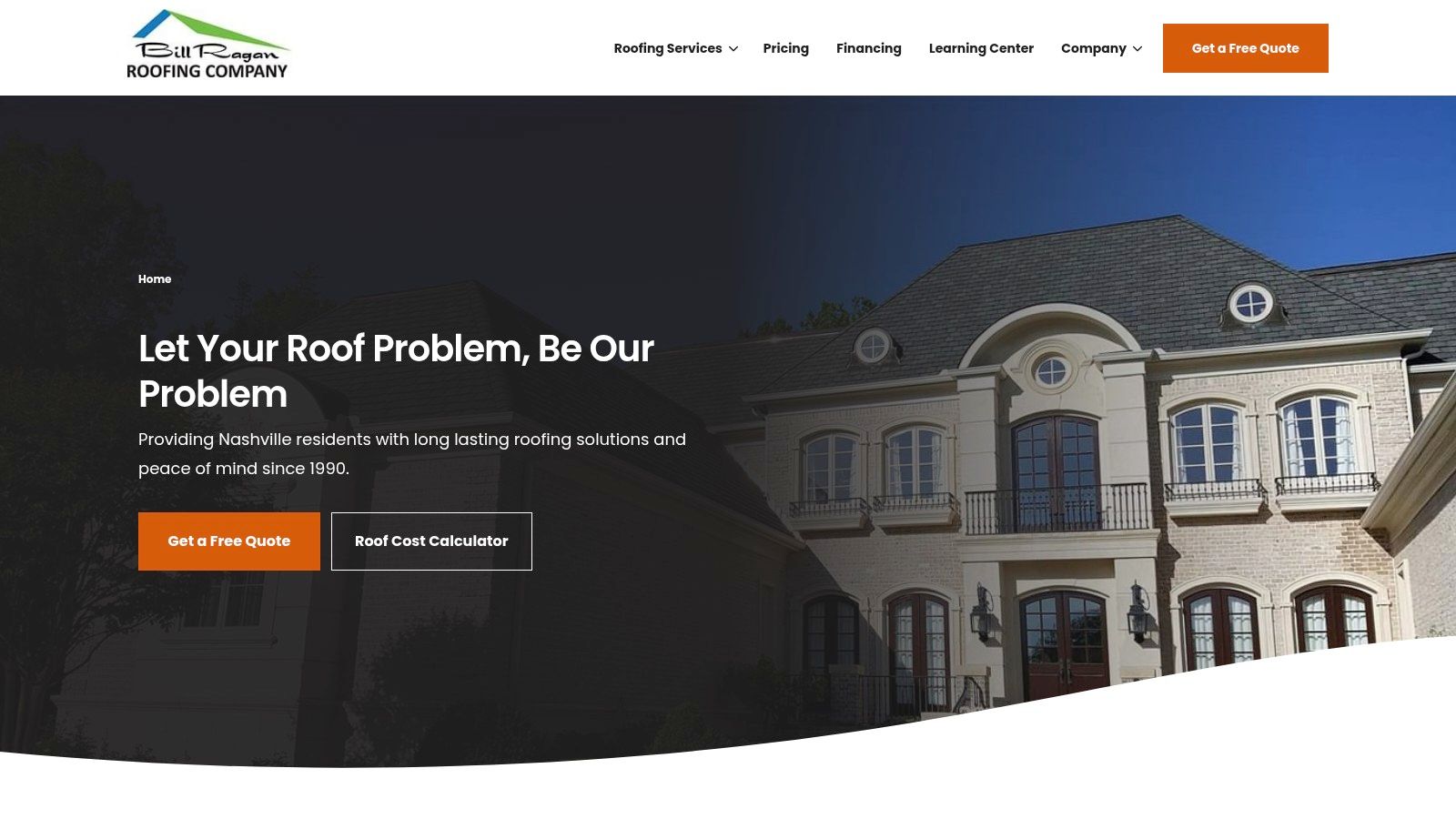
Nashville-based, and built around one idea: explain the process until the homeowner stops being afraid of it. The site walks through inspection and quoting, offers a roof-cost calculator, states plainly that the company runs no-pressure sales, and backs labor with a lifetime craftsmanship guarantee.
It also tells you what it won't do. Repairs for new clients are on hold, and that's written on the site rather than discovered after a form submission. Honesty about capacity is a trust signal, and most contractors never think to publish one.
Cost sits underneath all that education. Homeowner research compiled by This Old House found that nearly 52% of respondents paid at least $10,000 for a full replacement, while roughly 67% paid between $5,000 and $20,000, with labor and materials the leading cost factors and unexpected damage another major source of increases.
What the page does well
- Process before pitch: inspection steps and quote steps come before the ask, not after it.
- Policy in plain sight: the guarantee and the no-pressure promise sit where a skimmer will find them.
- Insurance claims content: written for the homeowner's decision path rather than the contractor's sales path.
- Calculator as a starting point: framed as planning help, not a quote.
Where it stops short
- One metro: Nashville-area service, so it works as a model rather than a map.
- Repairs paused for new clients: honest, and it costs the company the highest-intent repair searches.
- Final pricing needs an assessment: the calculator sets expectations it can't fully satisfy.
If you can't publish a price, publish the four things that move it. Tear-off layers, decking condition, ventilation, and disposal. A homeowner who understands those four line items stops treating the first number as final.
Site: Bill Ragan Roofing.
4. Lyons Roofing
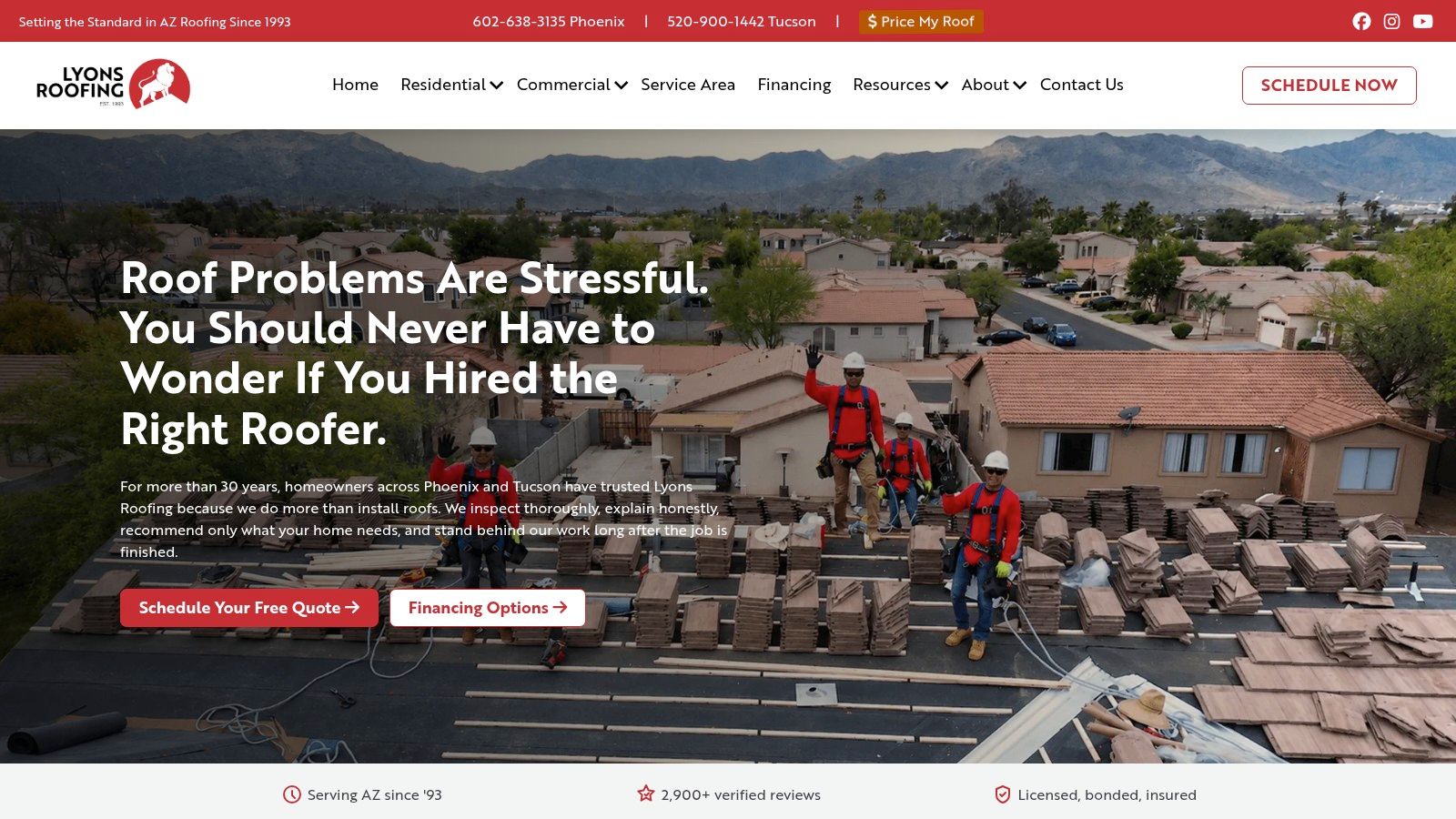
Phoenix and Tucson, with separate office contact details and a service menu that runs from shingles to foam to emergency repairs. It's the site to study if you've been putting off the job of organizing fifteen services on one domain.
The navigation handles a pre-purchase inspection for a homebuyer and a leaking commercial roof in the same menu, which is hard to do without making both feel like an afterthought. Financing gets its own path, quotes are requested rather than demanded, and reviews, awards, credentials, and safety information sit near the top instead of in a footer badge farm.
Staffing is where emergency promises get real. The U.S. had approximately 166,900 roofer jobs in 2025, according to statistics attributed to the Bureau of Labor Statistics in SchedulingKit's roofing industry statistics, and an August 2025 AGC/NCCER survey cited there found 45% of responding construction firms reported project delays caused by worker shortages affecting their own crews or subcontractors. Response time is a scheduling commitment, not a marketing line.
An emergency page that promises a tarp within the hour is a capacity claim. Publish the hours you actually answer the phone and the number of crews backing the promise.
What the page does well
- Dual-market clarity: Phoenix and Tucson each get their own contact path, so nobody dials the wrong office.
- Breadth without collapse: inspections, replacement, repair, financing, and pre-purchase checks each get a real destination.
- Credential density: awards, reviews, and safety information earn the scroll.
Where it stops short
- Dense for a simple repair: a homeowner with one missing shingle faces more calls to action than she needs.
- Desert-specific framing: tile underlayment and monsoon messaging won't transfer to a snow-load market.
- No fixed pricing: every number requires a conversation.
Site: Lyons Roofing.
5. Baker Roofing Company

Southeast and Mid-Atlantic, weighted toward commercial work, and unusually clear about who signs the contract. The national-accounts program speaks directly to a facilities manager coordinating repairs across a portfolio, which is a customer most residential-focused sites never address in a single sentence.
Featured projects are sorted by property type and location, so a warehouse owner can find a warehouse roof and a school administrator can find a school. Service descriptions cover repair, maintenance, replacement, restoration, and waterproofing as separate pages, plus a training and expertise section that answers the procurement question before it's asked.
What the page does well
- Multi-site model explained: the national-accounts page describes how work gets coordinated across properties instead of listing services and hoping.
- Project proof by building type: the gallery does the qualification work that a testimonial quote can't.
- Commercial vocabulary: restoration, waterproofing, and maintenance contracts are named the way facility teams search for them.
The structure behind a multi-market site is where the growth lives. A 12-market roofing website portfolio study reported average organic-click growth of 1,063% and impression growth of 498% after deploying a common architecture of dedicated location pages, topical silos, and technical SEO, with no link-building campaign. Those figures are provider-supplied averages across several sites, so validate them against your own Search Console data before treating them as a forecast.
Compliance belongs in that architecture too. A state-by-state licensing review reports that 27 states require roofing contractors to obtain a license while 13 require registration only, with the authority, classification, bonding rules, and insurance requirements varying by state. A company working across state lines should publish per-state compliance on its location pages and link out to the licensing authority.
Where it stops short
- Commercial emphasis: thin ground for a homeowner looking for a Saturday reroof.
- Regional footprint: the Southeast and Mid-Atlantic only.
- No standard pricing: procurement teams expect a quote, but a small property owner gets no anchor at all.
Site: Baker Roofing Company. One page per service and one per city is the core of our local SEO for roofers work.
6. Whipple Roofing
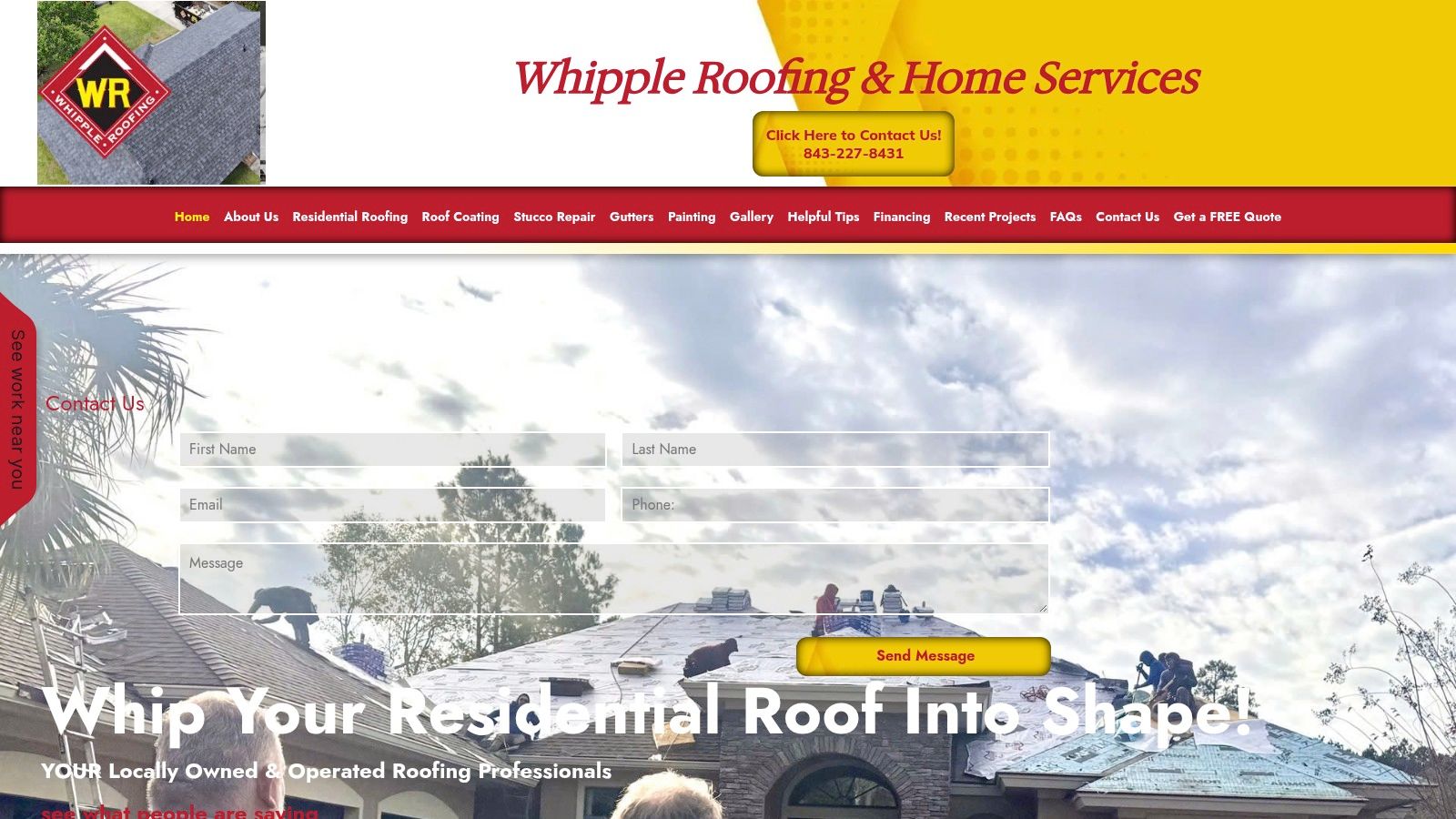
Start with the weather, not the shingle brochure. Coastal Georgia and South Carolina have roof problems shaped by salt air, wind, and afternoon storms, and Whipple Roofing builds its residential and commercial paths around that reality. Emergency response, replacement, repairs, maintenance, and low-slope systems each get a route. That matters because a homeowner with a leaking roof wants to know whether the contractor handles the exact job before they care about the photography.
The useful structure is simple: local service pages carry the geography, and the FAQ carries the anxiety. Storm behavior, repair-versus-replace decisions, and replacement timing are answered in plain text that a homeowner can read on a phone in the driveway. This is cheap content compared with a redesign, and it gets reused in search, on sales calls, and in estimate conversations.
Local visibility comes from matching the city page with the business profile. The page explains the service area; the profile confirms the business is active in that area. Keep the name, phone number, hours, and service categories consistent between the two, then send visitors from both places into the same clear estimate path. That is the copyable move here.
Search still matters more than most owners want to admit. In 2024, 54% of homeowners said search-engine results were among the ways they were most likely to find a roofing company, according to Roofing Contractor's homeowner trends survey. A roofer in this market should make every service page answer three questions fast: do you work here, do you handle this problem, and how do I request an estimate.
What the page does well
- Weather-first content: storm, wind, and moisture questions lead instead of generic shingle copy.
- FAQ depth: questions get answered before the estimate form appears.
- Emergency and commercial side by side: both high-urgency visitors find a door.
Where it stops short
- Regional reach: two states, so the model travels better than the copy.
- Response times unstated: availability and scheduling should be explicit on the emergency page.
- No published pricing: every project starts at zero information.
7. Joe's Roofing

Eatonton, Lake Oconee, and the communities around it, which makes this the best small-footprint example on the list. Service-area pages name the towns, the gallery shows local roofs, and the FAQ covers maintenance, inspections, and new-construction work rather than only storm emergencies.
A lake market is an age-mixed market. Retirees on the water and young families building their first house search the same terms from different devices, and the site serves both. In 2025, 70% of millennial homeowners and 65% of baby-boomer homeowners reported using search engines to find roofing contractors, according to Roofing Contractor's homeowner survey, so the pages have to read clearly to a 34-year-old on a phone and a 68-year-old on a tablet.
What the page does well
- Tight geography: town-level pages make "do you work on my street" answerable in one click.
- Project gallery: local roofs in local settings, which is proof no stock library can fake.
- Planned and emergency paths: new construction, replacements, repairs, and storm calls each have a route.
- Free estimate, stated plainly: the ask is visible and specific.
Where it stops short
- Adjacent services dilute the roofing story: gutters and exterior work pull attention away from the core trade.
- No listed prices: in 2025, 78% of homeowners said they were more likely to call a roofing contractor whose company website displayed transparent pricing, according to Roofing Contractor, so silence on cost costs calls.
- Local only: useless as a template for a statewide operator.
Site: Joe's Roofing.
How the seven roofing websites compare on structure, conversion paths, and local SEO
| Roofing Website | Best For | Standout Conversion Feature | Service Area Focus | Published Pricing |
|---|---|---|---|---|
| Houston Roofing & Construction | Residential, commercial, and multifamily customers | Clear estimate requests and separate service paths | Houston, Texas | No standard project prices |
| Roofing Giant | Homeowners seeking guidance before an inspection | Cost and deductible calculators, plus a hail-damage self-check | Dallas–Fort Worth, Texas | Calculators provide estimates, not guaranteed prices |
| Bill Ragan Roofing | Homeowners who value education and clear expectations | Roof-cost calculator and explanation of the quote process | Nashville, Tennessee | Calculator available; final pricing requires assessment |
| Lyons Roofing | Residential and commercial customers with varied roofing needs | Financing information and quote-request options | Phoenix and Tucson, Arizona | No fixed project rates listed |
| Baker Roofing Company | Commercial property owners and facility managers | National-accounts program for coordinating multiple properties | Southeast and Mid-Atlantic United States | Standard project prices not published |
| Whipple Roofing | Residential and commercial customers in coastal areas | Regional FAQs and visible quote-request options | Coastal Georgia and South Carolina | Standard project pricing not listed |
| Joe's Roofing | Regional customers with planned or emergency roofing needs | Free-estimate option and emergency-service information | Eatonton, Lake Oconee, and nearby Georgia communities | Standard roofing prices not listed |
Steal the Structure, Not the Design
Don't blend all seven into one site. Pick the example whose customer mix matches yours, then copy three things: the trust signal highest on the page, the structure behind the service-area links, and the next step the site asks for. Those three decide whether a visitor feels comfortable enough to request an estimate.
A residential-only shop in one metro should study Joe's Roofing for town-level pages and Bill Ragan Roofing for process content. A company running commercial and multi-site accounts should study Baker Roofing for the national-accounts page and the per-building-type gallery. A mixed residential and commercial operation should study Houston Roofing & Construction and Lyons Roofing. Those sites show how to hold two audiences on one domain without making either feel like the side business.
The competitive math makes that choice practical. Fixr's U.S. roofing industry statistics put the number of roofing-contractor businesses at 101,679 in 2025, a 2.7% increase from 2024. At that density, a homeowner has no shortage of contractors and almost no way to compare them except what the websites show her. If your site buries proof, scatters city pages, or asks for six different actions, she moves on.
The afternoon self-audit
- Estimate access: can you reach the estimate request from every service page without scrolling back to the header?
- Local depth: does each service area have its own page with towns, roof types, local conditions, and a real phone number?
- Price friction: is there a range, a financing note, or a calculator on the service page rather than buried in a FAQ?
- Proof in the first screen: years, roofs completed, review count, and license number visible before any scrolling?
- One ask: does every page end with the same next step, or does each page invent its own?
Run that audit on your site and on the two competitors who outrank you. The gap usually shows up in the same place: a service page that talks about roofing but gives the homeowner no clear reason to trust the company, no evidence it serves her town, and no simple path to an estimate.
Digital Skyrocket plans, designs, builds, writes, and optimizes lead-generating websites for roofers and other service companies. Its work includes responsive design, local service pages, search engine optimization, answer engine optimization, and conversion paths tied to calls, forms, and inspection requests. The 30-minute fit meeting is used to decide whether the business and the prospective client are a good fit before going further.
None of the seven sites hide the next step. None make a homeowner guess whether the company serves her neighborhood. Copy that part. It costs an afternoon, not a rebrand.