A lot of roofers are in the same spot right now. The trucks are on the road, the crews are working, referrals still come in, but Google Maps keeps sending calls to someone else. You search your own service area, see competitors in the top results, and realize most homeowners will never make it to your website if your business doesn't show up where they look first.
That matters because roofing searches are urgent. When a homeowner finds a leak after a storm, they don't compare twenty companies. They search, scan, and call. Approximately 78% of mobile local searches result in offline purchases, which is why mobile visibility and mobile usability aren't side issues for roofing companies. They're the front door to booked jobs (Cinch Local).
Most advice on local SEO for roofers stops at Google Maps. That's not enough anymore. The companies that win now build for both local rankings and AI answer engines, so they can show up when Google and AI tools summarize roofing questions directly instead of sending every searcher through a list of blue links.
Table of Contents
- Why Your Roofing Business Is Invisible Online
- Your Digital Storefront Mastering Google Business Profile
- Designing a Website That Converts Searchers into Callers
- Creating Content That Answers Questions and Wins Jobs
- Building Trust Through Reviews and Local Signals
- Tracking Your SEO Success and Improving ROI
Why Your Roofing Business Is Invisible Online
A homeowner hears dripping in the attic during a storm, grabs a phone, searches for roof repair nearby, and starts calling the first companies that look credible. If your business does not show up, or shows up with weak signals, you lose the lead before price, workmanship, or sales process ever enter the conversation.
That is the primary challenge with local SEO for roofers. Visibility is earned through relevance, trust, and usability across your site, your local profiles, and the wider web. Google wants proof that you serve the area, do the work claimed, and give searchers a fast path to contact. AI answer engines are pushing this even further. They do not just scan who exists. They favor businesses with clear service coverage, strong entity signals, consistent business data, and content that answers specific homeowner questions cleanly.
Common issues we see with underperforming roofing websites include:
- Weak local relevance: The site mentions a service area, but it does not have useful city or service pages that support those claims.
- Confused business signals: The business name, address, or phone number varies across listings. If you recently moved, clean up those records and update your profile correctly with this guide on changing your Google Business Profile address.
- Broad, unfocused service pages: One page tries to rank for repairs, replacements, inspections, gutters, storm damage, and every town in the county. That usually ranks for nothing meaningful.
- Poor mobile conversion paths: Call buttons are hard to find, forms ask for too much, and pages load slowly on the devices homeowners use in urgent situations.
- Thin trust evidence: Few recent reviews, weak project photos, and little proof of completed work in the markets you want to rank in.
- No preparation for AEO: The site is written like a brochure instead of a source an assistant or AI engine can cite. Roofing companies that start using voice search optimization strategies now will be in a better position as search shifts from ten blue links to direct answers.
I see one mistake more than any other. Roofing companies treat SEO like a website task instead of a lead generation system. They launch a site, add a few service paragraphs, then expect rankings to hold in competitive markets where other contractors are updating profiles, earning reviews, publishing jobsite photos, and building location depth every month.
Visibility problems usually come from accumulation, not one fatal flaw. A half-finished profile, thin location pages, slow mobile performance, and inconsistent citations can each suppress performance a little. Stack them together and the phone stays quiet.
The upside is practical. These are fixable problems, and fixing them tends to produce better calls, not just better rankings.
Your Digital Storefront Mastering Google Business Profile
Your Google Business Profile is the asset that can move the needle fastest in local roofing search. For many searches, it gets seen before your homepage does. If it's weak, outdated, or half-filled, you're asking Google to rank a storefront that looks closed.
Google also doesn't sit still. Google executes over 4,500 algorithm changes annually, which is why static local SEO work fades fast and active profile management matters (UpRankd).
Claim the right category and finish the profile
Start with the basics, but don't stop at the basics. Your primary category should be Roofing Contractor when that matches the core business. That's a strong relevance signal. Then fill in every field that supports trust and clarity.
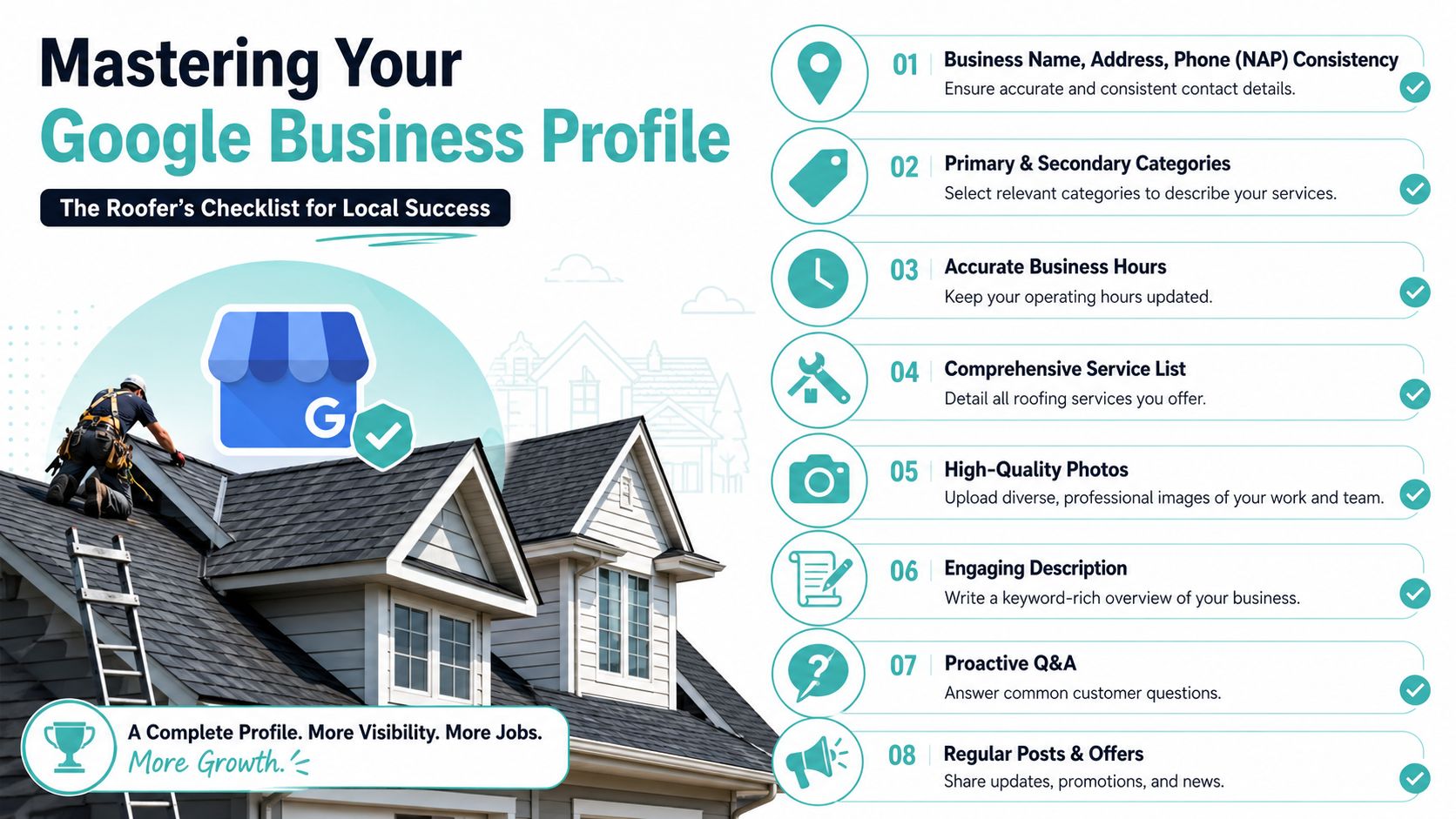
Use this checklist:
- Business identity: Keep your business name, address, and phone number consistent with your website and directory listings.
- Category selection: Choose the best primary category, then add secondary categories only when they reflect real services.
- Service details: List roofing repair, replacement, inspections, storm damage work, and any other real service you perform.
- Hours and service areas: Keep both current. Inaccurate service areas create friction and confused leads.
- Description: Write a plain-English summary with your core services and locations. Don't stuff keywords.
- Photos: Upload project photos, crew photos, equipment photos, and before-and-after shots that look real, not stock.
For roofers with old address data floating around online, fixing citation mismatches and profile confusion often starts with cleaning up location references. If you've moved or updated your official business details, this guide on changing your Google business address correctly is worth reviewing before you start wider citation cleanup.
Treat your profile like a live asset
The best roofing profiles don't look finished. They look active.
That means posting updates, adding fresh project photos, answering Q&A entries, and replying to reviews. Freshness helps both with local relevance and with homeowner confidence. A profile with recent roof replacement photos and recent review responses feels safer than one that hasn't changed in months.
A practical weekly rhythm looks like this:
| Task | What to add |
|---|---|
| Photo update | Completed roofs, flashing details, crew on site, materials |
| Review response | Thank the customer, mention the service naturally |
| Post | Storm response update, recent project, maintenance advice |
| Q&A check | Add answers to common homeowner concerns |
Practical rule: If your profile looks abandoned, homeowners assume your service is slow before they ever call.
This is also where voice-led searches overlap with local SEO. Homeowners increasingly ask devices conversational questions instead of typing stripped-down keywords. If you want to sharpen that side of your visibility, these voice search optimization strategies are useful because they align well with how roofers should phrase services, FAQs, and local answers.
Designing a Website That Converts Searchers into Callers
A ranking without a call is just a nice screenshot. Roofing sites fail all the time because they act like brochures when they need to act like dispatchers.
Your website has one job in local search. Help a stressed homeowner understand that you serve their area, handle their exact problem, and make it easy to contact you right now.
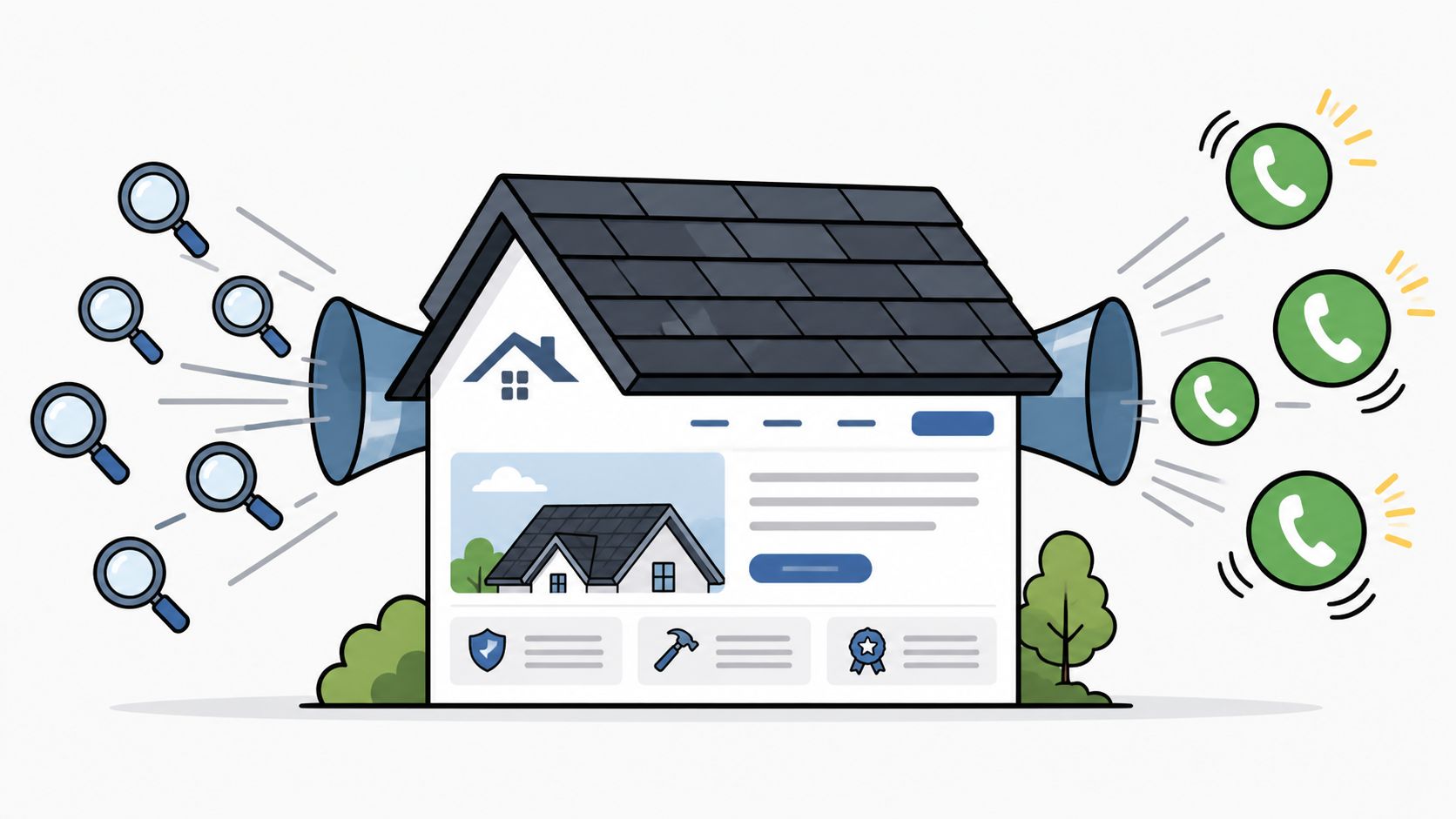
Roofing SEO requires dedicated service pages for each offering and city-specific landing pages for top service areas so you can target terms like "roofing company [city]" with relevance instead of forcing one generic page to do everything (Scorpion).
Build pages for services and cities
The structure that works is simple:
- one page for roof repair
- one page for roof replacement
- one page for inspections
- one page for emergency roofing if you offer it
- separate location pages for the main cities you aim to rank in
Don't jam "repair, replacement, inspection, gutter, storm damage, commercial, residential" onto one page and hope Google sorts it out. It usually won't. Homeowners also don't want to hunt through a catch-all page to figure out whether you solve their problem.
A strong service page needs:
- A precise headline: Say exactly what the page is about and where you offer it.
- A strong opening: Lead with the service and city in natural language.
- Proof of work: Use real photos, material types, process details, and common problem scenarios.
- A direct CTA: Put call buttons and form prompts where people can see them without scrolling forever.
If your current site looks good but doesn't convert, studying examples of web design for roofers that supports lead generation can help you spot where structure, layout, and calls to action are working against you.
Remove friction from the mobile path
A roofing lead often happens on a phone under bad circumstances. Someone's in the attic, in the driveway, or standing under a drip bucket. They don't want to pinch-zoom, decode a menu, or fill out a long contact form.
Here's the difference between a site that converts and one that bleeds leads:
| Weak setup | Better setup |
|---|---|
| Tiny phone number in header | Tap-to-call button visible on mobile |
| One long generic form | Short quote form with only essential fields |
| Stock imagery everywhere | Real project photos from your crews |
| Service info buried in paragraphs | Clear sections for problem, solution, and next step |
The best-converting roofing pages answer three questions fast: Do you serve my area, do you fix this problem, and how do I reach you?
Design and SEO converge. Good local SEO for roofers doesn't end when the click happens. It ends when the phone rings.
Creating Content That Answers Questions and Wins Jobs
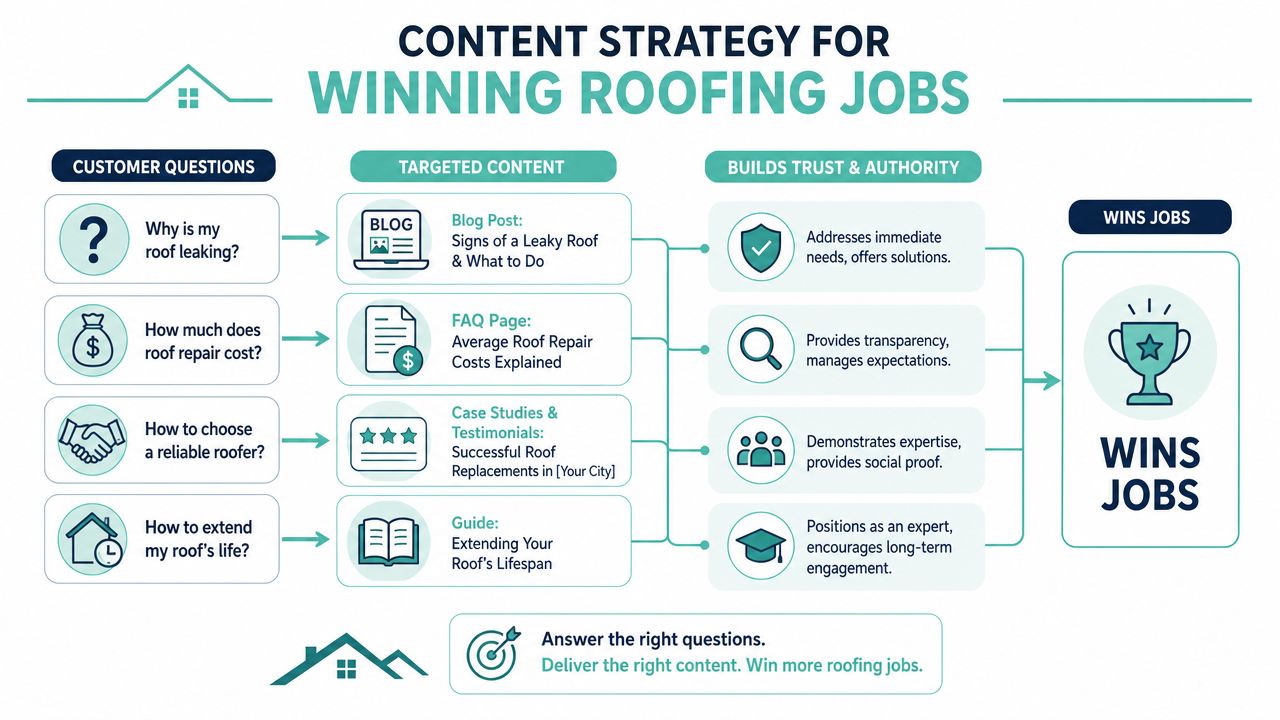
Most roofing content is either too vague to rank or too promotional to build trust. The sweet spot is content that answers the exact question a homeowner is asking before they call.
That includes service content, FAQs, city pages, and educational articles that make your company look competent without sounding rehearsed.
Write for real homeowner questions
Good roofing content usually starts with the questions your office hears every week:
- Leak concerns: Why is my roof leaking after heavy rain?
- Damage concerns: What does hail damage look like?
- Buying concerns: Do I need a repair or full replacement?
- Trust concerns: How do I choose a reliable roofing contractor?
Each question can become a page, article, or FAQ section. The point isn't to publish for the sake of publishing. The point is to remove doubt and capture searches that happen before a homeowner is ready to request a quote.
A useful content mix looks like this:
- service pages for high-intent terms
- location pages for core cities
- FAQ blocks on money pages
- blog articles that support trust and internal linking
- project documentation that shows real local work
If you're trying to build that system instead of posting random blog topics, a focused plan for content marketing that generates leads is a better model than publishing filler every month.
Add AEO structure before competitors do
A future gap is forming. Most local SEO for roofers content doesn't address AI-driven answer engines, even though a 2026 projection says AI engines extract 30–45% of roofing queries from structured summary blocks and schema, and the recommended format is an 80–120-word summary block at the top of each service page (Ottawa SEO).
That changes how roofing pages should be written.
Instead of opening a service page with fluffy brand copy, lead with a tight answer. If the page is about roof replacement in a city, the top block should explain what the service is, when homeowners usually need it, and what local conditions often trigger the need. Keep it concise, direct, and easy for both humans and machines to parse.
Roofers who only optimize for the Map Pack are building for today's clicks. Roofers who add structured answers are also building for tomorrow's citations.
A practical AEO-friendly page includes:
- An opening summary block in the recommended word range.
- Clear headings that match homeowner questions.
- Schema support where appropriate.
- Named author information when expert commentary appears on the page.
- Clean, factual language that can be quoted without rewriting.
Most competitors still miss this completely. That gives disciplined roofing companies a chance to gain visibility where others are still writing for an older search layout.
Building Trust Through Reviews and Local Signals
Google doesn't rank roofing companies on optimism. It ranks businesses that look established, active, and locally credible.
Two signals do a lot of that work outside your website: reviews and local citations or backlinks. If those are weak, national directories often stay ahead of you even when your actual service is better.
Success rates are tied to review velocity and photo frequency, and ignoring local backlinks from standardized NAP citations often results in failure to outrank national directories, because those citations are a primary signal for geographic authority (StrategyC).
Set up a review process your team can repeat
The biggest review mistake isn't asking poorly. It's asking randomly.
You need a repeatable trigger. The best time is right after a successful job, when the homeowner is relieved and your team is still top of mind. That process should live with your office staff, project manager, or whoever closes out the job.
A simple review workflow:
- Closeout moment: Ask once the homeowner confirms the work is complete and satisfactory.
- Direct link: Send them straight to the platform you want the review on.
- Photo habit: Pair review requests with fresh project photo uploads to your profile.
- Response routine: Reply to every legitimate review, good or bad, in a calm and professional tone.
Avoid bribing customers, over-scripting your ask, or sending the request weeks later when the emotional momentum is gone.
Build local authority outside your own site
Many roofers hear "backlinks" and think they need a complicated outreach campaign. Usually, they need local cleanup first.
Start with the places that prove you're a real local business:
- Core directories: Claim listings where your company name, address, and phone number should match exactly.
- Community organizations: Chambers, local associations, sponsorship pages, and neighborhood business directories.
- Supplier and manufacturer references: Approved contractor pages or partner listings when available.
- Local media mentions: Coverage tied to storm response, charity work, or community involvement.
Here's the trade-off. Cheap, irrelevant links can waste time or create noise. Local mentions with consistent business details help Google connect your company to a place. For roofing, place matters more than volume.
A roofer with fewer links but stronger local signals often beats a competitor with a messier footprint.
This part of local SEO for roofers isn't glamorous, but it creates a moat. Once your reviews, photos, citations, and local mentions are all aligned, your visibility gets harder for weaker competitors to dislodge.
Tracking Your SEO Success and Improving ROI
Roofing companies get into trouble when they judge SEO by feelings. More impressions feel good. More traffic sounds good. Neither matters if the calls don't improve.
The scoreboard should reflect the business, not the dashboard.
Expert-level local SEO for roofers requires monitoring map-pack rankings to maintain a top-3 position in at least 70% of target cities, because those placements sit closest to high-intent action (Roof Predict).
Track the numbers that connect to revenue
You don't need fifty KPIs. You need a small set that tells you whether local visibility is turning into booked opportunities.
Track these consistently:
- Map Pack visibility: Are you showing in the top results for your priority services and cities?
- Calls from organic and GBP: Separate them from paid channels so you can see what search is doing.
- Form submissions from money pages: Especially repair, replacement, emergency, and top city pages.
- Landing page performance: Which pages pull in leads, not just visitors?
- Search query quality: Are you attracting the right searches or broad, irrelevant traffic?
A simple priority table helps:
| Metric | Why it matters |
|---|---|
| Map Pack rankings | Indicates whether you're visible where urgency is highest |
| Call volume | Shows direct lead activity from search |
| Form submissions | Captures leads who don't call immediately |
| Top landing pages | Reveals which services and cities drive demand |
| Conversion paths | Shows where users drop off before contacting you |
Use the data to make hard decisions
Situations like these reveal the distinction between experienced operators and dabblers. If a city page ranks but doesn't produce leads, the page may be attracting weak intent or failing to convert. If a repair page gets calls and a replacement page doesn't, that tells you something about demand, positioning, or page quality.
Make decisions based on evidence:
- Improve pages that rank but don't convert
- Expand topics that already drive qualified inquiries
- Cut or rewrite pages that overlap and confuse Google
- Strengthen underperforming city pages with better local proof
- Audit mobile UX when traffic is present but calls lag
One more point matters here. SEO reporting should show direction, not just activity. If someone sends you a monthly report full of impressions, generic traffic charts, and no lead context, you're not looking at ROI. You're looking at motion.
If your roofing company needs a stronger website, cleaner local SEO execution, and a practical AEO strategy that turns visibility into calls, Digital Skyrocket is built for that kind of work. They focus on lead-generating websites, local search, answer engine optimization, and conversion improvements for service businesses that want qualified inquiries instead of vanity metrics.