Most contractors hear the same lazy advice, hire any digital marketing agency, run a few ads, publish some blog posts, and wait for the phone to ring. That wastes money in a business where buyers move slowly, projects are awarded through different procurement paths, and proof matters long before anyone asks for a quote. If an agency does not understand construction procurement, bid work versus negotiated work, and long sales cycles, it will hand you pretty dashboards and weak pipeline.
Construction is a research-heavy market. WebFX reports that 96% of people learn about local businesses like construction companies online, 62% ignore a business without a web presence, and there are about 1.7 million online searches for independent contractors each month, which is exactly why early visibility matters so much in this category. WebFX also reports that content marketing generates 54% more leads than traditional marketing in the same benchmark set, organic search drives 52.3% of global traffic, and construction websites should target about a 2.8% conversion rate WebFX construction statistics. If your agency cannot connect those realities to a lead path, it is not built for construction.
Practical rule: the right partner makes your firm easier to shortlist, easier to trust, and easier to contact.
A construction marketing agency should help buyers find proof, compare you against the right competitors, and move from interest to inquiry without friction. That is very different from generic brand marketing, and it is why a contractor with a capital need might also look at GoSBA Loans business financing while planning growth, because the marketing conversation and the financing conversation often show up in the same boardroom.
As an example of what search-led lead generation looks like for contractors, see Digital Skyrocket's contractor marketing approach.
Table of Contents
- Why Construction Firms Need a Specialized Marketing Partner
- Core Services a Construction Marketing Agency Should Deliver
- Key Questions to Ask Before Hiring an Agency
- Understanding Pricing Models and Engagement Structures
- What Onboarding and Reporting Should Look Like
- Red Flags That Signal a Poor Agency Fit
- Your Agency Selection Checklist
Why Construction Firms Need a Specialized Marketing Partner
A generalist agency usually treats construction like any other local service business. That's a mistake. Contractors don't sell an impulse purchase, they sell trust, schedule confidence, coordination, and proof that the team can handle risk on a live jobsite.
Bid work and negotiated work are not the same
A strong construction marketing agency understands that bid work and negotiated work need different messaging, different proof, and different measurement. In bid environments, the goal is to make a bidder look capable, organized, and low-risk before procurement even opens the door. In negotiated work, the agency needs to support relationship-building, expertise, and shortlist placement over a longer evaluation window.
That distinction matters because many agency websites still talk in vague lead-gen language. They don't explain how a general contractor should be positioned differently from a specialty subcontractor, or how to measure progress in sales cycles that can run six months or longer Mansfield construction agency guidance. If the agency can't talk through those realities without hand-waving, it probably won't understand your buyer's decision process either.
AI search has changed how buyers discover contractors
Search discovery is changing fast. Many contractor sites still lack the cluster-based content structure AI engines need, and newer contractor marketing guidance now ties local SEO, Google Business Profile work, project pages, and conversion-focused landing pages into one system Market Engine AI contractor guidance. That means “we post project photos” isn't a strategy anymore.
A contractor can do excellent work and still lose the shortlist if the web presence doesn't explain what the buyer needs to know.
The job of specialization is simple. It helps your firm show up earlier, communicate more clearly, and avoid wasting budget on tactics that look active but don't move procurement decisions. If an agency can't speak construction language, it's not really selling you marketing. It's selling you generic attention.
Core Services a Construction Marketing Agency Should Deliver
Not every agency needs to sell everything, but a serious construction marketing agency should connect the pieces that create inquiry. That means search visibility, a site that converts, and content that builds trust before the first sales call. Anything less is just activity.
The core stack that matters
Start with SEO and answer engine optimization. Construction buyers research heavily online, and organic search remains the main discovery engine for many firms. The agency should organize content into service pages, project pages, FAQs, and service-area structure that map to real buyer questions, not just keywords.
Then look at conversion-focused web design. A contractor site has one job, turn research into qualified contact. That means clean service navigation, clear proof, easy forms, fast mobile performance, and a structure that supports the about, safety, process, testimonials, and contact pages buyers expect.
What different contractor types need most
General contractors usually need broader proof architecture, because they're judged on experience, delivery method, and the ability to coordinate complex work. Specialty subcontractors often need tighter local visibility, more precise service pages, and stronger project evidence around a narrower set of scopes. Both need reputation management, but they use it differently.
A lot of firms also need structured content built around project pages and service-area architecture. Posting more project photos won't do much if no one can tell what was done, for whom, where, or why it mattered. That's why the better agencies treat each project as a proof asset, not just a gallery image.
For content-led lead generation ideas that support this structure, see Digital Skyrocket's content marketing for leads resource.
Practical rule: if an agency can't explain how a project page becomes a sales asset, it's not thinking like a construction marketer.
The best partners don't sell disconnected services. They build a system where search visibility, trust, and follow-up reinforce each other. That's the difference between a site that looks busy and a site that helps win work.
Key Questions to Ask Before Hiring an Agency
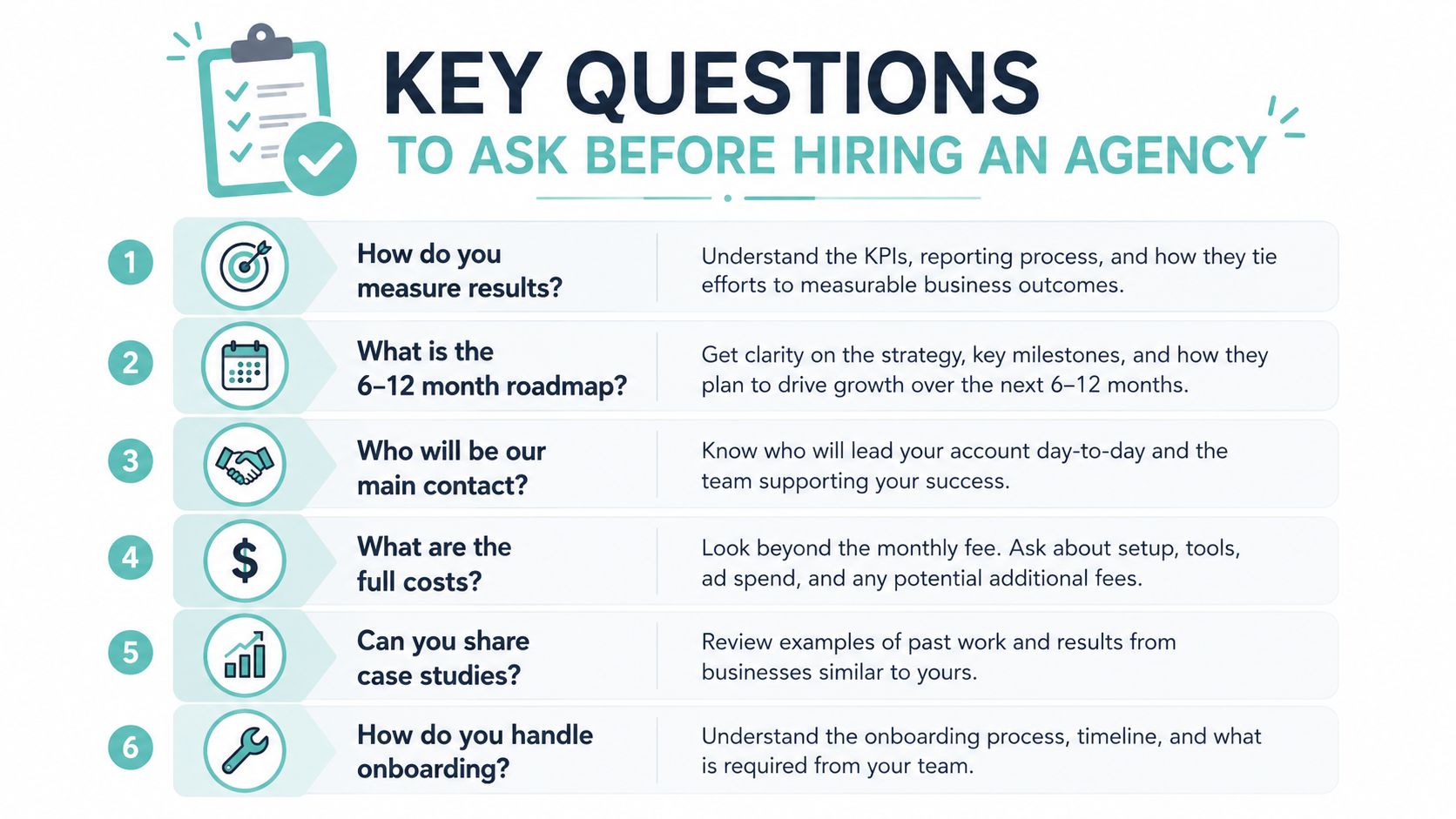
Ask better questions and you'll hear the difference fast. Weak agencies talk about impressions, rankings, and creative ideas. Strong ones talk about buyers, procurement, proof, and attribution.
Questions that expose real competence
Start with, How do you measure results across a sales cycle that may take months? A solid answer will connect traffic, inquiry quality, and pipeline movement. A weak answer will lean on rankings alone.
Ask, How do you position a general contractor differently from a specialty subcontractor? Good agencies will explain how the buyer's risk profile changes, how service pages should differ, and how proof should be organized. Vague agencies will say they “customize for each client” without describing anything concrete.
Next, ask, Do you work with competing firms in my market? If they do, you need a direct answer about account separation, conflict management, and access to strategy. If they dodge the question, assume they'd rather not talk about it.
What a real discovery process sounds like
Discovery should happen before you commit to a long contract. A credible agency asks about your best jobs, your worst jobs, your service mix, your ideal project types, your geography, your close rate, and the difference between leads you want and leads you don't want. It should also ask who handles follow-up inside your company, because marketing without response discipline is wasted effort.
That's the point behind a good market opportunity assessment, which is less about polished slides and more about finding where your visibility, proof, and lead handling are leaking.
If the agency never asks about procurement or follow-up, it doesn't understand how construction work is actually won.
Also ask how they measure touchpoints. Construction leads often need multiple contacts before converting, so a partner should be able to explain attribution across repeat visits, forms, calls, and sales outreach. If reporting only shows pageviews and impressions, it's not reporting. It's decoration.
Understanding Pricing Models and Engagement Structures
Price matters, but structure matters more. A cheap arrangement that ignores a contractor's sales cycle ends up costing more once you count bad leads, weak follow-up, and the time wasted sorting out vague scope. The right engagement should fit how your firm wins work, not how an agency likes to bill.
| Agency Pricing Models Compared | Typical Structure | Best For | Key Risk |
|---|---|---|---|
| Monthly retainer | Fixed monthly fee for ongoing strategy and execution | Firms that need steady SEO, content, and reporting | Scope drift if deliverables aren't defined |
| Project-based fee | One-time price for a site, audit, or campaign build | Companies with a clear one-off need | No continuity after launch |
| Performance-based arrangement | Fees tied to agreed outputs or outcomes | Narrow campaigns with clean tracking | Incentives can become distorted if metrics are too shallow |
| Hybrid structure | Retainer plus scoped projects or milestone work | Contractors with active growth plans | Complexity if roles and deliverables aren't written clearly |
What to compare before you sign
Construction revenue is project-based, so marketing spend feels risky when cash flow is uneven. That is why the scope has to spell out deliverables, reporting, ownership, and exit terms. If an agency will not put those details in writing, walk away.
For a useful frame on evaluating service-provider models and tradeoffs, the CFO guide to PEO comparison is a good reminder that structure affects outcomes as much as price does. The same rule applies here. A retainer only works if the agency is doing ongoing work, not sending a monthly PDF and calling it strategy.
The Data Insights Market construction marketing services report values the construction marketing services segment at $1,174 million, projects growth to about $1,398 million by 2033, and places implied growth at 3% CAGR. The same source says average marketing ROI ranges from 280% to 350%, with SEO cited at 681% ROI and another summary claiming SEO users generate 53% more leads than firms that do not Data Insights Market construction marketing services report. Use those figures as benchmarks, not guarantees.
Practical rule: if the proposal is cheaper because it strips out strategy, reporting, or conversion work, you are not saving money. You are postponing the cost.
What Onboarding and Reporting Should Look Like
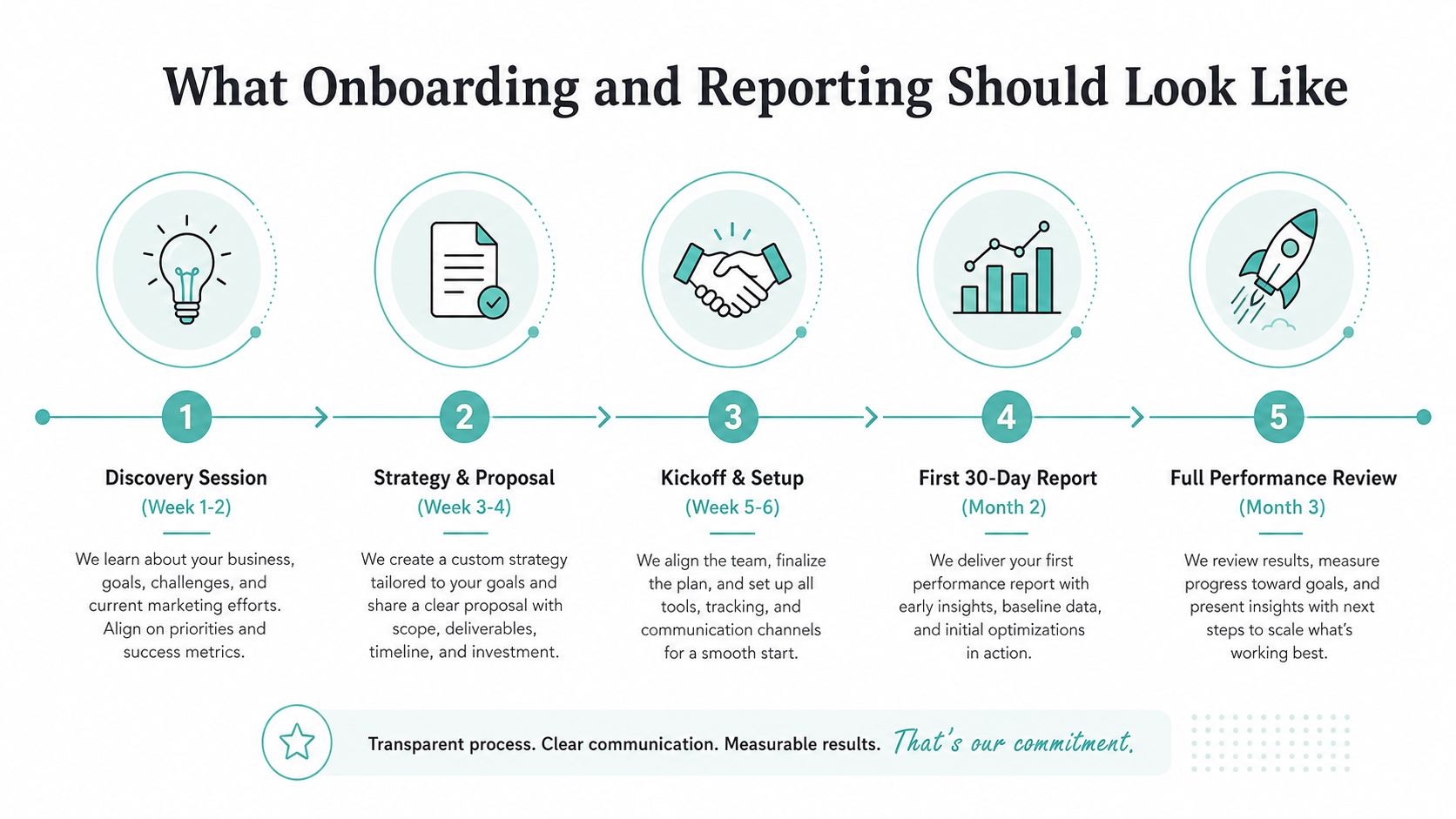
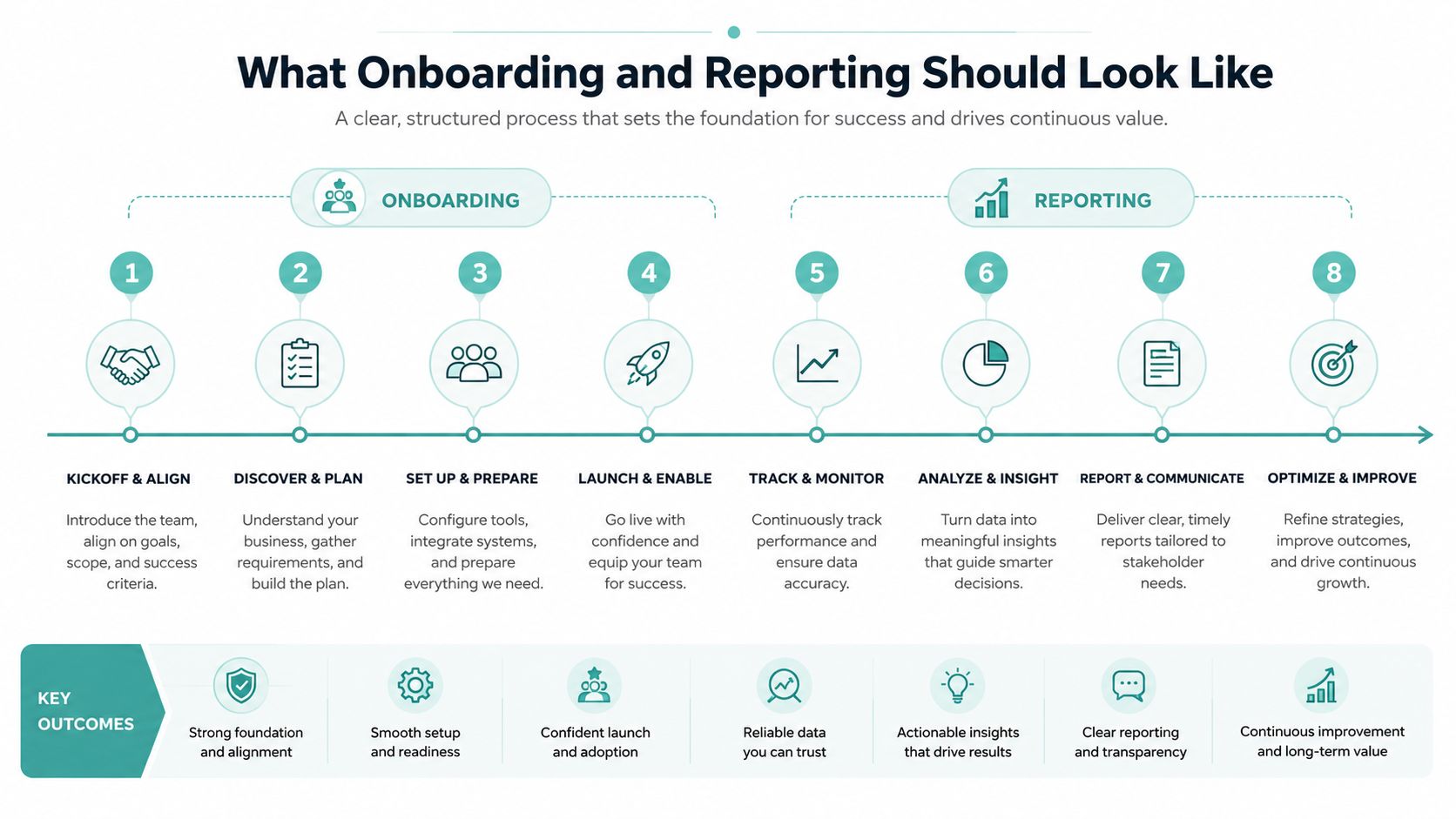
The first ninety days tell you almost everything you need to know. Good agencies don't hide behind vague kickoff language. They show their work, set a baseline, and connect technical fixes to business questions early.
Month one should feel structured, not busy
A healthy start begins with discovery, competitive review, site and content audit, analytics review, and a clean list of priorities. The agency should ask for your top services, service areas, strongest projects, and the kinds of leads you want. It should also identify gaps in technical setup before it touches content.
By the end of month one, you should have a baseline report that shows current visibility, major technical issues, and a plan for service pages, project proof, and lead paths. If the first report is full of jargon but short on priorities, that's a warning sign.
Month two should connect work to movement
In month two, the work should shift into implementation. That might mean site updates, page rewrites, local SEO work, project page drafting, or CRO changes. The report should connect those changes to ranking movement, traffic quality, calls, form fills, or other inquiry signals.
The broader data on construction marketing supports this approach. 79% of construction leads require 5+ touches before converting, firms that track marketing ROI see a 23% higher conversion rate, and 45% of construction firms use CRM systems to manage leads WorldMetrics construction marketing statistics. That means reporting has to include follow-up mechanics, not just website traffic.
Month three should reveal whether the agency understands your pipeline
By month three, the question isn't whether every keyword has moved. The question is whether the system is producing better inquiries and whether your team can see the path from search to pipeline. That's where reporting should become brutally practical.
A good agency report should mention:
- Visibility changes tied to services and locations
- Lead quality patterns from forms, calls, and chats
- Pages that support sales conversations
- Next actions for CRO, content, or technical cleanup
The agency that can't connect website activity to actual opportunities is making you manage marketing by guesswork.
Red Flags That Signal a Poor Agency Fit
Some bad fits announce themselves immediately. Others look polished until the contract is signed. You need to spot both.
The loud warnings
Run from any agency that promises overnight rankings. Construction SEO isn't magic, and anyone selling instant results is usually planning to cut corners. The same goes for vendors that refuse to explain how they'll handle your service area, your project types, or your procurement realities.
If they can't explain construction-specific strategy, that's not a small gap. It means they're applying generic templates to a specialized buying process. You'll feel that mistake later when the traffic doesn't match the leads you need.
The quieter problems
Watch out for reporting that only celebrates vanity metrics. A pretty dashboard with more impressions and no pipeline context is a distraction. You also want to know who does the actual work. If everything is outsourced and nobody in the room can describe the delivery process, accountability gets blurry fast.
Be cautious if the agency works with your direct competitors in the same market and can't give you a clear conflict policy. Also be wary of long contracts with no exit clause, especially when the first deliverables are vague. That combination traps contractors in relationships they can't easily leave.
A decent agency should be able to explain its onboarding, ownership, and handoff process without getting defensive. If it reacts badly to direct questions, you've already learned something useful.
Your Agency Selection Checklist
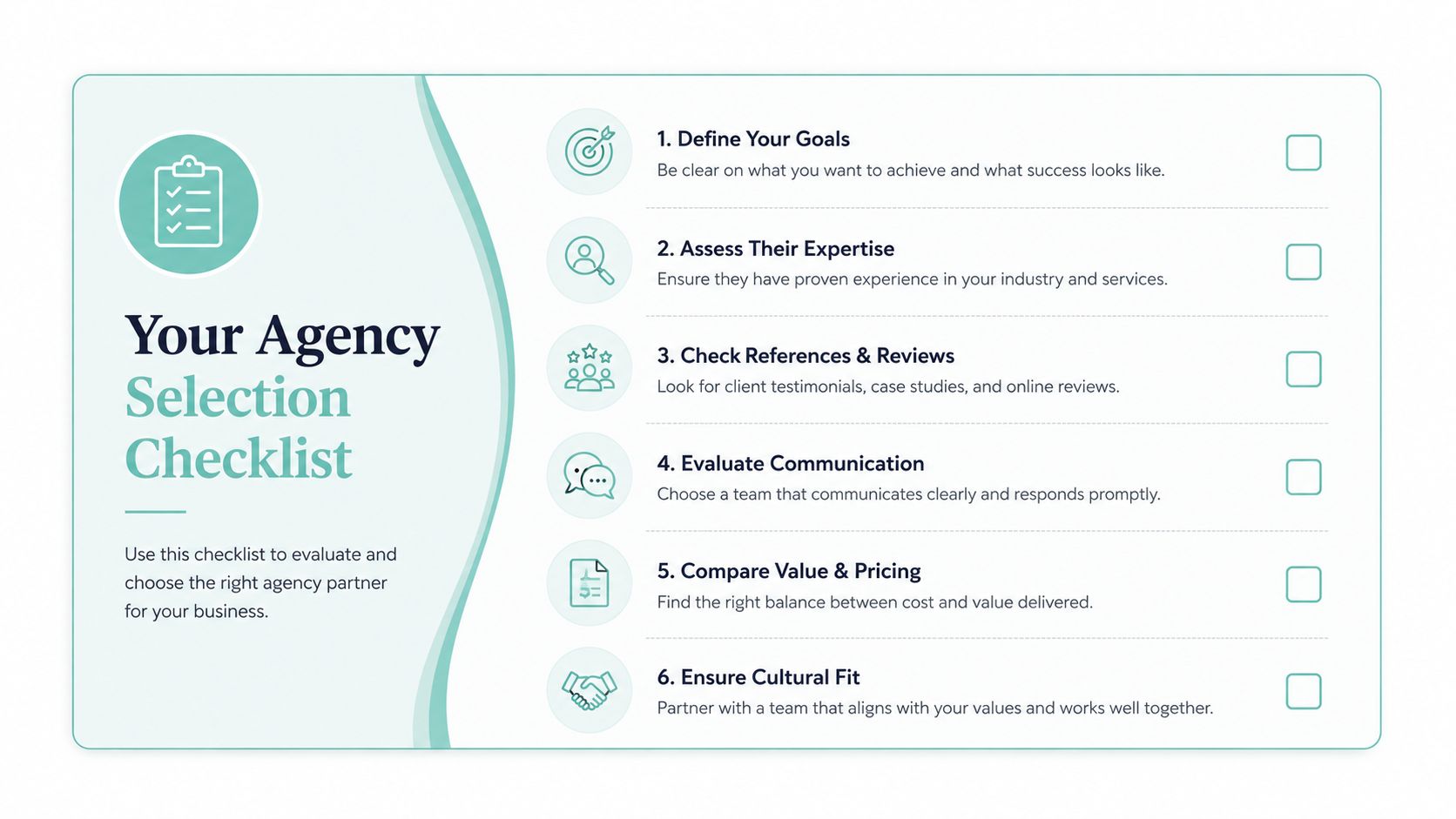
Use this as a screen before you sign anything. If an agency can't clear most of these items, keep looking.
Pre-meeting research
- Review their construction work: Look for contractor examples, not generic local business examples. A passing sign is clear sector familiarity.
- Check their service stack: They should explain SEO, web design, CRO, and reporting in plain language. If they push channels you don't need, they're padding the pitch.
- Scan for proof of process: Case studies, sample audits, or discovery deliverables matter more than slogans.
Discovery call questions
- Ask how they handle procurement realities: They should distinguish bid work from negotiated work without stumbling.
- Ask how they define success: Good answers mention inquiries, quality, and sales support, not just traffic.
- Ask about competing accounts: You need a direct answer, not a vague promise.
- Ask who owns the work: You want clarity on accounts, content, analytics, and site assets.
Proposal evaluation
- Look for a real scope: Deliverables, cadence, and responsibilities should be written out. If it reads like a brochure, it isn't a scope.
- Check the reporting plan: The report should connect traffic and rankings to lead activity.
- Look for conversion work: A site that only attracts visitors but doesn't convert them isn't done.
Contract review
- Read the exit terms: You need a clean way out if the work doesn't match the promise.
- Confirm access and ownership: The agency should not hold your site or data hostage.
- Expect a realistic timeline: Construction marketing is built over time, not overnight.
If no agency checks every box, choose the strongest fit on strategy, transparency, and execution. Walk away only when the answer is clearly wrong. A strong-but-imperfect partner is better than a polished salesperson who doesn't understand how contractors win work.
If you're comparing agencies for a new website, stronger local SEO, and better lead flow, Digital Skyrocket builds contractor-focused sites and search systems around those exact goals. Visit Digital Skyrocket if you want a team that works on web design, SEO, answer engine optimization, and conversion paths for service businesses that need more qualified inquiries.