
You published a post, shared it once on LinkedIn, maybe dropped it on Facebook, and then watched nothing happen. No rankings. No leads. No calls. Just a small bump in traffic from people who already knew your business.
That's where most service businesses get stuck when they ask, how do I publicize my blog. They assume promotion starts after publishing. It doesn't. Publicity starts when you choose the topic, structure the page, add the CTA, and decide where that post will fit in your sales process.
In 2026, blog promotion is less about chasing vanity traffic and more about building pages that can rank, get cited by AI engines, earn attention in niche communities, and push qualified readers toward a service inquiry. If your blog doesn't support that chain, more promotion just sends more people to a weak asset.
Table of Contents
- Build a Promotion-Ready Blog Foundation
- Your First 72 Hours A Post-Launch Publicity Blitz
- Find Your Audience in Niche Communities
- Amplify Your Reach with Strategic Outreach
- Turn One Post into Ten with Content Repurposing
- Measure What Matters From Traffic to Paying Clients
Build a Promotion-Ready Blog Foundation
A service business blog can pull in visitors and still produce zero leads. We see that problem all the time. The post ranks for a broad question, gets skimmed, and ends there because the page was never built to move a serious buyer toward an inquiry.
Promotion works better when the article is built to earn trust, support a service page, and give AI engines something clear enough to quote. That is more important now because AI Overviews and Answer Engine Optimization are changing how content gets discovered. According to Semrush's blog SEO guidance, AI Overviews and AEO now suppress 40–60% of traditional click-through traffic for informational queries, so a post needs to be citation-ready, not just optimized for blue-link rankings.
Start with structure before traffic
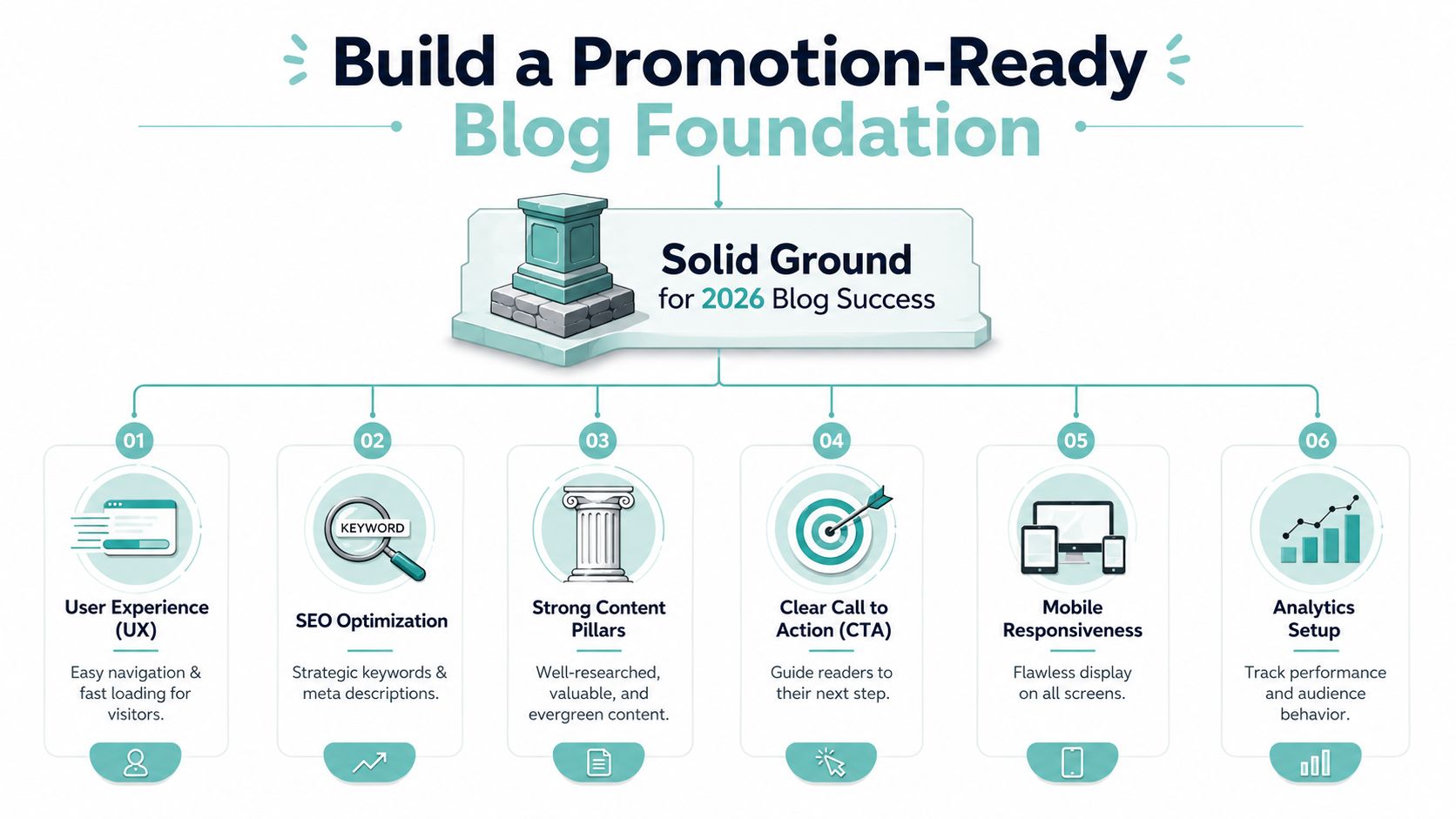
A post that is hard to scan, weakly connected to your services, or buried in messy site architecture is expensive to promote. Paid traffic will bounce. Community shares will underperform. AI tools are less likely to cite a page that lacks clear headings, supporting media, and context.
Start with a few baseline checks:
- Clear search intent: Choose topics tied to a buyer problem you can solve. “How much does emergency roof repair cost” will usually bring better prospects than a generic awareness topic.
- Scannable formatting: Use useful subheads, short paragraphs, comparison tables, pull quotes, and image alt text so readers and machines can process the page fast.
- Searchable metadata: Write a specific title tag, strong meta description, clean H1 and H2 structure, descriptive image names, and transcripts for video or audio assets.
- Internal connections: Tie the article into your site structure so authority can flow to nearby service and location pages. If your architecture is still loose, this sample sitemap for website planning shows a practical way to organize it.
- Visual support: Original photos, marked-up screenshots, short clips, pricing graphics, and process diagrams give readers proof and give AI systems more context to cite. The Nielsen Norman Group's guidance on scannable, web-friendly content supports this broader point. pages that are easier to scan and interpret hold attention better.
- Adequate depth: Thin posts rarely earn trust in competitive local or service-based searches. Orbit Media's annual blogging research has consistently shown that higher-performing blog posts tend to be longer and more detailed than quick opinion pieces.
Practical rule: If you would hesitate to send the post to a prospect after a sales call, do not spend time promoting it.
If you are still putting the core setup in place, this step-by-step guide to starting a blog on maxijournal.com is a solid primer before you put serious effort into distribution.
Build each post to support a service inquiry
For a service business, every blog post should help a buyer take the next step. That usually means one article supports one commercial destination.
In practice, we recommend mapping each post to a single service page, adding a contextual internal link early in the article, and placing a CTA where a qualified reader is likely to act. Mid-post CTAs work well when the article answers a high-intent question. End-of-post CTAs work well for readers who need the full explanation first. Use both if the topic is close to a buying decision.
A simple foundation checklist looks like this:
- Choose the right topic. Target a query connected to a real service need.
- Assign one commercial destination. Give the post one service page to support.
- Add a mid-content CTA. Put it after a meaningful answer, not in the intro.
- Close with a service CTA. Offer an estimate, consultation, audit, or next-step conversation.
- Use original supporting media. Add visuals that clarify the process and strengthen trust.
Blogs usually fail at promotion for a simple reason. The content was built to attract clicks, not qualified inquiries. Fix that first.
Your First 72 Hours A Post-Launch Publicity Blitz
A new post is most vulnerable right after publishing. If you hit publish and walk away, you waste the window when your team still has energy around the piece and your audience is most likely to react to it.
The first three days should feel deliberate, not frantic.
Day one sends the strongest signal
Your first move is your owned audience. Send the article to your email list. Put a blog subscription CTA on your site so you're not dependent on rented platforms, then use your newsletter to feature the new post in a way that tells readers why it matters to them, not just that it exists.
That email should do one job. Create the first wave of qualified visits.
If a post matters to your market, don't bury the link in a monthly roundup first. Give it a direct send while it's still timely.
What to do by hour and by channel
Expert guidance on blog promotion recommends a multi-channel timing strategy, including scheduling posts on Twitter multiple times at different hours and using a storytelling format on Facebook. That same guidance also stresses using UTM links and SEO tools to monitor rankings and click-through rates so you know what's working, not just what was posted, as outlined in Bristol Strategy's blog promotion tips.
Here's the version we'd use for a service business:
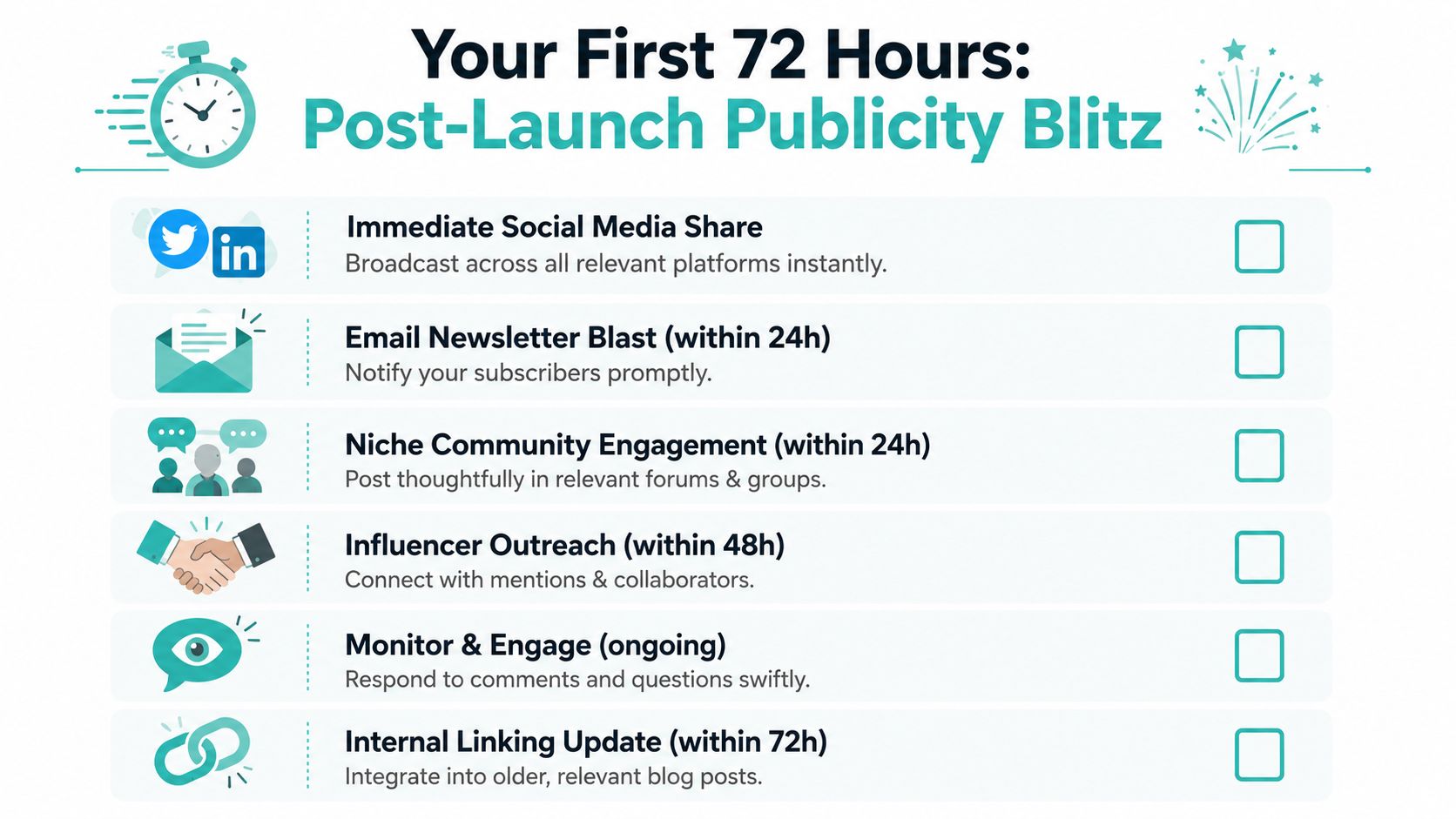
- Within the first hour: Publish the post, check the title tag, meta description, featured image, mobile layout, and CTA links.
- Within the same day: Send a focused email to subscribers with one clear reason to click.
- Later that day: Share the article on LinkedIn from the company page and the owner's personal profile, but rewrite the intro for each audience.
- Within 24 hours: Queue multiple social shares for different times instead of posting once and calling it done.
- Within 48 hours: Reach out to any partners, vendors, or industry contacts mentioned in the piece.
- Within 72 hours: Add links from older related posts to the new one so it doesn't sit isolated.
A short launch stack works best:
| Channel | Best first use | What to avoid |
|---|---|---|
| Direct announcement with a specific benefit | Sending a vague “new blog is live” blast | |
| Personal insight tied to the article | Copy-pasting the meta description | |
| Story-led summary of the problem | Bare links with no context | |
| Internal links | Add from older related articles | Waiting weeks to connect the post |
The mistake isn't using social. The mistake is thinking social alone is a promotion strategy.
Find Your Audience in Niche Communities
A service business usually does not need broader reach. It needs to show up where real buyers ask specific questions right before they hire.
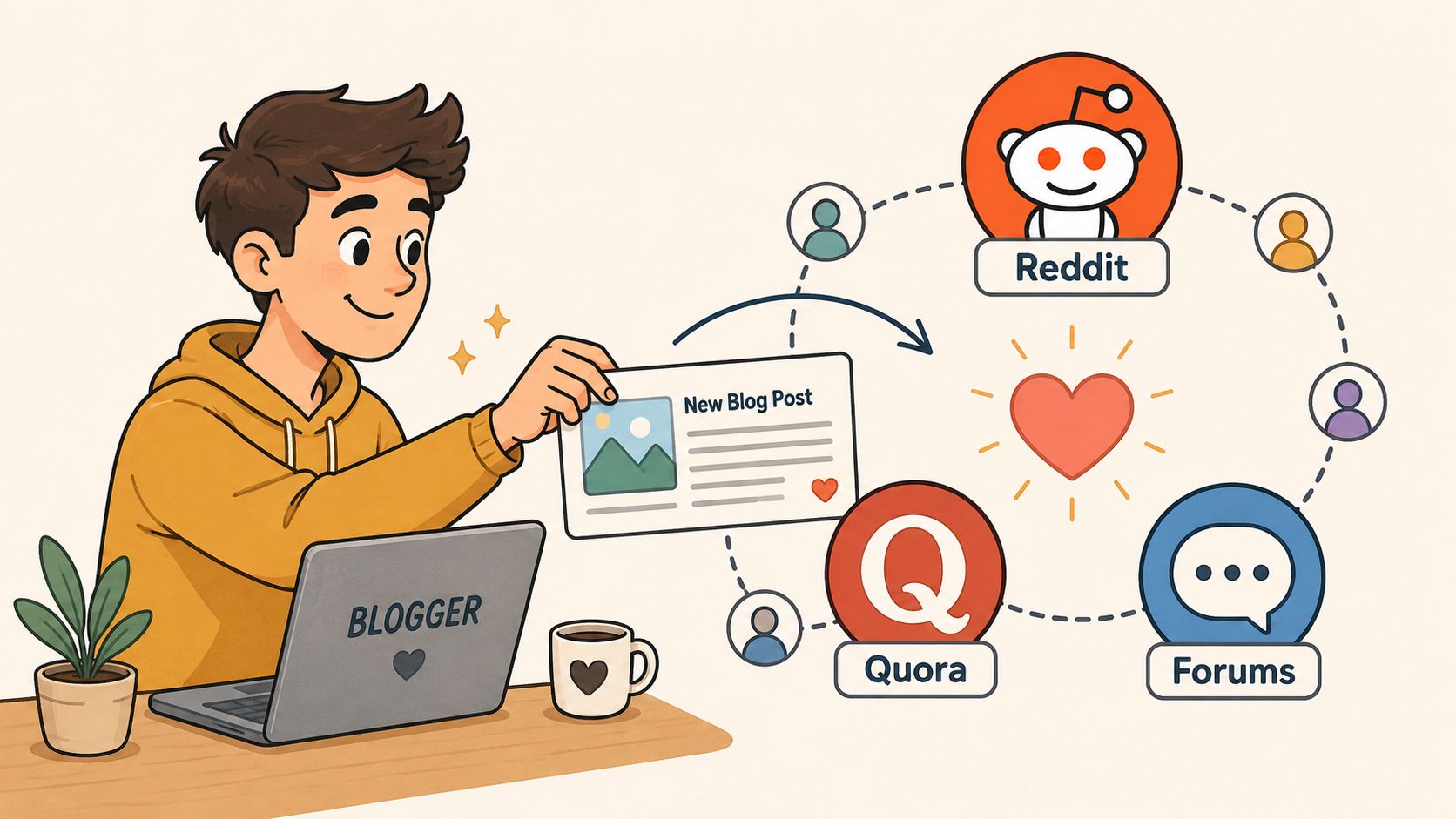
That is why niche communities outperform broad social promotion for many local and service brands. A well-placed answer in the right subreddit, trade forum, Facebook Group, or Quora thread can put your expertise in front of people who already have the problem. In 2026, there is another benefit. Clear, experience-based answers in public communities are more likely to be quoted, summarized, and cited by AI engines than another recycled social post.
What actually works inside communities
Community promotion works when the post stands on its own.
A weak Reddit comment says, “We just wrote a blog on this. Check it out.” That gets ignored, removed, or downvoted because it adds no value in the thread itself.
A strong comment answers the question directly, uses plain language, and adds one detail that only someone with field experience would know. Then, if the rules allow it, you link to the article as the full walkthrough. That approach earns trust first and clicks second.
We use the same standard for clients. If the comment would still help the reader after removing the link, it is strong enough to publish.
For an HVAC company, that might mean answering “why does my AC freeze up in summer” with the likely causes, the one or two safe checks a homeowner can do, and the point where a service call makes sense. The blog post becomes supporting material, not the pitch.
Choose communities where buyers ask narrow questions
You do not need ten channels. You need a small set of places where buying intent shows up in plain English.
Good options include:
- one active subreddit tied to the problem or location
- one Quora topic cluster with recurring service questions
- one niche forum, association board, or professional community
- one well-moderated Facebook Group if local homeowners or business owners participate there
The best communities reveal the language prospects use before they ever fill out a form. That helps you improve future blog topics, service pages, FAQs, and even the wording in your calls to action. If you want a better process for turning those recurring questions into low-competition topics, our guide to long-tail SEO for lead generation covers that in detail.
A practical workflow we use
Keep the process simple and repeatable:
- Read the rules before posting.
- Save five to ten threads that show what gets replies and what gets removed.
- Answer current questions manually. Do not paste brand copy.
- Add a link only when the article expands on the answer.
- Track which questions get responses, saves, clicks, and lead-quality conversations.
- Build future posts around the questions that keep resurfacing.
This is also a strong test bed for repurposing. If a short answer performs well in a forum or thread, you can adapt that same angle into email copy, a LinkedIn post, or even short-form social using tools to create engaging tweets.
Community promotion is not a volume play. It is a precision play. One useful answer in the right niche can generate better leads than a week of broad posting, especially for businesses that win work through trust, specificity, and timing.
Amplify Your Reach with Strategic Outreach
A strong post can sit on your site for months and do nothing until someone trusted by your buyers shares it, cites it, or references it in their own content. For service businesses, outreach closes that gap. It puts your article in front of audiences that already have intent.
We treat outreach as distribution and credibility-building, not a backlink scavenger hunt. The goal is qualified attention from people who may hire you, refer you, or mention your guidance in places AI engines can crawl and cite. Google's own guidance on creating helpful, reliable, people-first content supports the same idea. Original experience and useful contributions earn visibility over time.
Lead with audience fit
The best outreach targets are adjacent publishers and operators who already speak to your future customers. For a roofer, that could be a local real estate newsletter, a home inspector with a podcast, a property management company, or a builders' association editor. For a law firm, it might be accountants, HR consultants, or trade groups.
What matters is overlap in buyer need, not industry prestige.
A mention from the right source does three things at once. It sends referral traffic. It reinforces topical authority. It increases the chance your advice gets picked up in roundups, newsletters, and AI-generated answers that pull from trusted pages across the web. That is a better outcome than a random placement on a site that never reaches your buyers.
Give them a reason to share
Outreach works better when the article fills a gap for their audience. We have seen short, specific emails outperform polished outreach templates because they respect the recipient's time and make the value obvious.
Use angles like these:
- Shared audience problem: “Your readers ask about storm damage claims. We published a guide on what property owners should document before calling a contractor.”
- Expert contribution: “We covered inspection timelines and included a section your audience may care about. If you update this topic later, we can add a short quote or example.”
- Editorial resource: “You've written about this issue before. This piece could work as a supporting resource for a future newsletter or client email.”
That approach fits a broader content marketing strategy for lead generation. Each post should support sales conversations, referral relationships, and organic discovery. Outreach is part of that system.
Prioritize citation-worthy placements
Not every outreach win looks like a backlink in Ahrefs. Some of the highest-value placements are a quoted mention in a local newsletter, a link inside a trade association resource page, a reference in a podcast show note, or a partner who sends your guide to their client list.
Those placements often produce fewer visits and better leads.
They also create the kind of web footprint that supports AI visibility. If your article is cited by niche publishers, industry resources, and local experts, it has a stronger chance of being surfaced when AI engines assemble answers about your service category. That matters in 2026 because buyers increasingly get their first shortlist from AI summaries before they ever visit a search results page.
If your team needs sharper teaser copy while promoting those placements, these tools to create engaging tweets can help turn one article into cleaner social snippets without sounding robotic.
Keep outreach tight. One article, one audience fit, one reason it helps. That is usually enough to start conversations that turn into mentions, referrals, and leads.
Turn One Post into Ten with Content Repurposing
A strong post should keep producing leads after publication week. If it only lives as a blog URL, you paid for strategy, writing, and design once, then collected value once.
That is a poor trade for a service business.
Blogging takes real time. Orbit Media's annual survey of bloggers found that the average blog post now takes several hours to create, which is one reason repurposing pays off for small teams with limited bandwidth. If you already invested that effort, use the post in more places buyers pay attention to.
https://orbitmedia.com/blog/blogging-statistics/
Start with the parts your sales process can reuse
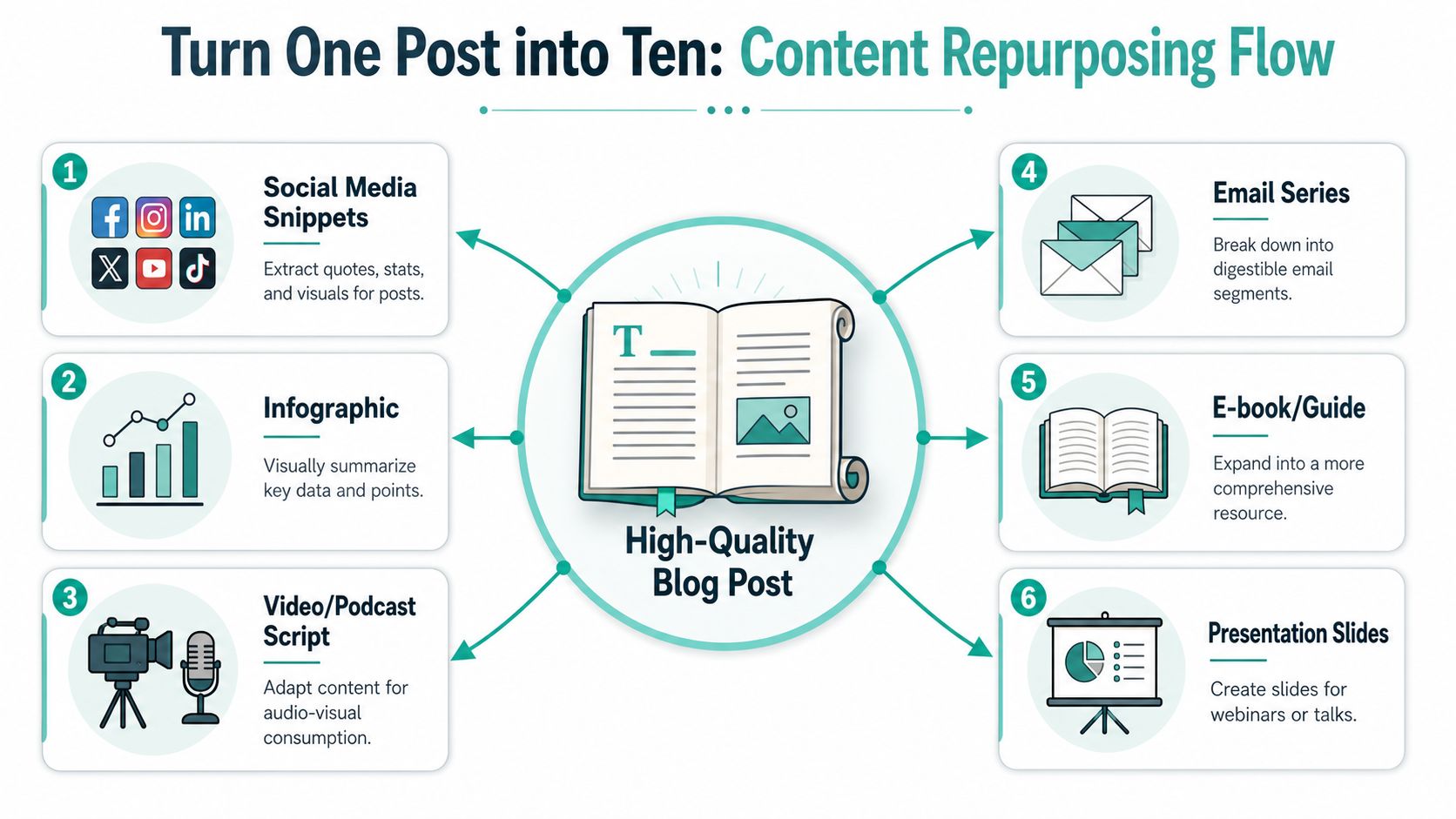
Every good article contains reusable pieces that can support outreach, follow-up, and search visibility:
- the headline promise
- the core problem
- a short list of mistakes
- the step-by-step process
- any chart, visual, or example
- the CTA and objection handling
We treat those as working assets, not finished copy. A useful post can supply your newsletter, proposal follow-up, FAQ answers, sales emails, and niche community posts without forcing your team to start from zero each time.
Repurpose by buyer intent
The mistake is copying the same post into every channel with minor edits. That creates noise. It rarely creates leads.
Repurposing works when each version matches a specific stage in the buying process and a specific context. A prospect scrolling LinkedIn needs a sharp point. A warm lead after a discovery call needs a useful explanation they can share with a business partner. An older blog post on your site may only need one new internal link to send readers toward the article that converts better.
A practical breakdown looks like this:
| Original asset from the post | Repurposed format | Best use |
|---|---|---|
| Intro problem statement | LinkedIn post | Awareness and industry commentary |
| Main steps list | Email series | Lead nurture and re-engagement |
| Key visuals | PDF, carousel, or one-page explainer | Sales follow-up and referrals |
| FAQ section | Short video script | Objection handling |
| CTA section | Sales email snippet | Post-call follow-up |
For service businesses, we usually turn one article into five immediate assets:
- A LinkedIn post built around the strongest opinion or takeaway.
- A short email sent to subscribers, past leads, or referral partners.
- A short video script answering one buyer question from the post.
- A sales asset your team can send after a call to reinforce the recommendation.
- A new internal link target from older articles that still get traffic.
The goal is consistency. Every version should point toward the same service, the same problem, and the same next step. Our content marketing strategy for lead generation follows that rule because repurposing only works when each asset supports the same commercial outcome.
There is also a 2026 benefit many businesses miss. Repurposed content increases the number of places your expertise appears in a format AI engines can cite, summarize, and connect back to your brand. A blog post, a supporting video transcript, a newsletter archive, and a quoted community answer create a stronger citation footprint than a single article sitting alone on your site.
Repurposing extends the life of the post. Done well, it also gives your sales team better proof, your site better internal pathways, and your brand more chances to show up where qualified buyers are already looking.
Measure What Matters From Traffic to Paying Clients
A service business should measure blog promotion the same way it measures any other marketing activity. By revenue potential, sales conversations, and qualified inquiries.
We see this mistake often. A post gets visits, impressions, and a few social shares, so the team assumes promotion is working. Then we check the CRM, call log, or form submissions and find no real movement. Traffic alone does not tell you whether a post is helping the business grow.
A better standard is simple. Ask whether the post attracts the right reader, moves that reader toward a service page or contact action, and contributes to a real sales conversation.
Track the path from post to inquiry
For service businesses, the posts worth promoting usually target buyers who are comparing options, evaluating a provider, or trying to solve a defined problem. Those posts need a clear next step on the page. In practice, that usually means a service-page link inside the article, a mid-page CTA for engaged readers, and an end-of-post CTA for readers who are ready to act.
Your tracking setup should answer four practical questions:
- Which post brought the visitor in?
- Which channel sent that visitor?
- Did the visitor move to a service page or contact page?
- Did that visit become a form fill, call, consultation, or sales-qualified lead?
That is enough to make smart decisions.
Use Google Analytics to track entry pages, traffic sources, and conversion events. Use UTM parameters on email links, community posts, partner shares, and any manual outreach so you can separate good channels from noisy ones. Use heatmaps or session recordings to check whether readers reach the CTA, ignore it, or get stuck. If your sales process runs through a CRM, tag leads by first-touch post when possible. That extra step closes the gap between publishing activity and booked work.
For 2026, there is another layer worth watching. Track whether a post starts generating branded searches, referral mentions, or citations in AI overviews and answer engines. Those signals do not replace lead tracking, but they help explain why certain posts assist conversions later in the buying cycle.
What to keep, fix, or cut
Review posts by commercial behavior.
A post earns more promotion when qualified readers click deeper, submit forms, mention the article on calls, or show up in your pipeline with clear purchase intent. A post needs revision when it attracts visits but fails to move readers forward. In those cases, the topic may be right while the offer, CTA placement, service-page link, or message match is wrong.
Some posts need repositioning instead of a light edit. That usually happens when the article ranks for research intent even though your goal is lead generation. If the traffic comes from students, job seekers, or people outside your service area, promotion will keep feeding the wrong audience.
Some posts should be cut from the rotation entirely.
We have had clients hold onto broad educational posts because the traffic looked good in a report. Once we traced lead sources, the picture changed. The articles producing the fewest sessions sometimes generated the best calls because they matched high-intent questions from buyers close to a decision.
The post with the highest business value is the one your sales team can connect to real opportunities.
Sample 30-Day Blog Promotion Timeline
This operating model keeps promotion tied to outcomes instead of activity for its own sake:
| Phase | Timing | Action Item | Goal |
|---|---|---|---|
| Launch | Days 1 to 3 | Publish, QA the page, send the email announcement, share in relevant channels, add UTM tracking | Start distribution with clean measurement |
| Community Seeding | Days 4 to 7 | Answer relevant questions in niche forums, industry groups, Reddit, or Quora, then link only when it helps the reader | Get qualified referral visits |
| Internal Promotion | Week 2 | Add links from older site pages and related articles | Improve discovery and move readers toward service pages |
| Outreach | Week 2 to 3 | Contact partners, associations, newsletter editors, and adjacent businesses with a specific angle | Get mentions, citations, and referral traffic |
| Repurposing | Week 3 | Turn the post into email snippets, short videos, sales follow-up assets, and community answers | Extend reach across formats buyers actually use |
| Review | Week 4 | Compare traffic source quality, service-page clicks, inquiries, and sales feedback | Decide what to scale, revise, or stop |
The discipline matters more than the spreadsheet. Promotion usually underperforms because teams publish, share once, and move on. The businesses that get leads from blogging keep checking source quality, adjusting CTAs, and putting more effort behind the posts that support sales.
If you are asking how do I publicize my blog, use that question to narrow your focus. Publicize the posts that attract buyers, earn citations, and help your team start better sales conversations. Then measure them against client inquiries, not vanity metrics.
If your website looks decent but still isn't turning search visibility into qualified leads, Digital Skyrocket helps service businesses fix the part that usually breaks the chain: the site itself. We design and build lead-focused websites, structure content for SEO and AEO, and refine conversion paths so blog traffic has a real chance to become calls, form submissions, and new client opportunities.