Your crews are busy. The phones ring hard after a storm, then go quiet. You've tried a little of everything, SEO, yard signs, maybe some Google Ads, but lead flow still feels uneven. One month looks strong, the next feels like starting over.
That's usually not a traffic problem. It's a systems problem.
Marketing for roofing companies works best when you build it the same way you'd build a house. Start with a foundation that can carry weight. Frame the structure so every part supports the next. Then add the channels that bring in demand. If you skip that order, you spend money patching leaks instead of building a durable pipeline.
Table of Contents
- The Foundation for a High-Growth Roofing Business
- Mastering Local SEO for High-Intent Roofing Leads
- Activating Paid Channels for Predictable Growth
- Building Trust with Field and Referral Marketing
- Converting Traffic into Customers with Optimization
- Your Implementation Playbook and Measurement Plan
The Foundation for a High-Growth Roofing Business
A roofing company can't scale on generic messaging and a brochure website. If your homepage says the same thing as every other roofer in town, homeowners compare you on price. That's a race most companies eventually lose.
Roofing companies must craft a unique value proposition that answers why homeowners choose them over competitors, avoiding generic claims like “high quality” or “great service” that fail in crowded markets, while developing direct response marketing and digital strategies tied to metrics like cost per lead and lead-to-sale conversion rate, as noted by Contractors.net's roofing marketing guidance.
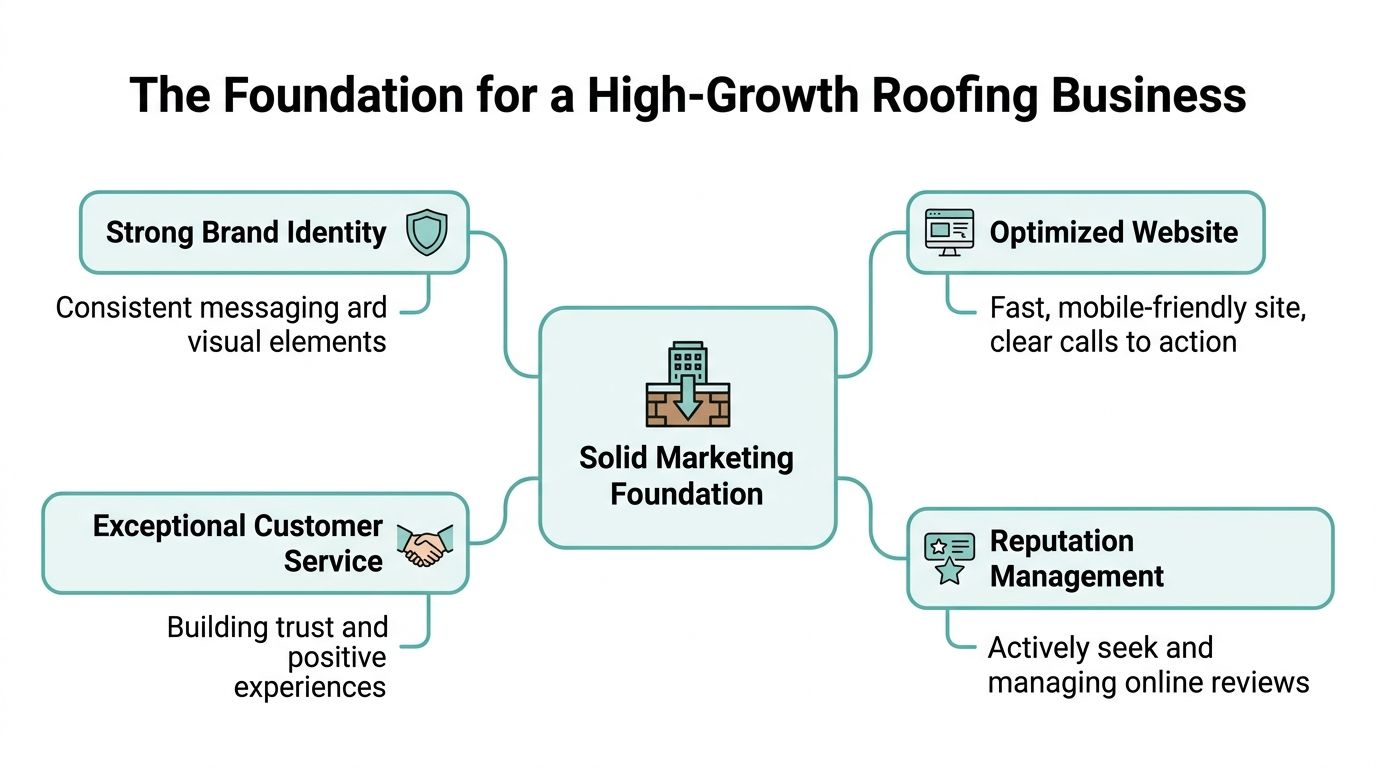
Start with a value proposition that means something
A strong UVP isn't a slogan. It's a reason to call.
If you specialize in insurance claim support, say that. If you win because you document storm damage better, communicate that. If your edge is clean project management, daily homeowner updates, and fast scheduling for emergency tarping, put that front and center. Homeowners don't hire a roofer because the company says it cares. They hire the company that feels lower risk.
Use this quick test:
- Replaceable claim: “We offer quality workmanship.” Every competitor can say it.
- Specific promise: “We photograph every slope, document damage clearly, and give homeowners a step-by-step scope before work begins.” That's harder to ignore.
- Operational proof: Show certifications, real project photos, financing details, warranty language, and review excerpts that back it up.
Practical rule: If your message could fit on any roofer's truck wrap in your city, it's too weak.
Good positioning also makes every other channel work better. It sharpens ad copy, improves landing pages, and gives your office staff language they can use on calls. If you want another outside perspective on how roofers can tighten their positioning and process, this resource on marketing for roofing contractors is worth reviewing.
Build a website that sells while your crew is working
Most roofing websites look acceptable and perform badly. They bury the phone number, lump all services onto one page, and make visitors hunt for proof that the company is legitimate.
A lead-generating site should act like a disciplined salesperson. It answers the first questions fast, reduces anxiety, and gives visitors an easy next step. That's the standard.
The basics matter:
- Mobile-first layout: Most roofing traffic arrives on a phone, especially in urgent situations.
- Clear service structure: Separate pages for roof repair, roof replacement, storm damage, inspections, commercial roofing, gutters, or any other core service.
- Visible conversion points: Sticky phone number, short forms, estimate request buttons, and clear emergency options.
- Trust assets: Licensing, insurance, financing availability, manufacturer affiliations, review snippets, and recent local jobs.
- Fast load time: If the site drags, people leave before they read your pitch.
Here's the simplest way to think about site structure:
| Website element | What it should do |
|---|---|
| Homepage | Establish trust, explain the UVP, route visitors to the right service |
| Service pages | Match search intent and answer job-specific questions |
| Location pages | Show relevance for each city or service area |
| Contact and quote flow | Reduce friction and capture leads fast |
A lot of service companies miss this because they treat the website like branding collateral instead of revenue infrastructure. This broader guide on service company marketing systems shows the same principle in a wider local-service context.
Mastering Local SEO for High-Intent Roofing Leads
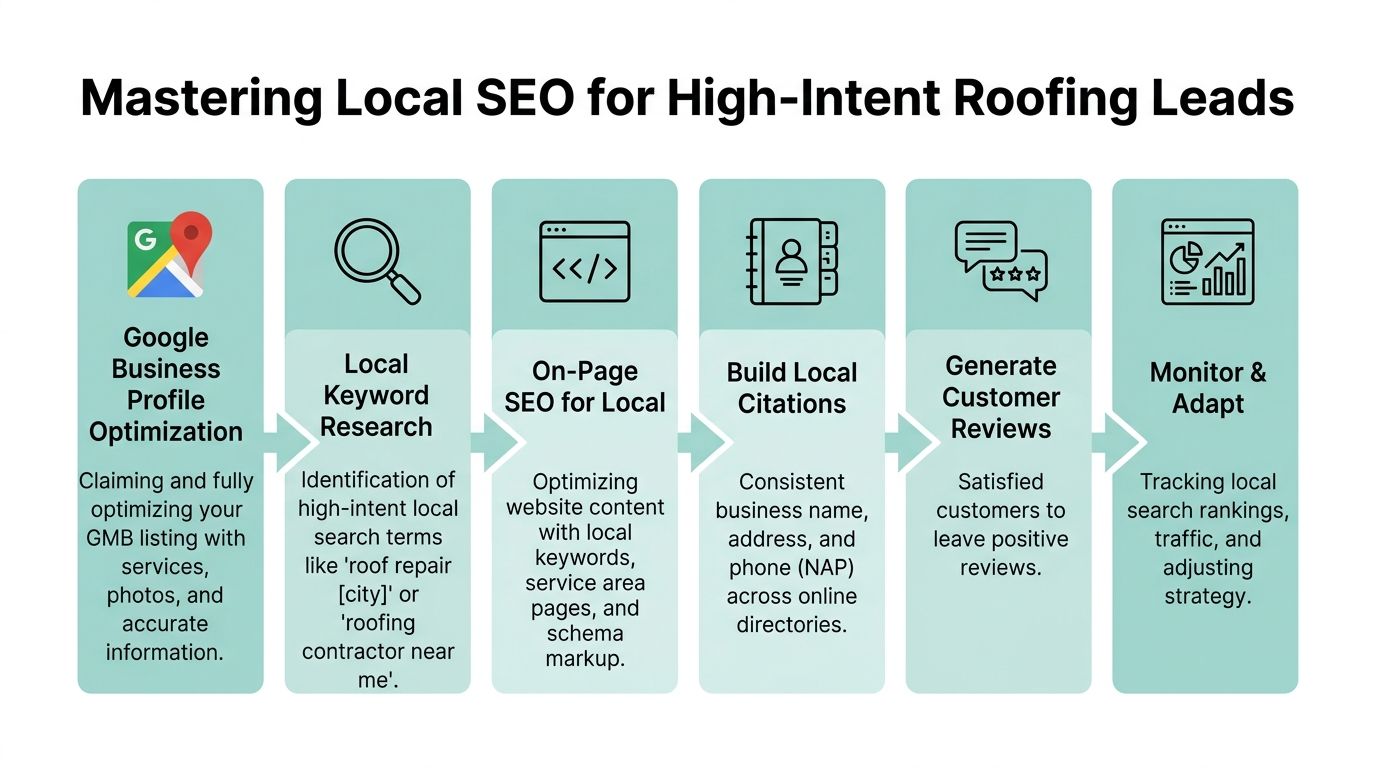
When a leak shows up in the ceiling or hail hits a neighborhood, homeowners don't browse casually. They search with intent. That's why local SEO matters so much in marketing for roofing companies. You're not trying to “build awareness” first. You're trying to appear at the moment demand appears.
For roofers, technical SEO success hinges on location-specific landing pages paired with local schema markup, and optimizing Google Business Profiles with precise service areas plus review generation directly increases local visibility by 30 to 50 percent in competitive markets, according to AMSI Supply's roofing marketing analysis.
Your Google Business Profile is the front door
Your Google Business Profile often gets seen before your website does. In many markets, that profile decides whether someone calls you, keeps scrolling, or taps a competitor instead.
A complete profile needs more than business hours and a logo. Add service categories, service descriptions, project photos, operating areas, and fresh updates. Make sure your service area reflects the places you want to win in, not a vague radius that spreads relevance too thin.
Use a checklist like this:
- Primary category selection: Choose the category most aligned with your highest-value work.
- Service coverage: List specific roofing services instead of relying on broad descriptions.
- Photo proof: Upload real job photos, not stock images.
- Operational accuracy: Keep hours, phone number, and website link current.
- Review process: Ask every satisfied customer at closeout, not weeks later.
A thin profile tells homeowners you're either new, inattentive, or both.
Service pages and location pages do the heavy lifting
A lot of roofers still try to rank one homepage for everything. That approach wastes intent.
If you serve several cities, build a page for each one. If you offer multiple services, build a page for each service. The strongest local SEO setups combine both into a clean hierarchy. That means a storm damage page, a roof replacement page, and city-specific pages that speak to local conditions, neighborhoods, and service relevance.
Long-tail search matters. Searchers don't always type “roofer.” They type urgent, specific phrases tied to place and need. A useful primer on long-tail SEO strategies helps explain why these narrower searches often convert better than broad terms.
What belongs on a strong location or service page?
- Local relevance: City name, nearby communities, service area details, and real project references.
- Specific service language: Materials, repair types, storm response details, inspection process, or commercial scopes.
- Schema support: Structured data that helps search engines understand your business and service footprint.
- Conversion paths: Quote form, call button, financing mention, and emergency options where appropriate.
Reviews turn rankings into calls
Reviews do two jobs. They strengthen local visibility, and they reduce hesitation when a homeowner compares options. Those jobs feed each other.
The mistake is asking casually. Review generation should be operational. The production manager, office staff, or salesperson should trigger the request at a consistent moment, usually right after the customer confirms the job is complete and they're satisfied. If you need a cleaner process, Twizzlo's Google reviews guide offers practical ideas for asking in a way that gets responses.
Keep the request simple. Send a direct link. Don't make customers search for your profile. Don't send a long email that buries the ask.
Activating Paid Channels for Predictable Growth
A roofing company cannot build predictable lead flow on paid ads alone. Paid channels work like the framing on a house. They add structure and speed, but they only hold up if the foundation is already in place. That means a credible website, clear service pages, strong intake, and tight follow-up. Without that base, paid traffic gets expensive fast.
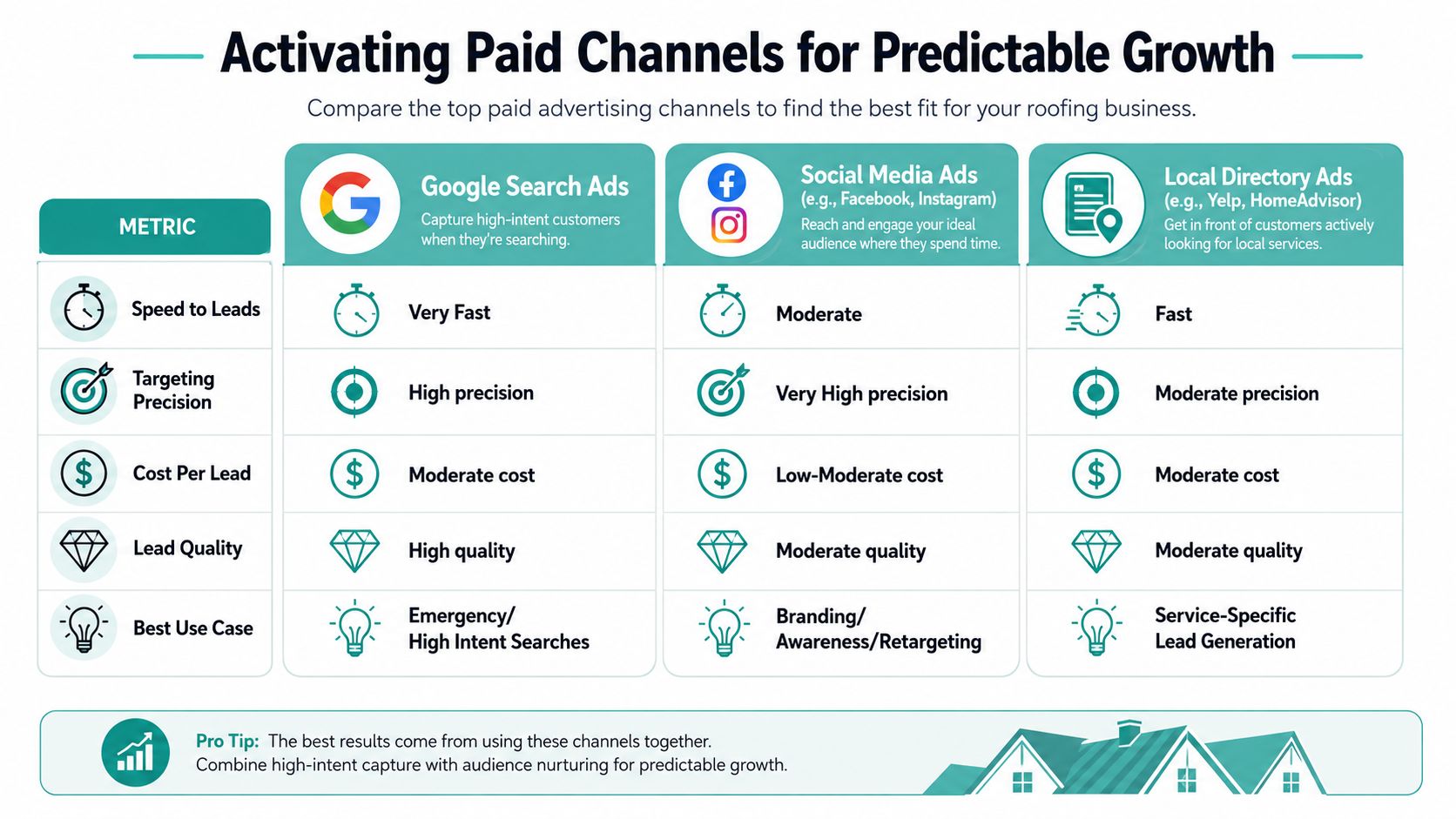
Paid media solves a specific problem. It lets a roofer create demand capture on command, whether the trigger is storm activity, a slow sales month, or expansion into a new service area. Roofr's guide to roofing lead generation points to Google Local Services Ads, instant-estimate website tools, and referral programs as effective lead sources. The useful takeaway is the mix, not the list. Use paid channels to create immediate opportunity, then route that traffic into a site and sales process built to convert.
Where each paid channel fits
Each paid channel does a different job. The mistake is treating them like interchangeable lead vendors.
| Channel | Best fit | Main advantage | Main limitation |
|---|---|---|---|
| Google LSAs | Emergency, inspection, replacement demand | High trust and direct lead flow | Less control over messaging and landing experience |
| Google Search Ads | Competitive keyword targeting and offer testing | Strong intent control and custom landing pages | Requires tighter management and sharper page alignment |
| Social ads | Retargeting, neighborhood awareness, referral amplification | Good audience shaping and visual storytelling | Lower purchase intent than search |
That trade-off matters.
A company that needs phone calls this week usually starts with LSAs or Google Search. A company trying to stay visible across neighborhoods where crews are already active can add paid social and retargeting. The system works best when channels are layered in the right order instead of launched all at once.
When LSAs deserve the first budget
LSAs often give roofers the fastest path to inbound leads because the format is built around calls and form submissions, not browsing. The Google Guaranteed badge also reduces hesitation for homeowners comparing three companies in ten minutes.
The downside is control. You cannot shape the sales message the way you can with a dedicated landing page. Lead quality can also vary by market, and disputed leads take management time. I usually treat LSAs as the top-of-funnel call generator, then rely on operations to qualify hard and respond fast.
If the goal is immediate demand capture, LSAs usually get the first test budget.
Where Google Ads earns its keep
Google Search Ads gives you more control over the entire path from keyword to close. You choose the search terms, write the offer, and send traffic to a page built for one service and one intent. That matters in roofing, where "roof repair," "storm damage inspection," and "full roof replacement" can produce very different lead quality.
It also lets you segment the account like a real sales system. Separate residential from commercial. Split replacement from repair. Create campaign groups for storm response versus non-emergency demand. That structure makes budgeting easier and performance easier to read.
Audience quality matters too. For example, Experian Marketing Services outlines audience and property segmentation options that include household income, home characteristics, and neighborhood-level data. For roofers, that supports a more practical media buy: put more budget into older housing stock, stronger home values, and service areas that match your job size and margin targets.
That is how paid media becomes predictable. Start with intent, then tighten the audience by property fit and economics.
Social ads support demand. They rarely create it.
Social ads help roofing companies stay visible, retarget site visitors, and reinforce credibility in neighborhoods where jobs are already underway. They are useful for before-and-after project creative, financing messages, storm awareness, and homeowner education.
They usually do not match search traffic for urgency.
That does not make social less important. It just gives it a different role in the system. Search captures active need. Social keeps the brand in front of people until timing and trust line up. Used together, they produce a steadier pipeline than either channel can produce alone.
Building Trust with Field and Referral Marketing
Roofing is local, visible, and heavily reputation-driven. People see your trucks, your yard signs, your crews, and your work in their neighborhood before they fill out a form. That makes offline marketing an amplifier, not a side project.
Digital-only roofing marketing often underperforms because it ignores how homeowners decide. They search online, but they also ask neighbors, notice who's active on the block, and trust companies they've already seen doing work nearby.
Referral systems beat random word-of-mouth
Every roofer says referrals matter. Fewer build a system for them.
A referral program doesn't need to be complicated. It needs to be remembered. The best time to ask is when the customer is relieved, happy with the cleanup, and confident recommending you. If your team waits for homeowners to bring it up on their own, referrals stay accidental.
Build the process into job closeout:
- Ask directly: Train the project manager or office team to make the request part of the final handoff.
- Make it shareable: Give customers a simple card, text template, or short link they can pass to a neighbor.
- Tie it to timing: Reach back out when storms hit their area or when nearby jobs start.
- Recognize the source: Track who referred whom so no opportunity gets lost.
Field marketing works when it follows the job trail
Door hangers, yard signs, wrapped trucks, and neighborhood leave-behinds still work in roofing because they create repetition in tight geography. What doesn't work is scattering them everywhere with no relationship to active jobs.
Use field marketing where your crews already are. A yard sign on a completed job, a door hanger on adjacent homes, and branded trucks parked cleanly near the site create a surround-sound effect. Homeowners search your name later because they've already seen it in person.
A few practical trade-offs matter:
- Door hangers work better when they reference nearby work and offer a clear next step.
- Yard signs work better when they stay up long enough to be noticed and you ask permission upfront.
- Truck wraps work better when the brand name, phone number, and service type can be read quickly from the street.
Offline trust cues support online conversion. Someone who saw your sign on their block is more likely to click your Google listing and less likely to bounce from your site.
Converting Traffic into Customers with Optimization
Traffic doesn't pay for itself. Conversion does.
Many roofing companies often stall here. They get the click from Google, maybe even rank well, but the page doesn't close the gap between interest and action. That gap is usually friction. Missing trust signals. Weak calls to action. Generic copy. Too many form fields. No obvious next step for someone who needs help fast.
Data shows 78 percent of homeowners search for “emergency roof repair near me” immediately after severe weather, yet few contractors optimize location-specific pages with storm-damage keywords, trust signals, and urgent CTAs, which leaves high-intent leads on the table, according to Housecall Pro's roofing marketing article.
What has to appear above the fold
The first screen should answer three questions immediately: Are you local, can you handle my problem, and how do I contact you right now?
If the hero section opens with a vague brand statement and a stock photo, you're making visitors work too hard. Roofing pages need to establish certainty fast.
A strong top section usually includes:
- A specific headline: Mention the service and the area served.
- A visible phone option: Especially for urgent repair or storm-damage searches.
- A short form or estimate path: Keep it simple. Name, contact info, address, and service need is often enough.
- Trust indicators: Review snippets, licensing, insurance, manufacturer affiliations, or financing language.
- Relevant imagery: Real crews, real roofs, real local jobs.
Homeowners don't want to decode your website. They want proof that you can solve the problem and that contacting you will be easy.
The landing page elements that remove friction
Once the visitor scrolls, the page should keep reducing doubt. Good roofing landing pages move in a logical order. Problem. Proof. Process. Action.
Here's a simple breakdown:
| Page section | What it should accomplish |
|---|---|
| Intro section | Confirm service, location, and urgency |
| Proof section | Show reviews, certifications, recent jobs, and warranties |
| Process section | Explain inspection, estimate, scheduling, and cleanup |
| FAQ or reassurance section | Address insurance, timing, materials, disruption, and financing |
| Final CTA section | Repeat the call, form, and next-step clarity |
The strongest pages also match the source of the click. If someone searched storm damage, don't dump them on a general homepage. Send them to a storm-focused page with emergency language, insurance-related reassurance, and a direct inspection request.
Design matters too. A dated layout or cluttered mobile experience creates hesitation before a word is read. If you want a better benchmark for what a modern, conversion-focused roofer site should include, review these examples and principles around web design for roofers.
Your Implementation Playbook and Measurement Plan
A lot of roofing companies hit the same wall around month three. The website is live. Ads are running. Somebody is posting on Facebook. Leads come in, but nobody can say which channel is producing good inspections, which neighborhoods are wasting spend, or where follow-up is breaking down.
That is a sequencing problem.
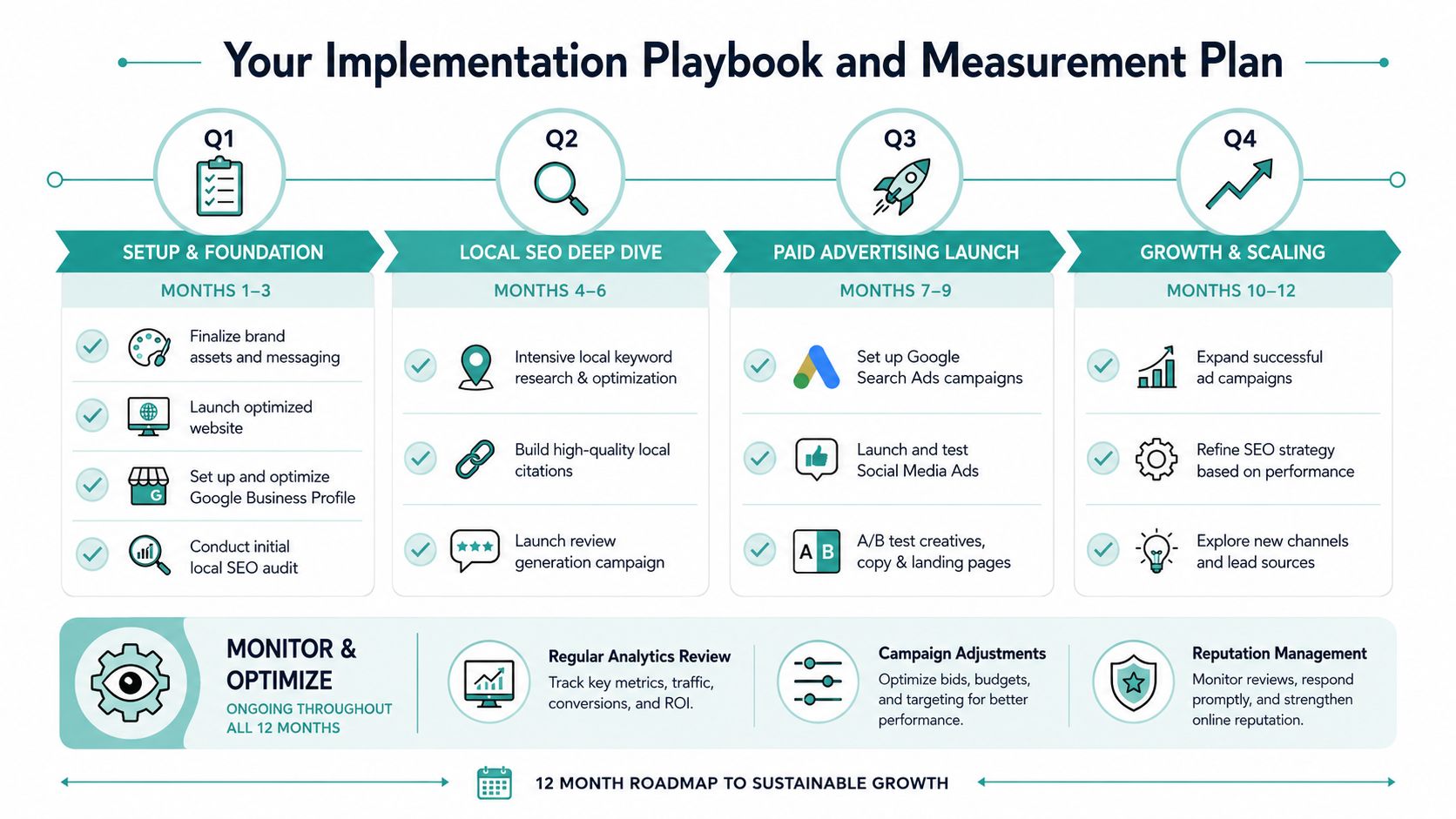
Roofing marketing works like building a house. The slab goes in first. Then framing. Then the systems behind the walls. If you start hanging drywall before the structure is square, you pay twice. Marketing behaves the same way. A roofer that tries to launch SEO, paid search, LSA, direct mail, wraps, and referral campaigns all at once usually gets noise instead of a clean growth signal.
Quarter one and quarter two
The first half of the year should create a stable base. That means the brand, website, local presence, and tracking are set up well enough that later wins can be measured and repeated.
Quarter one should focus on the core structure:
- Clarify the UVP: Decide what the company should be known for. Storm response, premium replacement, insurance claim support, metal roofing, financing, or commercial service. Generic positioning makes every channel harder to convert.
- Tighten the website: Build or revise service pages, city pages, mobile layouts, forms, click-to-call paths, and trust sections so traffic has somewhere credible to land.
- Set up tracking: Use call tracking, form tracking, and source reporting before increasing spend. If attribution is blurry, budget decisions will be weak.
- Clean up local profiles: Align Google Business Profile details, service areas, categories, hours, photos, and business information everywhere customers can find the company.
Quarter two should build local demand capture:
- Expand service and city coverage: Add pages for the services and locations that produce revenue.
- Create a review process: Ask after inspections, after job completion, and after insurance claim wins. Do it with a repeatable script and owner accountability.
- Improve on-page SEO: Tighten page titles, headings, internal structure, and schema where it supports local relevance.
- Review lead patterns: Look at which service and location combinations are creating calls, form fills, and booked estimates.
Quarter three and quarter four
The back half of the year is where more roofers should start pressing the gas, but only if the foundation is carrying weight.
Quarter three is usually the right point to expand paid acquisition. That can include Local Services Ads, Google Search, retargeting, and neighborhood campaigns around active jobs. Better targeting matters here, but the practical point is simple. Spend more where the homes, timing, and job values fit the work you want. A wide metro campaign may create lead volume. It can also bury the sales team in weak appointments.
Quarter four is for cleanup and scale. Keep the channels that turn into inspections, estimates, and signed jobs. Cut anything that produces calls without revenue. Then expand into nearby service areas, related services, or new campaign types once the first set is producing predictable results.
That is how a system gets stronger.
What to measure every month
A roofing company does not need fifteen dashboards. It needs a scoreboard the owner and sales manager will regularly review.
Track these every month:
- Lead volume by channel: Separate SEO, GBP, LSA, paid search, referrals, direct mail, and field marketing.
- Cost per lead: Review it by source, not as one blended average.
- Cost per appointment: This shows whether the channel is bringing in real opportunities or just inquiries.
- Lead-to-estimate rate: Good for spotting intake and qualification problems.
- Estimate-to-close rate: Good for judging lead quality and sales execution.
- Booked revenue by source: Revenue matters more than raw lead counts.
- Review velocity and review quality: These support both trust and local search performance.
- Response speed: Missed calls and slow callbacks undermine return on ad spend.
The trade-off is straightforward. Simpler reporting gives cleaner decisions, but only if the team logs job source accurately. If sales reps mark everything as "Google" or office staff forgets to ask how the customer found you, the reporting becomes decoration.
I prefer one monthly review with three questions. Which channels produced booked revenue? Which channels produced wasted time? Where did leads stall between first contact and signed contract? Those answers usually tell an owner what to fix next.
Marketing for roofing companies gets easier to manage when it is built in layers. Start with the foundation. Add local visibility. Add paid demand capture. Support it with field trust and referral activity. Then improve conversion rates across the whole structure.
If your roofing company needs a stronger website, cleaner local SEO, and a reputation strategy built to generate qualified leads, Digital Skyrocket is worth a look. They focus on lead-generating websites, SEO, AEO, and conversion optimization for service businesses, and they only take projects where a new website and ongoing SEO are part of the growth plan.