Your site can look polished, rank on page one, and still feel strangely quiet. The calls don't come in, the form stays empty, and the “traffic” you keep reporting never turns into a real pipeline. That gap is where search experience optimization earns its keep, because the problem usually isn't visibility alone, it's what happens after the click.
Service businesses run into this constantly. A roofer gets found, a law firm gets seen, an HVAC company gets impressions, but the page doesn't answer fast enough, doesn't guide hard enough, or doesn't make the next step obvious. Search experience optimization treats that whole path as one system, from query to lead, instead of pretending rankings and revenue are the same thing.
Table of Contents
- The Ranking Trap That Costs Service Businesses Leads
- What Search Experience Optimization Means
- How SXO Differs From SEO and AEO
- Why Service Businesses and Law Firms Benefit Most From SXO
- Building Your SXO Implementation Roadmap
- The Conversion-Focused SXO Checklist for Service Businesses
- Optimizing for Local Search and AI Answer Engines
- Real Results and Your Next Steps
The Ranking Trap That Costs Service Businesses Leads
A Dallas roofing company can sit on page one for several terms and still lose the month. The owner checks rankings, sees movement, and assumes the pipeline should follow, but the phone barely rings because the page does not do enough with the traffic it earns. That is the ranking trap, and it shows why search visibility without conversion is just expensive vanity.
The problem usually starts with a mismatch between intent and page experience. People searching for a service are not browsing for entertainment, they are comparing trust, speed, proof, and next steps. If the page makes them hunt for those answers, the click turns into a dead end.
Search has also scaled to the point where small post-click gains matter. Google handles about 40,000 searches per second, roughly 3.5 billion searches per day and 1.2 trillion per year worldwide (WebFX statistics roundup), so even modest improvements in how a page handles visitors can affect meaningful traffic volume. Search is also the starting point for a large share of online journeys, with BrightEdge-reported figures cited in 2026 SEO roundups saying 68% of online experiences begin with a search engine. That means the first click is not the finish line, it is the point where a site either earns trust or loses it.
For service businesses, that changes the job. A page has to rank, but it also has to calm doubt, answer the exact service question, and make the call or form submission feel like the obvious next move. If it does not, the business is still paying for visibility without getting paid back.
A better way to judge the page is to ask whether it helps content performance and lead quality at the same time. If a page gets impressions but no qualified inquiries, do not celebrate the rank, audit the experience.
What Search Experience Optimization Means
Search experience optimization sits where SEO, UX, and CRO meet, but that overlap is only the starting point. The shift is behavioral, because a page is not judged only by whether it appears in search results, it is judged by whether it keeps the right visitor moving toward action. That is why engagement and outcome signals matter so much in practice.
A service page can rank well and still fail if the headline misses the query, the layout buries the CTA, or the form asks for too much too soon. In SXO work, the page is not a content asset, it is a lead path. That matters for service businesses because every extra bit of friction makes the first click less likely to turn into a call, a form fill, or a booked appointment.
The metrics that matter
The practical metrics are the ones that show whether the search journey is working after the click. That usually means dwell time, scroll depth, interaction rate, and form completions, not just ranking positions or raw traffic. Those signals tell you whether the visitor found the page useful enough to keep moving, and whether the page is helping content performance instead of merely attracting visits.
A useful way to read those signals is straightforward. If the page attracts the right query but loses the visitor at the first screen, the search experience is broken. If the visitor scrolls, interacts, and converts, the page is doing its job.
For teams that want a more structured editorial approach to this kind of improvement, improve content performance can be a helpful way to treat on-page refinement as an ongoing process rather than a one-time rewrite. That mindset matters because SXO works best as a loop, not as a project with a finish line.
The feedback loop behind better pages
The loop is straightforward. Observe how people behave, identify where they stall, make one change, and measure again. Moz's SXO guidance specifically recommends changing one element at a time and using behavior tools like heat maps and session recordings before comparing the result to the original page.
Search experience optimization is less about guessing the right page and more about removing the friction users are already showing you.
That is why the best SXO teams do not treat conversion as a separate discipline. They treat the click, the scroll, the trust check, and the lead action as one journey that has to make sense from end to end.
How SXO Differs From SEO and AEO
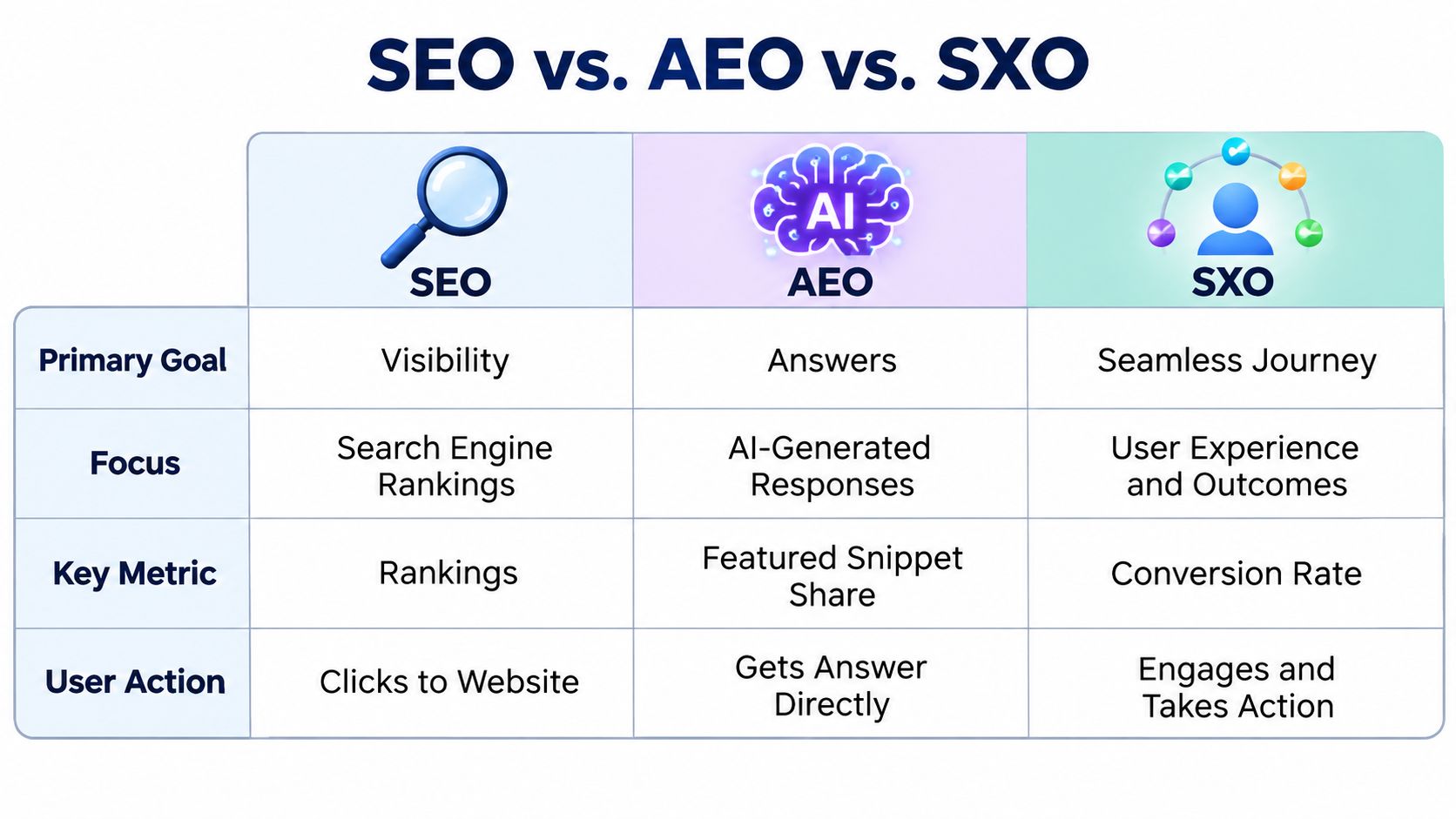
SEO, AEO, and SXO are related, but they solve different problems. SEO helps search engines find and rank pages. AEO helps answer engines understand content and choose what to cite. SXO focuses on what happens after the visitor arrives, whether that visit starts from a classic blue link, a featured answer, or another search surface.
That distinction matters because a page can perform well in one area and still underperform in another. A page may rank, yet fail to convert because the offer is unclear, the proof is weak, or the layout makes the next step feel like work. A page may be structured well enough for AEO, but if it does not persuade the click or it drops the visitor into a confusing experience, the business still loses the lead.
A practical way to separate the three
SEO is discoverability, AEO is extractability, and SXO is usability plus outcome. SEO gets the page found. AEO gets the content quoted or summarized. SXO gets the visitor to call, submit a form, or take the next commercial step.
Service businesses need all three, but they do not use them the same way on every page.
An emergency plumbing page should prioritize quick access, local proof, and a direct call path. A FAQ page can lean harder into AEO because it is built to be pulled into answer surfaces. A location page has to do both, since it must be readable by machines and convincing for people who are comparing nearby options. For law firms, website optimization for law firms has to account for the same tension between visibility and conversion, only the trust threshold is usually higher.
Why the integrated view matters
Search volume is one reason the integrated view matters. Google handles search at a scale that makes even small gains in inquiry rate meaningful for a service business. If more visitors move from result to contact, the business outcome changes fast, especially when qualified leads matter more than broad traffic growth.
Search experience optimization is the only one of the three that asks a business owner to care about the full chain. The page has to be found, understood, and persuasive enough to produce a conversation, a form fill, or a booked job. That is why page structure, proof, and friction removal usually matter more than rankings alone.
Why Service Businesses and Law Firms Benefit Most From SXO
Local service companies feel the SXO gap faster than most other businesses because the path to revenue is short. There is no cart to warm up and no long product catalog to browse, just a phone call, a form, or both. If the page does not create confidence quickly, the lead disappears.
The pressure is even higher in legal, roofing, HVAC, and similar categories because search intent is often immediate and comparative. One roundup from SEO Sherpa statistics roundup says about 46% of Google searches have local intent, and it also points to more than 5.9 million “near me” keywords generating around 800 million searches per month. For firms and contractors competing nearby, search is not just a visibility channel, it is the front door.
Zero-click search changed the math
Zero-click search pushed the problem further. Recent industry estimates place the share of Google searches that end without a click at roughly 58% to 60%, with one cited breakdown putting zero-click rates at 61.5% on desktop and 34.4% on mobile, and another 2025/2026 roundup reporting about 58.5% of U.S. Google searches result in zero clicks (SEO Sherpa statistics roundup, SearchAtlas statistics roundup). That means many search journeys finish on the results page, not on your site.
For a law firm, that is not a reason to give up on search. It is a reason to win the click when it happens and make the landing page worth the effort. For a roofer or HVAC company, it means the page has to work harder to capture intent that is already under pressure from maps, snippets, and answer surfaces.
If the visitor is comparing three providers in under a minute, your page needs to answer faster than your competitor's.
A practical example is a personal injury firm that gets decent visibility but weak intake. A homepage stuffed with generic service language will not move a caller. A page built around specific case types, trust signals, and a clear intake path can.
For firms that want a deeper look at that kind of structure, the search-to-intake conversation usually starts with website optimization for law firms.
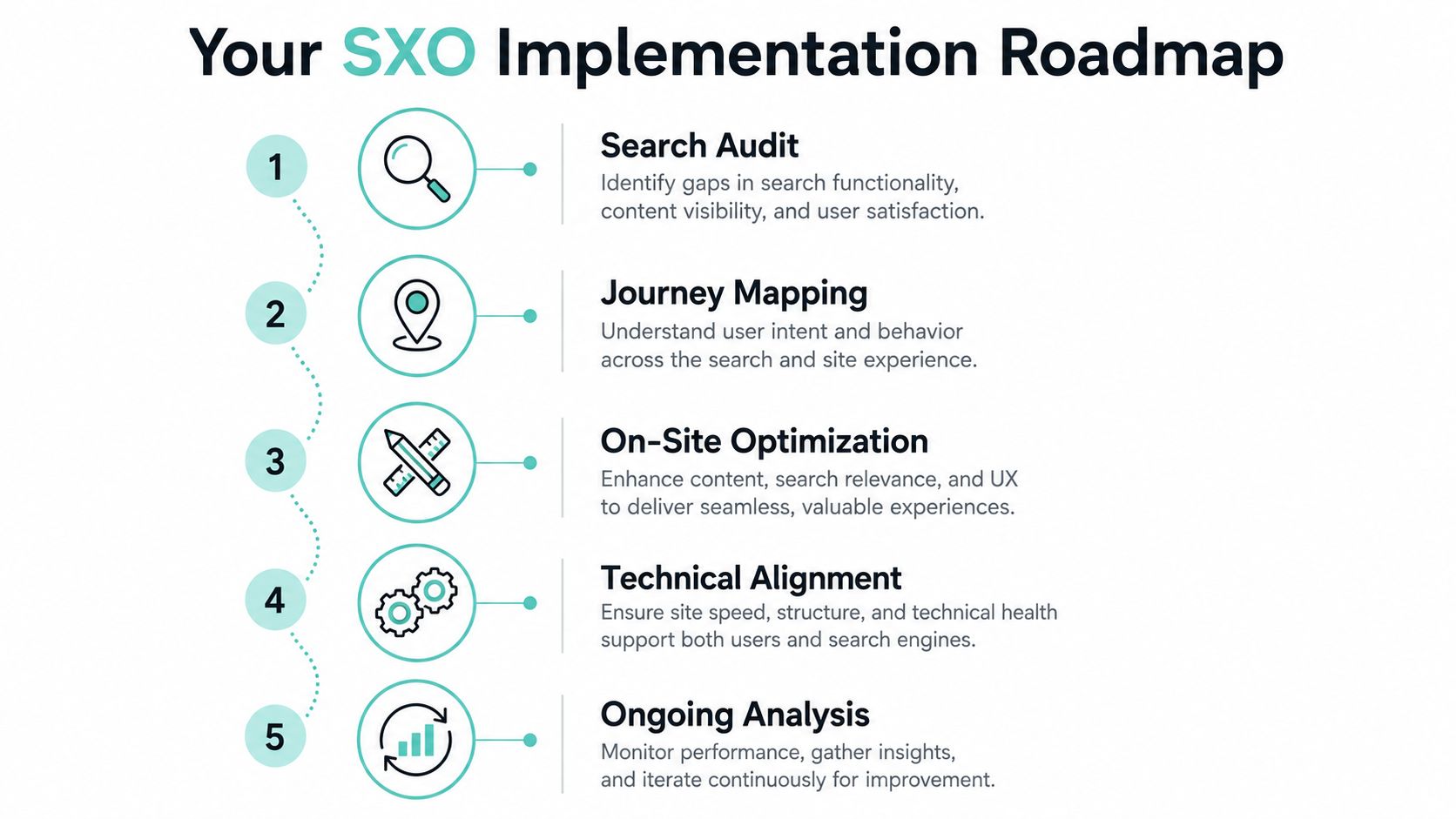
Building Your SXO Implementation Roadmap
A service page can look persuasive on paper and still lose the lead before anyone reads the first line. Slow load times, broken mobile layouts, and confusing crawl paths stop the experience before copy, offers, or calls to action have a chance to work. An SXO roadmap has to start there, because revenue depends on pages people can use.
Google's page experience framework centers on Core Web Vitals, mobile usability, HTTPS, and the absence of intrusive interstitials (Google page experience documentation). In practical terms, that puts speed, accessibility, and clean rendering ahead of cosmetic design choices. If the first interaction feels unstable, the page loses trust before the prospect gets to the pitch.
Start with technical alignment
Fix the bottlenecks that slow the page or make it frustrating on mobile. That usually means addressing TTFB, compressing images in modern formats, lazy-loading assets below the fold, and breaking up JavaScript long tasks over 50 ms. Those changes reduce abandonment risk and make the page feel responsive enough for a visitor to keep going.
Google's documentation on page experience also points to broader load and usability concerns that affect whether the page survives that first interaction. The same practical logic shows up in site audits every week. If a service page looks fine in a desktop mockup but drags on mobile, it will underperform no matter how strong the offer is.
A technical SEO survey also reported that 53% of users abandon sites taking more than 3 seconds to load, and that organizations often wait 1-24+ months to implement technical SEO changes. The lesson for service businesses is plain. Speed work produces real gains, but delay turns it into a recurring revenue leak.
That is also where tools and metrics for CRO become useful, because the team needs a way to prove whether technical fixes change behavior. Without measurement, a faster page can still fail if the layout, messaging, or form flow keeps people from acting.
Then map intent to page structure
Once the site can deliver the experience, align the content with the search intent that brought the visitor in. Service pages should answer the query quickly, location pages should make local relevance obvious, and supporting pages should remove doubt before the user reaches the form. If the page structure does not match how people search, the site keeps leaking leads at each step.
The testing discipline matters just as much as the build. Moz's SXO workflow recommends observing behavior, identifying friction, and testing one change at a time so the causal effect stays clear. That keeps teams from guessing whether the copy, layout, or CTA caused the shift.
Digital Skyrocket's process fits that same logic when a service business needs one team to handle website design, SEO, answer engine optimization, and conversion refinement together. The value is not in adding more noise. It comes from reducing handoffs that blur accountability, and from tying the work back to increase conversion rate on website outcomes that show up in real leads and booked calls.
The Conversion-Focused SXO Checklist for Service Businesses
A roadmap tells you the order. A checklist tells you what to verify on a live page right now. If a service page is underperforming, the fastest wins usually come from removing friction, not adding more content.
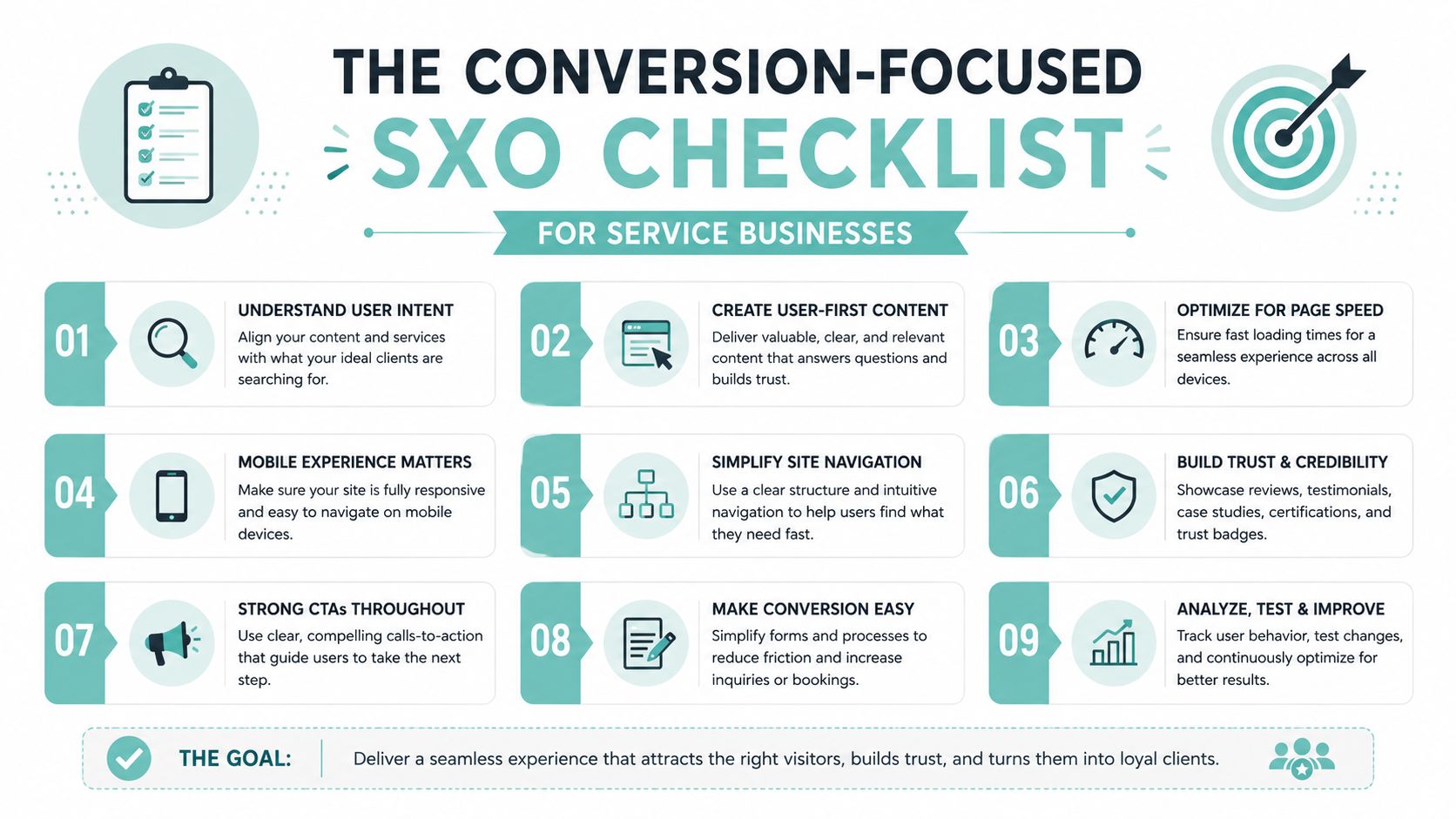
The page-level checks that matter most
- Confirm the load experience first. If the page feels slow or jumps around on mobile, fix that before anything else, because users won't stay long enough to notice the copy.
- Put the main CTA where eyes land naturally. Heat-map work usually shows that buried calls to action get ignored, even when the offer is strong.
- Make the contact path effortless. A form with too many fields creates hesitation, while a clear phone number or short form lowers friction.
- Match the headline to the search intent. If the query is local and urgent, the page shouldn't read like a generic company brochure.
- Use trust signals near the first action point. Reviews, credentials, and proof help users decide faster when the purchase is high-stakes.
- Check mobile layout before anything else. Service traffic is often mobile-first, and cramped spacing or tiny tap targets destroy conversions.
- Answer the questions buyers ask before calling. People want to know what you do, where you work, and why they should trust you.
- Add structured local signals where they belong. Location relevance should be clear in the content, not buried in the footer.
- Review the interaction data after launch. Session recordings and scroll maps show where visitors hesitate, click aimlessly, or give up.
For teams wanting a framework around the conversion side of that work, tools and metrics for CRO gives useful context for the measurement layer behind these changes. That matters because SXO is only useful if the business can tell whether a change improved inquiry quality, not just button clicks.
For a practical companion on the conversion side, increase conversion rate on website is the kind of resource that helps teams think about the page as an intake system instead of a brochure.
Optimizing for Local Search and AI Answer Engines
Search journeys aren't as linear as they used to be. A buyer might start with Google, skim an AI summary, open a map result, compare reviews, and come back later to call. SXO has to account for that non-linear path, because a page that only works as a blue link is already behind.
That's where local search and answer engines intersect. Google's AI Overviews and similar surfaces can surface parts of your content without sending the visitor to your page, which means the page has to be both extractable and persuasive. In other words, the content must be easy for machines to summarize and strong enough for people to still click when they want the deeper story.
Balancing extractable answers with lead generation
The practical fix is structure. Service pages, location pages, and FAQs need clear headings, direct answers, and enough supporting detail to earn trust once the user arrives. Don't hide the main answer behind fluffy intros or buried accordion text if the page needs to convert.
Local visibility still depends on fundamentals, too. Business profile consistency, review signals, and location relevance all shape whether the right searcher sees the right result. For a working reference on local setup, 2026 local SEO setup tips is useful because it keeps the focus on the profile and local discovery layer rather than generic advice.
For teams trying to adapt the content side, what is answer engine optimization helps frame why summaries, citations, and concise answers matter more now than they did a few years ago. The important trade-off is simple. If you make every page too summary-heavy, you may satisfy the machine and weaken the sales pitch. If you write only for humans with no structure, you may lose discoverability.
Practical rule: use concise answers at the top, then build persuasion underneath them.
That balance is what keeps local service sites useful in both worlds. The page can still be found, still be summarized, and still make the case for a call.
Real Results and Your Next Steps
The strongest SXO projects usually follow the same pattern. They start with a discovery assessment, identify pages that get attention but underperform on inquiry, and then rebuild the content and conversion path around the search intent that matters. The traffic often exists already, the site just isn't doing enough with it.
What changes most often is not the number of visitors. It's the quality of the page logic. Better hierarchy, cleaner proof, tighter calls to action, and technical cleanup make it easier for the right visitor to move from search to lead without friction. That's why SXO is so effective for service businesses, especially where the lead is a call, a form, or a booked consultation.
The companies that get the best outcomes usually treat the website as a working system, not a one-time design project. They also choose partners carefully. A good fit is usually a team that understands lead generation, documents outcomes, and builds with evidence instead of guesswork.
Digital Skyrocket works in that lane by combining web design, SEO, answer engine optimization, and conversion refinement for service companies that need qualified inquiries, not just traffic. If you're comparing options, ask any agency how they measure post-click behavior, how they handle local intent, and whether CRO is part of the build or an afterthought.
If your site is getting search visibility but not enough qualified leads, Digital Skyrocket can help you close the gap with website design, SEO, answer engine optimization, and conversion-focused refinements built for service businesses. Visit Digital Skyrocket to see how a search experience optimization approach can turn more of your existing traffic into calls and form submissions.