
You know the feeling. The team is good, patients who do come in stay loyal, and the office runs well enough. But there are too many gaps in the schedule, and when someone in your city searches for "dentist near me," your practice is nowhere obvious.
That disconnect is the core problem. Most dental practices don't struggle because they lack clinical skill. They struggle because the right patients never find them at the exact moment they're ready to book. Search visibility decides who gets considered first, who gets the call, and who gets left out.
SEO for dental practices isn't a side tactic anymore. It's the operating system behind local discovery, website trust, and increasingly, AI-generated answers. If your online presence is weak, every other strength in the practice has to work harder to make up for it.
Table of Contents
- Why SEO Is No Longer Optional for Dental Practices
- Mastering Local SEO Your Digital Front Door
- Building a Patient-Attracting Website
- A Content Strategy That Fills Your Appointment Book
- The Power of Schema for Dental Practices
- Building Local Authority and Trust with Link Building
- Measuring SEO Success and Optimizing for Growth
- Frequently Asked Questions About Dental SEO
Why SEO Is No Longer Optional for Dental Practices
A dentist can do everything right inside the operatory and still lose new patients outside it. I've seen practices with strong reviews, modern equipment, and good staff get outranked by offices with weaker patient experiences because those competitors show up first in search.
That's the hard truth. Visibility often wins the first round before quality ever gets a chance to compete.
97% of dental patients use online search to find local healthcare providers, which makes SEO a basic requirement for visibility and patient acquisition, not an optional marketing layer, as noted in this dental SEO guide on LinkedIn. If your practice doesn't appear where patients are already looking, referrals and word of mouth have to carry too much of the load.
That changes how a practice owner should think about marketing. SEO isn't just promotion. It's infrastructure. Your phone, front desk, online booking flow, and search presence all work together.
Practical rule: A beautiful practice that can't be found online has the same problem as a great office hidden on the wrong street.
The strongest practices treat search visibility like chair availability. If there are open appointment slots, they need a reliable path for qualified local patients to discover the office, compare options, and take action. That's why a broader dental practice marketing approach only works when search is built into the foundation.
What doesn't work is treating SEO like a one-time checklist. A few title tags, a homepage rewrite, and a handful of directory listings won't hold up in competitive markets. Dentistry is local, high-intent, and trust-sensitive. Patients aren't browsing for entertainment. They're searching because they need care, and they usually pick from the practices that look most visible, relevant, and credible at that moment.
Mastering Local SEO Your Digital Front Door
Local SEO is where most dental growth starts. Before a patient reads your about page or compares financing options, they usually see your Google Business Profile, your reviews, and the basic business details Google has collected about your practice.
That's your digital front door. If it looks incomplete, inconsistent, or neglected, many searchers won't even reach your website.
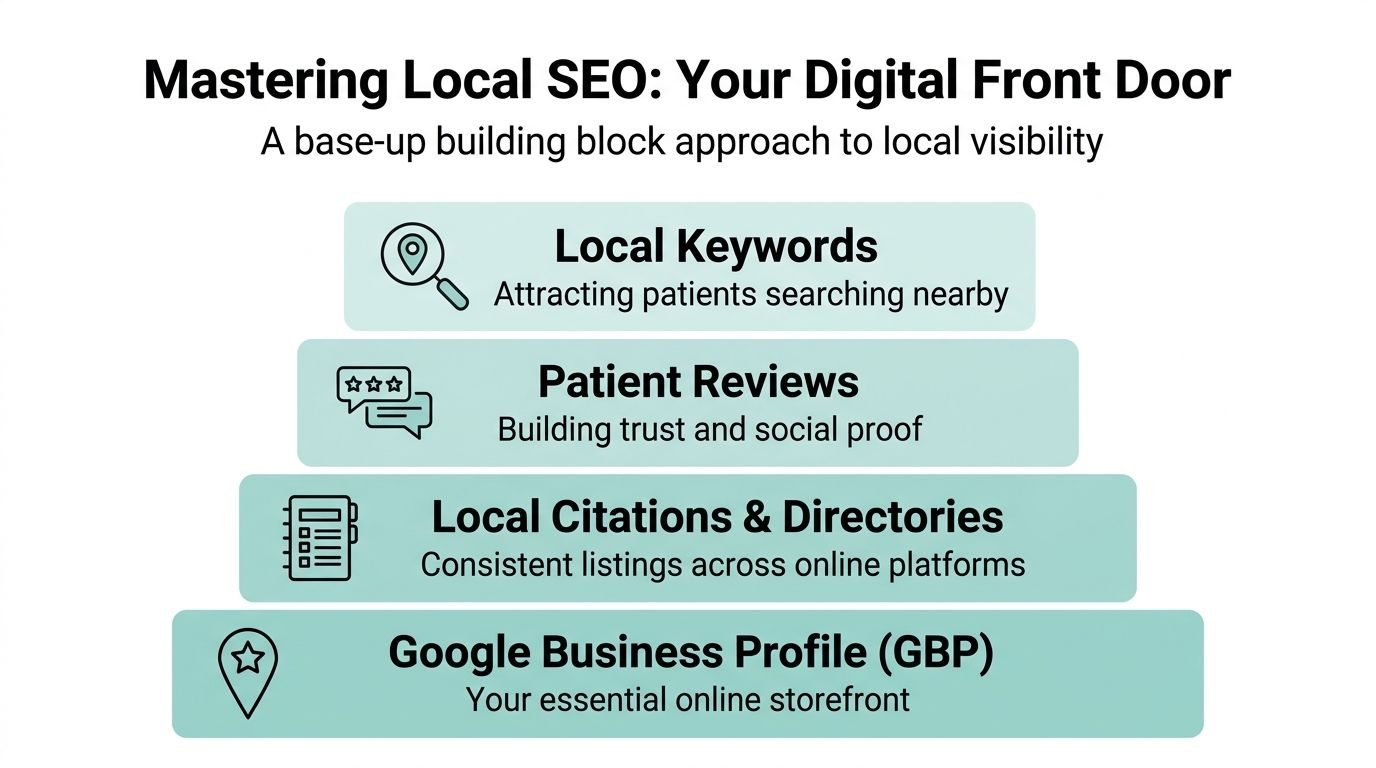
With 78% of local mobile searches resulting in offline visits to dental offices, local mobile visibility has a direct connection to appointments and in-person visits, according to these dental marketing statistics. That means local SEO isn't abstract. It influences whether someone physically walks into your office.
Your Google Business Profile does the first impression work
Most practices underuse Google Business Profile. They claim it, fill in the basics once, and move on. That leaves rankings and conversions on the table.
A stronger setup usually includes:
- Accurate core details: Practice name, address, phone number, hours, and website must match your site exactly.
- Real service coverage: Add services like dental implants, emergency dentistry, Invisalign, pediatric dentistry, or cosmetic dentistry instead of relying on a generic business description.
- Current photos: Upload exterior photos, reception, operatories, team images, and provider headshots. Patients want visual reassurance before they call.
- Q&A management: Seed common questions and answer them clearly. This helps both search visibility and patient confidence.
- Ongoing updates: Posts aren't the main ranking factor, but an active profile signals that the business is alive and responsive.
If you want a practical walkthrough, this guide on how to optimize Google Business Profile for local SEO is useful because it focuses on the details many offices skip.
Reviews and citations decide whether Google trusts you
Reviews are part ranking signal, part conversion asset. Patients use them to answer one simple question: "Can I trust this office?" Google uses them to evaluate relevance and credibility.
What works with reviews:
- Ask soon after the visit: Front desk follow-up by text or email usually gets better response than a generic reminder sent days later.
- Guide without scripting: Encourage patients to mention the service they received and what stood out, but don't hand them a fake template.
- Respond like a professional: Thank happy patients and handle criticism calmly. Defensive replies hurt more than a bad review.
Citations matter too. Your name, address, and phone number should be consistent on platforms like Yelp, Healthgrades, Bing Places, Facebook, and dental directories. Think of citations like matching entries in a patient chart. If one page says Suite 200 and another says Suite B, Google has to decide which record to trust.
A local SEO setup usually fails at the seams, not the center. The profile is fine, but the hours are old, the address varies, or the reviews have gone stale.
Local keywords sit on top of this foundation, not underneath it. Terms like "family dentist in [city]" or "emergency dentist near [neighborhood]" matter, but they work best when your local trust signals are already clean and complete.
Building a Patient-Attracting Website
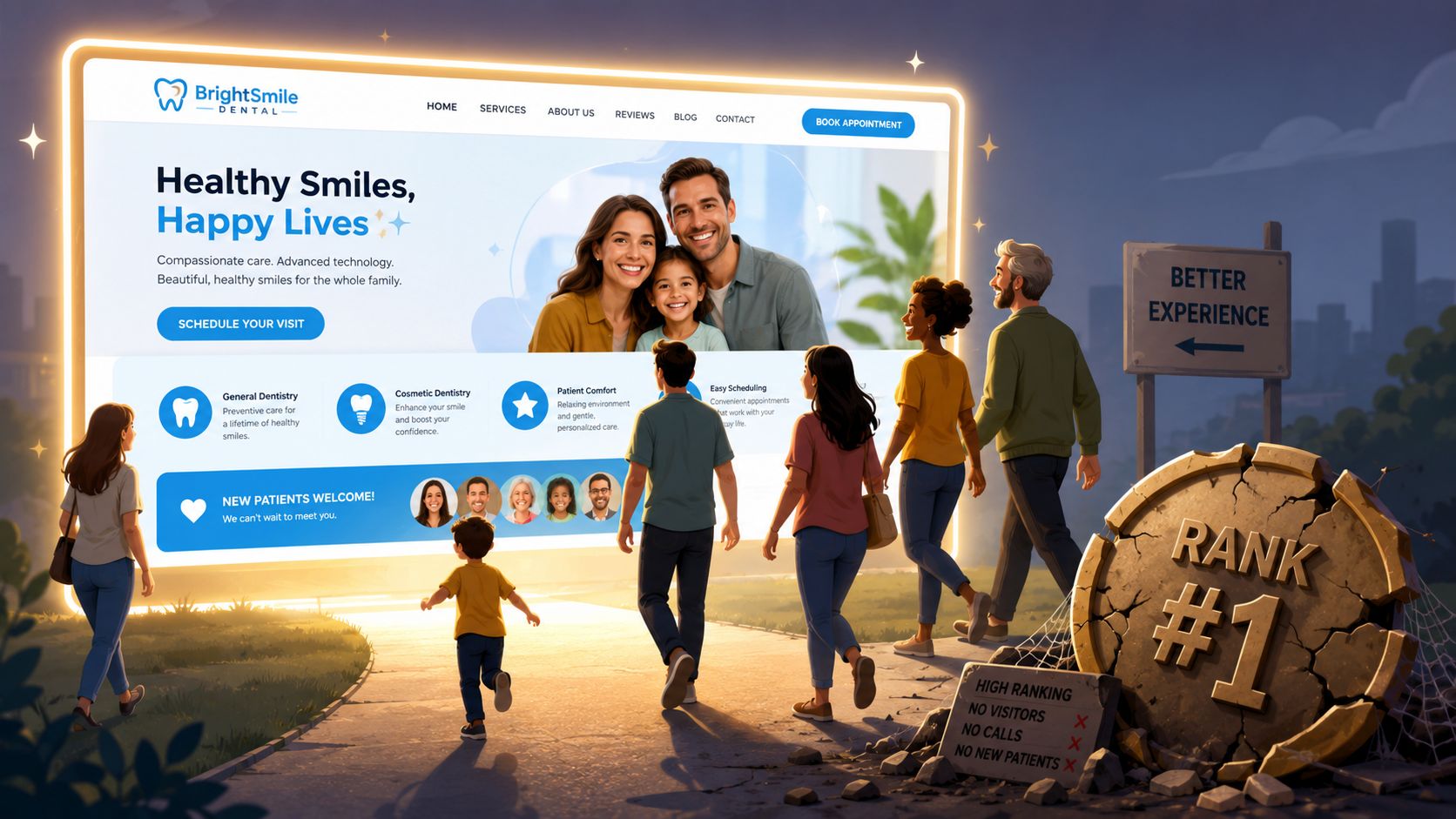
Your website is where local visibility either turns into a booked appointment or doesn't convert. Ranking is useful. But if a patient lands on a confusing service page, can't find your phone number, or waits for a slow mobile site to load, the visit won't produce much.
A dental website has two jobs. It has to make sense to Google and feel easy to trust for a real person who may be anxious, busy, or comparing multiple providers.
Service pages need to match real patient intent
A common mistake is dumping every treatment into one generic "Services" page. That weakens relevance and makes decision-making harder. Someone searching for Invisalign doesn't want to sift through dentures, cleanings, and root canals to find the basics.
Strong dental sites usually build individual pages for core treatments and write each one around patient intent. That means including:
| Page element | What it should do |
|---|---|
| Clear headline | Confirm the exact treatment and location |
| Procedure overview | Explain what it is in plain language |
| Candidacy details | Help patients self-identify whether it's right for them |
| Process expectations | Cover timeline, discomfort, recovery, and follow-up |
| Trust signals | Show dentist credentials, reviews, FAQs, and photos |
| Primary CTA | Make booking or calling obvious on every device |
Site structure matters too. A clean page hierarchy helps both usability and crawlability. If you're planning or rebuilding a site, a good sample sitemap for website planning process can prevent the messy navigation that hurts both rankings and conversions.
Technical SEO removes friction before patients feel it
For dental practices, technical performance isn't just a developer concern. It's part of search visibility. According to My Social Practice's guide to SEO for dentists, Google prioritizes sites loading under 1 second, and dental websites should implement structured data for Dentist, LocalBusiness, and Review types, which can increase click-through rates by up to 45%.
That's why I treat technical SEO like the plumbing in a building. Patients may never compliment it, but they'll notice fast when it breaks.
Key priorities include:
- Mobile-first design: Most dental search journeys begin on a phone.
- Fast page delivery: Compress oversized images, cut unnecessary scripts, and keep templates lean.
- Secure browsing: HTTPS isn't optional for patient trust.
- Clean internal linking: Related services, financing pages, FAQs, and contact pages should connect naturally.
- Schema implementation: This helps search engines understand what your practice offers and how to display it.
A good website also supports the larger patient journey. This piece on how Simbie AI discusses healthcare patient flow is worth reading because it frames the website as part of the digital front door, not a standalone brochure.
If a patient has to hunt for the phone number, wonder whether you offer their treatment, or pinch-zoom through your forms, the site is working against you.
A Content Strategy That Fills Your Appointment Book
Many dental blogs fail for one simple reason. They answer whatever is easy to publish instead of what patients search before they choose a provider.
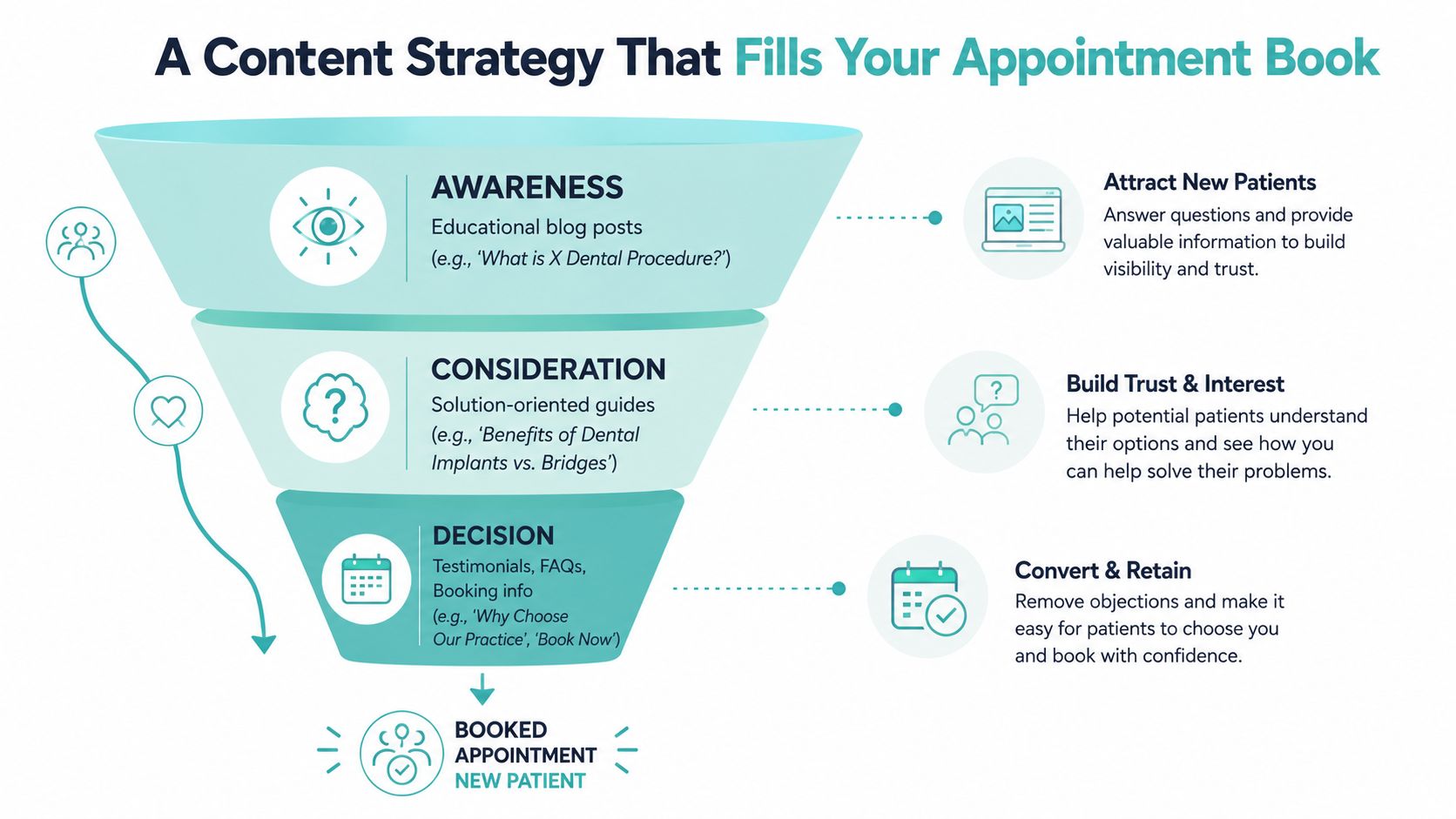
The content that drives new appointments usually sits in three layers. One layer educates broad audiences. Another helps patients compare options. The last removes the final hesitation before contact. When those layers work together, your website becomes less like an online pamphlet and more like a patient acquisition system.
Build content around patient decision stages
A practical content mix looks more like this:
- Early-stage education: Articles answering questions such as what veneers are, what causes tooth pain, or whether a cracked tooth is an emergency.
- Mid-stage comparison content: Pages comparing implants vs bridges, clear aligners vs braces, or emergency dentist vs urgent care for dental trauma.
- Decision-stage assets: FAQs, insurance information, financing details, before-and-after examples, provider bios, and clear booking steps.
Long-tail search proves valuable. Broad terms are competitive and often vague. More specific searches usually show clearer intent. A useful primer on long-tail SEO explains why those narrower phrases often lead to better-qualified traffic.
A smart dental content plan also stays close to treatment pages. Blog content shouldn't float disconnected from the services that generate revenue. If you write "How long do dental implants last?" that article should link clearly to your implant page, financing details, and consultation booking path.
AEO changes how dental content should be written
Answer Engine Optimization changes the format, not just the topic. According to MB2 Dental's write-up on SEO tips for dental practices, most dental SEO content fails to prepare for answer engine optimization (AEO), even though AI-generated search results prioritize concise, FAQ-style content with structured data.
That means long, wandering blog posts aren't enough anymore. AI systems tend to favor pages that answer direct questions cleanly and support those answers with clear structure.
A better format often includes:
- A direct answer near the top instead of burying it after several paragraphs.
- Short FAQ blocks with natural-language questions.
- Procedure-specific explanations written for patients, not dental peers.
- Supporting schema markup so search engines can classify the page correctly.
- Local context that ties the information to the practice's service area.
For practices thinking more broadly about online visibility, these digital strategies for healthcare are useful background because they show how patient education and trust-building now extend across multiple digital touchpoints.
The main trade-off is simple. Generic content is easier to produce at scale. Specific, structured, patient-focused content is harder. But the second type is what tends to rank, earn trust, and appear in emerging AI search experiences.
The Power of Schema for Dental Practices
Schema sounds technical because it is technical. But the concept is simple. Schema markup is code that tells search engines what a page means, not just what words appear on it.
Schema functions as a translator standing between your website and Google. Without that translator, Google has to infer whether a page is about a dentist, a location, a review, a FAQ, or a service. With schema, you label those things directly.
Think of schema as a translator for Google
A normal page might mention office hours, accepted insurance, patient reviews, and a treatment like Invisalign. A human reader can piece that together easily. Search engines benefit when you spell it out in structured form.
That's why schema often improves visibility far beyond what the patient sees on the page itself. It can help search engines connect your content to rich results, local listings, and answer-oriented search features.
Schema doesn't make weak content strong. It makes strong content easier for search engines to interpret.
This matters even more for dental practices because patient decisions often hinge on very specific questions. Do you offer emergency treatment? Are you local? Do you accept a certain insurance plan? Do you have reviews? Schema helps put those answers into a machine-readable format.
The schema types dental practices should prioritize
For most practices, four schema types deserve immediate attention:
- Dentist schema: Identifies the practice as a dental provider rather than a generic local business.
- LocalBusiness schema: Reinforces address, contact details, hours, and geographic relevance.
- FAQ schema: Supports clear question-and-answer sections, which aligns well with answer engine visibility.
- Review schema: Helps communicate reputation signals when implemented correctly.
The biggest mistake isn't usually bad schema. It's missing schema. Many dental sites rely on visual design and copy alone, which leaves important context unspoken to search engines.
The second mistake is sloppy implementation. If your schema says one thing and your visible content says another, trust breaks down. Schema should reflect what is present on the page and what is factual about the practice.
For SEO for dental practices, schema is one of the rare technical tasks that affects local relevance, click behavior, and AEO readiness at the same time. That's why it punches above its weight.
Building Local Authority and Trust with Link Building
At some point, on-site work stops being enough. You can clean up your pages, improve your profile, publish strong content, and still hit a ceiling because competitors have more local authority.
That's where link building matters. Good links act like third-party validation. Not random backlinks from junk websites. Real mentions from credible local organizations, community groups, news outlets, healthcare resources, and business associations.
Local links beat random links
A dental practice doesn't need a mountain of irrelevant links. It needs believable local authority.
The best opportunities usually come from things the practice is already doing or could do without much strain:
- Community sponsorships: School events, youth sports, local nonprofits, and charity drives.
- Professional partnerships: Orthodontists, oral surgeons, pediatricians, pharmacies, and wellness businesses.
- Local media angles: Oral health awareness months, community service, scholarship announcements, or dentist commentary on common dental concerns.
- Membership listings: Chambers of commerce, dental associations, and local business groups.
A link from a neighborhood publication that patients in your city read is often more useful than a backlink from a generic site with no local relevance. Google is trying to determine whether your practice is trusted in the market you serve.
Use ranking gaps to guide outreach
One issue many dentists never diagnose is uneven local visibility. A practice can rank well in one part of a city and disappear in another. According to Group Dentistry Now's article on local SEO for dentists, many practices lose visibility in specific neighborhoods despite solid overall performance, which is why Google heat maps help reveal these ranking gaps and identify areas where a listing drops to page 2 (positions 4+).
That changes link building strategy. If heat maps show weakness in a particular neighborhood, outreach should become more local to that area.
For example:
| Weak area | Better outreach target |
|---|---|
| North side neighborhood | Local school sponsorship, neighborhood blog, chamber listing |
| High-income cosmetic market | Lifestyle publication, wedding vendor network, beauty or wellness partnerships |
| Family-heavy suburb | Parenting newsletter, youth sports sponsor page, pediatric referral partners |
The best local links don't look like SEO tactics. They look like a real practice participating in its real community.
That's the point. Real-world authority creates digital authority.
Measuring SEO Success and Optimizing for Growth
A lot of dental SEO reporting is noisy. It highlights impressions, generic traffic spikes, or a grab bag of keywords with no connection to actual patient acquisition. Practice owners need a cleaner view than that.
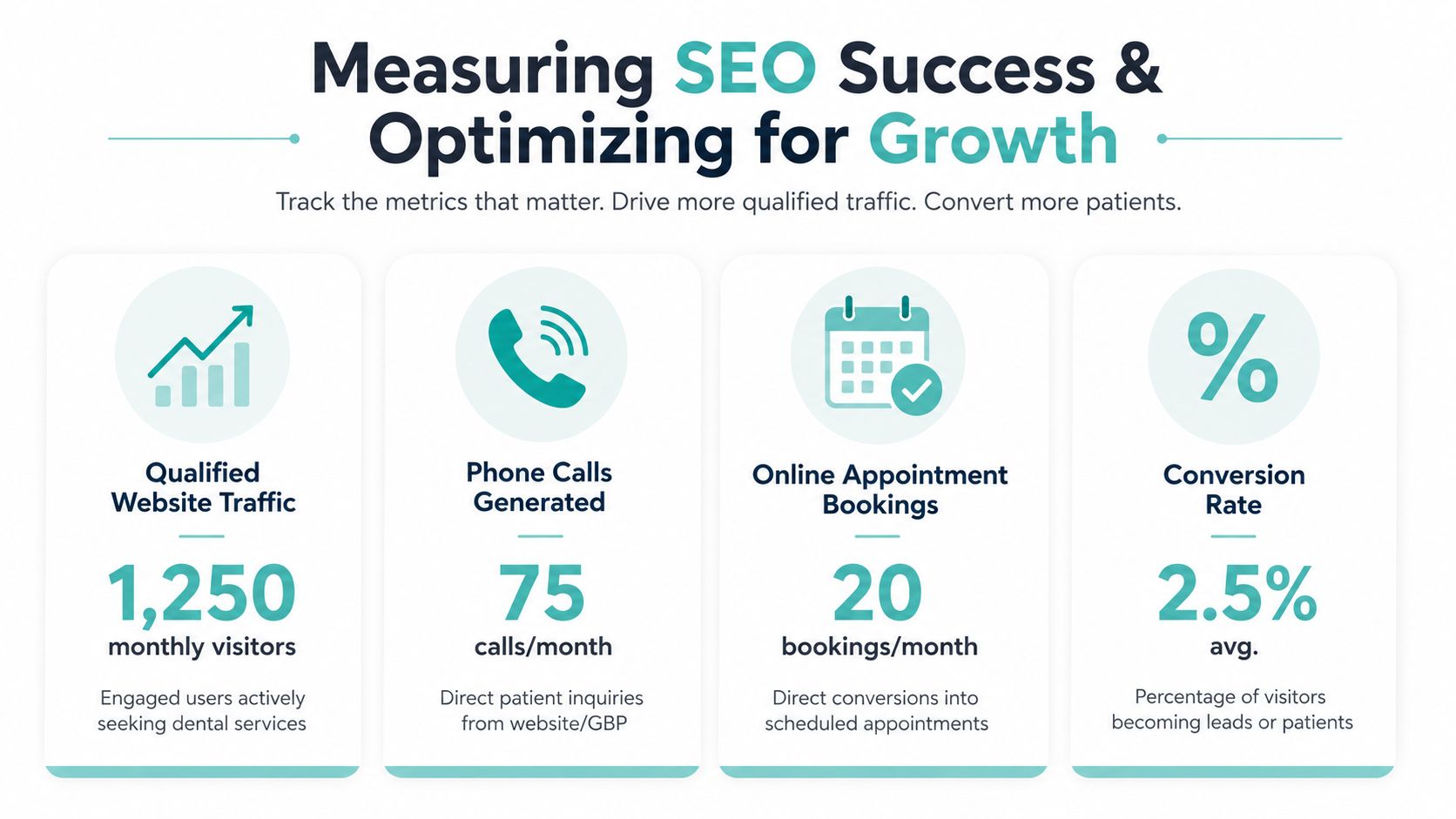
The most useful scorecard is simple. Track whether you're becoming more visible for the right searches, attracting more organic visitors, and generating more new patients from that traffic.
Track the metrics that connect to revenue
According to Identity Dental's guide to tracking SEO performance, the three primary metrics dental practices should track are Google rankings, organic website traffic, and the influx of new patients, because those connect search visibility directly to revenue.
That framework holds up in real practice.
- Google rankings: Track core service and local terms that matter to the business, not vanity phrases that sound impressive in a report.
- Organic traffic: Watch whether service pages, location pages, and FAQ pages are attracting qualified visits from search.
- New patient volume: Measure calls, forms, online bookings, and front-desk-confirmed new patient sources.
Good measurement also depends on setup. Google Analytics, Google Search Console, call tracking, form tracking, and appointment attribution should all feed into one clear reporting process. If the front desk marks every caller as "Google" without more detail, reporting will stay blurry.
Use benchmarks carefully and improve continuously
SEO isn't finished when rankings improve. That's when conversion work becomes more important.
If traffic rises but contact rates stay flat, the issue usually sits on the page. Maybe the CTA is weak. Maybe the service page answers clinical questions but skips practical ones such as cost expectations, scheduling, sedation options, or insurance. Maybe the mobile experience still feels clumsy.
The ADA notes that a successful dental practice should aim for 10% to 15% annual new patient growth as a benchmark for organic acquisition success in measurement, according to this ADA resource on measuring practice success. That benchmark is useful as a directional reference, but each market has different competition, specialty mix, and starting visibility.
What matters most is disciplined iteration:
- Review rankings and patient-source data monthly
- Identify weak pages and weak neighborhoods
- Improve copy, layout, internal links, and CTAs
- Keep testing what turns visitors into booked appointments
SEO for dental practices works best when it's treated like clinical improvement. Diagnose, implement, measure, refine.
Frequently Asked Questions About Dental SEO
How long does dental SEO take to show results
It depends on your market, your website quality, and how weak or strong your starting point is. Local improvements such as Google Business Profile cleanup and review generation can move faster than authority-building and content growth. Competitive service lines usually take longer than branded terms.
Can a dental practice do SEO in-house
A practice can handle pieces of it in-house, especially review requests, photo updates, FAQ collection, and local community outreach. The harder parts are technical SEO, schema, page architecture, content strategy, and ongoing measurement. Most offices don't have spare time for those tasks, and partial execution often creates uneven results.
What's the biggest mistake dentists make with SEO
Trying to rank one generic homepage for everything. Dental SEO works better when each major service has its own page, local signals are consistent, and the questions patients ask before booking.
Should dentists care about AEO now or wait
Start now. AI-generated search experiences already reward clear answers, structured FAQs, and schema-supported content. Practices that delay usually end up retrofitting weak content later.
How should a practice budget for SEO
Budget based on the work required, not on the cheapest monthly retainer. If the website is outdated, the local foundation is messy, and service pages are thin, the need is larger than "monthly SEO." In most cases, practices get better results when they treat the website, local SEO, AEO, and conversion work as one system.
If your practice needs a stronger website and a serious search strategy, Digital Skyrocket builds lead-focused websites and handles ongoing SEO, local SEO, AEO, and CRO for service businesses that want more qualified inquiries from Google. They don't offer general marketing packages. They focus on the work that turns search visibility into real leads.