It's Saturday morning, and a homeowner has water dripping through the ceiling. Your roofing crew could handle the job, but the homeowner's phone shows another contractor with clear availability, recent project photos, and a working call button. Meanwhile, you're looking at a website report that shows more visitors without explaining why the estimate calendar hasn't filled.
That's the gap SEO for home improvement needs to close. Before pushing a page higher in search, make sure it identifies the problem you solve, confirms where you work, and gives the right homeowner a practical next step.
Table of Contents
- Why Homeowners Still Start on Google
- Map Each Homeowner Search to One Page
- Build Keyword Lists From Real Calls and Jobs
- Local Listings and Business Data That Match
- Service Pages That Answer and Verify
- Speed and Stability on the Quote Page
- Emergency Demand and the Leads Worth Counting
- Choose the Next Quarter of SEO Work
Why Homeowners Still Start on Google
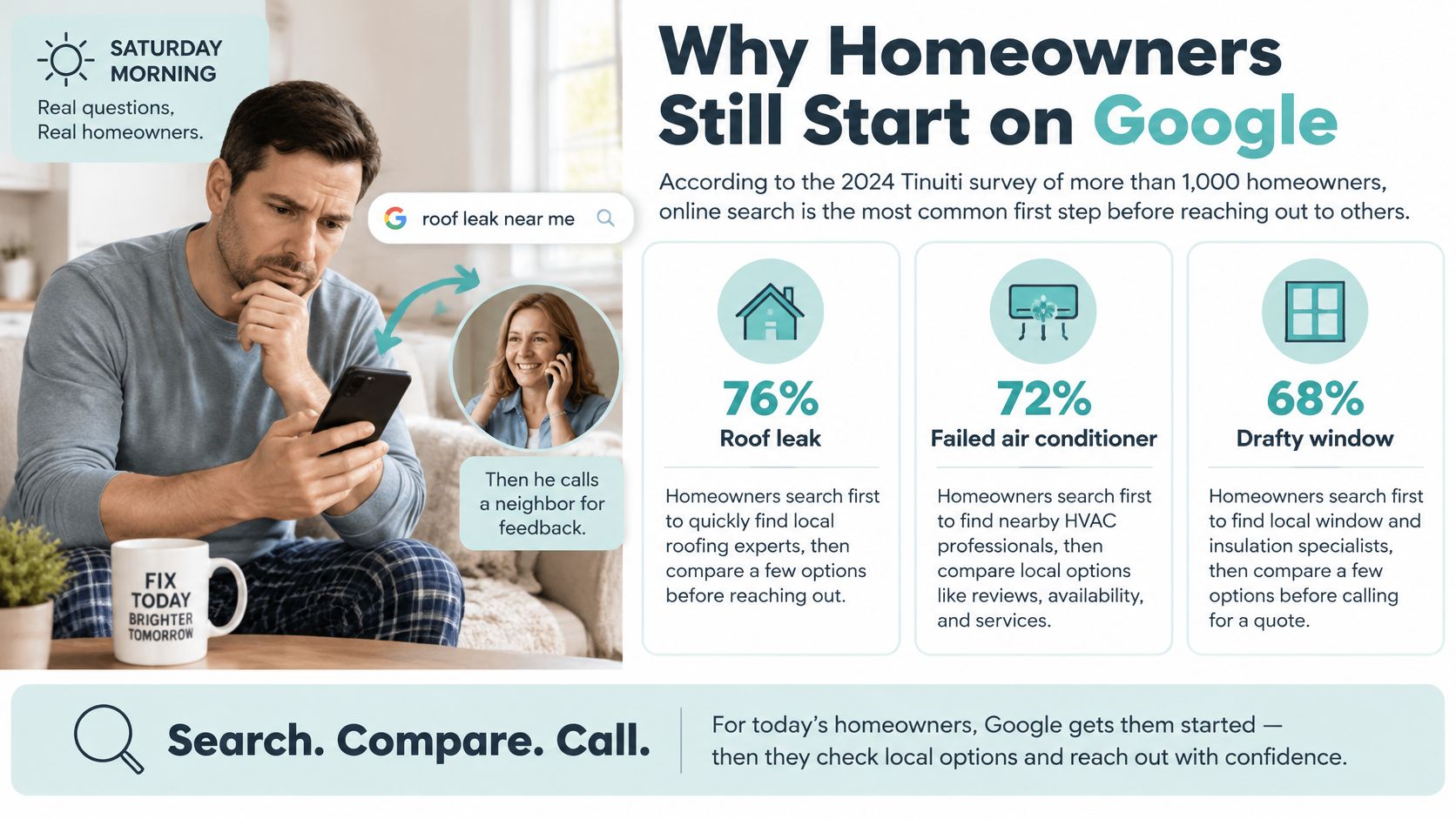
The homeowner with the leak picks up a phone before calling a neighbor. Someone else is standing beside an air conditioner blowing warm air, while another homeowner is trying to decide whether a drafty window needs repair or replacement. Each starts with a problem, not a contractor's brand name.
In its 2024 home-services marketing study, Tinuiti surveyed more than 1,000 homeowners and found that 86% of surveyed U.S. homeowners began searching online when actively looking for a home-services company, while 61% started with a traditional search engine such as Google or Bing.
Make the business visible where the job begins
For a small or mid-sized roofing, HVAC, window, plumbing, gutter, or remodeling company, SEO means making one real service in one real area easy to find and inquire about. It's not adding city names to headings. The homeowner needs to recognize that your company handles this problem and can serve the property.
Think of an excellent crew working out of an unmarked truck on a side street. The workmanship might be exceptional, but nobody passing by can identify the business, understand the service, or find the phone number.
A vague website creates the same problem online. A headline about quality craftsmanship won't help someone distinguish emergency roof repair from a planned kitchen renovation.
Practical rule: A homeowner should understand what you do, where you do it, and how to contact you without decoding your navigation.
Build around the next decision
The owner wants booked work. The marketing director needs to know which pages contribute to it. Both need a website that distinguishes an immediate service request from a homeowner gathering estimates.
Start by checking whether the page answers these questions:
- Service fit: Does the company handle this specific repair or installation?
- Geographic fit: Is the property inside the actual service area?
- Next step: Should the homeowner call, send photos, request an inspection, or book a visit?
A pile of generic remodeling posts won't resolve those questions. Neither will a one-time website launch followed by months of unchanged service information. Useful SEO starts with the page a homeowner should reach for the job they need done.
Map Each Homeowner Search to One Page
Home-improvement search intents and the page that should rank
| Search intent | Example query | Page to build | Conversion path |
|---|---|---|---|
| Emergency repair | emergency roof leak repair near me | Dedicated emergency page with hours, response time, and service limits | Click-to-call or text |
| Major replacement | roof replacement cost in [city] | Service page with cost factors, process, and project proof | Estimate form that asks for address and project scope |
| Recurring maintenance | HVAC tune-up in [city] | Maintenance service page with what is included | Request a visit or book a time |
| Energy or resilience | energy efficient window installation | Specialty service page tied to savings, comfort, and eligibility factors | Quote request |
| Storm or insurance | storm damage roofing help | Storm page covering documentation, timing, and what the crew does | Call with a notes field for the claim |
| Provider comparison | best gutter company in [city] | Service or location page with credentials, photos, and reviews | Call or short form |
The spending context supports starting with concrete services: Harvard's Joint Center for Housing Studies reported improvement and repair spending rising from $404 billion in 2019 to $611 billion in 2022, replacement projects accounting for 49% of improvement expenditures in 2023, and average homeowner spending of about $4,700 on improvements and roughly $1,200 on maintenance in 2023.
Separate the job from the topic
An emergency page needs operational information before educational detail. State when someone answers, whether after-hours work is available, and where crews can travel. Don't advertise immediate response if the office only takes messages until the next business day.
A roof-replacement visitor needs a different experience. Explain what the estimate includes and what the inspection must establish before pricing is credible. The form should collect enough scope to route the inquiry without asking the homeowner to complete a roofing specification.
Maintenance pages should make the visit tangible. List the inspection and service tasks your technicians perform, identify exclusions, and explain how scheduling works.
For energy-efficient windows, distinguish product characteristics from guaranteed savings. Explain comfort goals and eligibility factors without implying every homeowner qualifies for an incentive.
Give uncertain homeowners a useful route
Storm-related visitors may not know whether they need temporary protection, permanent repairs, or documentation. Explain what your crew can inspect and record, and leave coverage decisions to the insurer. A claim-notes field can capture context without making insurance status a condition of contacting you.
Someone comparing gutter companies needs evidence rather than another paragraph claiming superior service. Show relevant installations, explain material options, and make credentials easy to inspect.
A single Remodeling page can't adequately answer both a late-night leak and a kitchen project planned months ahead. Combining every service also makes internal reporting less useful because different jobs arrive through the same landing page.
Use one primary service and one primary area per URL, without manufacturing a page for every possible wording. Related searches can share a page when the homeowner needs the same service and next step. Match the phone, text, booking tool, or estimate form to that intent.
Build Keyword Lists From Real Calls and Jobs
Your best starting material is already inside the company. Search Console shows how people find the site, while dispatch notes explain what they need. A keyword tool can expand that evidence, but it shouldn't replace it.
Collect the homeowner's language
Start with a working spreadsheet rather than a large automated export. Give each potential cluster a service, location, intent, owner page, and business priority.
- Export Search Console queries. Filter by existing service and location pages. Flag relevant searches with impressions but few clicks, then inspect whether the page's title and content match the query.
- Review recent inquiries. Pull the last 90 days of call notes and form submissions as a practical working sample. Preserve phrases such as my ceiling is dripping or the AC blows warm instead of immediately translating everything into trade terminology.
- Read public wording. Google Business Profile questions and customer reviews reveal how homeowners describe the problem, the finished work, and their concerns about hiring.
- Group by job and city. Storm roof repair in Tyler and HVAC replacement in Longview belong in different clusters because they require different expertise, evidence, and inquiry handling.
Assign each cluster an intent: emergency, replacement, maintenance, energy, storm, or comparison. Our guide to keyword research for local SEO provides a useful process for organizing local terms without turning the exercise into a list of disconnected phrases.
Prioritize what the company can deliver
Search volume doesn't establish commercial value. A lower-volume service that fits your crew, territory, and project economics may deserve attention before a broad remodeling term.
Use these filters before approving content:
- Operational fit: Remove towns where you have neither practical coverage nor project evidence.
- Commercial connection: Keep informational questions as supporting articles when they have a useful path to a real service.
- Page ownership: Assign each cluster to a single primary URL rather than commissioning overlapping pages.
- Capacity: Favor work the business can responsibly accept, not services the owner hopes to offer someday.
When existing URLs compete for the same cluster, inspect their content and links before writing more. Merge redundant pages, redirect retired URLs to the best matching destination, and update internal links.
The deliverable is a short, ranked list the owner can approve. Review it monthly against completed jobs and qualified inquiries, not just changes in keyword position.
Local Listings and Business Data That Match
Your Google Business Profile and website should describe the same business. If the profile lists different hours, an old phone number, or a location the website doesn't explain, the homeowner has to resolve the contradiction.
Google's business-details documentation explains the roles of a claimed Business Profile and structured data: the profile manages business information in Search and Maps, while markup gives search systems explicit clues about the page and business.
Establish the business record first
Set the primary profile category to the best available match for the company's main work. Add genuine secondary services, then compare that service list with the website navigation.
Maintain a reference record for the business name, eligible address information, telephone, opening hours, service area, and website URL. Use it when updating directories so employees and vendors don't improvise different versions.
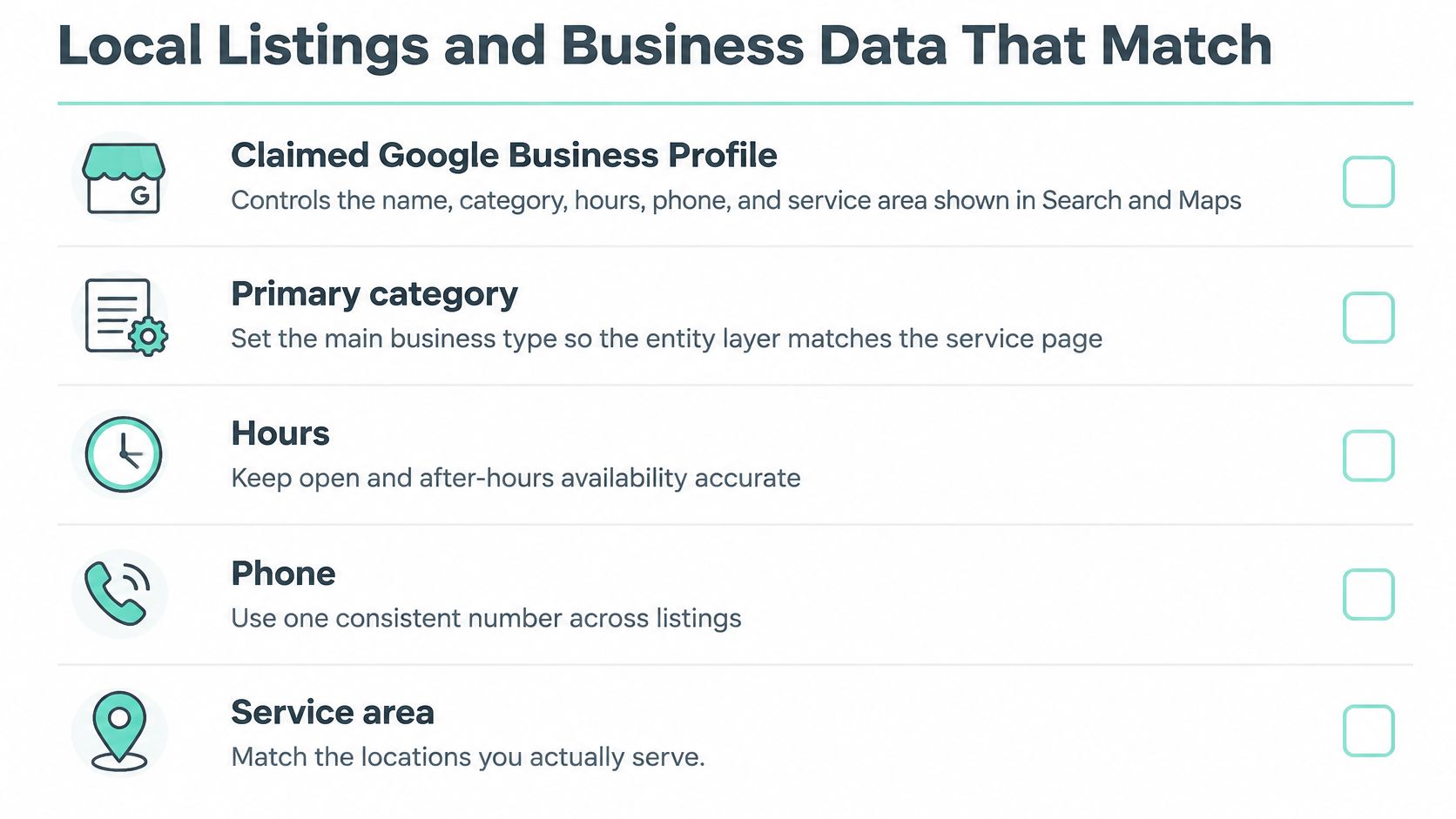
Add real job photos and keep holiday hours accurate. Separate the hours someone answers the phone from the hours crews perform work, especially if an answering service handles overnight calls.
Our NAP consistency guide explains how to audit name, address, and phone information across listings. If you use call tracking, document the relationship between tracking numbers and the permanent business number rather than letting vendors replace numbers independently.
Connect the record to crawlable pages
Add LocalBusiness structured data using the most specific applicable subtype, such as RoofingContractor or HVACBusiness. Keep the markup consistent with visible page content and don't add an address, credential, or service the business can't substantiate.
Use this deployment checklist:
- Match the entity: Connect the business name, contact details, hours, service area, and URL to the correct location.
- Test the markup: Run the Rich Results Test and correct applicable errors before deployment.
- Inspect the URL: Use Search Console's URL Inspection tool to check access and indexing.
- Connect the pages: Link core services to relevant location pages and include canonical, indexable URLs in the XML sitemap.
Dedicated pages make sense for legitimate staffed locations. Service-area pages can describe places you work, but they must not imply an office exists where it doesn't.
Google needs accessible pages to process this information. Check for blocking robots.txt rules, noindex directives, and login restrictions; Google also notes that recrawling and reindexing can take several days. Markup doesn't promise review stars, enhanced results, or a map-pack position.
Fix the mismatched suite number or unexplained tracking-number conflict before commissioning another blog post. A coherent business record gives both homeowners and search systems less ambiguity to resolve.
Service Pages That Answer and Verify
A service page needs to work for someone who's still learning and someone checking whether you're worth calling. Those visitors may read the same answer but need different amounts of supporting evidence.
In Modernize's 2024 research involving more than 150,000 U.S. homeowners, 53% of surveyed homeowners spent between 1 and 5 hours researching before beginning a project, and 30% planned at least 10 additional hours of research before selecting a contractor.
Build the roof-replacement page around an answer
Open with a direct response to a practical question. For a question about urgency, explain that active water entry warrants prompt professional assessment and that replacement versus repair requires an inspection. Don't diagnose structural safety or promise that every leak needs a new roof.
Follow that answer with the evidence needed to evaluate your service:
- Who it's for: Describe the roof systems and property types your company handles.
- Included work: Explain tear-off, protection, installation, ventilation assessment, cleanup, and disposal where those tasks are part of your scope.
- Price factors: Discuss pitch, existing layers, decking condition, material selection, access, and disposal rather than publishing an invented universal price.
- Scheduling: Explain inspection, material ordering, weather dependencies, and how the homeowner receives a project schedule.
- Credentials: Identify applicable licensing and insurance accurately, without implying requirements are identical across states.
- Warranty terms: Separate manufacturer coverage from your workmanship warranty and make exclusions accessible.
Use project photos with captions that identify meaningful details: an asphalt-shingle replacement with damaged decking, for example, or a metal installation with complex flashing. Obtain permission before publishing customer-identifying information.
Before-and-after resources such as Jennifer Gilmer Kitchen & Bath transformations can help a remodeling team plan how to explain visible changes. Your own project documentation should go further than attractive photographs by stating what changed, why it changed, and what work the customer purchased.
Change the evidence when the service changes
An HVAC replacement page should explain how the contractor determines equipment sizing, evaluates ductwork, and presents efficiency options. Don't reduce the decision to buying a larger unit or choosing the highest efficiency label.
Explain what an estimate should identify: equipment, installation scope, controls, relevant electrical or duct modifications, disposal, and warranty conditions. Discuss operating cost as a household-specific consideration, not a guaranteed saving.
The same principle applies to forms. An installation inquiry can ask about the current system and the homeowner's goals, while an urgent repair form should avoid questions that delay contact.
Keep the business name visible throughout the experience. A homeowner shouldn't reach the final form before learning who will receive the inquiry.
Make local claims confirmable
A location page needs more than a swapped city name. Include relevant project evidence, honest driving or scheduling context, and service limitations that help someone in that area make a decision.
If you don't have enough distinct information to support a city page, strengthen the broader service-area page instead. A long list of near-identical pages gives visitors more claims to verify without giving them better information.
Link each service to relevant locations and a deeper answer where it helps. A roof-replacement page might link to an explanation of decking repairs, while a window page might explain installation methods.
Treat answer engines as discovery, not the whole journey
The consumer survey summarized by PPC Land found that 78.7% of surveyed consumers primarily used traditional search engines for local-business discovery, compared with 2.0% using AI assistants, while reviews and ratings were most valued at 33.6%, ahead of contact details and hours at 29.5%.
That supports a practical distinction: an answer engine may introduce your company, but the homeowner still needs to verify the recommendation. Concise answers help explain the service; visible credentials, project evidence, business details, and accessible reviews help substantiate it.
If an assistant quoted this paragraph, could the homeowner confirm the claim on your website and in Google without calling first?
Use that test before publishing. Unsupported prices, vague qualifications, hidden identities, and unverifiable location claims fail it, regardless of how neatly the answer is formatted.
Speed and Stability on the Quote Page
Google's Core Web Vitals guidance sets “Good” thresholds of Largest Contentful Paint at or below 2.5 seconds, Interaction to Next Paint below 200 milliseconds, and Cumulative Layout Shift below 0.1, assessed using real-user field data at the 75th percentile; Search Console determines a URL group's status from its slowest metric.
A passing desktop lab score isn't the objective. The service page needs to load, respond, and stay still on the phone a homeowner is using.
Connect each metric to an action
Say a homeowner opens your storm-repair page and taps the call button. A review badge loads above it at that moment, moving the button and sending the tap somewhere else.
That's a layout problem with a direct operational consequence. The visitor was ready to call, but the page interrupted the action.
| Page behavior | Likely issue | First place to investigate |
|---|---|---|
| Main content appears slowly | LCP | Hero image, render-blocking CSS, server response |
| Form or menu responds late | INP | Heavy JavaScript, chat tools, sliders, tracking scripts |
| Phone number or button moves | CLS | Unsized images, late fonts, injected widgets |
Don't remove useful features blindly. Identify whether the scheduling widget, gallery, or chat tool helps qualified visitors complete the task, then weigh that benefit against its performance cost.
Fix the shared template in order
Start with responsive WebP or AVIF images, sized for their display area and supplied with explicit width and height. Don't lazy-load the main image if it's the element visitors need immediately.
Then address the code and delivery:
- Prioritize visible content: Deliver critical CSS without forcing the browser to process unnecessary styling first.
- Defer optional scripts: Delay nonessential JavaScript and remove duplicate tags.
- Reserve embed space: Give review, scheduling, and other third-party components a stable container.
- Improve delivery: Configure server or CDN caching and investigate slow hosting responses.
Our guide on how to improve site speed can help organize that work. Test the primary roof, HVAC, or emergency template before spending time polishing a low-traffic article.
The quote workflow needs the same scrutiny. A resource such as Breaking Glass Co.’s prepare for same day pricing is useful context for considering what customers should have ready before requesting pricing; put your own requirements beside the form rather than introducing them after submission.
Test the full journey on a phone: open the page, tap the number, complete the form, and check the confirmation. Recheck the field report after changes have had time to appear. The outcome worth pursuing is a usable inquiry path, not a score trophy or another layer of tracking tags.
Emergency Demand and the Leads Worth Counting
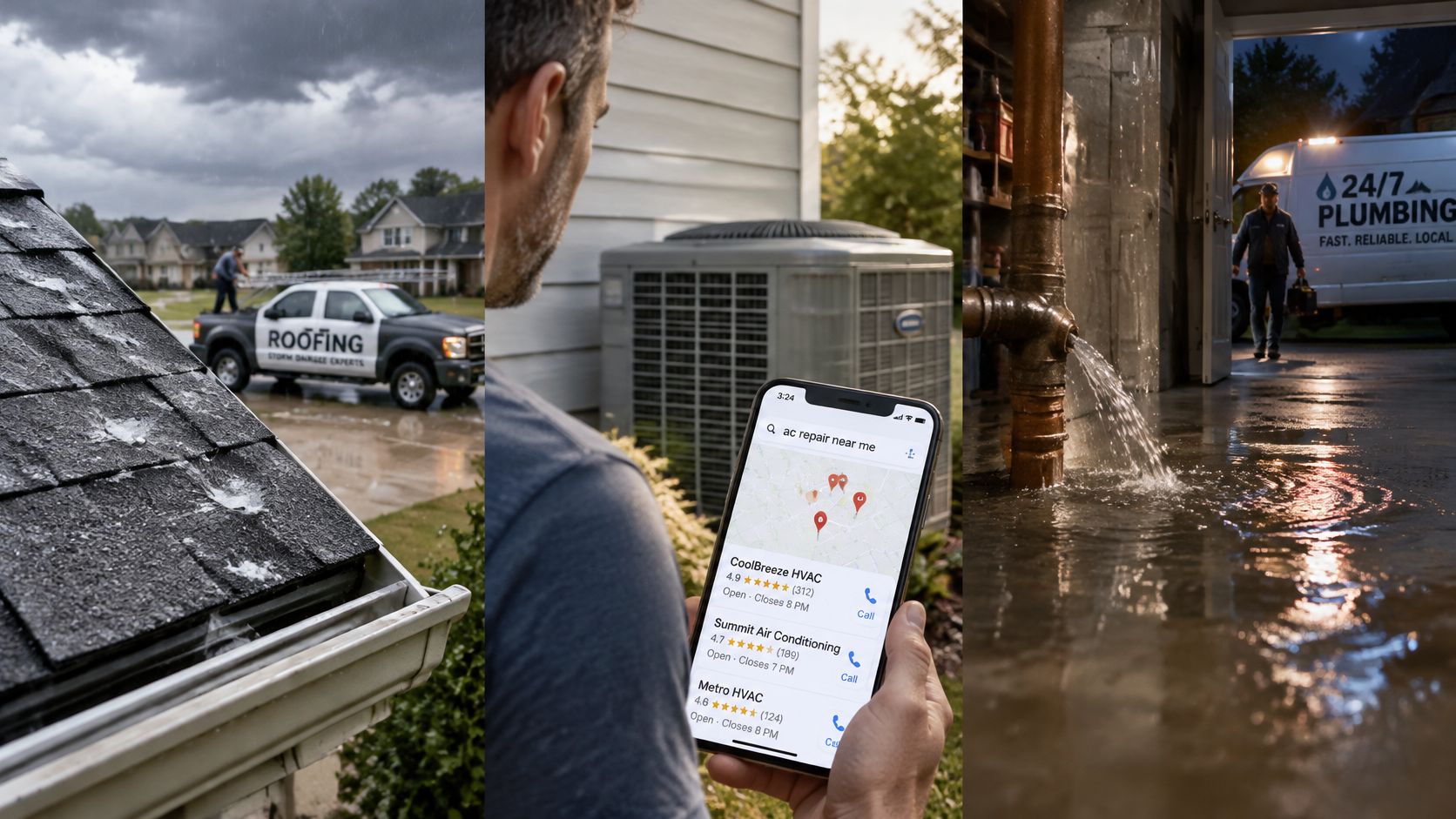
A hailstorm brings homeowners looking for roofers. A hot July afternoon brings calls about failed air conditioning. A burst pipe after hours brings someone who needs to know whether a plumber can answer now.
A ranking doesn't settle any of those jobs. The landing page and intake team must agree about availability, territory, and what happens after contact.
Route the urgent visitor differently
Put call or text access near the top of the emergency page. State response expectations, explain geographic limits, and describe documentation help or financing only if the business provides it.
A homeowner dealing with water entry may also need calm, practical information while arranging help. Resources such as Superior Home Improvement's roof leak advice can support that educational need, but your own page shouldn't bury dispatch information beneath a lengthy article.
A window-replacement researcher can reasonably receive more product comparisons, project proof, and a longer inquiry form. Applying that same experience to an after-hours plumbing visitor creates unnecessary work at the wrong moment.
Give the page and CRM the same qualification fields
Use a shared definition of a qualified lead so the marketing report matches what the office receives.
- Service needed: Record the actual repair, installation, or maintenance request.
- City or ZIP: Confirm that a crew can serve the property.
- Urgency: Distinguish active damage, immediate loss of function, and planned work.
- Property type: Identify residential fit and any building types you don't handle.
- Booking readiness: Establish whether the caller can authorize a visit or needs another decision-maker involved.
Don't force every detail into the website form. Some belong in the call script or follow-up conversation, especially when a visitor needs immediate help.
Track landing pages that produce calls and forms, then connect those inquiries to qualification and booked work. Report indexed service and location URLs, profile completeness, and review activity as operating checks, not substitutes for jobs.
Make reviews part of project closeout
BrightLocal's 2025 Local Consumer Review Survey found that 40% of consumers said they were most likely to leave a review when asked by email, supporting a consistent post-job follow-up process.
Invite honest feedback after completed work, without screening customers for positive sentiment. Answer praise and complaints on Google, and route unresolved service issues to someone who can act.
More organic traffic isn't progress if the extra callers are outside your territory or need work you don't perform.
Split the emergency template from the research template. Report qualified leads by landing page, and let the office identify which inquiries were worth receiving.
Choose the Next Quarter of SEO Work
A quarter is enough time to fix the pages that produce estimates and too short to attempt every tactic at once. Put the work on a dated schedule, and treat answer engines as an early discovery layer: homeowners may find your company there first, but they still verify you in Google, Maps, and reviews before calling. The pages those checks land on should be ready first.
Put the work on a dated calendar
The dates below are a sample implementation schedule. Rankings move on their own timeline; the schedule controls the work.
| Sample dates | Work to complete | Approval checkpoint |
|---|---|---|
| April 1–14 | Confirm primary services and cities; repair listing and address mismatches | Operations approves coverage and availability |
| April 15–30 | Publish or rewrite the top two estimate-producing pages | Each qualifies urgency, location, and readiness to book |
| May 1–15 | Fix the mobile template those pages share | Calls and forms work on a phone |
| May 16–31 | Add verifiable answers and project evidence | Claims match actual services and credentials |
| June 1–29 | Report calls and qualified forms by page; prioritize further promotion | Owner can identify useful inquiries |
Give each task a named owner. A page qualifies for a ranking push when a visitor can confirm you handle the problem, serve their city, and request a booking from a phone. Until those three are true, promotion sends more traffic to a page that cannot convert it.
If the site cannot support distinct service pages, fast templates, or reliable forms, optimizing it indefinitely wastes the quarter. Plan a replacement instead of patching the same constraints for another 90 days.
Rebuild when the platform blocks the work
At Digital Skyrocket, we strategize, design, build, write, and SEO the client's website as one project instead of only optimizing a site someone else built. SEO is part of the package: Local SEO, On-Site SEO, and Off-Site SEO together, never a separate purchase.
The AVCO Roofing case study recorded annual Google search visitors rising from 1,935 to 4,593, a 137.36% increase in one year, and AVCO said almost 3,000 more people found the company on Google than the year before. Olympic Exteriors recorded a 150% search engine visibility increase in 22 days. Results like these come when content, technical fixes, and conversion paths move together. Treat them as evidence the model works, with your own outcome depending on your market and starting point.
For East Texas businesses, explore web design in Tyler, TX. We also welcome fit conversations with home-services companies outside Texas that want a new website and ongoing SEO together.
Name the two pages that should produce estimates this quarter. Start there.
Digital Skyrocket builds lead-focused websites with ongoing SEO and conversion improvements tied to qualified inquiries. Visit Digital Skyrocket to discuss your service area, the pages that should generate estimates, and whether a new website with ongoing SEO fits your next quarter of work.