

Your trucks are rolling, your techs are solid, and your referrals still matter. But referrals don't fill every gap in April, and they don't scale when July heat hits and homeowners start searching right now for help. That's where most HVAC companies feel the tension. One month the phones are busy. The next month the schedule looks thin and everyone starts asking whether pricing, weather, or competition is the problem.
A strong website fixes part of that. A real SEO system fixes the bigger issue.
Good seo for HVAC isn't about collecting rankings and hoping for the best. It's about building a lead-generation machine that shows up when homeowners need service, gives them a clear reason to trust you, and makes it easy to call or book. When this is done correctly, your site works like another technician on the team. It doesn't take a day off, it doesn't miss calls, and it keeps qualifying local buyers while your crew handles the field work.
Table of Contents
- Why SEO Is Your Most Valuable Technician
- Building Your Digital Blueprint
- Owning Your Local Service Area
- The Seasonal Content and Campaign Playbook
- Winning with Technical SEO and Site Speed
- Advanced SEO for HVAC Leaders
- Tracking What Matters Leads and Revenue
Why SEO Is Your Most Valuable Technician
Most HVAC owners start with the same growth model. Do good work, ask for referrals, stay visible in the community, and keep the trucks moving. That works up to a point. Then the schedule gets uneven, a competitor shows up stronger in Google, and the website that used to feel “good enough” starts looking like a missed opportunity.
SEO is the fix because it turns demand you don't control into a system you do.
When someone searches for emergency repair, replacement, or installation, they're not browsing for fun. They have a problem. Your site's job is to get found, answer the immediate question, establish trust fast, and move that person to a call. That's why I treat seo for HVAC as an operations function, not a branding exercise.
Practical rule: If your website can't generate qualified calls without someone manually pushing traffic to it every day, it's a brochure, not a growth system.
The reason this matters is simple. HVAC buyers often decide fast. A homeowner with no cooling or no heat doesn't want clever copy. They want the right service, in the right city, with a visible phone number, real hours, and proof that your company serves their area. That's the work SEO handles when the site is built correctly.
A lot of owners benefit from reviewing broader SEO fundamentals before getting deep into local strategy. UpTime Web Hosting's search engine optimization guide gives a solid overview of how search visibility is built from content, technical setup, and site structure working together.
What this changes in practice
Instead of hoping referrals carry the month, you build a predictable channel that compounds:
- Search visibility: Service pages target the terms buyers use.
- Lead quality: Local pages filter for the cities and service areas you want.
- Conversion: The site routes urgent visitors to call now, not wander around.
- Stability: Organic visibility keeps working even when short-term campaigns stop.
That's why the best HVAC SEO strategy behaves like your most reliable technician. It shows up every day, handles the first stage of the sales process, and keeps producing opportunities while your team does the actual work.
Building Your Digital Blueprint
Every HVAC SEO campaign that works starts with structure. Not content first. Not backlinks first. Structure first. If the site architecture is wrong, everything you add later has less impact because Google can't clearly understand what you do, where you do it, and which page deserves to rank.
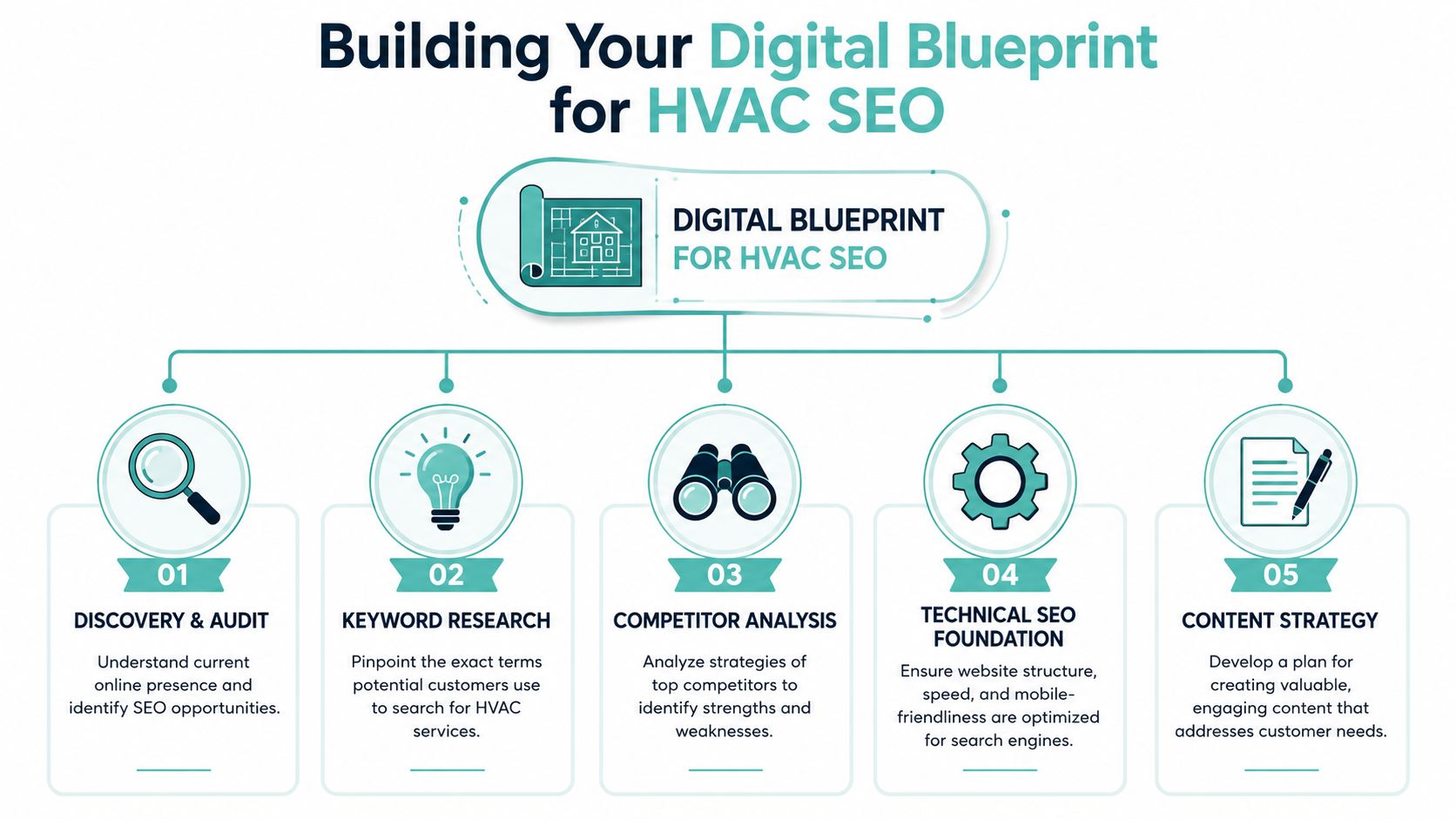
According to Nopio's HVAC SEO guide, HVAC SEO campaigns typically require a 3–6 month latency period before measurable traffic improvements appear, with significant returns and lead volume stabilization occurring at the 6–12 month mark, and a common failure point is the service-location page conflation error, where contractors merge service and city intent into one URL. That dilutes topical relevance and prevents strong rankings for both.
Start with search intent, not vanity keywords
The first pass is discovery. We look at what the business sells, which jobs produce margin, which cities matter most, and how customers phrase those needs in search. That usually splits into very different buckets:
| Search type | What it signals | What page should target it |
|---|---|---|
| Emergency service query | Immediate need | Dedicated service page |
| Replacement or install query | Higher-consideration buying | Dedicated service page |
| City-based query | Geographic intent | Dedicated location page |
| Homeowner question | Research and trust-building | Blog or resource article |
This is also where weak keyword strategy shows up. Many contractors target broad phrases that sound important but don't line up with calls. A page built around “HVAC cost” behaves differently from one built around “emergency AC repair” or “furnace installation.” One attracts mixed research intent. The other aligns with a real service request.
For teams that create thought leadership alongside company content, building content as a founder is a useful read because it shows how expertise becomes a publishing system instead of random output.
Build a page structure Google can understand
The architecture we want is simple and strict. One page for each core service. One page for each target location. Then internal links connect them in a way both users and search engines can follow.
A clean HVAC site often looks like this:
- Core service pages: AC repair, AC installation, furnace repair, furnace installation, heat pump service, indoor air quality, maintenance plans.
- Location pages: One page per city or service area.
- Supporting content: Articles that answer pre-purchase and emergency questions.
- Conversion paths: Call buttons, quote forms, financing prompts, and service area references throughout.
The mistake to avoid is combining everything into pages like “AC Repair Dallas” and expecting one page to rank everywhere. That usually creates thin coverage, limits expansion, and makes internal linking messy.
Keep service intent and location intent on separate canonical pages. Then connect them with clear internal links and consistent navigation.
If you serve multiple markets, this structure becomes critical. It's how you scale without cannibalizing your own pages. It also makes future expansion easier because you can add locations without rebuilding the whole site.
A deeper breakdown of how this supports lead generation across the full website is covered in this guide to digital marketing for HVAC companies.
Map content to the sales cycle
Once the site structure is in place, content gets easier because every page has a job.
- Service pages close urgent buyers: They need trust signals, speed, financing or scheduling clarity, and location relevance.
- Location pages prove local fit: They should describe coverage, nearby neighborhoods, response expectations, and matching services.
- Blog content captures earlier-stage searches: This supports visibility and builds authority that strengthens the rest of the domain.
Most HVAC SEO problems don't start with lack of effort. They start with building pages in the wrong order and forcing one page to do three jobs. The blueprint fixes that first.
Owning Your Local Service Area
For HVAC, local visibility isn't a side task. It's the front door. When someone searches from a phone and needs service fast, your Google Business Profile often shapes the first impression before they ever visit your website.
That's why I tell contractors to stop treating GBP like a listing and start treating it like a storefront. It needs maintenance, accuracy, and local signals that support legitimacy.
Treat your Google Business Profile like a storefront
ServiceTitan's HVAC SEO article makes one rule especially clear: HVAC businesses must never include keywords in their Google Business Profile name and should use only their actual registered business name. The same source also emphasizes keeping accurate hours of operation and using a local phone number as a legitimacy indicator for local search algorithms.
That means the “do this, not that” list is straightforward:
- Use your real business name: Don't stuff “best,” “cheap,” or city keywords into the listing name.
- Set real hours: If you offer emergency service, your profile should reflect how customers can reach you.
- Use a local phone number: This supports trust and aligns with local intent.
- Complete every relevant field: Categories, service descriptions, service areas, photos, and updates all matter.
- Use Q&A proactively: Add and answer common questions before a prospect asks them.
A weak profile sends mixed signals. A complete one helps qualify leads before they click.
Build consistency beyond Google
Local SEO also depends on consistency outside Google. Your business name, address, and phone details need to match across important directories, maps, and industry listings. Inconsistent data confuses both search engines and buyers. It also wastes time because people call the wrong number, drive to old addresses, or question whether the company is still active.
Here's the standard I use:
| Asset | What to check |
|---|---|
| Google Business Profile | Business name, hours, phone, services |
| Website footer and contact page | Exact match business details |
| Major directories | Same contact information and branding |
| Local citations | Correct categories and service areas |
Local SEO gets stronger when every listing tells the same story about who you are, where you work, and how a customer can reach you.
If your business has moved, merged offices, or changed service footprints, cleaning that up comes first. This walkthrough on how to change your address on Google is useful when the listing itself needs correction.
The HVAC companies that win local search usually aren't doing anything flashy. They're just more disciplined. Their listing is complete, their service areas are clear, their contact details are consistent, and they don't sabotage trust with spam tactics.
The Seasonal Content and Campaign Playbook
HVAC marketing breaks if you treat demand as flat all year. It isn't. Search behavior swings hard with weather, urgency, and homeowner pain. The contractors who wait until the first heat wave or cold snap are already late.
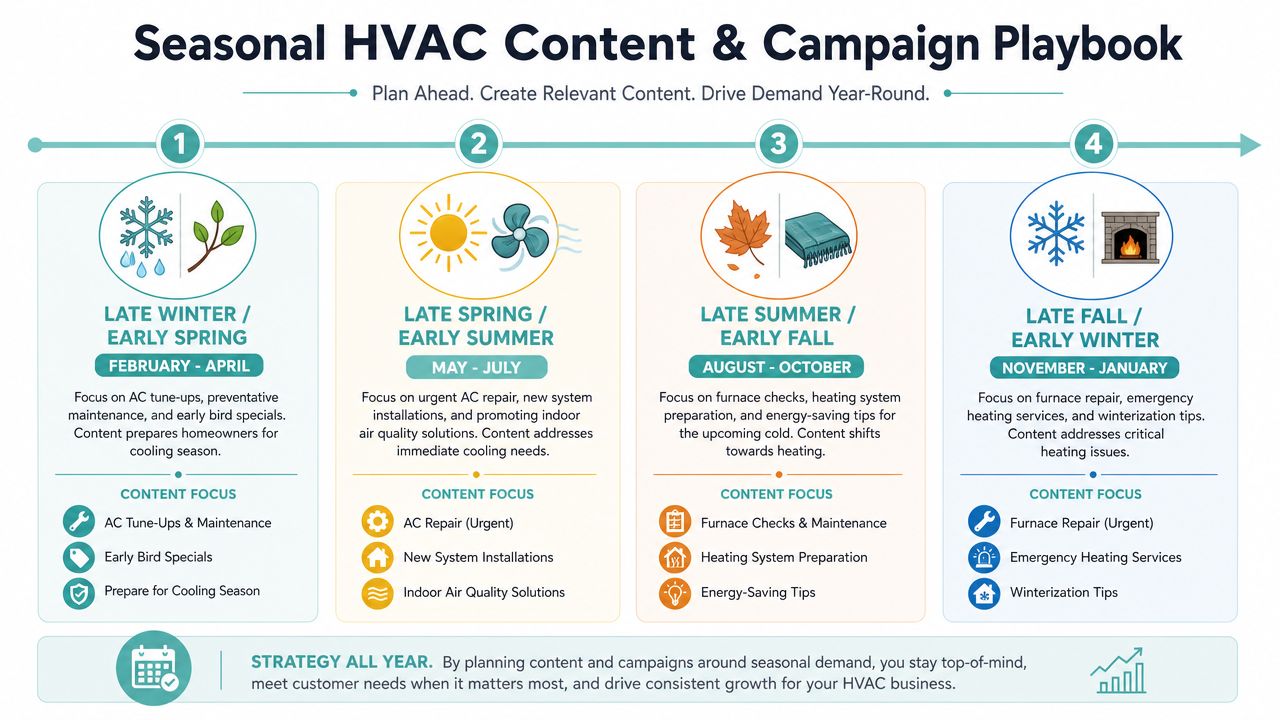
According to Sequoia's HVAC statistics page, “AC repair” search volume surges 266% in July while “furnace repair” peaks 137% above baseline in January. The same source notes that HVAC websites should publish high-value content posts between 800 and 1,500 words to attract organic traffic and establish expertise.
Publish before demand peaks
This changes how smart HVAC companies plan content. You don't optimize cooling pages when the phones are already overloaded in midsummer. You optimize them before the rush so those pages are crawled, indexed, and gaining strength ahead of demand.
A practical sequence looks like this:
- Late winter into early spring: Refresh AC repair, AC installation, maintenance, refrigerant, airflow, and thermostat content.
- Late spring into early summer: Push urgent cooling pages harder. Tighten internal links, update calls to action, and expand answer-focused FAQs.
- Late summer into early fall: Shift to heating prep. Build and improve furnace repair, furnace installation, and heating inspection pages.
- Late fall into early winter: Support emergency heat content and winter reliability topics.
That timing matters because SEO needs runway. Content published early has time to mature before homeowners flood search results.
A practical year-round content rhythm
Most HVAC blogs fail because they publish generic homeowner advice with no connection to services, locations, or conversions. The better play is to pair service demand with supporting content that answers the questions people ask right before they book.
A strong seasonal content mix might include:
- Cooling season support content: “How to Know If Your AC Needs a Recharge,” “Why Is My AC Blowing Warm Air,” “Should I Repair or Replace My AC Unit”
- Heating season support content: “5 Signs Your Furnace Needs Replacing,” “Why Your Furnace Keeps Turning Off,” “What to Do Before Calling for Emergency Heat Repair”
- Shoulder-season authority content: maintenance checklists, indoor air quality topics, ductwork concerns, thermostat upgrades, energy-efficiency questions
The best-performing articles don't wander. They answer one real homeowner problem, connect back to a service page, and present a clear next action.
A blog post should help a homeowner make a decision. If it only fills space on the site, it won't help rankings or booked jobs.
Long-tail strategy becomes particularly useful. Questions with specific intent are often easier to win and easier to convert. This guide on long-tail SEO is a good reference for building content around those narrower, high-fit searches.
Turn field knowledge into search assets
The easiest way to create better HVAC content is to stop outsourcing all the thinking. Your technicians, CSRs, and comfort advisors already hear the exact questions customers ask. That material should become content.
One efficient workflow is to record short videos or voice notes after service calls, then turn those into articles. If your team prefers speaking over writing, the SpeakNotes video to blog guide offers a practical workflow for converting spoken expertise into publishable content.
That approach solves two problems at once. It gives you more authentic content, and it keeps the writing tied to real issues buyers face in your market.
Here's a simple editorial lens I use:
| Content type | Best use |
|---|---|
| Service page update | Improve conversion and commercial relevance |
| FAQ article | Capture specific pre-call questions |
| Seasonal checklist | Earn top-of-funnel traffic and internal link opportunities |
| Emergency explainer | Support urgent mobile searches |
When seo for HVAC is handled this way, content stops being a chore. It becomes a scheduling tool. You publish early, support the right services, and position the site to catch demand before competitors react.
Winning with Technical SEO and Site Speed
Technical SEO sounds abstract until you watch how people use an HVAC website on mobile. A homeowner searches with a broken unit, taps a result, lands on a slow page, pinches to zoom, hunts for a phone number, and leaves. That wasn't a traffic problem. It was a technical and conversion problem.
Technical SEO affects calls, not just crawlability
A fast, clean site keeps urgent visitors moving. A messy one creates friction at the exact moment you need clarity. This is why site speed, responsive design, secure browsing, and clean page structure matter so much in seo for HVAC. They shape whether someone contacts you or bounces.
Core Web Vitals matter because they reflect user experience in practice. The same goes for mobile responsiveness. If buttons are too small, forms are annoying, or major content shifts while the page loads, prospects don't wait around. They hit back and call someone else.
What we fix first
I don't start with the most advanced technical item. I start with the issues that block visibility or kill conversion.
- Mobile layout problems: Call buttons should be easy to tap, text should be readable, and service areas should be visible without effort.
- Page speed bottlenecks: Heavy images, bloated scripts, and poor hosting often drag down urgent pages.
- URL structure: Keep URLs short, readable, and aligned with the site hierarchy.
- HTTPS and trust signals: Secure browsing supports form submissions and buyer confidence.
- Indexing hygiene: Important service and location pages need to be crawlable, canonicalized correctly, and included in the site's internal link paths.
A technically sound site doesn't win because Google likes neatness. It wins because it removes friction. On HVAC websites, that usually means more calls from mobile users, cleaner tracking, and stronger performance from every page you've already invested in.
Advanced SEO for HVAC Leaders
Most HVAC companies stop at basic local SEO. They build service pages, fill out the Google Business Profile, publish a few blogs, and call it a strategy. That's enough to compete in weak markets. It's not enough if you want to lead.
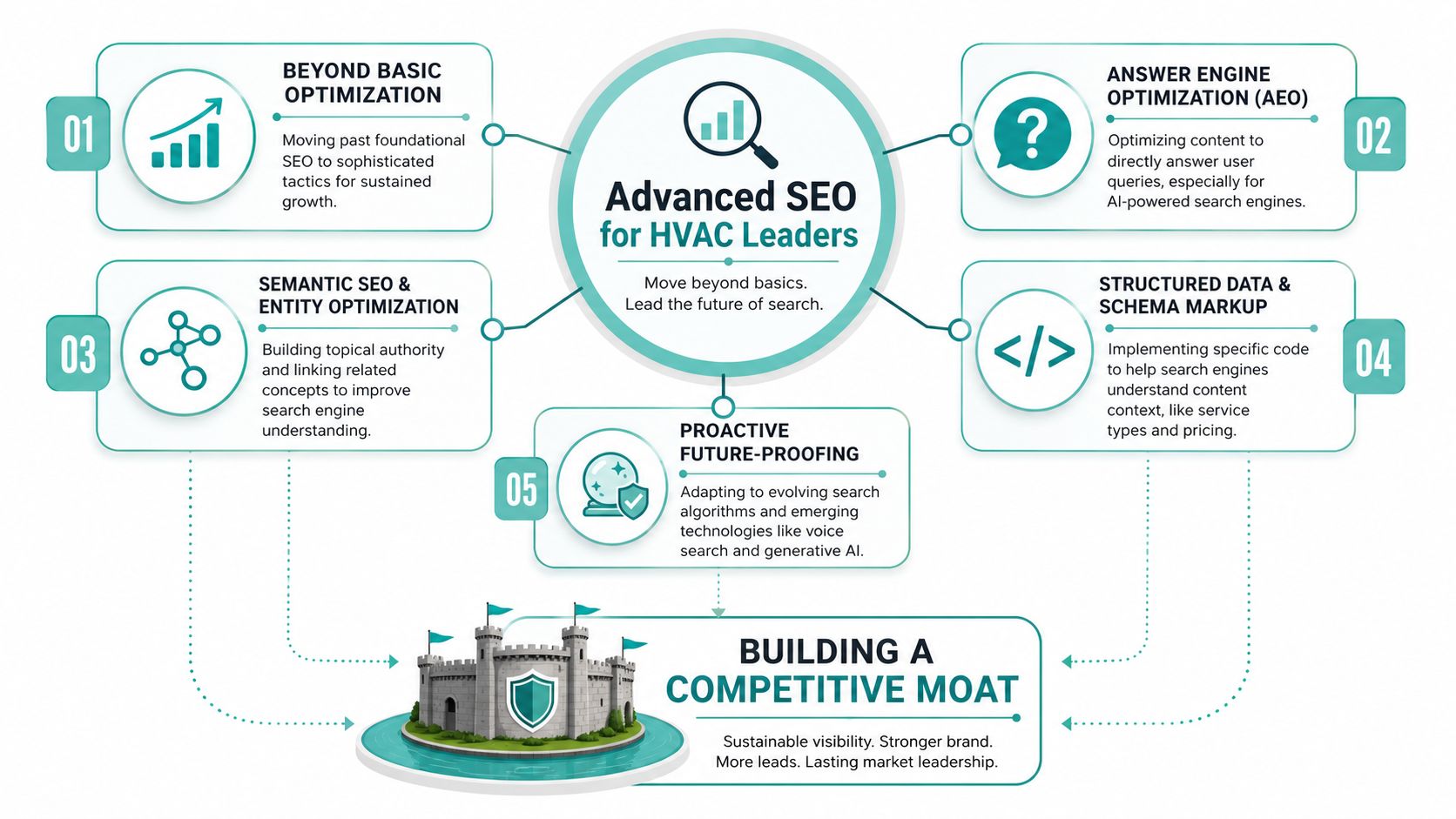
The next layer is making your business easier for search engines and AI systems to extract, summarize, and surface for urgent local intent.
AEO is the next local battleground
Housecall Pro's HVAC SEO resource points to an underserved opportunity: many HVAC guides talk about high-intent content, but they don't address AI-driven Answer Engine Optimization for emergency intent, such as structuring pages so AI overviews surface “emergency AC repair near me” with your phone number and service area.
That matters because emergency buyers often want one thing from search immediately: a valid answer tied to a real local company. If your page makes contact details, hours, service area, and emergency response clear, you increase the odds that both users and AI systems can pull the right information quickly.
The future of local HVAC search isn't just ranking blue links. It's being the business that search systems can confidently summarize.
Schema that helps search engines surface your business
Schema markup is one of the most practical ways to support that. It gives search engines structured signals about your company. Not hype. Just cleaner data.
A useful LocalBusiness schema setup for HVAC pages should clearly reinforce:
- Business identity: legal business name and primary business type
- Contact pathways: phone number and website
- Operating details: hours and service availability
- Service footprint: cities, counties, or regions served
- Page relevance: matching service information on the page itself
Here's a simplified example format teams can adapt with a developer:
<script type="application/ld+json">
{
  "@context": "https://schema.org",
  "@type": "LocalBusiness",
  "name": "Your HVAC Company",
  "telephone": "Your Local Phone Number",
  "areaServed": ["City One", "City Two"],
  "openingHours": "Mo-Su",
  "url": "https://www.example.com"
}
</script>
The code alone won't make a weak page rank. But paired with strong service pages, a clear GBP, and accurate business information, it helps search engines understand your site faster and with less ambiguity.
Reviews strengthen the moat
Advanced HVAC SEO also includes reputation systems. Not random review requests. A process.
The strongest approach is operational:
- Ask for reviews after positive service outcomes.
- Direct customers to the correct profile.
- Respond consistently and professionally.
- Feed recurring review language back into on-page copy and FAQs.
That strengthens both trust and message alignment. If customers repeatedly praise fast response, clear communication, or clean install work, your website should reflect those expectations.
Leaders in HVAC SEO build an advantage by making their site easier to understand, easier to trust, and easier to extract into modern search experiences. That's the moat.
Tracking What Matters Leads and Revenue
Rankings can look great while the sales team stays unimpressed. Traffic can rise while booked jobs stay flat. If you don't connect seo for HVAC to inquiries and revenue, you're grading marketing on the wrong paper.
Build a reporting stack around inquiries
The dashboard should answer practical questions. Which pages drive calls? Which locations generate form submissions? Which services attract real demand? Which visits turn into booked work?
That means tracking needs to center on actions, not vanity.
A useful reporting view includes:
- Phone calls from organic traffic
- Form submissions by landing page
- Direction or contact interactions from local profiles
- Top-performing service and location pages
- Booked jobs tied back to inquiry source where possible
This also keeps expectations realistic. Earlier in the article, the timeline issue was addressed already. HVAC SEO compounds over time, and the strongest results come from consistency, not impatience. If a campaign is only measuring rank movement and impressions, you can miss what matters most.
CRO closes the gap between traffic and booked jobs
Many HVAC companies leave money on the table. They improve visibility, earn the click, and then make the website too passive.
CRO fixes that.
Small changes often have outsized impact on lead flow:
| CRO element | What it should do |
|---|---|
| Sticky mobile call button | Make urgent contact immediate |
| Short quote form | Reduce friction for non-callers |
| Service-area proof near the top | Confirm local fit fast |
| Review snippets and trust signals | Lower hesitation |
| Strong page-specific CTA | Match the service intent |
If a visitor has to hunt for your phone number on an emergency service page, the page is underperforming no matter where it ranks.
The goal is straightforward. Build pages that don't just attract visitors, but move them toward the right action with as little friction as possible. That's how SEO becomes a revenue system instead of a reporting exercise.
Digital Skyrocket helps service businesses turn their websites into lead-generating assets through custom web design, local SEO, AEO, and CRO. If you want a site that ranks, converts, and supports real growth, visit Digital Skyrocket.