You're probably seeing the same pattern a lot of local service owners see. The site ranks, the map pack looks healthy, and yet the phone doesn't move the way it should. In that gap, voice search optimization usually gets treated like a side project, when the issue is that customers are asking for help in a more conversational way than most service pages are written.
That shift matters most for businesses that sell urgency, proximity, and trust, like law firms, roofers, dentists, HVAC contractors, and other service companies. People don't speak in fragments when they need a quick answer. They ask full questions, they ask them on mobile, and they expect one clean response, not a list of ten possibilities.
The practical move is to treat voice as part of the same local search stack, not as a separate channel. The work starts with the questions customers ask, then moves into page structure, schema, Google Business Profile, and measurement that can separate voice-driven lift from broader SERP gains. When those pieces line up, voice-ready pages tend to help both spoken queries and regular local search.
Table of Contents
- Why Voice Search Changes the Lead Funnel for Local Services
- How Spoken Queries Differ from Typed Searches
- Mining Conversational Questions Your Customers Actually Ask
- Writing Answer-First Pages That Win Spoken Results
- The Technical Stack That Makes Content Eligible
- Testing Dialogue-Style Content and Tracking Voice KPIs
- Your 30-Day Rollout and What to Measure First
Why Voice Search Changes the Lead Funnel for Local Services
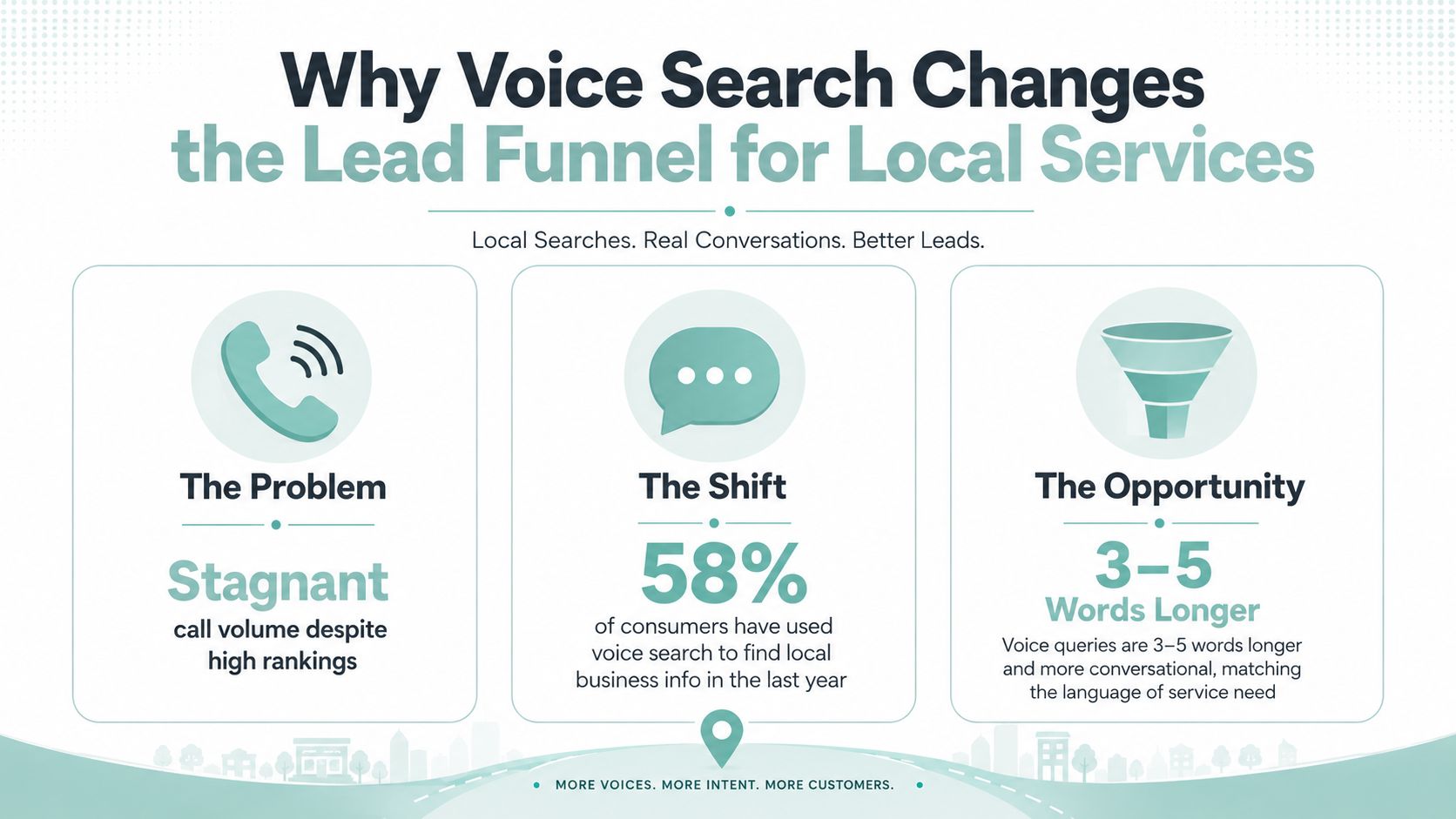
A roofing owner in Tyler can do everything right and still feel the pipeline tighten. The site shows up, the maps listing is intact, and a few branded calls still come through, but new leads slow down because the customer's first touchpoint is no longer a typed query. Instead, the customer is asking a phone, a car interface, or a smart speaker something like, “Who can fix storm damage near me today?”
That shift matters because voice search is now mainstream. Industry reporting estimates 8.4 billion voice assistants in use worldwide and about 20.5% of people globally using voice search, with roughly 153.5 million people in the U.S. using voice assistants as well, according to Yaguara's voice search statistics. For a local service business, that means the lead funnel is no longer just about ranking, it is about being the answer when a customer speaks the need out loud.
Why this shows up most clearly in service businesses
Voice matters most where intent is local and immediate. Industry sources report that about 58% to 76% of voice searches are used to find local businesses or local information, and one benchmark says 46% of people look up local businesses by voice every day, according to SEOProfy's voice search statistics roundup. That is why service businesses should care first, because local searches are tied to calls, directions, bookings, and form fills.
For ecommerce, a voice query might start research. For a local plumber, roofer, dentist, or attorney, the same query can become an immediate lead. Voice assistants usually read one best result, so the page that gets surfaced has to answer cleanly, sound natural, and fit local intent at the same time.
Practical rule: if the page would feel awkward when read aloud, it is probably not ready for voice.
The old mental model, rank on page one and the leads follow, does not hold as cleanly here. The funnel now rewards pages that can satisfy a question quickly, show location relevance, and signal trust in the same screenful or spoken response. That is why voice search optimization overlaps so heavily with local SEO and answer-engine work.
A more useful frame is this, the interface changed, not the buyer's intent. The customer still wants a nearby expert, but they are asking in complete sentences now, which changes how the page has to be written, structured, and measured. It also changes the technical checklist, because local signals, including understanding what NAP stands for, need to stay consistent across the site and the listings that feed it.
For service businesses, the practical question is not whether voice deserves its own silo. It is whether the page can earn the spoken answer while the rest of the local stack does the heavy lifting. That usually means improving answer-first copy, tightening local trust signals, and tracking whether voice-friendly pages lift conversions beyond the baseline gains already coming from local SERP visibility.
How Spoken Queries Differ from Typed Searches
Typed queries tend to be clipped and compressed. Spoken queries tend to sound like a person talking to another person, with full sentences, location context, and a clearer service need. A research review makes that distinction directly, noting that voice searches use natural-language question phrases while written searches more often use single keywords, and it recommends question-form keyword research with tools like AlsoAsked or AnswerThePublic, according to this review from the University of Barcelona repository.
That difference matters because voice assistants don't behave like a traditional search results page. They're built to read a single spoken answer, which pushes the winning content toward concise, direct responses and snippet-friendly formatting. For local services, that usually means the query includes a service, a problem, and a place, then the assistant looks for the most confident answer nearby.
What changes in the query itself
A typed query might be something like “Tyler roofer.” A voice query is more likely to be, “Who's the best roofer near me for hail damage?” The second version tells you much more about intent, urgency, and purchase readiness.
That's why voice-friendly pages usually also perform well for featured snippets. The same structure that helps an assistant read a page aloud also helps Google extract a quick answer. In practice, voice and snippet optimization are closer cousins than many realize.
A good test is simple, if your target question sounds natural out loud, your content probably has the right shape.
The local bias also changes what “good SEO” means. When users speak a query, they often expect the assistant to solve the problem immediately, so pages that bury the answer under long marketing copy usually lose. The page has to say what it is, who it serves, and where it serves them without making the reader hunt.
The strategic implication is straightforward. Voice search optimization is not about inventing a separate keyword universe. It's about matching spoken intent with clearer questions, tighter answers, and location-aware page language that fits the way people ask for help.
Mining Conversational Questions Your Customers Actually Ask
Start with the language customers already use. A question list built from Search Console, People Also Ask, and actual front-desk conversations will beat a brainstormed keyword list almost every time because it reflects how prospects really talk. I like to treat this as an intake problem first and an SEO problem second.
The fastest way to build the list is to combine three streams. Search Console tells you what Google already associates with your pages, People Also Ask reveals adjacent questions, and call logs or chat transcripts expose the words people use when they're close to hiring. That blend gives you both search demand and revenue proximity.
Sort the questions by intent, not by volume
Once the questions are collected, bucket them into practical groups. The goal isn't a giant spreadsheet, it's a short working set that maps to page types and business value.
- Who questions: These usually point to fit, specialty, or audience, such as who needs a certain service or who qualifies for a certain process.
- How much questions: These are pricing and estimate questions, and they often deserve direct, plain-language answers on service pages or FAQs.
- Near me questions: These signal local intent and should be tied to location pages, Google Business Profile, and local trust signals.
- How to questions: These are ideal for service explanations, HowTo content, and pages that need a clearer process section.
Use the right source for the right job
| Source | Best For | Caveat |
|---|---|---|
| Google Search Console | Real queries already reaching your site | It only shows what you're already visible for |
| People Also Ask | Adjacent questions and related phrasing | The list shifts, so it's best used as a discovery tool |
| AlsoAsked | Question clustering around a topic | Great for expansion, but not a substitute for first-party data |
| AnswerThePublic | Broad conversational keyword ideas | Useful for ideation, less useful for prioritization |
| Call logs and intake emails | Actual customer language and objections | Needs manual review, but the phrasing is gold |
| Live chat transcripts | High-intent, near-ready language | Often reveals the exact wording prospects use before converting |
The strongest pages usually start with the customer's wording and then refine it for clarity. That's where the research pays off. If a dozen calls mention “same-day leak repair,” that phrase deserves more attention than a generic “roof repair” header because it reflects both urgency and voice-friendly language.
For businesses that work with multiple cities or neighborhoods, the question set should be sorted by geography too. A question about emergency service in one market may deserve a dedicated local page, while another may belong on a core service page with a location-specific section. The aim is to give every high-intent question a clear home instead of scattering it across the site.
Writing Answer-First Pages That Win Spoken Results
The best voice-friendly service page doesn't read like a brochure. It reads like a clear answer wrapped in a conversion page. That means the first paragraph under a heading should answer the question directly, then the rest of the section can handle nuance, proof, and service details.
A useful pattern is a 30 to 50 word answer block immediately below the heading, followed by supporting detail. A source from The HOTH also notes that exact-match voice keywords in title tags appeared in less than 2% of voice results, which is why natural body copy matters more than title stuffing, according to their voice search SEO guide.
A before-and-after example for a roofing page
Take a roofing company page targeting “how much does a roof replacement cost in Tyler.” The weak version usually opens with company background, awards, or generic promises. The query gets buried, and the page doesn't give an assistant anything it can comfortably read aloud.
The stronger version starts like this in plain language:
A roof replacement in Tyler depends on roof size, material, slope, tear-off needs, and any decking repairs. Most homeowners need an inspection first, because storm damage and hidden leaks can change the scope quickly. A clear estimate should break down materials, labor, disposal, and any required repairs.
That opening works because it answers the question immediately, uses natural phrasing, and creates room for conversion content underneath. The rest of the page can then explain the estimate process, material options, financing if offered, and the next step to schedule an inspection.
Structure the page like a conversation
Question-based H2s and H3s help the page sound like a real exchange. Definition statements help too, especially when the assistant needs a concise answer for a snippet. A page can still be persuasive, but the persuasive material should sit below the answer, not in front of it.
- Lead with the answer: Put the direct response in the first paragraph after the heading.
- Use dialogue-style subheads: Phrase headings the way a customer would ask them aloud.
- Add an FAQ block: Keep the questions tight and the answers short.
- Keep the tone natural: Read the page out loud before publishing. If it sounds written for a committee, it will usually underperform.
The trade-off is that you give up some brand flourish in exchange for clarity. That's a good trade for service pages. Prospects who need urgent help want confidence and speed, not clever copy.
When that structure is paired with answer-engine thinking, the page can support both local ranking and spoken-query capture. The answer is doing the heavy lifting, and the rest of the page supports the sale.
See the broader framing in answer engine optimization, because voice search usually rides on the same answer-first logic.
The Technical Stack That Makes Content Eligible
A clean answer still can't be spoken if the page isn't eligible. Voice assistants lean on structured data, business profiles, mobile performance, and local trust signals to decide which results are safe enough to read aloud. If those signals are weak, the content may be fine and still never get surfaced.
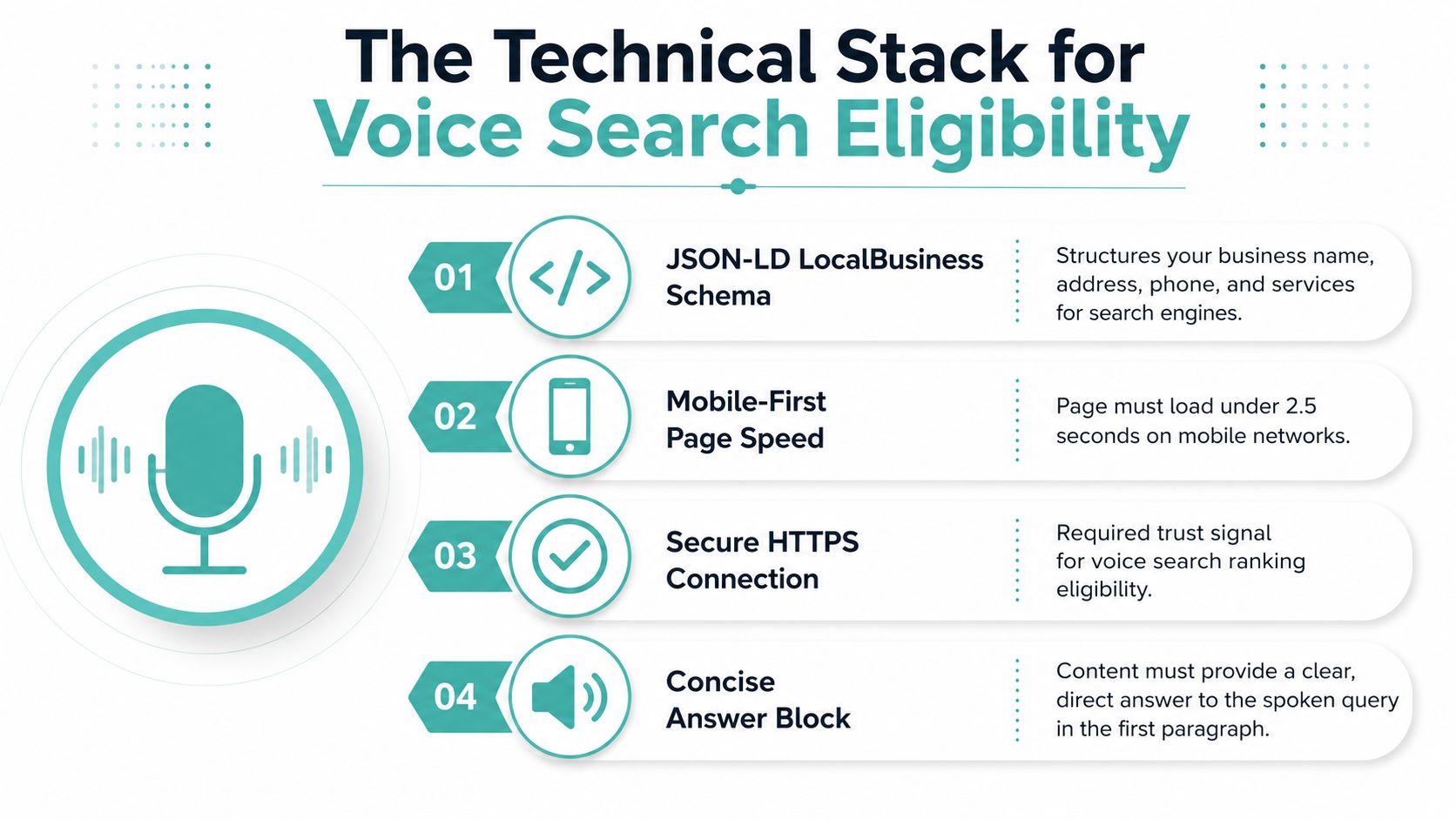
The stack starts with schema. Use JSON-LD for LocalBusiness, FAQPage, and HowTo on the pages where those types fit, then make sure your Google Business Profile is fully filled out with accurate hours, categories, photos, and services. Keep NAP consistency across citations and directories, because mismatched names, addresses, or phone numbers create friction for both users and search engines.
A practical way to organize that work is to treat it in order of impact. First, fix the business identity signals. Then, make the page machine-readable. Finally, remove speed and mobile issues that could block visibility.
The technical gates that usually matter first
Several independent guides recommend mobile LCP under 2.5 seconds and HTTPS as baseline technical requirements for voice visibility, and that lines up with what service sites usually run into in audits. A page can have excellent copy and still lose if the mobile experience is slow or insecure. For local-service businesses, that's especially costly because voice intent often comes from a phone in the moment of need.
If the mobile version is slow, the voice answer usually dies before the content even gets a chance.
The order of operations matters here. Start with the Google Business Profile, because it influences local discovery quickly. Then fix schema on the most important templates, especially local service pages and FAQ-heavy pages. After that, clean up citation consistency and mobile performance together, since the business listing and the landing page need to reinforce each other.
A lot of teams overinvest in content and underinvest in eligibility. That's the wrong split for voice. The assistant needs to trust the business, understand the page, and load it without friction.
For a simple reference point on how the business data should stay organized, the sample sitemap for a website can help teams see where service pages, local pages, and FAQ sections usually fit in the architecture. The point isn't the sitemap itself, it's making sure the technical structure supports the answer structure.
Testing Dialogue-Style Content and Tracking Voice KPIs
Testing voice work means more than checking whether a page “sounds better.” The page needs to be read by a real assistant, and the result has to be measured against the leads that matter. That's where a lot of voice search optimization programs fall apart, because they stop at implementation and never isolate lift.
Test the content the way users will encounter it
Read the answer blocks aloud on a smart speaker or mobile assistant. If the response sounds clunky, too long, or too promotional, trim it. If the question can't be answered cleanly in one breath, the page probably needs another edit.
Then watch the search-side signals. Search Console can show which question-based queries are gaining impressions and clicks, and snippet ownership can be tracked for the target questions you're trying to win. The point is to separate “we published something” from “the right query started producing visibility.”
Measure the four signals that matter most
- Question-query impressions and clicks: These show whether your conversational phrasing is getting traction in search.
- Local pack calls and direction requests: These connect spoken-intent visibility to real local actions.
- Snippet ownership for target questions: This is one of the clearest signs that your answer format is working.
- Lead source attribution on voiced-query landing pages: This helps you see whether the work is changing revenue, not just rankings.
One industry discussion notes a common gap in the field, voice work is often treated like a separate channel, while most answers come from the same local and featured-snippet ecosystem as traditional search. That's exactly why the dashboard has to isolate incremental lift instead of assuming every win is voice-specific.
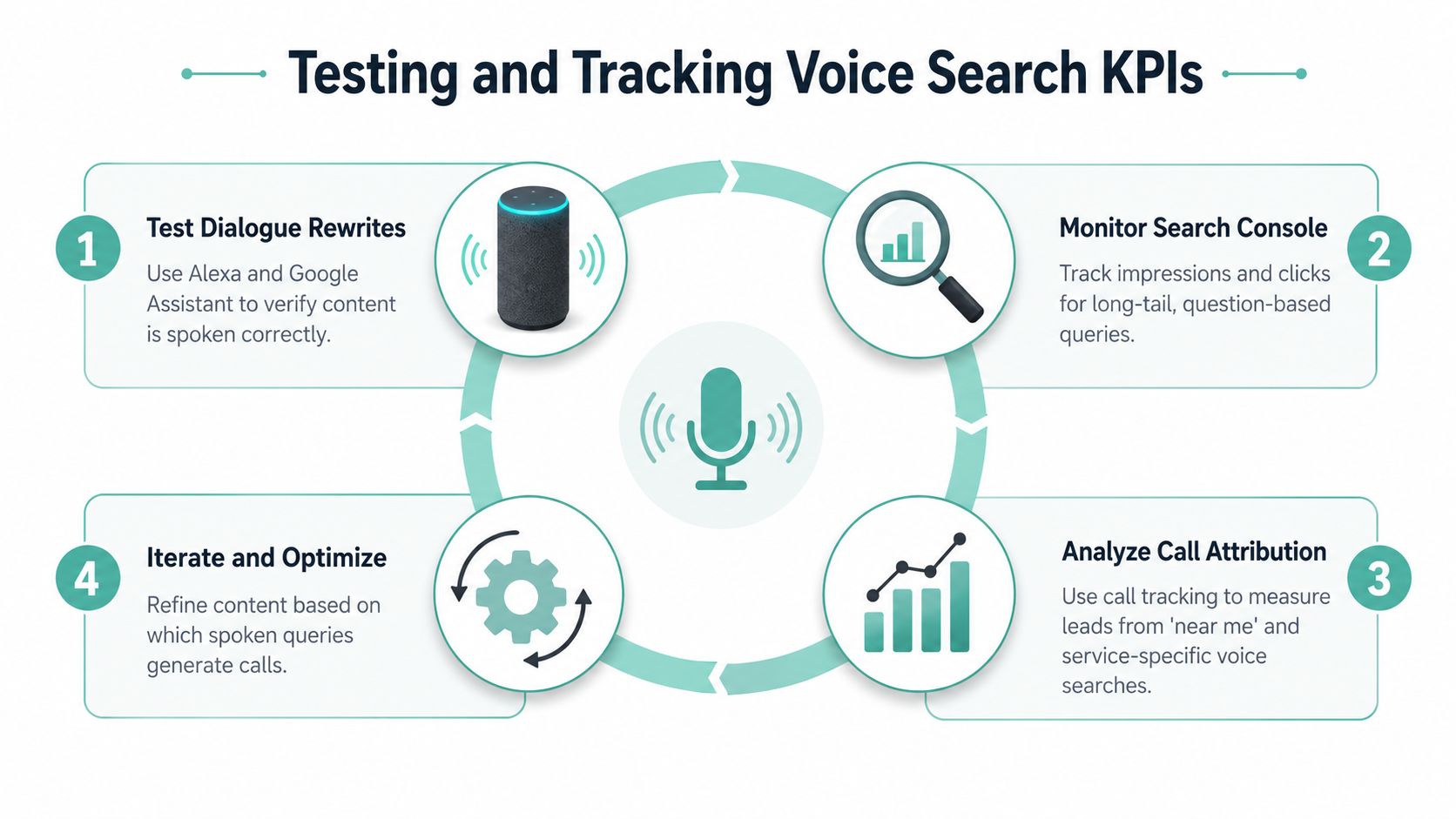
A clean measurement setup also helps teams avoid false credit. If local SEO improves, calls may rise for reasons that have nothing to do with spoken answers. If a FAQ page earns a snippet, that may help both typed and voiced queries. The dashboard should make those overlaps visible instead of pretending they're separate funnels.
In practice, the strongest attribution comes from combining landing-page tagging, call tracking, and query-level monitoring. That doesn't make the data perfect, but it does make it useful enough to steer the next round of changes.
Your 30-Day Rollout and What to Measure First
The first month should stay narrow. Week one is for the question audit and Search Console baseline, week two is for rewriting the top three service pages, week three is for schema and Google Business Profile cleanup, and week four is for testing plus KPI setup. That sequence keeps the work tied to revenue pages instead of spreading effort across low-value content.
If you want a useful real-world reference for how service businesses often think about local trust and customer intent, trustworthy plumbing services is a good example of how a trade site can keep its messaging clear and local without overcomplicating the path to contact. The lesson isn't industry-specific, it's that the page has to answer the job, the area, and the next step fast.
What to measure first is simple. Track question-query impressions and clicks, local pack calls and direction requests, snippet ownership, and leads tied to the pages you rewrote. If those numbers move together, the work is probably doing more than just polishing content.
Voice search optimization is best treated as durable answer-engine optimization on the same local stack you already need for SEO and reputation. That's why it compounds, the same pages that help voice also help featured snippets, local discovery, and mobile conversions. The strongest programs don't chase a separate channel, they make the business easier to understand, easier to trust, and easier to contact.
If you want a team that builds lead-generating sites and search programs around this exact stack, Digital Skyrocket plans, designs, and optimizes websites for service businesses that need more qualified inquiries from Google and answer engines. Visit Digital Skyrocket if you want a practical audit of your content, local visibility, and technical setup, then turn those gaps into a roadmap that fits the way your customers search.