
In SEO, NAP stands for Name, Address, and Phone Number. Those three contact identifiers help search engines verify a local business's legitimacy and location, and if they're inconsistent, rankings can slip after a move or a rebrand.
If you searched this because you saw conflicting answers, that confusion is real. NAP also means a non-aggression pact in gaming and politics, Network Access Protection in enterprise networking, and a short sleep in everyday English, so the right answer depends on context (abbreviations.com, Merriam-Webster's definition of nap, Microsoft's Network Access Protection overview). For a service business owner, though, the local SEO meaning is the one that usually matters most.
A lot of owners notice the problem only after something changes. The website still looks fine, the logo still looks fine, but the Google Business Profile, old directory listings, and the contact page all disagree about the company name, street address, or phone number. That mismatch is usually where the visibility problem starts.
Table of Contents
- What NAP Means Across Different Contexts
- Breaking Down Name Address and Phone Number
- Why NAP Consistency Drives Local Search Visibility
- Common NAP Mistakes That Hurt Local Rankings
- How to Audit and Fix Your NAP Across All Channels
- Maintaining NAP Consistency Over Time
What NAP Means Across Different Contexts
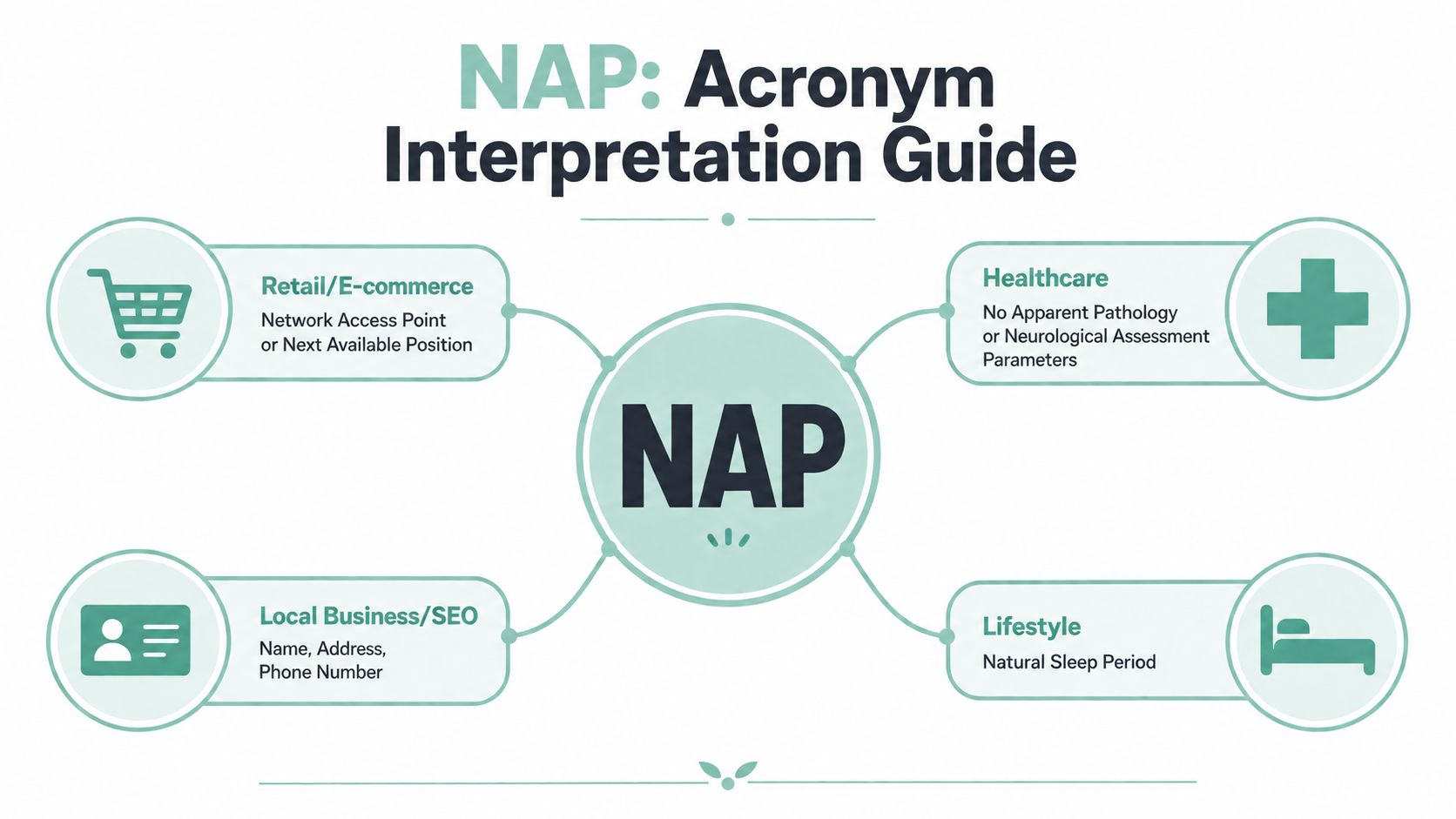
You can usually tell a business owner has been burned by this acronym when they ask one question and get three different answers. That's because NAP isn't a single universal term, it changes meaning with the context.
SEO and local business
In SEO, NAP stands for Name, Address, and Phone Number, the core contact fields used to identify a local business online (Page One Power's SEO glossary). That's the meaning local marketers care about when they audit Google Business Profile, citations, and schema.
Gaming, networking, and everyday English
Outside SEO, the same acronym can mean a non-aggression pact in gaming and political contexts, or Network Access Protection in enterprise networking (abbreviations.com, Computer Hope's explanation of Network Access Protection). In everyday English, nap means a short sleep, especially during the day (Merriam-Webster).
Practical rule: if the person asking is a plumber, roofer, lawyer, or dentist, they almost always mean NAP in local SEO, not a gaming treaty or a brief doze.
That disambiguation matters because intent drives the rest of the work. A service business owner doesn't need a broad acronym explainer, they need to know whether the business identity data is clean enough for search engines to trust it. If that data drifted after a move, a remodel, or a DBA change, rankings often start wobbling for reasons that look mysterious until the listings are compared side by side.
Breaking Down Name Address and Phone Number
NAP works best as one identity record, not three separate fields. Search engines are not looking for contact details in isolation, they are looking for a business profile that stays stable wherever it appears.
Name
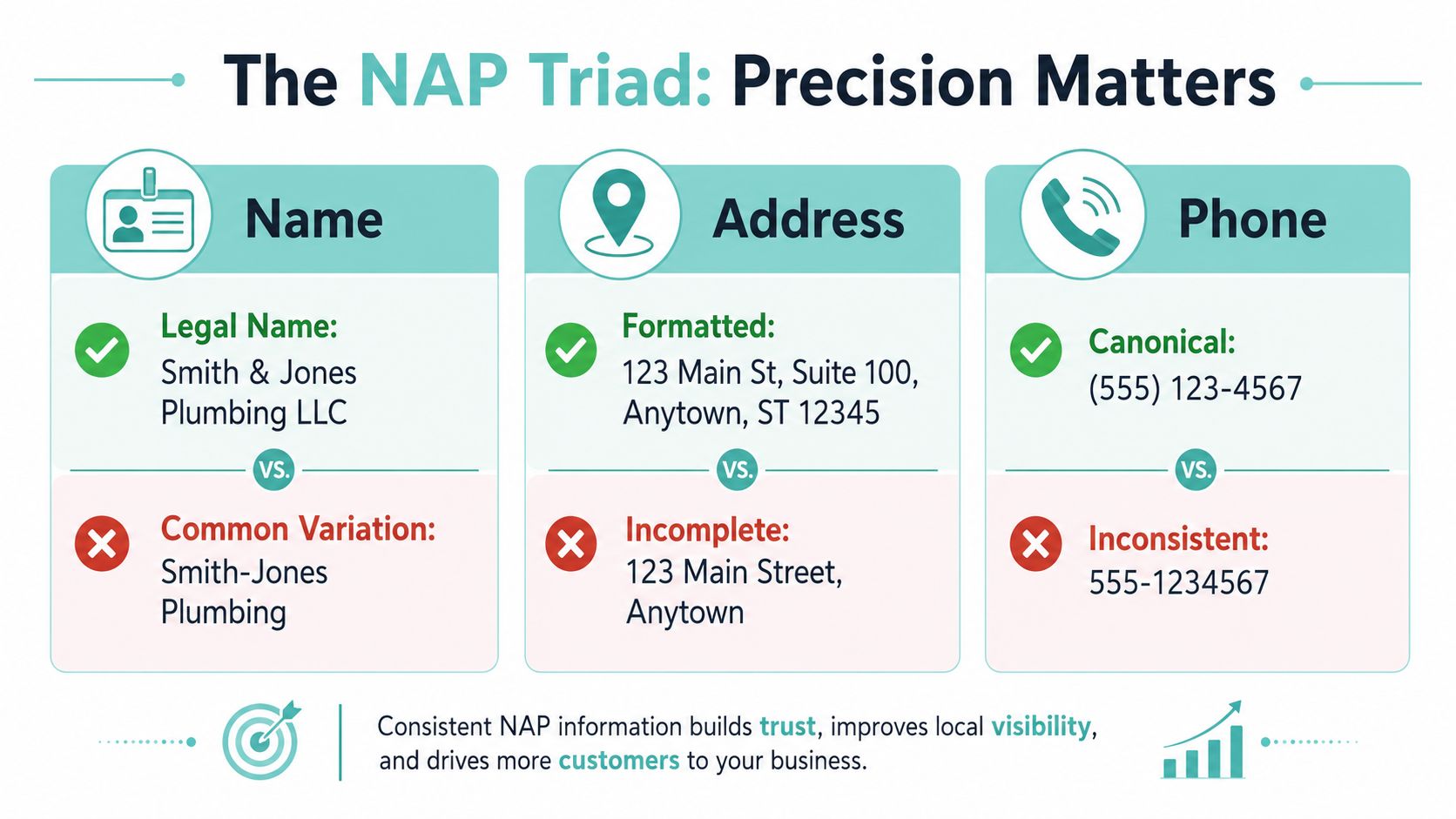
The Name field should match the business name as customers and search engines see it in the market. Leave out extra keywords, skip city names tacked onto the brand, and avoid casual variations just because a directory allows them.
A legal name and a DBA can both work, but they need to be used consistently. If a business appears as “Smith & Jones Plumbing LLC” in one place and “Smith-Jones Plumbing” in another, the search system has to decide whether it is looking at one entity or two.
Address
The Address should be formatted the same way everywhere it appears. If the office uses a suite number, that suite belongs in the canonical version, and the same version should show up on the website, Google Business Profile, and citation profiles.
Small differences matter less than drift. “St.” and “Street” usually matter less than a missing suite, a dropped street number, or a listing that switches to a mailing box.
Phone
The Phone Number should stay the same on the business's core listings. If there is one main line that customers use, that line should be the public-facing number wherever the business identity needs to match.
For a practical check on location records, PartnerScanX's address search tips can help confirm whether a location is being represented the way you expect. That matters after a move, because an old suite, a former storefront, or an outdated map pin can linger far longer than the owner expects.
Practical rule: standardized NAP is less about perfect punctuation and more about removing ambiguity. Every extra variant gives search engines one more reason to hesitate.
Why NAP Consistency Drives Local Search Visibility
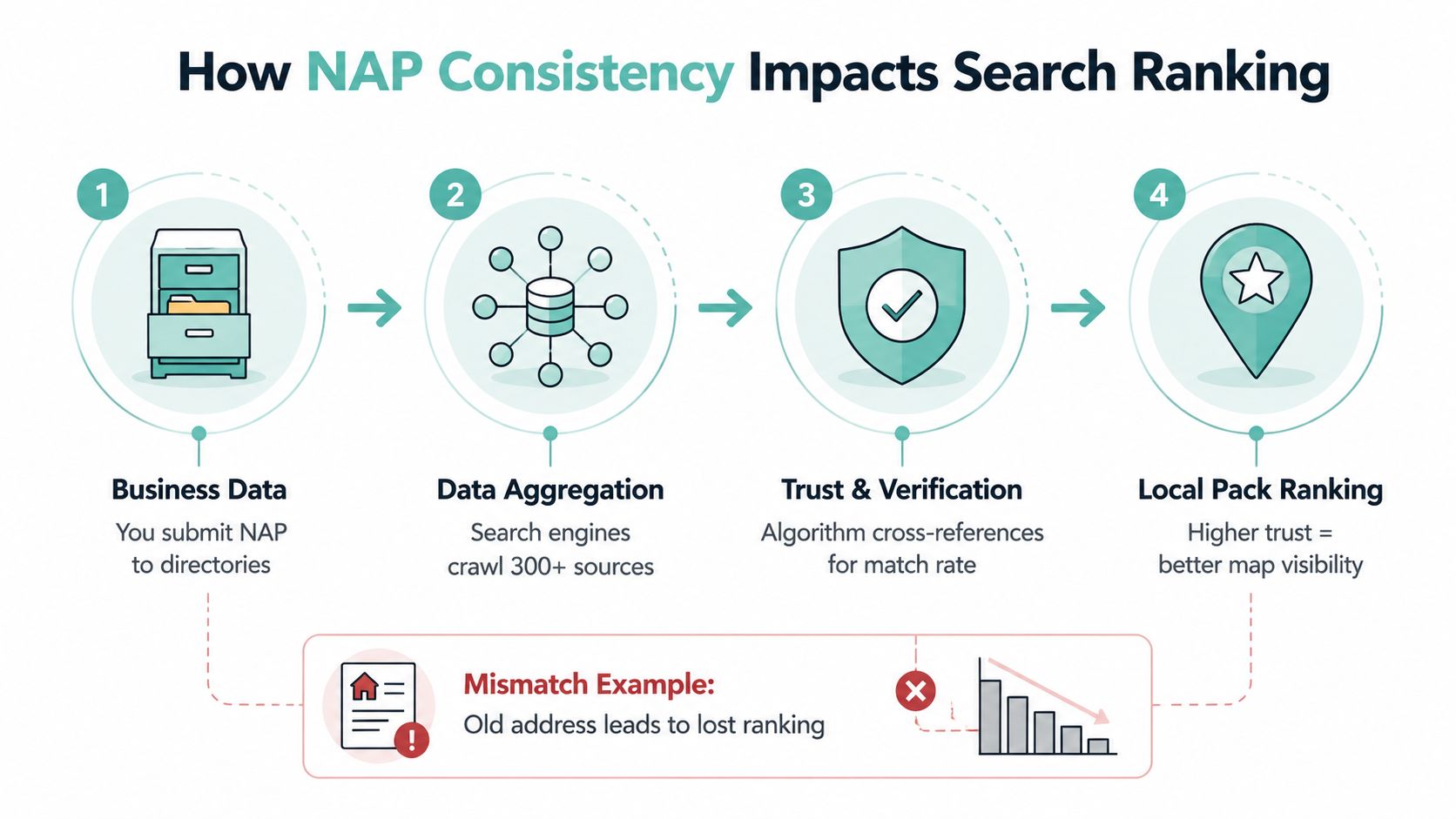
A local ranking drop after a move or rebrand usually starts with the same problem, the business record no longer points to one clear entity. Search engines compare the name, address, and phone number across the website, Google Business Profile, directories, and structured data, then decide how much confidence they have in what they find.
Trust grows when the record matches
Local-search guidance treats NAP consistency as a trust signal because the same business details appearing in the right places reduces ambiguity. When the business name, address, and phone number match across the website, Google Business Profile, schema, and citation listings, the location is easier to connect to one entity and one set of contact details (BrightLocal).
That matters after a move or rebrand. If the storefront changed, the brand changed, or the main line changed, the old versions have to be cleaned up fast. Otherwise the search system keeps seeing two or three plausible records and has to guess which one is current.
Why mixed signals create ranking problems
Mixed signals make local search work harder than it should. A business that shows one name on the website, a slightly different one in directories, and a third version in map data forces the system to reconcile whether those profiles belong to the same place. That confusion can weaken how the listing is indexed and attributed, which is why rankings often slip when the public record drifts (CorporateComm).
The practical fix is consistency across the full stack, not just one listing. I audit the Google Business Profile first, then the site's contact page and schema, then the main directories that feed location data into other systems. If one of those layers still shows the old phone number or old suite, the mismatch keeps spreading.
Search systems are doing reference checks. If every directory says something slightly different, the record stops looking stable.
What this means in practice
A clean NAP profile tells search engines the company is tied to one physical location and one public line. A messy profile leaves them sorting through competing versions, and that extra uncertainty can make the business harder to surface for local intent. After a move, the quickest wins usually come from fixing the core record first, then cleaning up the wider directory footprint and any stale map entries.
The user impact is just as direct. If someone lands on a listing, checks the website, and gets a disconnected number or an outdated address, the business loses trust before the call even starts. In that situation, a cleanup plan matters more than new content. If the wrong Google Business Profile is still live, how to delete a Google Business Profile page becomes part of the fix, not an optional extra.
Common NAP Mistakes That Hurt Local Rankings
The worst NAP problems are usually boring, not dramatic. They show up as small inconsistencies that owners overlook because each one seems harmless on its own.
Tracking numbers without a canonical main line
A tracking number can be useful internally, but it becomes a problem when different directories show different public-facing phone numbers. That fragments the signal, because the business identity stops looking unified.
A PO Box instead of a real location
Service businesses sometimes try to substitute a mailing box for the physical location they want indexed. That creates a trust problem because local search systems are trying to understand where the business operates, not just where it receives mail.
Keyword stuffing the business name
Adding city names, service terms, or slogans into the business name field can look like optimization, but it often backfires. Google Business Profile is not a place to stuff extra descriptors into the brand line.
Rebrands and moves that never got cleaned up
The damage often gets worse. A new sign goes up, the website gets updated, but old citations, aggregator records, and map listings keep the previous version alive.
Outdated directory propagation
If third-party data providers keep pushing the old address or phone number, the mismatch can spread into more places than the owner expects. By the time the issue is obvious, the business may have several versions of the same identity floating around online.
One practical cleanup step is removing or consolidating dead assets before chasing citation fixes. If a business has an obsolete Google presence tied to an old profile, this guide to deleting a Google Business page is a useful companion when you're untangling duplicate records.
Diagnostic check: if a customer could reasonably call one number, drive to one address, and read one business name, but your listings show three different versions, you already have a local SEO problem.
How to Audit and Fix Your NAP Across All Channels
The fix starts with one decision. Pick the exact version of the business name, address, and phone number that will serve as the canonical record, then make every public profile match it without improvising.
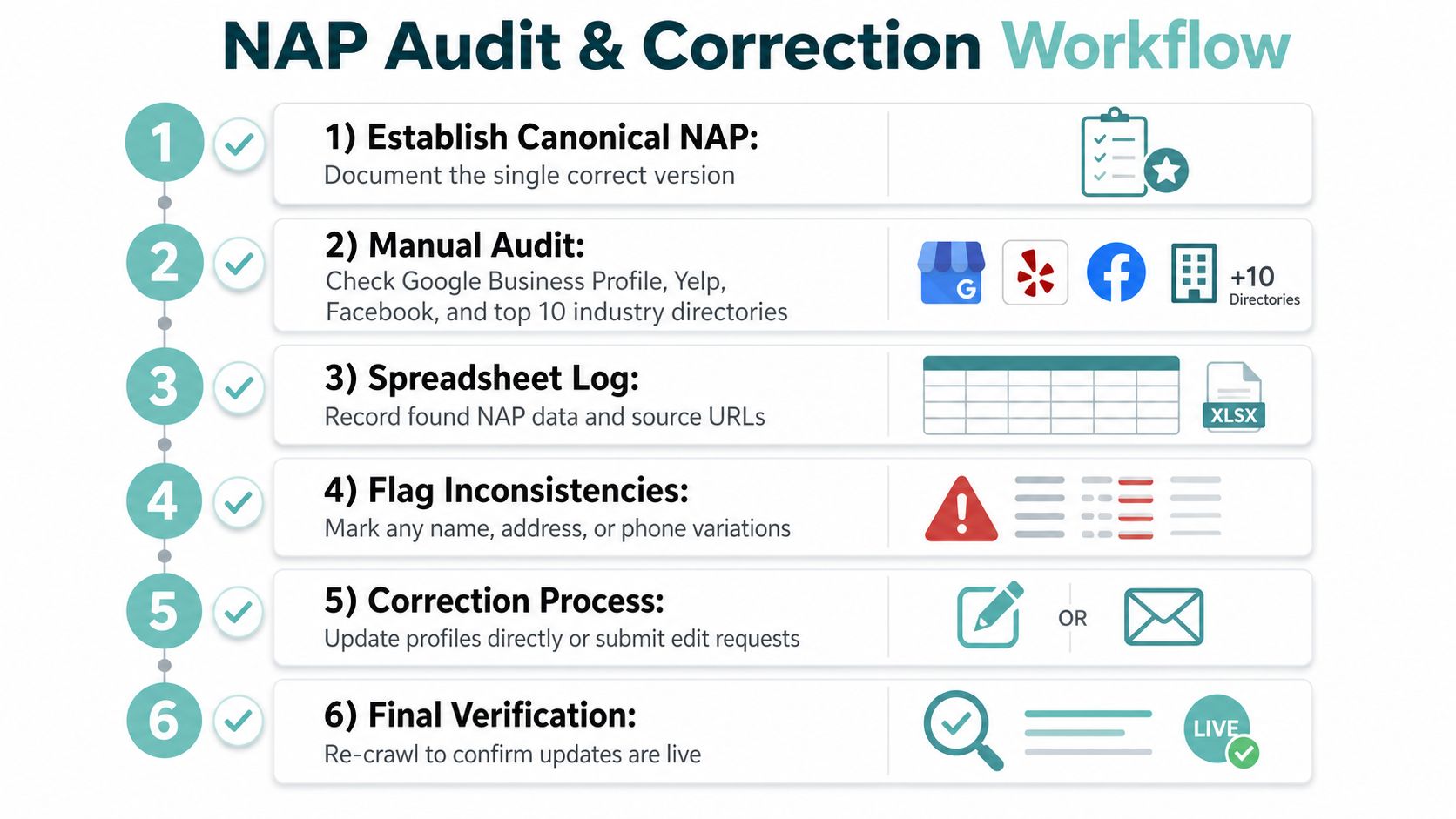
Start with Google Business Profile
Google Business Profile deserves first attention because it's often the listing customers see first. Check the business name, address, phone number, categories, and any hidden traces of an old location or old number.
If the profile doesn't match the canonical NAP exactly, correct it before moving on. A half-fixed profile is worse than a messy one, because it creates a false sense of completion.
Bring the website into alignment
Then check the website's contact page, footer, and structured data. The published business identity on the site should mirror the canonical record, not a legacy version left behind by a designer or an old CMS template.
A lot of owners miss schema because they only look at what's visible on the page. If the footer shows one number and the contact page shows another, the site is telling two stories at once.
Clean up citations and directory profiles
After the website is fixed, audit the major listings and the industry-specific directories that matter in your space. Update the highest-authority sources first, then work through the rest in a documented sequence.
Keep a master spreadsheet with the canonical NAP, each listing URL, the current live data, and the date it was corrected. That's tedious, but it prevents the same mistake from getting rediscovered six months later.
If you're working through a service-area campaign, this local SEO for HVAC guide can help you think about how location signals, service areas, and directory cleanup fit together in a real campaign.
The important part is consistency of execution. If you fix five listings and leave the sixth untouched, the record still looks unstable. If you correct the source data first and then update the rest methodically, the business starts presenting like one legitimate entity instead of a scattered set of old snapshots.
Maintaining NAP Consistency Over Time
A clean NAP profile can drift again if nobody owns it. Rebrands, relocations, new phone lines, and added branches all create fresh opportunities for the data to split apart.
Treat change management as part of SEO
Any time the business changes its name, address, or primary phone number, the update should trigger across every channel at once. That includes the website, Google Business Profile, major citations, and any place the public sees contact details.
For a move, the cleanest approach is to update the core record first and then push the new version outward in a controlled sequence. This address change guide for Google is useful when the move affects a public profile that already has search equity attached to it.
Use one record per location
Multi-location businesses need separate but internally consistent NAP records for each branch. The mistake is mixing branch identities together or letting one office inherit another office's number, address, or brand formatting.
Build a review rhythm
Quarterly citation checks are a sensible maintenance habit for most service businesses. The goal isn't to obsess over every tiny directory, it's to catch drift before it spreads into visible ranking problems.
If no one owns the contact record, the contact record will eventually own you.
Toll-free numbers can work in some organizations, but the public-facing number still needs to be the same everywhere it appears. Service-area businesses without a storefront need the same discipline, just with a different location model, because consistency still matters even when the address is hidden from customers.
The businesses that stay visible over time are the ones that treat NAP like infrastructure. They document it, protect it, and update it the moment anything changes.
If your rankings dipped after a move, a rebrand, or a messy directory cleanup, Digital Skyrocket can help you straighten out the technical details that keep local visibility stable. Visit Digital Skyrocket if you want a team that handles local SEO, website updates, and conversion-focused fixes as one coordinated system.